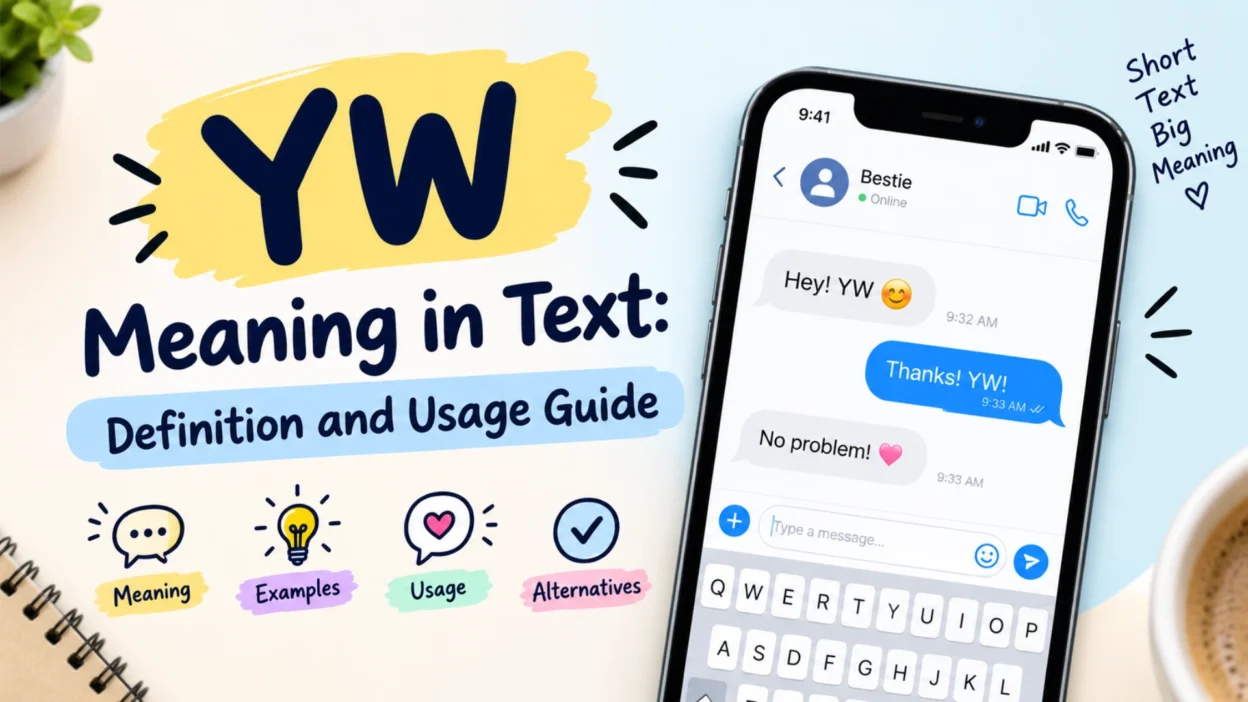
A friend helps you move a heavy box, you send a quick “thanks,” and the reply comes back as two letters: yw. No punctuation. No elaboration. The yw meaning in text is about as straightforward as internet slang gets—it usually stands for “you’re welcome”—but the abbreviation carries more nuance than a simple courtesy. It can be warm, automatic, slightly dismissive, or even sarcastic, depending on how it’s typed and who sent it.
Most people encounter yw as the natural partner to “ty” (thank you). The two abbreviations almost always appear together, forming a tiny social exchange that keeps digital conversations moving without slowing down for formal pleasantries. Understanding when that exchange feels friendly, when it feels cold, and when it means something else entirely is what separates a confident reader from someone who misreads a two-letter reply.
The Core Definition: You’re Welcome, Shortened
YW is an initialism of “you’re welcome,” used in text messages and online communications. It functions as the standard short reply to an expression of gratitude, whether the original message said “thank you,” “thanks,” “thx,” or the abbreviated “ty”.
The abbreviation emerged online in the 1990s and early 2000s, when character limits and fast chat rooms rewarded compression. Typing “you’re welcome” takes thirteen characters; typing “yw” takes two. That efficiency matters in quick exchanges, and it explains why the abbreviation survived long after early chat platforms disappeared. It does one job extremely well: it acknowledges gratitude without requiring a full sentence.
Lowercase “yw” appears far more often than uppercase “YW” in casual messages. The lowercase form blends into the sentence and matches the relaxed rhythm of quick chats. Capitalization doesn’t change the meaning, though it can subtly change the tone.
Why YW Exists: The Partner to TY
Every text abbreviation solves a small problem, and yw solves the problem of what to say after “thank you.” A full “you’re welcome” can feel overly formal in a casual thread, while saying nothing at all can seem rude. YW threads the needle. It’s polite enough to acknowledge the thanks, brief enough to keep the conversation moving, and casual enough to avoid sounding stiff.
This partnership with “ty” is one of the most consistent patterns in texting slang. The two abbreviations almost always appear together, forming a natural pair. When someone sends “ty,” they’re not expecting a paragraph in return. They’re expecting a quick acknowledgment, and yw delivers exactly that.
Interestingly, yw is rarely heard in spoken conversation. Unlike “lol” or “omg,” which crossed over into speech, yw remains almost exclusively written. It belongs to the keyboard, not the voice.
YW Versus NP: Two Ways to Accept Thanks
YW isn’t the only way to respond to gratitude. “NP” (no problem) is the other common option, and the two carry slightly different social meanings. YW accepts the thanks formally, acknowledging the courtesy directly. NP waves the thanks away, suggesting the favor cost nothing and the thanks weren’t necessary.
This distinction matters in tone. YW can sound warmer and more traditional, while NP sounds more casual and modest. Neither is wrong, and many people use them interchangeably. However, choosing between them can subtly shape how the exchange feels. A yw after a significant favor reads as gracious; an np reads as humble. A yw after a trivial favor can feel slightly formal, while an np feels more natural.
The choice often comes down to personal habit. Some people default to yw, others to np, and the preference rarely carries deep meaning. Still, the difference is worth knowing for anyone who wants to read tone accurately.
The Sarcastic Reading: When YW Means the Opposite
Most guides define yw as a friendly courtesy and stop there. That’s incomplete. Written on its own after a full stop, or when nobody actually said thank you, yw can mean the opposite of politeness. The abbreviation becomes a passive-aggressive signal, a way of saying “you should have thanked me” without saying it directly.
This reading depends heavily on context. If someone helps you with a task and you forget to say thanks, a standalone “yw” can land as a pointed reminder. If the conversation is already tense, yw can read as sarcastic or dismissive. An exclamation mark or a friendly emoji usually keeps the tone warm; a flat period or no punctuation at all can push it toward coldness.
Online slang references also record a separate sarcastic sense: “yeah, whatever.” By 2009, yw was being used as an expression of annoyance or passive aggression, saying one thing while meaning another. This usage is less common than “you’re welcome,” but it exists, and it can confuse readers who only know the primary definition.
The Other Meanings: When YW Isn’t a Courtesy
YW is a crowded abbreviation. Outside casual texting, the same two letters point toward a wide range of unrelated things, and context is the only reliable guide.
By 2010, yw had been recorded as an abbreviation for “you whitey,” a slur directed at a white person. Slang sources note that it can be used either in hostility or in jest, and it remains racially offensive. This meaning rarely appears in neutral conversation, but it exists in certain online communities.
In organizational and fandom contexts, YW commonly stands for Young Women, a youth program of The Church of Jesus Christ of Latter-day Saints. In gaming, YW can refer to Youkai Watch, a popular franchise. In chat slang, it occasionally appears as “yo, wassup,” a casual greeting rather than a courtesy. Technical and transportation contexts add more: YW is the IATA code for Air Nostrum, a reporting mark for a railroad, and a US Navy hull classification symbol.
None of these secondary meanings competes with “you’re welcome” in everyday texting. They simply show how much weight context carries. A message containing “ty” followed by “yw” is almost certainly a courtesy exchange. A message about church youth programs is not.
Punctuation and Formatting: Where the Tone Hides
YW is short enough that tiny formatting choices carry disproportionate weight. A plain lowercase “yw” with no punctuation usually reads as neutral and friendly. Add an exclamation point—”yw!”—and the message becomes warmer, more enthusiastic. Add a period—”yw.”—and the reply feels flatter, almost clipped.
Emojis shift the tone again. A heart or a smiley face after yw softens the reply into something affectionate, especially from younger users. A thumbs-up keeps it friendly but slightly more casual. No emoji at all can read as efficient rather than warm, which is fine in a quick exchange but may feel cold in a more personal conversation.
Capitalization matters less, but it isn’t meaningless. “YW” can feel louder or more emphatic, while “yw” blends in. Neither is more formal; both are casual.
YW on Snapchat, TikTok, Instagram, and WhatsApp
Each platform gives yw a slightly different flavor, though the core meaning stays the same. On Snapchat, yw appears as a quick reply in fast chats, often with an emoji or a reaction to keep the tone light. The app’s disappearing messages and casual rhythm make brevity natural.
On TikTok and Instagram, yw shows up in comments and direct messages, usually in response to public thanks or a creator’s acknowledgment. The public nature of comments keeps the tone playful and light. On WhatsApp, the abbreviation travels across languages and cultures, often appearing in bilingual conversations where a short, recognizable reply is more practical than a full sentence.
Text messaging remains the most common home for yw, especially in one-on-one threads and group chats. School groups, family chats, and friend groups all use it to wrap up a thank-you exchange quickly and move on to the next topic.
YW in Group Chats: The Quick Close
Group chats give yw a specific social function. When someone shares notes, sends a file, or helps with homework, a quick “ty” follows, and the helper replies “yw.” That exchange closes the loop without requiring a longer conversation. In a busy group thread, that efficiency is valuable.
Family chats add an interesting wrinkle. Younger users often send yw without thinking, while older relatives may not recognize the abbreviation and ask what it means. That generational gap is a reminder that yw, like all slang, isn’t universal.
In friend groups, yw functions as a low-effort politeness marker. It lets people acknowledge gratitude without slowing down the conversation or making a simple exchange feel formal.
When YW Doesn’t Belong: Professional and Formal Writing
One of the most common mistakes people make is dropping yw into professional communication. In a work email, a client message, or a note to a manager, the abbreviation can read as overly casual or careless. A colleague who helped with a project deserves “You’re welcome” written in full, not a two-letter reply that looks like it was typed in a hurry.
This isn’t because yw is inherently rude. It’s about register. Text slang signals informality, and professional settings typically expect fuller language. Using yw in a job interview follow-up or a client update can make the sender seem dismissive, even when the intent was simply to be efficient.
A practical rule helps here. Keep yw for friends, peers, and casual chats. In anything that could be forwarded to a manager or saved in a record, write the courtesy in full. The extra keystrokes cost little and prevent a lot of misreading.
Common Mistakes People Make With YW
The first mistake is assuming yw is always friendly. It can be sarcastic or passive-aggressive, especially when it appears without a preceding thank-you or with flat punctuation. Ignoring that possibility can lead to misunderstandings.
The second mistake is overusing yw until it loses warmth. A reply that always looks automatic can make the sender seem perfunctory, even when they genuinely mean it. Varying the response with a fuller “happy to help” or “anytime” keeps the tone honest.
The third mistake is using yw with people who may not recognize it. Parents, older relatives, or new acquaintances might read it as a typo. A quick expansion prevents confusion without much effort.
Finally, some people misread the abbreviation’s other meanings. A yw in a gaming context might refer to Youkai Watch, and a yw in a church context might refer to Young Women. Context decides the reading, and ignoring it leads to confusion.
How to Reply to YW Without Overthinking It
The right reply depends on the exchange. In most cases, no reply is needed at all. YW is a closing courtesy, and acknowledging it with another “thanks” can create an awkward loop. A simple emoji reaction or a topic change keeps the conversation moving naturally.
If the yw felt warm and personal, a brief acknowledgment like “appreciate it” or a heart emoji maintains the connection without overdoing it. If the yw felt cold or sarcastic, addressing the underlying issue directly works better than matching the tone. A calm question—”everything okay?”—surfaces the real problem faster than a passive-aggressive reply.
In professional settings, respond to the substance rather than the abbreviation. If a colleague writes “yw” after helping, a brief “thanks again” or a follow-up question keeps the exchange productive. There’s no need to comment on the word choice.
YW and Similar Courtesy Abbreviations Compared
AbbreviationCommon MeaningTypical ToneYWYou’re welcomePolite, casual, sometimes sarcasticTYThank youGrateful, casualNPNo problemModest, casualTYSMThank you so muchEmphatic gratitudeTHXThanksQuick, informalYW (alt)Yeah, whateverSarcastic, dismissiveYW (org)Young WomenOrganizational, formal
YW stands apart in this group because it’s the only abbreviation that serves as a direct response to gratitude. TY and THX express thanks; NP accepts them with modesty; YW accepts them with courtesy. That complementary role is why the two-letter reply remains so common.
Generational and Cultural Nuances
Younger texters tend to use yw without much thought, treating it as ordinary vocabulary alongside ty and np. Older users often recognize “you’re welcome” but may not pick up on the abbreviated form or its sarcastic potential, which can create mismatched expectations in mixed-age conversations.
Cultural background matters too. Because yw travels well across languages and platforms, it has become one of the most widely recognized English texting abbreviations worldwide. At the same time, its secondary meanings—particularly “you whitey”—are culturally specific and potentially offensive, which is a reminder that the same two letters can carry very different weight depending on who is using them and why.
Regional differences add another layer. In some online circles, yw is almost invisible because it’s so common. In others, it still reads as distinctly online shorthand. These variations don’t change the primary definition, but they do change how the message lands.
Frequently Asked Questions About YW
What does YW stand for in text?
YW most commonly stands for “you’re welcome,” the standard short reply to “thank you” or “ty” in casual messaging. It’s one of the most widely used texting abbreviations.
Is YW rude?
It can be, depending on tone and context. A warm “yw!” with an emoji is polite and friendly. A flat “yw.” after someone forgets to say thanks can read as passive-aggressive. Punctuation and timing matter more than the letters themselves.
What’s the difference between YW and NP?
Both respond to gratitude, but they carry slightly different tones. YW accepts the thanks formally, while NP waves it away by suggesting the favor cost nothing. NP often sounds more casual and modest.
Does YW have other meanings?
Yes. It can stand for “yeah, whatever” in a sarcastic sense, “you whitey” as a racial slur, Young Women in a church context, or Youkai Watch in gaming. Technical and transportation contexts add more meanings, including airline and railroad codes.
Is YW okay to use at work?
Generally, no. YW is casual slang, and professional communication usually calls for “You’re welcome” written in full. Client emails and formal reports are not the place for it.
Why do people use lowercase “yw” instead of uppercase “YW”?
Lowercase is more common in casual texting because it blends into the sentence and matches the relaxed rhythm of quick messages. Capitalization doesn’t change the meaning, though it can subtly change the tone.
Can YW be sarcastic?
Yes. Written on its own after a full stop, or when nobody actually said thank you, yw can mean the opposite of politeness. The sarcastic reading depends heavily on context and punctuation.
How should I respond to YW?
In most cases, no response is needed. YW is a closing courtesy. If you want to acknowledge it, a brief “appreciate it” or an emoji reaction keeps the exchange friendly without creating a loop.
Final Thoughts: Two Letters That Close the Loop
YW is a small abbreviation with a clear primary job. At its core, it acknowledges gratitude and closes a thank-you exchange without slowing down the conversation. Around that core, meanings branch: the warm courtesy, the modest deflection, the sarcastic retort, and a crowded field of organizational, gaming, and technical acronyms that have nothing to do with politeness.
The practical takeaway is straightforward. Read the punctuation before deciding what someone meant. Use yw with friends and peers, not in professional writing. And when the two letters arrive, accept them as the quick courtesy they usually are. Two letters shouldn’t create confusion—especially when the thank-you exchange is right there on the screen.

Serhii Dunev is a passionate content creator dedicated to crafting meaningful texts, messages, and word inspirations. He aims to help people express their emotions clearly through simple and impactful words.