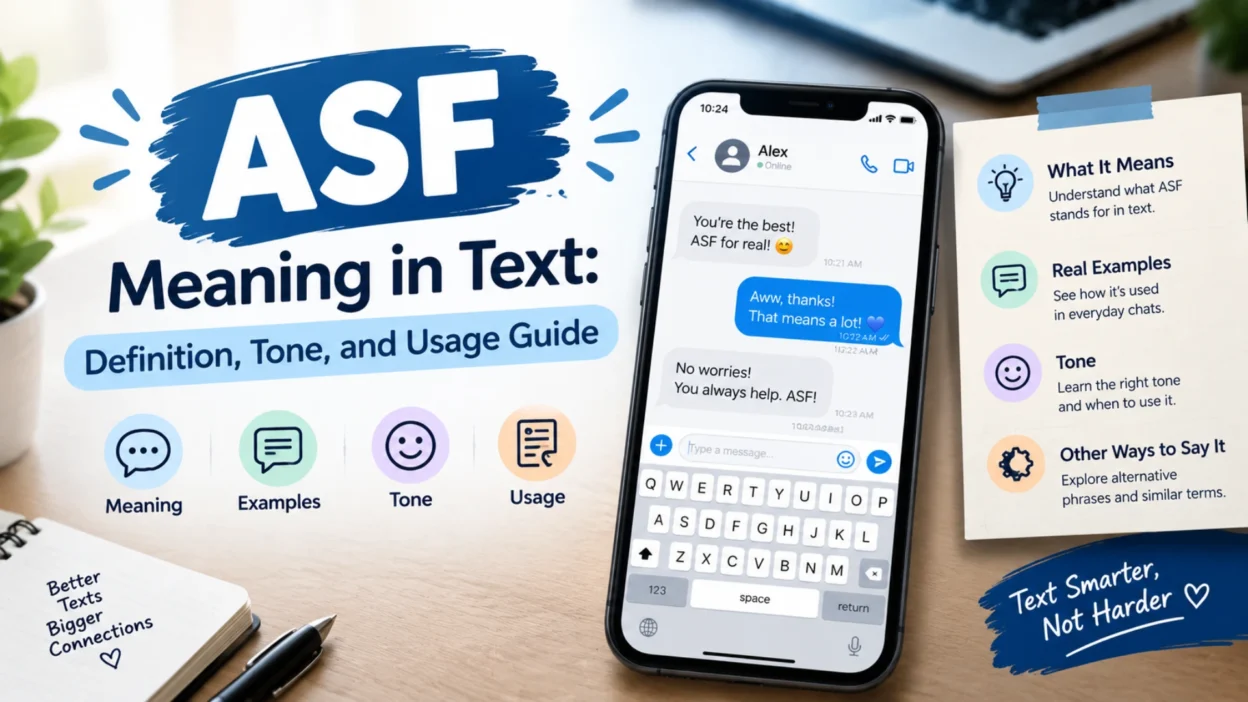
A friend types “tired asf” and you feel the exhaustion through the screen. Someone comments “that’s funny asf” under a video and the laughter lands harder than a plain “that’s funny” ever could. The asf meaning in text looks simple at first glance—it’s usually a compressed way of writing “as f**k,” an intensifier that turns a mild statement into an extreme one—but the abbreviation carries more history, more variation, and more social nuance than a three-letter tag suggests.
What makes asf worth understanding is its split identity. In most modern texting and social media, it amplifies an adjective or a feeling. In older chat rooms, the same letters asked a completely different question: age, sex, from. And in technical fields, asf points toward file formats and standards that have nothing to do with either. Reading the context correctly is the whole game, and getting it wrong can turn a casual compliment into a confusing exchange.
The Core Definition: As F**k, Compressed
ASF is a text and chat acronym that usually means “as f**k,” functioning as an intensifier that communicates “extremely so” or “to a high degree.” It attaches to an adjective or an adverb and amplifies whatever came before it. “Hungry asf” means very hungry. “Cold asf” means extremely cold. “Annoying asf” means the annoyance has reached a peak.
The abbreviation works as a suffix rather than a standalone word. You don’t typically say “asf” by itself; you attach it to a description. That grammatical role explains why it spreads so easily. It slots into existing sentences without requiring any restructuring, and it replaces longer intensifiers like “very,” “really,” or “extremely” with something punchier and more expressive.
Interestingly, asf is the less common sibling of af. Dictionary resources consistently note that af is the far more frequent version of this acronym, while asf appears as a secondary spelling. Both mean the same thing, but the extra letter changes the feel slightly, and that difference matters more than most people realize.
ASF Versus AF: The Softer Spelling
AF is the standard intensifier. It’s short, sharp, and everywhere—on X, Reddit, Instagram, and in direct messages between friends. ASF is a softer spelling of the same phrase, visually less aggressive, and sometimes used as a way to dodge platform filters that block the shorter version.
This distinction isn’t just cosmetic. Slang observers describe asf as the softer spelling, useful for visual softness or for slipping past automated filters, while af remains the standard suffix that works almost anywhere. The meaning stays identical, but the delivery shifts. ASF feels slightly more deliberate, slightly less reflexive, and occasionally slightly more polite, even though the underlying word is the same.
The practical upshot is simple. If you’re choosing between the two, af is the default and asf is the variation. Neither is wrong, and neither changes the sentence. The choice depends on how much edge you want the message to carry.
Where ASF Came From: Rap Lyrics and Early Internet Chat
The phrase “as f**k” has a longer history than the abbreviation. One of the earliest widely reported usages in popular music appears in N.W.A.’s 1988 track “Straight Outta Compton,” which includes the line “Ice Cube is crazy as f**k.” The phrase spread through rap lyrics, casual speech, and eventually internet culture over the following decades.
The abbreviated form took hold as chat rooms and instant messaging made brevity valuable. Platforms with character limits rewarded compression, and “as f**k” was an obvious candidate because it was already a high-frequency phrase in casual speech. Once people started typing asf, the habit stuck, and the abbreviation migrated from chat windows into text messages, comment sections, and social media captions.
That timeline explains why asf feels both old and new. The phrase itself is decades old, but the shorthand only became mainstream as digital communication matured. Older readers often recognize the full phrase while finding the abbreviation unfamiliar, which is one reason context matters so much in mixed-age conversations.
ASF in Everyday Texting: How It Actually Sounds
In real conversations, asf rarely appears alone. It clings to adjectives and turns them up. A friend describing a bad day writes “exhausted asf.” Someone reacting to a bizarre video comments “this is weird asf.” A group chat roasting a bad take says “that’s wild asf.” The pattern is consistent: description first, intensifier second.
The abbreviation also appears in emotional statements. “I miss you asf” carries more weight than “I miss you” because the intensifier signals that the feeling is unusually strong. Similarly, “I’m stressed asf” tells the reader the stress is not ordinary. That emotional amplification is why asf shows up so often in messages about feelings, moods, and reactions.
Notably, the abbreviation tends to appear in casual, peer-to-peer exchanges. It feels natural in a text to a close friend and awkward in a message to a professor. That register gap is built into the word itself, not just the way people use it.
Punctuation and Placement: Reading the Intensity
ASF is short enough that formatting choices carry real weight. A plain lowercase “asf” with no punctuation usually reads as casual and matter-of-fact. Add an exclamation point and the intensity climbs. Stretch the letters—”asfff”—and the message becomes playful or exaggerated, often signaling that the sender is being dramatic on purpose.
Capitalizing the whole thing—”ASF”—adds emphasis, though capitalization habits vary widely between individuals. Emojis shift the tone again. A laughing emoji after asf softens the statement into something light, while a skull or a crying emoji pushes the intensity into comic exaggeration.
Placement matters too. When asf appears at the very end of a sentence, it reads as a natural amplifier. When it’s dropped into the middle, the sentence can feel choppier. Most people keep it at the end for exactly that reason: the intensifier lands last, and the impact lands with it.
ASF on TikTok, X, Instagram, and Gaming Chats
Each platform gives asf a slightly different flavor. On TikTok, the abbreviation appears in comments and captions, usually as a reaction to something funny, shocking, or relatable. The platform’s short-video format rewards quick, punchy reactions, and asf is built for exactly that.
On X, formerly Twitter, asf shows up in replies and quote posts, often when users want to amplify an opinion without writing a full sentence. The abbreviation fits the platform’s compressed style, and its edge suits the combative tone of many threads.
Instagram leans more toward captions and story text, where asf usually adds humor rather than confrontation. Gaming chats add another layer entirely, because asf often appears there as an interjection after a surprising play or a frustrating loss. The meaning stays stable across all four platforms, but the emotional temperature shifts with the audience.
The Unrelated Meanings: When ASF Isn’t an Intensifier
ASF is a crowded acronym, and texting is only one of its homes. In technical contexts, the same letters commonly stand for Advanced Systems Format, a Microsoft file container used for streaming audio and video. In computing and networking, ASF sometimes appears as an abbreviation for Abstract Syntax Format or similar technical labels.
Older internet users may also recognize ASF as “age, sex, from”—a three-part question once common in chat rooms when people introduced themselves. In organizational settings, ASF occasionally stands for African Swine Fever in agricultural reporting, or for the Airport Security Force in some regions. In financial and charitable contexts, it has appeared as a shorthand for the Angelman Syndrome Foundation.
These meanings rarely collide with casual texting because the surrounding language is so different. A technical document mentioning ASF has nothing to do with a friend describing a bad day. Still, the overlap is a useful reminder that abbreviations are community property. The same three letters can mean very different things depending on who is using them and why.
When ASF Doesn’t Belong: Work, Family, and Public Posts
One of the most common mistakes people make is dropping asf into professional communication. In a work email, a client message, or a note to a manager, the abbreviation can read as careless or unprofessional. Even if the platform tolerates it, the recipient may not.
This isn’t because asf is inherently offensive. It’s about register. The abbreviation stands for a profane phrase, and it signals informality. Using it in a job interview follow-up, a client update, or a formal report can make the sender seem dismissive, even when the intent was simply to add emphasis.
Family settings require similar care. Sending “tired asf” to a parent or an older relative often creates confusion, and explaining the abbreviation doesn’t always improve the reaction. Public posts carry the same risk, especially when the audience includes coworkers, clients, or strangers who don’t share the sender’s vocabulary.
A practical rule helps here. Keep asf for friends, peers, and casual chats. Avoid it in writing that could be forwarded, screenshotted, or read by someone outside the conversation. The abbreviation is memorable precisely because it’s blunt, and bluntness travels poorly outside its intended audience.
Common Mistakes People Make With ASF
The first mistake is assuming asf always means the intensifier. It doesn’t. “Age, sex, from” and Advanced Systems Format are both valid readings in the right context, and ignoring the surrounding language leads to confusion.
The second mistake is using asf with people who may not recognize it. Parents, older colleagues, and non-native speakers often read it as a typo or an unfamiliar code. A quick expansion prevents confusion, even if it costs a few extra characters.
The third mistake is overusing it. Like any intensifier, asf loses impact when every sentence carries it. A message where everything is “crazy asf” or “good asf” eventually stops feeling emphatic and starts feeling repetitive.
Finally, some people misjudge the audience. A joke that lands in a group chat among close friends can read as rude in a public comment thread or a mixed professional space. The abbreviation doesn’t change meaning across those settings, but the reaction certainly does.
How to Reply to ASF Without Overthinking It
The right reply depends on what the asf is doing. If a friend says they’re “tired asf,” a sympathetic response works better than a literal one. “Same” or “get some rest” acknowledges the feeling without turning the exchange into a grammar lesson.
When asf appears in a joke or a reaction, matching the energy usually helps. A short “lol” or an exaggerated reply keeps the exchange playful. Attempting to correct the abbreviation mid-conversation rarely lands well, especially when the sender was clearly being casual.
In professional or unfamiliar settings, the safest approach is to read past the abbreviation and respond to the substance. If someone writes “busy asf” in a work chat, the useful reply addresses the workload, not the word choice. Clarity always beats commentary when the stakes are higher.
ASF and Similar Intensifiers Compared
| Term | Common Meaning | Typical Use |
|---|---|---|
| ASF | As f**k | Amplifies an adjective in casual text |
| AF | As f**k | The more common, sharper default |
| TBH | To be honest | Signals candor, not intensity |
| NGL | Not gonna lie | Signals honesty, not emphasis |
| IMO | In my opinion | Marks an opinion, adds no intensity |
| FR | For real | Confirms sincerity |
| Lowkey | Slightly, secretly | Softens a statement |
ASF belongs to the same family of shorthand as af and fr, but it stands apart because it amplifies rather than qualifies. TBH and NGL frame how honest a statement is. ASF changes how strong it is. That difference is why asf attaches to adjectives while the others attach to opinions.
Generational and Cultural Nuances
Younger texters tend to use asf without thinking about its origin or its edge. It’s simply part of the vocabulary. Older users often recognize the underlying phrase but may still find the abbreviation jarring, especially in written form. That gap explains why asf sometimes needs a quick explanation in mixed-age conversations.
Cultural background matters too. Because the phrase comes from profane English slang, it doesn’t translate cleanly into other languages, and non-native speakers may read asf as a typo or a random string of letters. Meanwhile, in communities where the acronym has technical or organizational meanings, the same letters point somewhere entirely different.
Regional differences add another layer. In some online circles, asf is almost invisible because it’s so common. In others, it still reads as aggressive or unfamiliar. These variations don’t change the definition, but they do change how the message lands.
Frequently Asked Questions About ASF
What does ASF stand for in text?
ASF most commonly stands for “as f**k,” an intensifier used to amplify an adjective or a feeling. It’s a variation of the more common abbreviation af and carries the same meaning.
Is ASF rude?
It can be, depending on the setting. The abbreviation stands for a profane phrase, so it rarely belongs in professional or formal writing. Among friends and peers, it’s usually casual and harmless.
What’s the difference between ASF and AF?
They mean the same thing, but af is the far more common version. ASF is a softer spelling, sometimes chosen for visual softness or to slip past automated filters. Neither changes the meaning of a sentence.
Does ASF have other meanings?
Yes. In technical contexts, ASF often stands for Advanced Systems Format, a Microsoft streaming file container. Older chat users may also recognize it as “age, sex, from.” In organizational settings, it can stand for African Swine Fever or the Airport Security Force.
Is ASF okay to use at work?
Generally, no. The abbreviation stands for a profane phrase and signals informality. Work emails, client messages, and formal reports usually call for emphasis written in full or removed entirely.
Why do people use lowercase “asf” instead of uppercase “ASF”?
Lowercase is more common in casual texting because it blends into the sentence and matches the relaxed rhythm of quick messages. Uppercase appears in more emphatic contexts and in technical writing, where it points to different meanings.
Can ASF be used as a standalone word?
Not usually. ASF works as a suffix that attaches to an adjective or a feeling, like “tired asf” or “funny asf.” Standing alone, it reads as incomplete and often confuses readers.
What should I do if I’m not sure which meaning someone intended?
Look at the surrounding words. A description followed by asf points to the intensifier. Technical or formal language points to one of the unrelated meanings. When context is thin, a quick question clears things up.
Final Thoughts: Three Letters That Turn the Volume Up
ASF is a small abbreviation with a clear job. At its core, it amplifies whatever it follows, turning a mild statement into an emphatic one. Around that core, meanings branch: the softer spelling of af, the older chat-room question about age, sex, and location, and a crowded field of technical acronyms that have nothing to do with texting at all.
The practical takeaway is straightforward. Read the context before deciding what someone meant. Use asf with friends and peers, not in professional writing. And when the abbreviation appears in a message, respond to the feeling behind it rather than the letters themselves. Three letters shouldn’t create confusion—especially when the sentence around them does most of the explaining.

Serhii Dunev is a passionate content creator dedicated to crafting meaningful texts, messages, and word inspirations. He aims to help people express their emotions clearly through simple and impactful words.