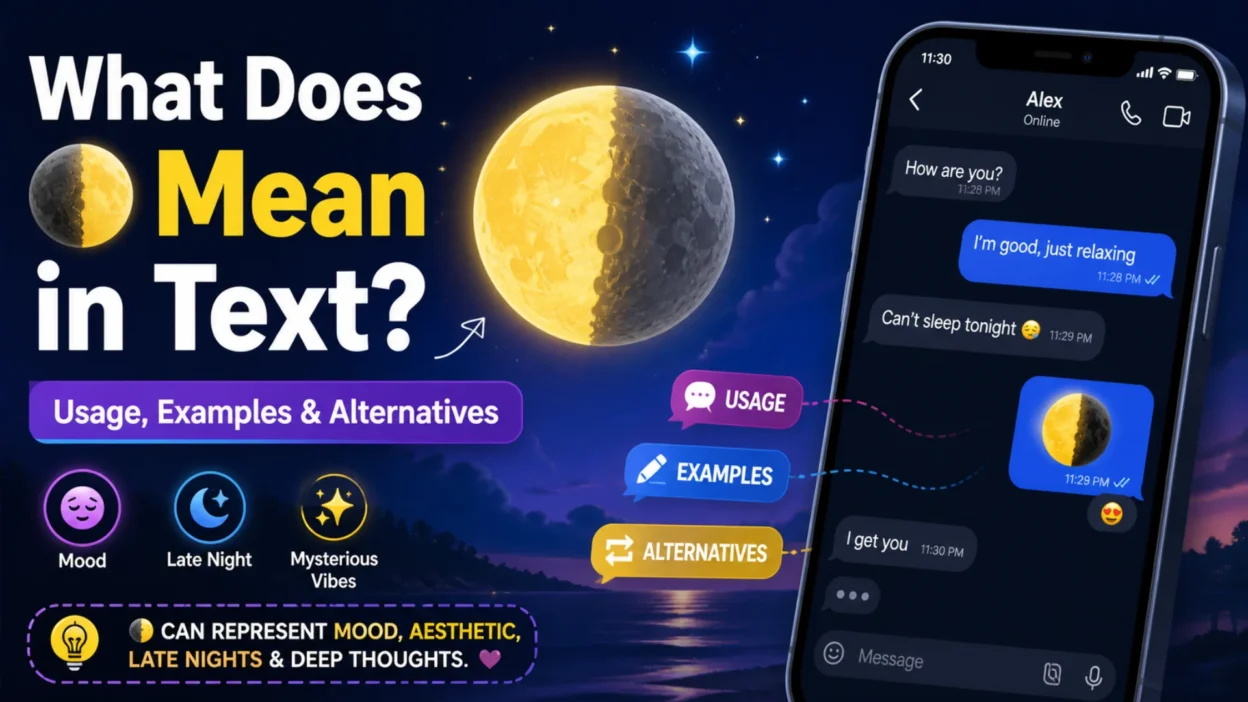
Have you ever received a mysterious moon emoji and wondered what it really means? You are not alone. Texting slang evolves rapidly, and celestial symbols often carry hidden meanings. The 🌖 (waning gibbous moon) emoji is one such symbol that confuses many users. Unlike the full moon or new moon, this specific phase appears less frequently in daily chats. Nevertheless, its usage is growing across social media, dating apps, and gaming communities. In this guide, we will explore everything about 🌖 in texting. You will learn its definition, origins, real-world examples, and how context changes its interpretation. Additionally, we will compare 🌖 to similar slang terms, discuss its tone, and provide polite alternatives. By the end, you will confidently decode and use 🌖 like a pro. Let’s dive in. 😉
Definition & Core Meaning
What exactly does 🌖 represent in text conversations? The waning gibbous moon emoji depicts the moon when it is more than half illuminated but decreasing in size. Astronomically, this phase occurs right after a full moon. In texting, however, 🌖 has taken on several metaphorical meanings. Typically, it signals that something is ending, fading, or winding down. For instance, a user might send 🌖 to express that a relationship is cooling off or that a fun weekend is nearly over.
Another core meaning involves subtlety and introspection. Because the moon is still bright but shrinking, 🌖 can represent a moment of reflection before a major change. People often use it to say, “I’m still here, but I’m pulling back.” Additionally, 🌖 sometimes indicates mystery or incomplete information. Unlike the bold full moon (🌕), which suggests completeness, the waning gibbous hints that something is missing. As a result, you might see 🌖 in response to a vague message or an unanswered question.
Importantly, 🌖 rarely carries negative energy. Instead, it feels calm, thoughtful, and slightly bittersweet. Think of it as the textual equivalent of a slow exhale. When someone types 🌖, they are not angry or overly excited. They are simply acknowledging a transition phase. Furthermore, in niche communities like astrology or spirituality, 🌖 can refer to letting go of old habits. But for everyday texting, focus on the “fading but not gone” idea. Keep this core meaning in mind as we explore further examples.
History & Origin of 🌖
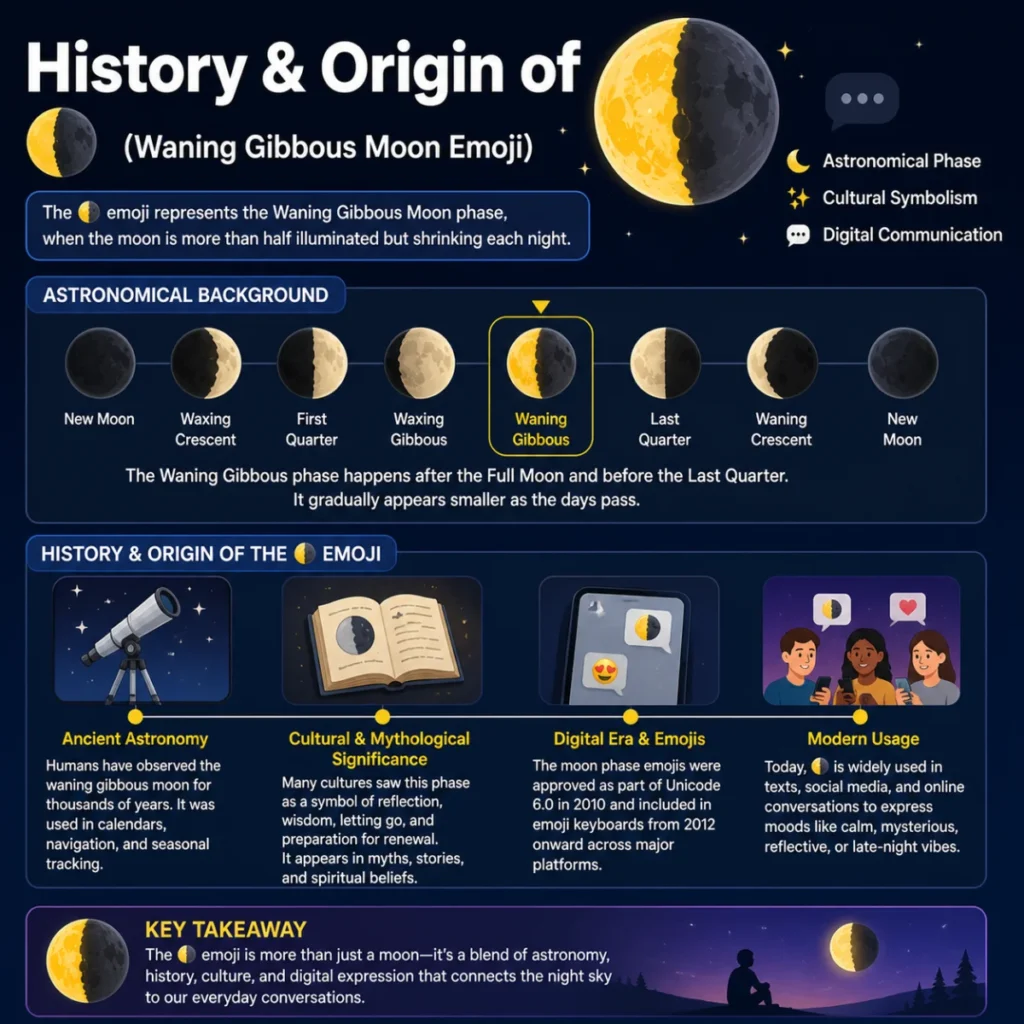
Where did 🌖 originate as a texting symbol? Interestingly, the emoji itself was officially added to Unicode in 2010 under version 6.0. It is part of a complete set of moon phase emojis, including 🌑 (new moon), 🌓 (first quarter), 🌕 (full moon), and others. However, the waning gibbous specifically took years to gain slang popularity. Initially, users employed moon emojis for literal astronomical posts. For example, photographers shared 🌖 to caption a real night sky image.
The shift toward metaphorical usage began around 2015 on platforms like Twitter and Tumblr. Young adults started using 🌖 to describe emotional states related to decline or quiet endurance. One popular tweet from 2016 said, “My motivation is 🌖 right now.” That post went viral, sparking a trend. Subsequently, dating app users adopted 🌖 to signal that a conversation was losing energy but not yet dead. By 2018, the emoji had become a recognized shorthand in texting guides.
Another key influence came from astrology communities. Astrologers often discuss moon phases to time rituals or decisions. The waning gibbous, in astrological tradition, is a time for releasing what no longer serves you. Consequently, spiritual influencers began pairing 🌖 with hashtags like #LetGo and #Release. This spiritual layer merged with casual texting, giving 🌖 a dual identity: practical and mystical. Today, the emoji appears across all major messaging apps, from WhatsApp to Discord. Nevertheless, many people still find it confusing compared to the more common 😂 or ❤️. Understanding this history helps you appreciate why 🌖 feels both familiar and obscure.
Real-World Examples in Conversations
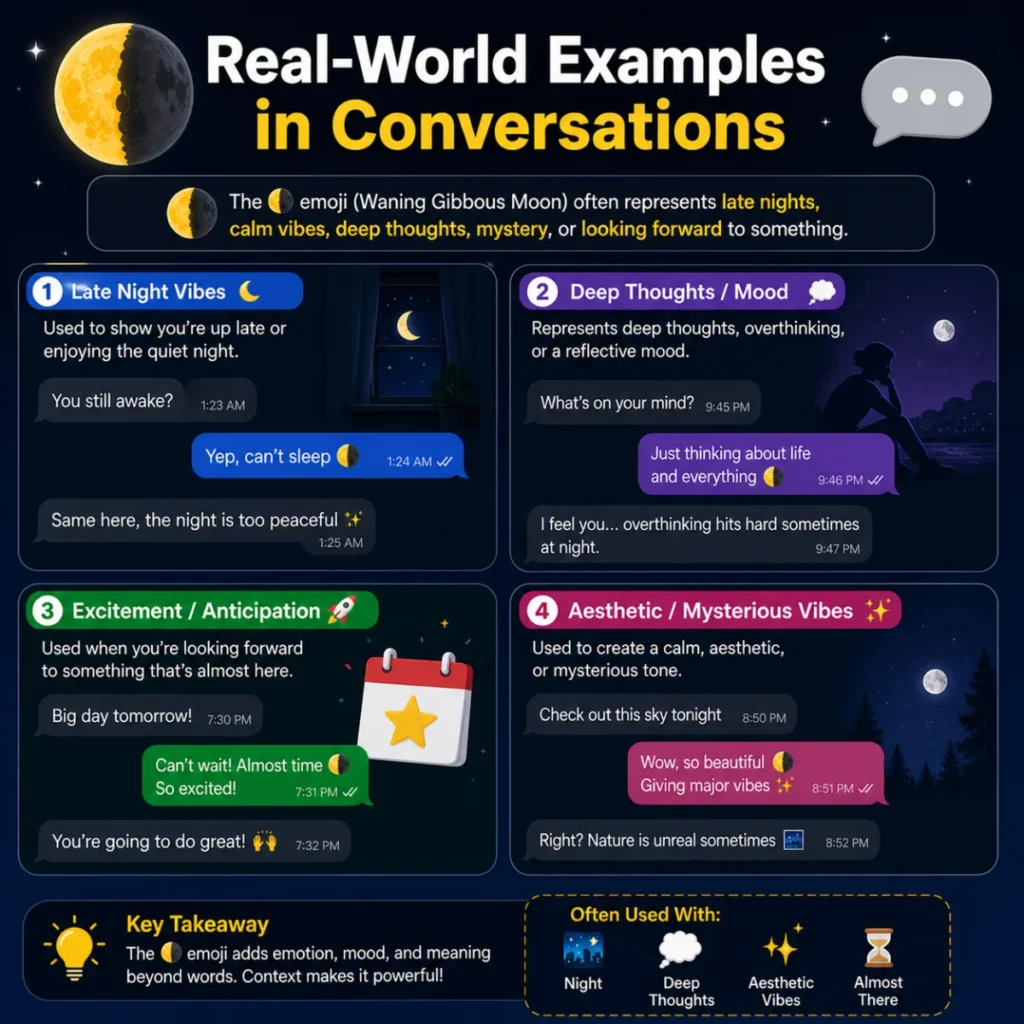
To truly grasp 🌖, let’s examine authentic texting scenarios. Below are four typical exchanges where 🌖 appears naturally. Each example shows how the emoji conveys fading energy, reflection, or subtle endings.
Example 1: Friends Ending a Hangout
Person A: “That was such a great day at the beach. I’m exhausted but happy.” Person B: “Same here. The sun is setting, and so is our energy 🌖. Drive safe!”
In this case, 🌖 replaces a longer phrase like “our fun is winding down.” It adds a poetic touch without being overly dramatic.
Example 2: Dating App Conversation
Person A: “You seem cool, but I’ve been busy lately. Not sure I can keep chatting daily.” Person B: “No worries. I feel the 🌖 vibe too. Take your time.”
Here, 🌖 signals mutual acknowledgment that the initial spark is cooling. Neither person is offended; they simply recognize a natural fade.
Example 3: Work Project Update
Person A (manager): “How’s the quarterly report coming along?” Person B (employee): “Almost done. The momentum is 🌖 today, but I’ll finish by Friday.”
🌖 in a professional context? Surprisingly, yes. This usage softens the admission of slowing down. It sounds more creative than saying “I’m procrastinating.”
Example 4: Social Media Caption
Caption on a photo of a half-eaten cake: “My diet plan: 🌖 into a cheat day 🍰”
For Instagram or TikTok, 🌖 humorously represents a resolution that is fading. The joke lands because people relate to goals that shrink over time.
Notice how none of these examples use 🌖 angrily. Instead, the emoji creates a shared understanding of temporary decline. As a result, conversations remain positive even when discussing slowdowns.
How Context Changes Meaning
The meaning of 🌖 shifts dramatically depending on where you use it. Let’s break down four common platforms: texting, social media, gaming, and dating apps. Each context adds a unique flavor to the emoji.
Texting (iMessage, WhatsApp)
In private one-on-one chats, 🌖 often signals emotional honesty. For instance, a close friend might send 🌖 to say, “I’m feeling less enthusiastic than before.” Because texting lacks tone, the emoji acts as a gentle warning. It tells the recipient not to expect high energy. Nevertheless, texting also allows for quick clarification. If someone misinterprets 🌖, you can simply follow up with a sentence. This flexibility makes texting the safest space for using 🌖.
Social Media (Twitter, Instagram, TikTok)
On public platforms, 🌖 becomes a visual shorthand for relatable decline. Users frequently pair it with captions about burnout, weekend endings, or fading trends. For example, a tweet reading “My will to adult is 🌖” might get thousands of likes. The emoji here is humorous and self-deprecating. Additionally, social media algorithms treat emojis as engagement boosters. Consequently, 🌖 helps posts appear in search results for moon-related moods.
Gaming (Discord, Twitch Chat)
Gamers have adopted 🌖 to describe a match or team that is losing momentum. Imagine playing a battle royale game. Your squad starts strong but then gets scattered. A teammate might type “gg 🌖” to mean “good game, but we’re fading.” Similarly, streamers use 🌖 when their viewership declines late at night. The emoji feels less harsh than saying “we’re failing.” It preserves team morale while acknowledging reality.
Dating Apps (Tinder, Bumble)
Perhaps the most nuanced context is dating apps. Here, 🌖 serves as a polite “slow fade” indicator. For instance, after three days of constant messaging, one person might respond only with 🌖. That single emoji says, “I’m losing interest, but I don’t want to ghost you.” Recipients typically understand the message. However, some find 🌖 frustrating because it is ambiguous. Therefore, dating experts recommend using 🌖 only when both parties know the slang. Misunderstandings can otherwise occur.
As you can see, context is everything. A 🌖 in a gaming chat feels neutral. The same emoji on a dating app might signal an upcoming goodbye. Always consider where the conversation happens before interpreting 🌖.
Tone Nuances: Is 🌖 Rude or Friendly?
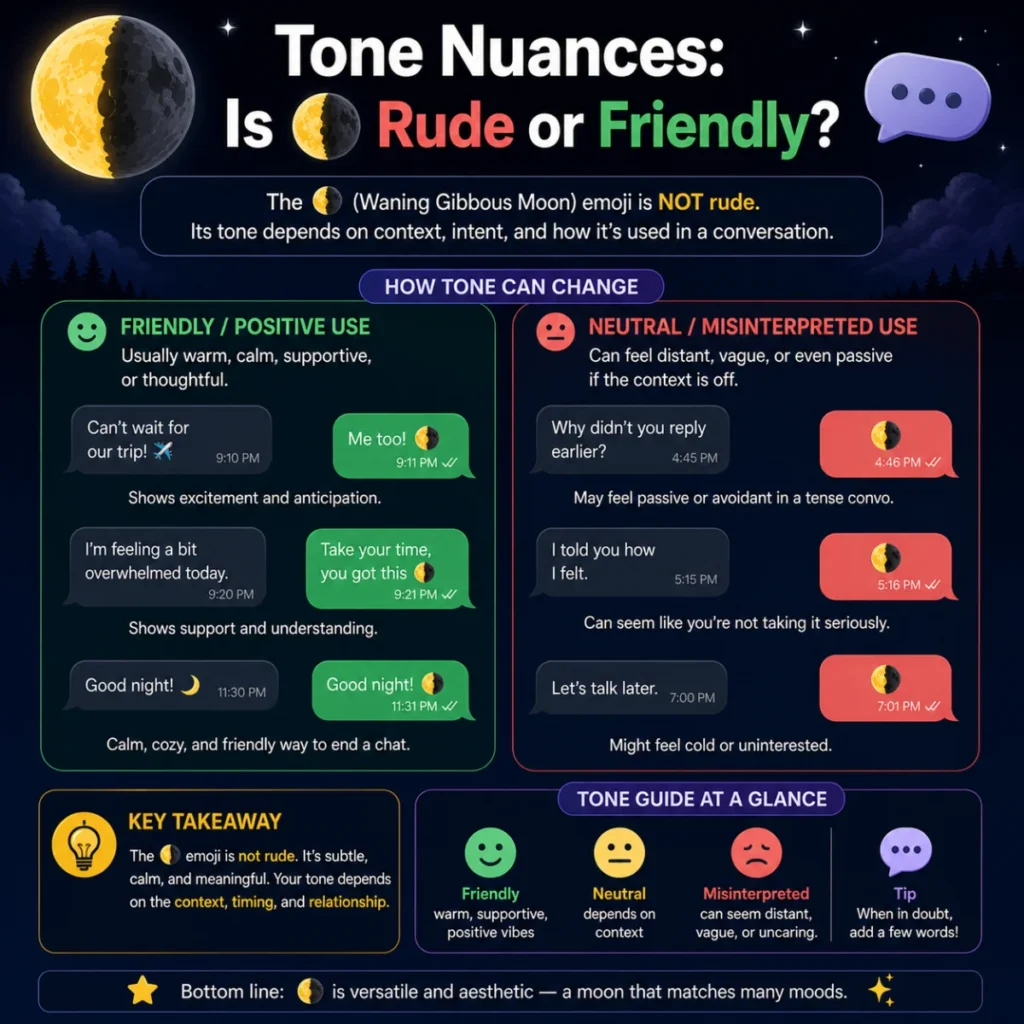
Many people ask: does 🌖 come across as rude? The short answer is no, but with one condition. 🌖 is generally friendly, calm, and introspective. Unlike the middle finger emoji or the skull emoji, 🌖 has no aggressive origin. Nevertheless, tone depends heavily on relationship dynamics. Between close friends, 🌖 feels soft and poetic. For example, replying 🌖 to a friend’s long story about a breakup shows empathy and understanding. You are basically saying, “I see your sadness fading gradually.”
On the other hand, using 🌖 with a stranger or a boss might cause confusion. Because not everyone knows this slang, the recipient could think you are being dismissive. Imagine you are a customer service agent. A client asks for an update, and you reply 🌖. That would seem unprofessional and odd. Therefore, always gauge the other person’s familiarity with moon emoji slang. When in doubt, add a short text explanation. For instance: “My energy is 🌖 (winding down), but I’ll get back to you.”
Another nuance involves sarcasm. Some users deploy 🌖 to mock someone who is overly dramatic about minor declines. Suppose a colleague says, “Our project is failing because one task is late.” You might reply 🌖 to sarcastically suggest the problem is shrinking, not growing. This usage is rare and risky. Sarcasm often fails in text. Hence, avoid sarcastic 🌖 unless you know the person extremely well.
Ultimately, 🌖 leans friendly. It invites reflection rather than confrontation. Use it when you want to sound thoughtful, not when you need to express urgency or anger. And remember: if someone sends 🌖 to you, they likely mean no harm. They are probably just indicating a gentle slow-down.
🌖 vs Similar Slang Terms (Comparison Table)
How does 🌖 compare to other moon-related or “decline” slang? The table below breaks down key differences. This comparison helps you choose the right symbol for your message.
Slang TermPrimary MeaningEmotional ToneBest Used For🌖 (waning gibbous)Fading, winding down, subtle endingCalm, reflective, bittersweetRelationships cooling, motivation dropping, weekend ending🌕 (full moon)Completeness, peak energy, crazinessIntense, wild, celebratoryBig events, all-nighters, “full moon madness”🌗 (last quarter)Halfway point, decision timeNeutral, analyticalMid-project updates, “I’m undecided”🌑 (new moon)New beginning, darkness, resetHopeful, mysteriousStarting fresh, hiding feelings, secrets“Fading” (word)Active decrease, often negativeDirect, sometimes harshProfessional emails, clear warnings“Ghosting” (slang)Complete disappearance, no contactNegative, hurtfulDating context for sudden silence
Notice that 🌖 occupies a unique space between full energy and complete disappearance. It is softer than “fading” and less final than ghosting. Additionally, unlike 🌕, which suggests excitement, 🌖 suggests quiet acceptance. Use the table to decide which symbol matches your emotional intent. For instance, if you want to celebrate a victory, choose 🌕. If you want to acknowledge a slow goodbye, choose 🌖.
What Does “If 🌖 🌖” Mean?
You might occasionally see a double 🌖 in a message: “If 🌖 🌖.” What does this pattern mean? This construction is rare but emerging in niche online communities, especially among astrology enthusiasts and meme creators. Typically, repeating the emoji twice intensifies the meaning. So “🌖 🌖” translates to “very much winding down” or “double fading.” For example, a user might tweet, “My patience is 🌖 🌖 after this meeting.” That means their patience is almost gone but not entirely.
Another interpretation comes from conditional statements. “If 🌖 🌖” sometimes appears as a playful code. Imagine two friends who share a secret signal. They might agree that sending “If 🌖 🌖” means “if things are really slowing down, let’s cancel our plans.” In this case, the repetition emphasizes certainty. However, because this usage is not standardized, avoid using double 🌖 in formal or mixed company. Most people will not understand it. Stick with a single 🌖 for clarity. If you want to express stronger fading, add a word like “really” or “completely” before the emoji. For instance: “completely 🌖” works better than doubling the symbol.
How to Respond to 🌖 (3 Scenarios)
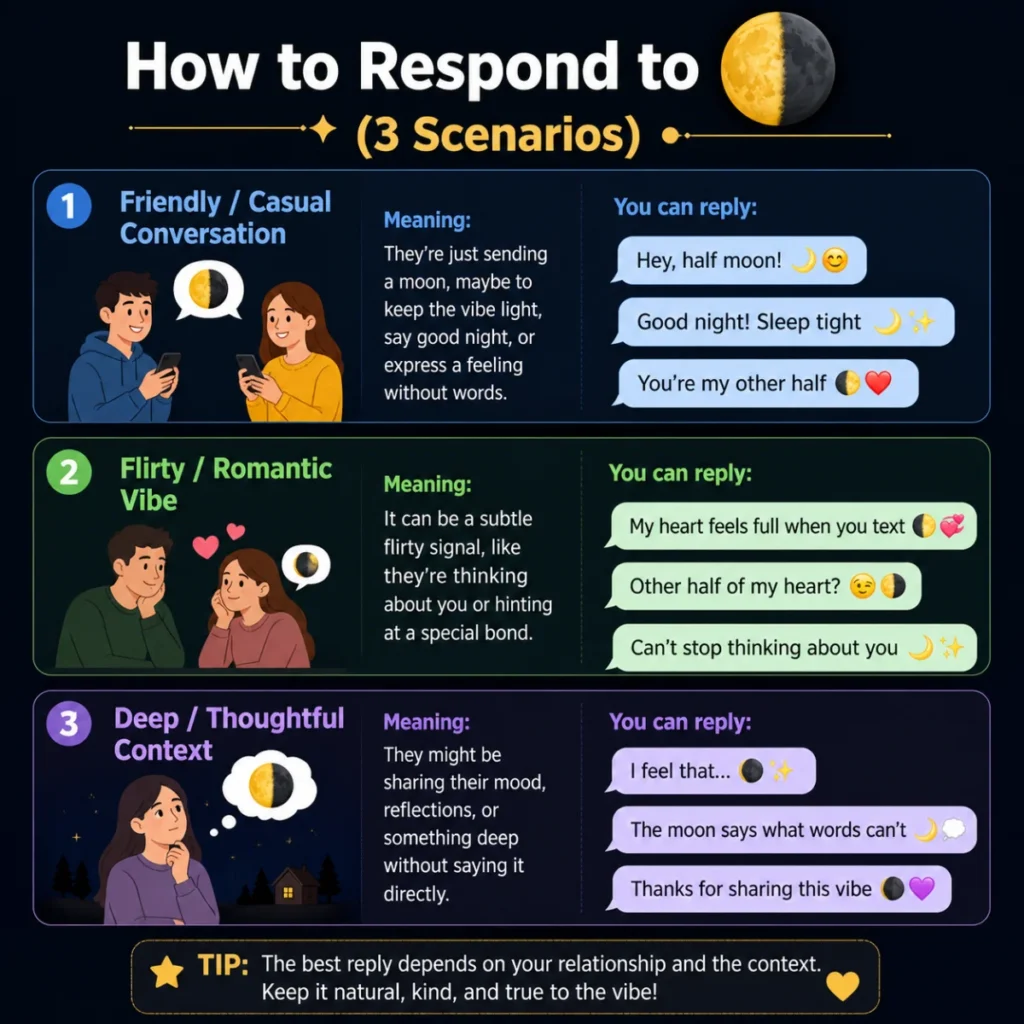
Receiving a 🌖 can feel puzzling. What should you say back? Your response depends on the context and your relationship. Below are three common scenarios with suggested replies.
Scenario 1: A Friend Uses 🌖 to Describe Low Energy
Friend: “I’m so tired. My whole weekend vibe is 🌖.” Your Response: “I feel you. Want to reschedule our plans for next week?” Why this works: You acknowledge the fading energy without judgment. Offering a concrete solution shows support.
Scenario 2: A Dating Match Sends 🌖 After Days of Silence
Match: “Hey, sorry for the delay. Things have been 🌖 on my end.” Your Response: “No worries. Thanks for being honest. Let me know if you want to pick this back up later.” Why this works: You accept the slow fade gracefully. You also leave the door open without pressuring them. This response maintains your dignity.
Scenario 3: A Coworker Uses 🌖 About a Project Deadline
Coworker: “Our progress is 🌖 today. Might need an extra day.” Your Response: “Thanks for the heads-up. Can you send a quick list of what’s left?” Why this works: You transform the vague emoji into actionable information. Asking for specifics moves the conversation forward positively.
In all scenarios, avoid overreacting or demanding clarification aggressively. Remember, 🌖 is rarely meant to offend. Respond with curiosity rather than suspicion. If you truly don’t understand, simply ask: “What do you mean by 🌖?” Most people will happily explain.
Professional Use: Can You Say 🌖 at Work?
Is 🌖 appropriate for workplace communication? The honest answer: it depends on your company culture. In creative industries like marketing, design, or journalism, using 🌖 in Slack or Teams is often fine. Young teams especially embrace emoji shorthand. For instance, a graphic designer might post 🌖 to say “my creative energy is dipping.” Coworkers typically understand and laugh.
However, in formal environments like law, finance, or healthcare, avoid 🌖. These fields prioritize clarity and professionalism. An emoji could be misinterpreted as flippant or immature. Instead of 🌖, use precise language: “I’m experiencing a slowdown,” or “My productivity is decreasing this afternoon.” Such phrases carry the same meaning without ambiguity.
What about external communication with clients? Never use 🌖 in emails or proposals. Clients expect polished, unambiguous messaging. Even if the client uses emojis themselves, it’s safer to stick to words. One exception: if you have a long-term, very casual relationship with a client, and they have used 🌖 first, then mirroring it is acceptable. But let them initiate.
Pro tip: When in doubt, leave 🌖 out. You can still convey a fading tone with transitional phrases like “winding down,” “tapering off,” or “nearing completion.” These alternatives sound professional yet friendly. Save 🌖 for after-work group chats or internal channels with a relaxed policy.
Common Misconceptions (3-4 Myths Debunked)
Several myths surround 🌖. Let’s set the record straight with evidence-based corrections.
Myth 1: 🌖 Means the Same as 🌑 (New Moon)
False. While both are moon emojis, their meanings are opposites. 🌑 (new moon) symbolizes a complete absence of light, representing new beginnings or secrets. 🌖, conversely, represents an almost-full moon that is shrinking. Thus, 🌖 relates to endings and gradual decline. Never swap one for the other.
Myth 2: Sending 🌖 Is Always Passive-Aggressive
False. As we have seen, 🌖 is usually friendly or neutral. Passive-aggressive behavior involves hidden hostility. 🌖 carries no inherent hostility. However, a person could use it passive-aggressively by pairing it with silence. For example, replying only 🌖 to a heartfelt message might feel dismissive. But the emoji itself is not the problem; the lack of words is. Always add context.
Myth 3: Only Teenagers Use 🌖
False. Surveys of emoji usage show that adults aged 25–35 use moon emojis more often than teens. Why? Because adults face more situations involving slow fades: job transitions, relationship shifts, and energy management. Teens tend to prefer dramatic emojis like 😭 or 🔥. So do not assume 🌖 is childish.
Myth 4: 🌖 Has No Place in Serious Conversations
False. Many therapists and life coaches actually recommend soft symbols like 🌖 for discussing sensitive topics. A couple in marriage counseling might use 🌖 to indicate that an argument is de-escalating. This emoji provides a non-threatening way to acknowledge decline. As a result, 🌖 can be a tool for healthy communication, not just casual slang.
By debunking these myths, we hope you feel more confident using and interpreting 🌖 correctly.
5 Polite Alternatives to 🌖 (With Table)
Sometimes you need to express the same idea as 🌖 but without using an emoji. Perhaps your audience prefers words, or you are writing a formal document. Below are five polite alternatives, along with a table comparing their nuances.
Alternative PhraseMeaningToneWhen to Use“Winding down”Gradually ending or decreasingNeutral, professionalWork emails, end-of-day updates“Losing momentum”A decrease in speed or enthusiasmSlightly analyticalProject status reports, team chats“Tapering off”Slowly becoming less intenseGentle, almost poeticPersonal conversations, therapy“Nearing completion”Almost finished but not there yetFormal, respectfulClient communications, academic writing“Taking a backseat”Becoming less of a priorityCasual but politeSocial planning, family texts
Each alternative avoids the potential confusion of 🌖. For example, instead of texting “My interest is 🌖,” you could say “My interest is tapering off.” The meaning remains clear, and the tone stays polite. Similarly, in a business email, write “Our efforts are winding down for the quarter” rather than inserting 🌖. Use the table to pick the best substitute for your specific audience.
Nevertheless, do not abandon 🌖 entirely. Emojis add personality and emotional subtext that words sometimes miss. The key is knowing when an alternative serves you better. For formal writing, choose words. For casual texting with friends, 🌖 is perfectly fine.
Frequently Asked Questions (FAQs Minimum)
Is 🌖 the same as the “waning moon” emoji on all devices?
Yes, 🌖 is the Unicode standard for a waning gibbous moon. However, Apple, Google, and Samsung may display slightly different artwork. But the meaning remains identical across platforms. So do not worry if the visual varies.
Can I use 🌖 to describe a person’s mood?
Absolutely. Many people say “I’m feeling 🌖” to mean they are becoming less energetic or happy. It is a soft way to describe a low mood without alarming others. For instance, “After the bad news, my spirits are 🌖.”
What does 🌖 mean in astrology texts?
In astrology, 🌖 represents the phase for releasing, forgiving, and editing. Astrologers recommend this period for decluttering your life—both physically and emotionally. Consequently, you might see 🌖 in posts about full moon rituals or let-go ceremonies.
How do I type the 🌖 emoji on my phone?
On iPhone, open your emoji keyboard and search for “moon.” Scroll until you see the waning gibbous (it looks like a mostly full moon with a small shadow on the left). On Android, the same method applies. Alternatively, copy it from this article: 🌖.
Is there a difference between 🌖 and 🌘 (waning crescent)?
Yes, a big difference. 🌖 (waning gibbous) is still more than half illuminated. 🌘 (waning crescent) is less than half illuminated and looks like a thin curved sliver. Metaphorically, 🌘 represents almost complete disappearance, while 🌖 represents partial decline. So 🌘 is stronger and closer to “vanishing.”
Conclusion
Understanding 🌖 unlocks a subtle layer of digital communication. This waning gibbous moon emoji is not just an astronomical symbol. It is a versatile tool for expressing gentle endings, fading energy, and reflective moments. We have covered its core meaning, historical origins, real-world examples, and context-dependent shifts. Additionally, we compared 🌖 to similar slang, debunked common myths, and offered polite alternatives. Remember, 🌖 is generally friendly and thoughtful—not rude. Use it when you want to acknowledge a slowdown without negativity. Conversely, avoid it in formal work settings unless your team is highly casual. As with any slang, the golden rule is to know your audience. When in doubt, pair 🌖 with a clarifying sentence. Now you are ready to text, tweet, and chat with confidence. Go ahead and use 🌖 wisely. 😊

Serhii Dunev is a passionate content creator dedicated to crafting meaningful texts, messages, and word inspirations. He aims to help people express their emotions clearly through simple and impactful words.