Four letters land in your notifications with zero context. SMH. No emoji, no punctuation, no follow-up to explain the intent. The SMH meaning in text feels obvious to some people and completely baffling to others, which is exactly why the acronym keeps showing up in search bars around the world.
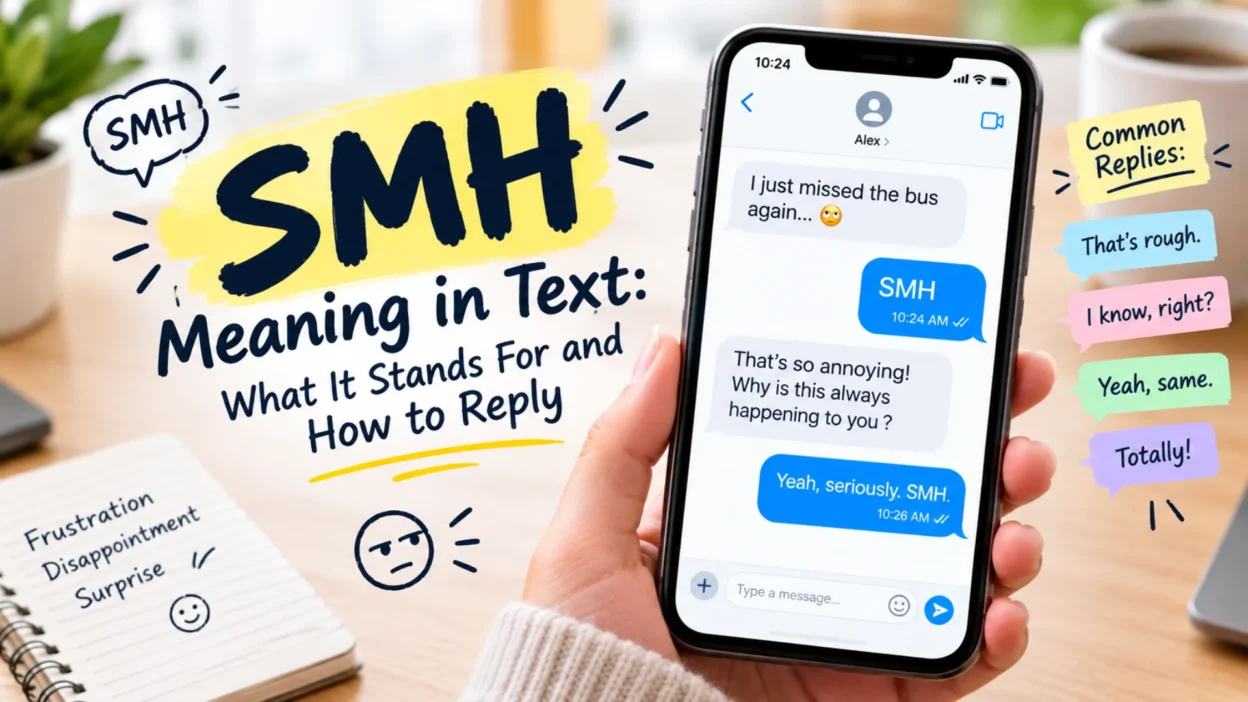
Here’s the direct answer: SMH stands for “shaking my head.” It works as a casual way of expressing disappointment, disbelief, or frustration. Nothing more complicated than that. The confusion starts when the same four letters carry a second meaning, or when someone mistakes it for a completely different acronym.
This breakdown covers every real meaning, explains how the tone shifts across platforms, and shows you the exact reply that keeps a conversation alive.
The Quick Answer: SMH Unpacked
SMH is a texting abbreviation for “shaking my head.” In everyday messages, it functions as a way to react to something disappointing, foolish, or hard to believe. Someone uses it to express disapproval without writing a full paragraph.
Think of it as a virtual headshake. The physical gesture of moving your head from side to side in disbelief translates directly to the screen. When someone types SMH, they’re not actually shaking their head, but they’re definitely conveying that feeling.
Because it’s so short, SMH often doubles as a tone-setter. Placed before a complaint, it signals mild exasperation. Placed after a ridiculous statement, it signals that words fail. The same four letters do different jobs depending on where they sit.
What SMH Really Means in Different Tones
SMH covers a wide range of emotional temperatures. The surrounding message usually shows which one applies. Three tones cover almost every real use.
| Tone | Example Message | What the Sender Signals |
|---|---|---|
| Disappointment | SMH, I really thought he would show up this time | Let down, but not surprised |
| Disbelief | SMH, I can’t believe they actually canceled the concert | Genuine shock at something absurd |
| Mild frustration | SMH, this traffic is never going to end | Everyday annoyance, often half-joking |
Disappointment is the most common. In messages about people, SMH signals that expectations were not met. A friend who promised to call and didn’t gets an SMH. A colleague who missed a deadline gets an SMH. The tone stays mild, almost resigned, rather than angry.
Disbelief comes next. Placed beside shocking news, SMH strengthens the reaction. “SMH, they raised the price again” tells the reader the sender finds the situation genuinely hard to process.
Mild frustration is the lightest use. Traffic, slow Wi-Fi, long lines, and minor inconveniences all earn an SMH. The sender isn’t truly upset, just acknowledging the absurdity of everyday life.
SMH vs. SMDH vs. Other Acronyms: Clearing Up the Confusion
These abbreviations get mixed up constantly. They’re related, but they don’t mean the same thing.
| Abbreviation | Full Meaning | Typical Use | Tone |
|---|---|---|---|
| SMH | Shaking My Head | Disappointment, disbelief, frustration | The standard version |
| SMDH | Shaking My Damn Head | Stronger reaction | More emotional, more intense |
| SMFH | Shaking My F***ing Head | Extreme frustration | The strongest version |
| LMFAO | Laughing My F***ing Ass Off | Genuine amusement | The opposite of SMH |
| TBH | To Be Honest | Adding sincerity | Neutral, clarifying |
| FR | For Real | Agreement or emphasis | Casual, low-intensity |
SMDH adds emphasis. When SMH doesn’t feel strong enough, SMDH steps in. The extra word signals that the sender’s patience has worn thinner. SMFH pushes even further, usually reserved for moments of genuine outrage or disbelief.
A practical rule: SMH handles everyday disappointment. SMDH handles the moments that make you stop and stare at your screen. SMFH handles the moments that make you want to throw your phone.
Where SMH Came From
Texting abbreviations rarely have a single origin story. They evolve from spoken phrases that people eventually shorten because typing full sentences feels like too much effort.
SMH has been in use since at least the early 1990s. A 1994 Usenet post listed the acronym alongside other early internet slang, including “silly little grin” and “same old, same old.” The abbreviation was already circulating before most people had ever sent a text message.
The acronym gained wider recognition in 2004 when a user on Urban Dictionary defined it as “something so stupid, no words can do it justice.” That definition captured the essence of the gesture: a silent, almost helpless reaction to something that defies explanation.
Over the years, variations emerged. SMDH and SMFH added intensity. The core meaning stayed the same. By the time Twitter and later TikTok arrived, SMH was already a well-established piece of digital vocabulary. It has since become one of the most searched internet acronyms in the world, with hundreds of thousands of monthly searches.
Where SMH Lives: Platform by Platform
The meaning of SMH stays fairly consistent from app to app. What shifts is the tone and the kind of response people expect.
| Platform | How SMH Appears | Expected Response |
|---|---|---|
| Text messages | Direct reaction between friends | Casual acknowledgment |
| Twitter / X | Quote tweets and replies | Agreement or pushback |
| TikTok comments | Reactions to videos or captions | Quick agreement or shared disbelief |
| Instagram DMs | Reply to a story or post | Light, low-pressure response |
| Snapchat | Chat replies | In-the-moment reaction |
| Group chats | Filler to emphasize a point | Acknowledgment or shared frustration |
TikTok and Twitter produce the most SMH messages because both platforms reward short, reactive comments. A cringe-worthy video, a bad take, or a frustrating news story all earn an SMH in the replies.
In private texts, SMH lands much softer. It feels more like a quick eye-roll between friends than a serious insult. People drop it into DMs when they want to say “come on, you know better” without starting an argument.
On Twitter, SMH often appears in quote tweets and replies, functioning as a rhetorical “I can’t believe this.” The public nature of the platform makes the reaction feel sharper. A private SMH to a friend carries less weight than a public SMH under someone’s post.
The “So Much Hate” Mistake and Other Misreadings
SMH doesn’t always mean “shaking my head.” A second usage exists, and it shows up more often than you’d expect.
“So much hate” is the alternative definition. Some people use SMH to express that a situation is generating excessive negativity or hostility. It’s a cleaner way of saying “this is toxic” without typing a full sentence.
The key difference comes down to context. If SMH follows a heated argument or a controversial post, it might mean “so much hate.” If it stands alone or reacts to something foolish, it almost certainly means “shaking my head.”
A quick example makes it clear:
- Message: “The comments on that post are brutal.”
- Reply: “SMH, people are ruthless.”
Here, SMH could mean either. The sender might be shaking their head at the cruelty, or they might be commenting on the sheer volume of hate. Both readings work.
Other misreadings exist too. Some people confuse SMH with SHM, which is simply a typo. The correct abbreviation is SMH. SHM doesn’t stand for anything in common usage.
When You Shouldn’t Use SMH
SMH belongs to casual conversation. Using it in the wrong setting can make you sound careless or out of touch.
Professional emails. Clients, managers, and colleagues deserve clearer language. “I’m disappointed” or “That’s frustrating” does the job without sounding like a group chat.
Formal writing. Essays, reports, and applications never include texting abbreviations. Standard English applies.
Cross-language conversations. SMH hasn’t spread as widely as some internet slang. If the other person isn’t fluent in casual English texting, they may not recognize it at all.
Serious conversations. If you’re working through a disagreement, SMH can sound dismissive or passive-aggressive. Direct sentences carry more respect.
Public brand accounts. Companies should avoid SMH unless they’re deliberately adopting a casual tone. Even then, it can backfire. A brand using SMH to react to customer complaints reads as unprofessional rather than relatable.
Common Mistakes People Make With SMH
Most SMH mishaps come from small errors, not big ones.
Mistake 1: Assuming it always means anger. SMH covers a wide emotional range, from mild disappointment to genuine disbelief. The frustration version is only one part of the picture.
Mistake 2: Overusing it. Like any slang term, SMH loses impact when it appears in every other message. Save it for moments that genuinely warrant a headshake.
Mistake 3: Confusing it with SMDH. They’re close, but not identical. SMDH carries more intensity. Using SMDH when SMH would do makes the reaction feel disproportionate.
Mistake 4: Using it in professional settings. Even relaxed workplaces expect clearer language in writing. SMH belongs in the chat window, not the inbox.
Mistake 5: Forgetting the “so much hate” meaning. If you see SMH under a toxic comment thread, don’t assume the sender is shaking their head at the original post. They might be commenting on the hostility itself.
How to Reply to SMH Without Overthinking It
Your reply should match the sender’s energy. That’s the entire rule.
- If it’s the disappointment version:
- “I know, right?”
- “That’s frustrating.”
- “I’d be upset too.”
2. If it’s the disbelief version:
- “Wait, really?”
- “That’s wild.”
- “No way, tell me more.”
3. If it’s the frustration version:
- “Ugh, same.”
- “I feel you.”
- “That’s the worst.”
4. If you’re unsure what they mean:
- “What happened?”
- “Are you okay?”
- “Tell me more.”
5. If you want to playfully push back:
- “Oh, come on, don’t SMH me.”
- “I know, I know, I messed up.”
- “Fair, I deserve that.”
Notice how none of these replies overcommit. They leave space for the conversation to go wherever it’s meant to go.
SMH in Real Conversations
Seeing the acronym in context makes its meaning click faster than any definition.
The disappointed friend
- Person A: “He canceled again.”
- Person B: “SMH. That’s the third time this month.”
- Result: Shared frustration, no argument needed.
The shocking headline
- Person A: “They’re raising tuition by 15 percent.”
- Person B: “SMH, where is that money even going?”
- Result: Disbelief lands, conversation continues.
The group chat reaction
- Person A: “I forgot my laptop charger at home.”
- Person B: “SMH.”
- Person C: “Classic.”
- Result: Light teasing, no hard feelings.
The public comment
- Post: A celebrity says something controversial.
- Comment: “SMH, I expected better from them.”
- Result: Public disapproval, community agreement.
Notice how SMH never demands a long response. It sets a tone and lets the conversation flow from there.
Generational and Regional Patterns
SMH is most common among younger texters in the United States, though it has spread widely across age groups. Gen Z and millennials use it naturally. Older users often recognize it but rarely adopt it.
Regional differences stay minor. An SMH from California means the same as an SMH from Florida. The acronym originated online rather than in a specific geographic community, so it travels well.
Outside the U.S., SMH appears in Canada, the UK, and Australia, but at lower frequency. Each of those countries has its own texting slang, and SMH hasn’t displaced any of it. That said, the acronym is recognizable enough that most English-speaking internet users understand it even if they don’t use it themselves.
Related Abbreviations Worth Knowing
SMH belongs to a family of short reactions that dominate casual texting. Learning the relatives helps you pick the right one.
| Abbreviation | Meaning | Best Situation |
|---|---|---|
| LOL | Laughing Out Loud | Genuine amusement |
| OMG | Oh My God | Surprise or shock |
| WYD | What You Doing? | Current activity check |
| WYO | What You On? | Plans or availability |
| ISTG | I Swear To God | Emphasis or frustration |
| TBH | To Be Honest | Signaling sincerity |
Texters swap these freely, and no conversation falls apart when one replaces another. Fluency comes from use, not memorization.
FAQ
What does SMH stand for in texting?
SMH stands for “shaking my head.” It’s a casual way to express disappointment, disbelief, or frustration. It behaves similarly to a virtual headshake, signaling that something is disappointing or hard to believe.
Can SMH mean something other than “shaking my head”?
Yes. SMH can also mean “so much hate,” especially in contexts involving toxic comment threads or online arguments. Some people also use it as a variant of “scratching my head,” though that usage is less common.
Is SMH the same as SMDH?
Not exactly. SMDH stands for “shaking my damn head” and carries more intensity. SMH is the standard version. SMDH signals stronger frustration or disbelief.
What does SMH mean on TikTok?
On TikTok, SMH almost always means “shaking my head.” It’s used in comments and captions to react to cringe-worthy content, bad takes, or frustrating situations. It’s one of the most common acronyms on the platform.
Should I use SMH at work?
No. SMH belongs to informal conversation. Workplace messages should use clear, standard language instead. Even relaxed offices expect professional phrasing in writing.
How do I reply to SMH?
Match the sender’s energy. If they’re disappointed, acknowledge it. They’re expressing disbelief, react with interest. If they’re frustrated, show solidarity. Short, natural replies work best.
Where did SMH come from?
SMH has been in use since at least the early 1990s. A 1994 Usenet post listed the acronym alongside other early internet slang. It gained wider recognition in 2004 when Urban Dictionary defined it as “something so stupid, no words can do it justice.”
Is SMH used outside America?
It appears in Canada, the UK, and Australia, but less frequently. Each of those regions has its own texting shorthand, and SMH hasn’t replaced any of it. Most English-speaking internet users still recognize it.
Final Thoughts on Reading SMH Correctly
SMH is a small abbreviation with a straightforward job. It expresses disappointment, disbelief, or frustration in four letters. Most of the time, that’s all it means. The confusion comes from the rare cases where it signals “so much hate” instead, or when someone mistakes it for a typo.
The next time those four letters show up in your messages, you won’t need to guess. Read the context, match the tone, and reply like someone who actually understands digital shorthand.

Serhii Dunev is a passionate content creator dedicated to crafting meaningful texts, messages, and word inspirations. He aims to help people express their emotions clearly through simple and impactful words.