If you’ve searched for 128 text message, you may be wondering why the number 128 appears in your messaging history, phone bill, or carrier usage records. It can look unusual, especially when you don’t remember sending or receiving a message from a number called 128.
In many cases, 128 isn’t a regular personal phone number. It can appear as a carrier-related identifier, particularly when voicemail or other network services interact with your mobile account. However, the exact meaning can depend on your carrier, phone, and the place where you see the number.
This guide explains what 128 can mean, why it may appear, whether it represents a real text conversation, and what you should do if you keep seeing it.
What Does 128 Text Message Mean?
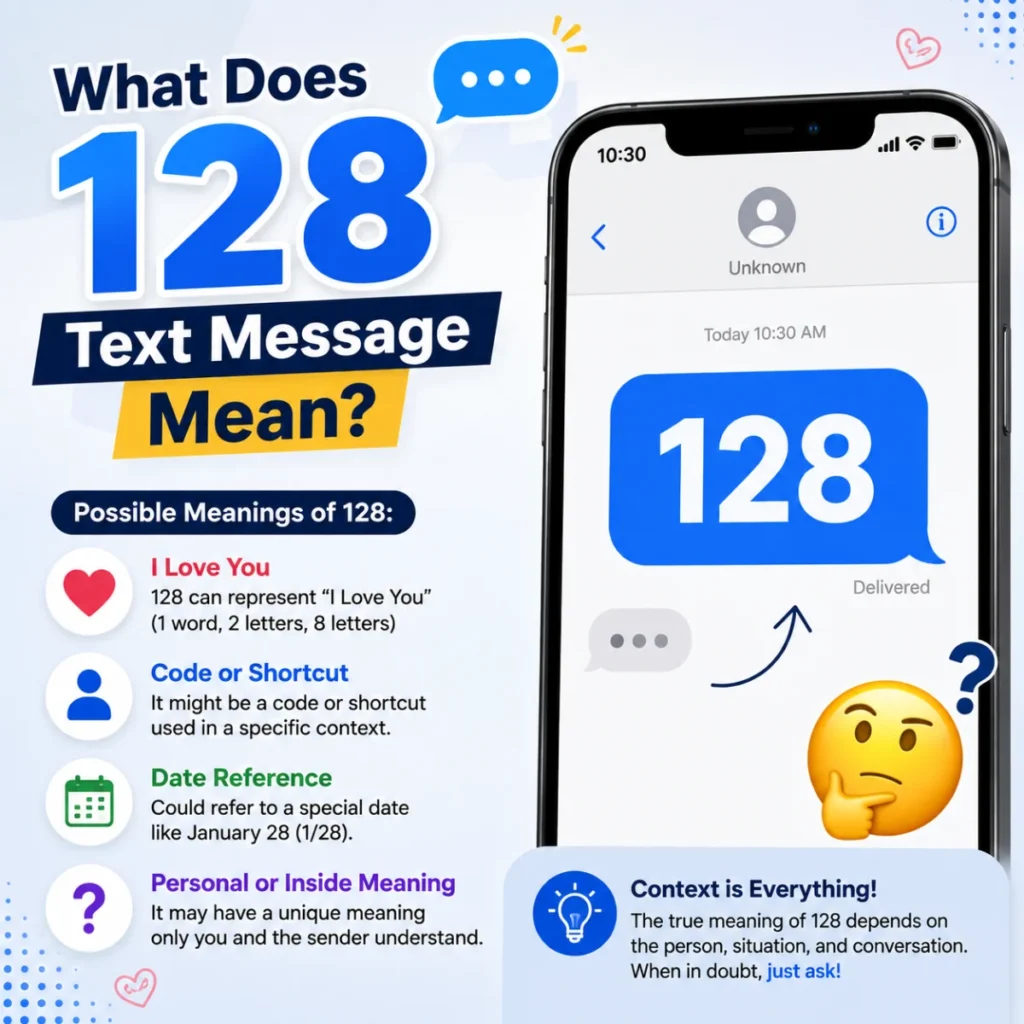
A 128 text message generally refers to an entry where the number 128 appears in your phone or carrier’s messaging records.
The important thing to understand is that a carrier’s usage history doesn’t always work like your regular Messages app. Your carrier may record certain service-related events separately from ordinary conversations.
For example, a 128 entry may be connected with:
- Voicemail notifications
- Voicemail access
- Carrier messaging activity
- Network-generated notifications
- Other mobile service events
Therefore, seeing 128 doesn’t automatically mean that another person sent you a normal text message.
The context matters. If the entry appears immediately after receiving or checking voicemail, the two events may be connected.
Why Does 128 Appear in Text Message Records?
The reason 128 appears can depend on where you’re seeing it.
If you find it in a detailed carrier usage log, the entry may represent network activity rather than a standard SMS conversation. This is especially important for users who notice 128 but cannot find a matching conversation inside their messaging app.
For instance, imagine that you receive a voicemail while you’re away from your phone. Your carrier processes the voicemail notification, and later you check your account history. You might notice an entry associated with 128 even though you never intentionally texted that number.
Similarly, accessing your voicemail can create related carrier activity.
That’s why the first step is to determine whether 128 appears in your actual Messages app or only in your carrier account.
Is 128 a Real Phone Number?
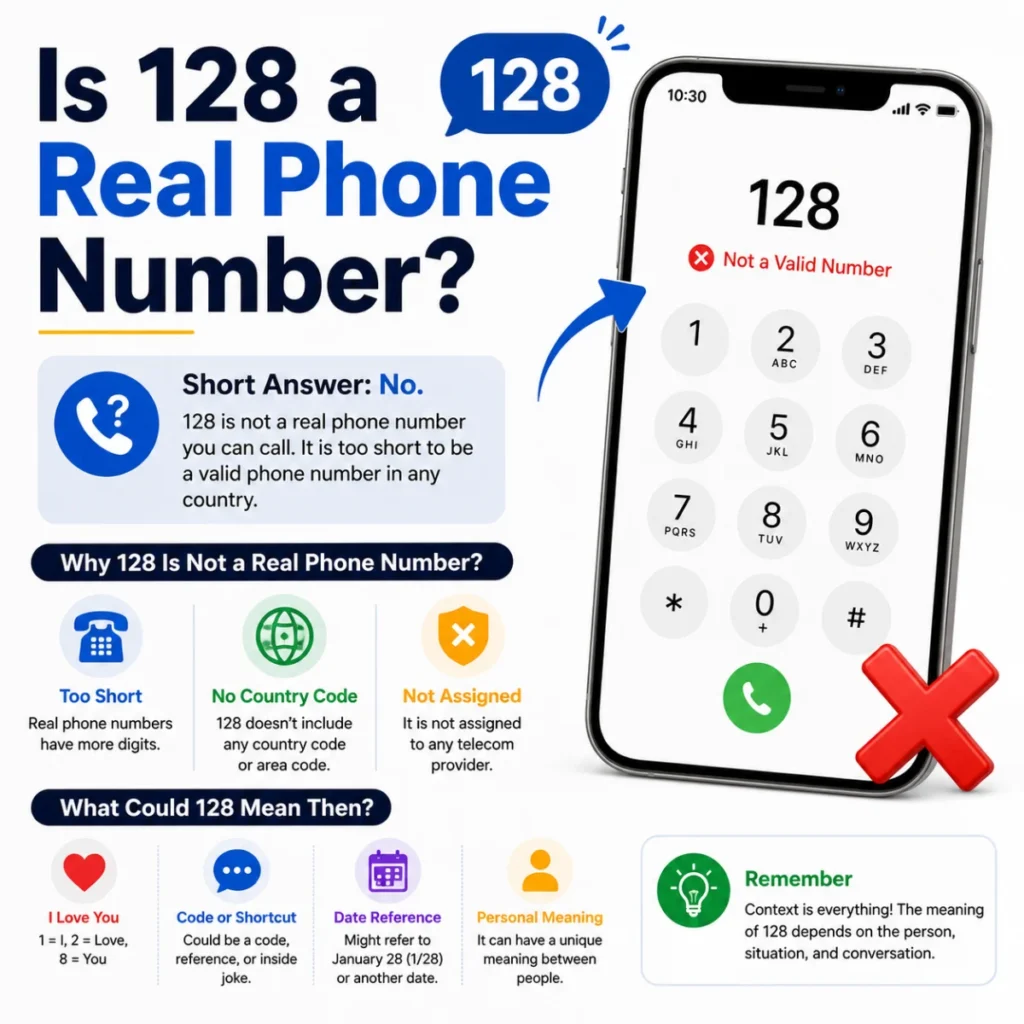
128 shouldn’t automatically be treated as a normal personal phone number.
A traditional phone number generally identifies a specific mobile or landline subscriber. In contrast, short identifiers can sometimes represent services, automated systems, or carrier functions.
As a result, seeing 128 in a usage record doesn’t necessarily tell you that a specific person contacted you.
The difference becomes clearer when you compare these situations:
| Where 128 appears | What it may indicate |
|---|---|
| Regular message conversation | An actual message or service notification |
| Carrier usage history | Network or service-related activity |
| Detailed phone bill | A recorded communication event |
| After voicemail activity | Potentially voicemail-related activity |
| Without a visible conversation | Possibly a carrier-generated record |
Therefore, don’t assume that 128 represents a hidden contact simply because it appears in your account history.
Is 128 Connected to Voicemail?
Voicemail is one of the common explanations associated with 128 entries for some mobile users.
When someone leaves a voicemail, your carrier may send or record a notification. Likewise, calling your voicemail can create network activity that appears differently from an ordinary phone call.
This can make the record confusing.
For example:
- Someone leaves you a voicemail.
- Your carrier processes the voicemail notification.
- Your account records the related activity.
- You later check your usage history.
- You notice 128 and wonder who sent it.
In this situation, 128 may have nothing to do with a person manually sending you an SMS.
However, carrier systems can vary. Therefore, voicemail should be considered a possible explanation rather than an assumption that applies to every carrier.
Does 128 Mean Someone Sent a Secret Text?
No. A 128 entry by itself doesn’t prove that someone sent a secret message.
People sometimes become concerned when they see unfamiliar numbers in their phone records. However, carrier logs can contain information that isn’t represented as a normal conversation.
For example, a usage record may show a service identifier even though your Messages app contains no matching chat.
Consequently, it’s better to investigate the surrounding information before reaching a conclusion.
Check the:
- Date of the entry
- Time of the entry
- Type of activity
- Voicemail history
- Actual message inbox
- Billing information
- Other account activity
If 128 appears only in your carrier’s records and you don’t see an actual message, there’s little reason to interpret it as proof of a hidden conversation.
Could 128 Be Related to WhatsApp or Social Media?
You shouldn’t assume that a 128 entry means someone used WhatsApp, Instagram, Facebook Messenger, or another social platform.
Many messaging applications use internet data instead of traditional SMS. Therefore, activity inside these apps doesn’t necessarily appear as a standard carrier text record.
Some users may notice unfamiliar entries and connect them with social media activity. However, the number alone isn’t enough to establish that connection.
For example, if you see 128 in your carrier account but don’t see a corresponding conversation in WhatsApp, that doesn’t mean WhatsApp created the entry.
Instead, look at the actual information provided by your carrier.
This distinction is particularly useful when you’re trying to understand an unfamiliar phone record without jumping to conclusions.
Why 128 May Not Appear in Your Messages App
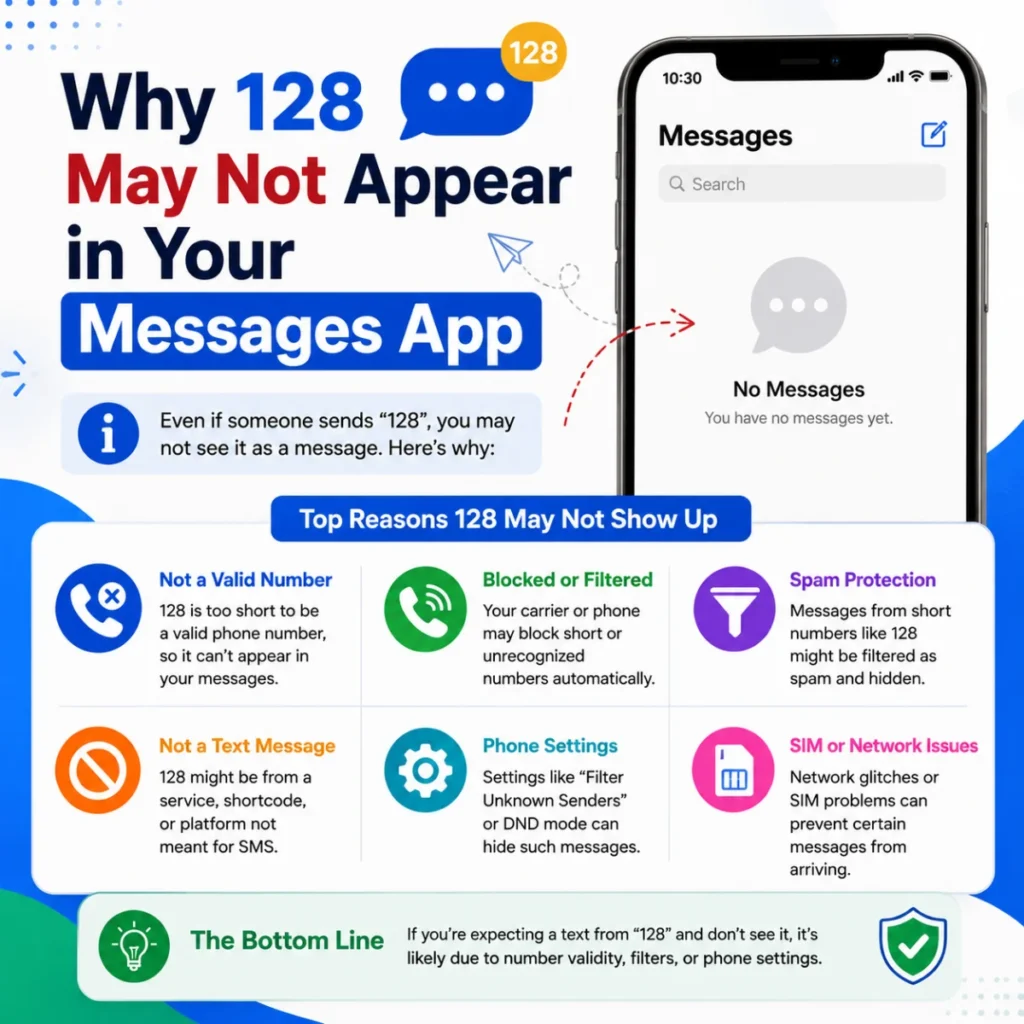
One of the biggest reasons this situation causes confusion is the difference between your phone’s messaging app and your carrier’s usage records.
Your messaging application primarily shows conversations and notifications that the phone receives through supported messaging services.
A carrier account, on the other hand, can display network-level information.
Therefore, these two records don’t always match perfectly.
You might see:
Carrier account: 128 — Incoming activity
Messages app: No conversation with 128
That doesn’t necessarily indicate that something is missing from your phone. It may simply mean that the carrier recorded a service event that wasn’t displayed as a standard conversation.
Does 128 Mean You’re Being Charged?
Not necessarily.
A usage entry doesn’t automatically mean that you were charged an additional fee.
Your carrier can record communication events even when your plan includes messaging or other services. Whether an event results in a charge depends on your specific plan and the type of activity involved.
Therefore, if you’re worried about money, look at the actual billing section instead of assuming that every 128 entry represents a paid text.
Pay particular attention to:
- Extra messaging charges
- Premium services
- Third-party subscriptions
- International messaging
- Unrecognized account changes
If you see an unexpected charge alongside a 128 entry, contact your carrier and ask them to identify the charge.
What If 128 Keeps Appearing?

Repeated 128 entries can look suspicious, but repetition doesn’t automatically mean someone is repeatedly texting you.
If the number is connected with a carrier service, repeated activity can produce repeated records.
For example, multiple voicemail notifications or voicemail interactions may result in several related entries.
When this happens, compare the timestamps.
If the 128 entries occur around the same time as voicemail notifications, there’s a reasonable possibility that the two are related.
On the other hand, if the entries appear at unusual times and you’re also seeing unexpected charges or account changes, further investigation makes sense.
The key is to examine the entire pattern rather than focusing on the number alone.
How to Check a 128 Text Message Entry
If you want to understand an unfamiliar entry, follow a simple process.
1. Check Your Messages App
Look for an actual conversation associated with 128.
If no conversation exists, don’t assume that a message was deleted or hidden.
2. Check Voicemail
Look for new voicemail notifications or recently accessed voicemail.
This can provide an important clue.
3. Compare the Timestamps
Write down when the 128 entry appeared. Then compare that time with your voicemail and phone activity.
A matching time can help explain the record.
4. Review Your Carrier Account
Check whether 128 appears under incoming texts, outgoing texts, data usage, or another category.
The category can change the meaning considerably.
5. Review Your Bill
If you’re concerned about charges, check the actual billing details.
A usage record and a billable charge aren’t necessarily the same thing.
6. Contact Customer Support if Needed
If the record still doesn’t make sense, give your carrier the exact date and time.
They can usually provide more account-specific information than a general internet search.
Common Mistakes People Make About 128
Unfamiliar numbers often lead people to make assumptions. Several mistakes are particularly common.
Mistake 1: Assuming 128 Is a Person’s Number
The number may represent a service or carrier identifier rather than an individual.
Mistake 2: Assuming Every Record Is an SMS
Carrier logs can contain different types of communication events.
Mistake 3: Assuming It Proves Hidden Messages
A single unfamiliar entry isn’t evidence of secret communication.
Mistake 4: Assuming It’s Automatically a Scam
The number itself doesn’t prove that something is fraudulent.
Mistake 5: Ignoring Voicemail Activity
If 128 appears around the same time as voicemail activity, that connection is worth checking.
Mistake 6: Looking Only at the Number
The date, time, location of the record, message content, and billing information provide much more context.
Avoiding these mistakes can make the situation much easier to understand.
Is 128 a Scam Number?
The appearance of 128 doesn’t automatically mean you’re dealing with a scam.
A scam usually involves additional warning signs. These can include suspicious links, requests for money, demands for passwords, fake verification requests, or pressure to provide personal information.
For example, if you receive a message saying that your account will be closed unless you click an unfamiliar link, the content deserves attention regardless of the sender number.
However, if you simply notice 128 in your carrier usage history without any suspicious message or charge, that alone isn’t strong evidence of fraud.
When something seems suspicious, focus on the behavior and content rather than the number alone.
128 Text Message vs. Short Codes
It’s also easy to confuse a carrier identifier with an SMS short code.
Businesses commonly use short codes for automated alerts, promotions, verification messages, and customer notifications.
A carrier-related identifier can serve a different purpose.
That’s why seeing a short number doesn’t automatically tell you who sent the communication or what service generated it.
| Feature | Personal Number | Business Short Code | Carrier Identifier |
| Usually linked to a person | Yes | No | No |
| Can send automated messages | Sometimes | Yes | Yes |
| May appear in carrier records | Yes | Yes | Yes |
| Always represents a conversation | No | No | No |
| Can relate to network services | Rarely | Sometimes | Often |
This distinction helps explain why 128 may appear differently from a normal contact.
Does 128 Mean Someone Accessed Your Phone?
Not by itself.
A carrier usage record doesn’t automatically indicate that someone accessed your device.
If you’re concerned about unauthorized access, look for stronger signs, such as:
- Unknown apps
- Unexpected account changes
- Unfamiliar login notifications
- Changed passwords
- Unrecognized calls
- Suspicious messages
- Unexpected charges
A 128 entry alone doesn’t provide enough information to conclude that someone accessed your phone.
Therefore, don’t treat the number as evidence of phone monitoring or unauthorized access without additional signs.
What Does 128 Mean on T-Mobile?
For T-Mobile users, 128 has been discussed as a carrier-related entry associated with voicemail activity.
Users have reported seeing 128 in incoming usage records, particularly around voicemail notifications or voicemail access.
That makes voicemail one of the first things to check if you’re a T-Mobile customer.
Still, carrier systems can change, and different accounts may behave differently. Therefore, don’t assume that the same identifier has the same purpose across every network.
If you’re using another carrier, the safest approach is to ask that carrier directly what the entry represents.
What Does 128 Mean on iPhone and Android?
The phone brand isn’t necessarily the main factor.
An iPhone and an Android phone can both display carrier-related information, while the carrier controls much of the network-side activity.
Therefore, the more important question is where you found the number.
If 128 appears inside your regular messaging application, inspect the message itself.
If it appears only in your carrier account, treat it as a carrier usage record first.
This approach works regardless of whether you’re using an iPhone, Samsung phone, Google Pixel, or another Android device.
When Should You Contact Your Carrier?
You don’t usually need to contact customer support simply because 128 appears once.
However, reaching out makes sense if:
- The entry comes with an unexplained charge.
- You see many unexplained records.
- Your voicemail behaves unexpectedly.
- Your account shows unfamiliar changes.
- You receive suspicious messages.
- The activity doesn’t match anything you’ve done.
When contacting support, provide the exact date, time, and type of entry.
That information can help the representative identify the underlying service more quickly.
A Quick Checklist for Understanding 128
If you want a simple way to investigate the entry, ask yourself these questions:
Does 128 Appear Only in the Carrier Account?
If yes, it may be a network or service record.
Did You Recently Receive Voicemail?
If yes, the entry may be connected.
Did You Call Voicemail?
If yes, compare the timing with the 128 record.
Is There an Actual Message in Your Inbox?
If not, don’t automatically assume a hidden conversation.
Is There an Unexpected Charge?
If yes, review the billing details.
Does Anything Else Look Suspicious?
If yes, contact your carrier for account-specific assistance.
This checklist can help you separate an ordinary carrier record from a genuinely unusual account event.
FAQs About 128 Text Message
1. What Is a 128 Text Message?
A 128 text message usually refers to an entry where 128 appears as a sender or identifier in a phone or carrier usage record. It may represent carrier-related activity rather than a normal personal text.
2. Does 128 Mean Someone Texted Me?
Not necessarily. A carrier can record service-related activity separately from normal conversations. Check whether an actual message appears in your messaging app.
3. Why Does 128 Appear on My Phone Bill?
The entry may represent a carrier or messaging event. For some users, it can be connected with voicemail notifications or voicemail access.
4. Does 128 Mean Someone Is Hiding Messages?
No. A 128 entry alone doesn’t prove that someone is hiding messages or having a secret conversation.
5. Is 128 Connected to WhatsApp?
There’s no reason to assume that every 128 entry comes from WhatsApp. Internet-based messaging apps and carrier SMS records generally operate differently.
6. Can 128 Be a Scam?
The number alone doesn’t prove that it’s a scam. Look for suspicious links, payment requests, requests for passwords, or other unusual behavior.
7. Why Do I See 128 but No Message?
The carrier may have recorded a network or service event that doesn’t appear as a normal conversation in your Messages app.
8. What Should I Do if 128 Keeps Appearing?
Check voicemail activity, compare timestamps, review your carrier account, and look for unexpected charges. If the entries remain unexplained, contact your carrier.
Conclusion
Seeing 128 text message in your phone or carrier records can seem confusing, but it doesn’t automatically mean that someone sent you a hidden message. In many cases, the entry may relate to carrier services, voicemail notifications, or other network activity.
Before making assumptions, check the date, time, voicemail activity, messaging app, and billing records. If everything matches your normal phone activity, there’s usually no reason to worry.
However, unexpected charges, suspicious messages, or unusual account activity deserve further investigation. In that situation, contacting your mobile carrier can help you understand exactly what the entry represents.
In short, 128 is best understood by looking at the context in which it appears. Don’t judge the number alone. Instead, consider the surrounding activity to determine what the entry actually means.

Serhii Dunev is a passionate content creator dedicated to crafting meaningful texts, messages, and word inspirations. He aims to help people express their emotions clearly through simple and impactful words.