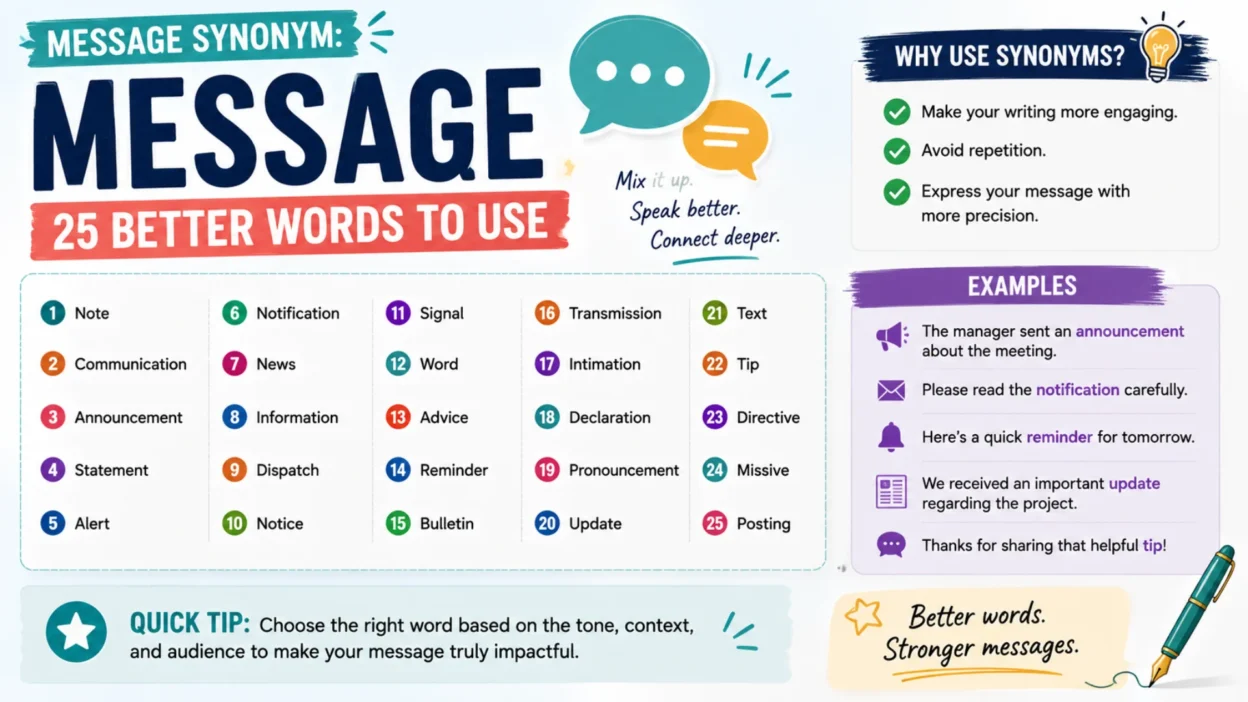
English gives you plenty of ways to say the same thing. Yet the word “message” shows up everywhere, from text threads to corporate emails. It’s a useful word, but repeating it makes writing feel flat. That’s where a good message synonym comes in. Swapping in a fresh term can sharpen your meaning, set the right tone, and keep readers engaged. The catch is that not every synonym fits every situation. “Note” works for a quick line to a coworker, but it sounds odd for a formal announcement. “Communiqué” suits a government statement, though it would feel ridiculous in a group chat. This guide breaks down the best alternatives by meaning, context, and tone. You’ll learn which words to use, which to avoid, and why context matters more than any thesaurus.
Why Synonyms for “Message” Matter More Than You Think
Repetition dulls writing. If every sentence uses “message,” readers start skimming. Synonyms fix that problem, but they do something bigger too. They add precision. A “memo” implies something internal and official. A “ping” suggests something quick and casual. An “address” carries weight and formality. Each word nudges the reader toward a specific interpretation. Choosing well means your audience understands not just what you said, but how you meant it. According to writing guides, varying word choice also improves readability scores and keeps attention longer. So the goal isn’t decoration. It’s clarity.
Message as a Noun: Synonyms for a Communication
When “message” refers to a piece of communication, several nouns fit. The right one depends on length, formality, and medium.
Note works for short, informal writing. “I left a note on her desk.”
Memo suits internal business communication. “The manager sent a memo about the policy change.”
Letter implies formality and often paper. “He wrote a letter to the editor.”
Email is now its own category. It’s specific and clear.
Communiqué appears in official or diplomatic contexts. “The ministry issued a communiqué.”
Dispatch suggests urgency or journalism. “The correspondent filed a dispatch from the region.”
Bulletin implies a broadcast to many people. “The school posted a bulletin about the closure.”
Announcement covers public statements of any kind.
Each option carries a slightly different flavor. Using “note” where “communiqué” belongs, or the reverse, creates an odd mismatch.
Message as a Verb: Alternatives for Sending Word
“Message” also functions as a verb. “I’ll message you later” is common, especially in British English. Here are alternatives that work in different registers.
Text is the everyday choice for SMS. “Text me when you arrive.”
DM works on social platforms. “She DM’d me the details.”
Ping is informal and workplace-friendly. “Ping me if you need anything.”
Contact is neutral and professional. “Please contact us within 48 hours.”
Notify implies official information. “We’ll notify you of the result.”
Inform is slightly formal. “I informed the team about the delay.”
Alert suggests urgency. “The system will alert you to any changes.”
Advise appears in formal writing. “We advise you to check the terms.”
Mixing these up changes the tone fast. “Ping” in a legal notice would be absurd. “Notify” in a text to a friend would sound robotic.
Digital Message Synonyms: Text, DM, Chat, and More
Digital communication has its own vocabulary. These terms rarely appear in formal writing, but they dominate everyday speech.
Text refers to SMS or iMessage.
DM means direct message, mostly on Instagram, X, or LinkedIn.
Chat covers ongoing conversation, especially in apps.
Ping is a quick check-in.
Inbox can mean the message itself in casual use. “I sent you an inbox.”
Ping and buzz both suggest a light nudge.
Thread refers to a chain of messages rather than one.
Comment applies to public replies on posts.
Interestingly, some of these words have crossed into general use. “DM” now appears in marketing copy and job descriptions. “Ping” has become standard office vocabulary. Their informality is part of their appeal.
Synonyms for an Underlying Meaning or Moral
Sometimes “message” refers to the point behind something. A film, speech, or gesture can carry a message without containing any words. Here are synonyms for that sense.
Point is the simplest. “I get your point.”
Meaning suggests significance. “The meaning of the gesture was clear.”
Moral applies to stories and fables. “The moral of the tale is patience.”
Lesson implies something learned. “There’s a lesson in what happened.”
Theme covers a recurring idea. “Loss is a central theme.”
Subtext is the unstated meaning beneath the words.
Implication suggests something hinted rather than said.
Takeaway is modern and practical. “The main takeaway is to plan ahead.”
These synonyms matter in analysis, reviews, and teaching. Using “moral” when you mean “subtext” weakens your argument.
Formal and Professional Alternatives
Workplace and academic writing demands a more measured vocabulary. These synonyms sound natural in reports, proposals, and official correspondence.
Correspondence covers written communication broadly. “All correspondence should go through HR.”
Memorandum is the full form of “memo.”
Notice implies an official alert. “Employees received a notice about the audit.”
Directive suggests an instruction from authority.
Briefing covers informational sessions or documents.
Statement applies to formal positions. “The company released a statement.”
Release often means a press release.
Circular refers to a message distributed widely. “The department issued a circular.”
These words signal professionalism. However, using them in casual settings creates distance. A “directive” sent to a friend would sound absurd.
Message Synonyms for Voicemail and Phone Contexts
Phone-related communication has its own set of terms. These often go unnoticed, yet they’re useful.
Voicemail is the standard term.
Voice note refers to recorded audio in messaging apps.
Recording is broader and more neutral.
Callback request describes the purpose of a message rather than its form.
Notification covers automated alerts.
Alert implies urgency or system-generated information.
Update suggests new information. “I left an update on your phone.”
For business voicemail, “I left a detailed update” often beats “I left a message.” It tells the listener what to expect.
Choosing the Right Synonym by Context
Context decides everything. A word that shines in one setting fails in another. This table maps common situations to appropriate choices.
| Context | Good Choices | Avoid |
|---|---|---|
| Texting a friend | Text, DM, ping, note | Communiqué, memorandum |
| Workplace email | Email, note, update, notice | Ping (too casual in formal emails) |
| Official statement | Communiqué, statement, release | Text, DM |
| Academic writing | Correspondence, communication, notice | Ping, buzz |
| Literature analysis | Theme, moral, subtext, meaning | Update, notification |
| Social media | DM, comment, post, reply | Memorandum, circular |
| Voicemail | Voice note, recording, update | Bulletin, dispatch |
The pattern is clear. Formality rises with the audience. Casual words suit close relationships. Formal words suit institutions and records.
Common Mistakes When Swapping “Message”
Even careful writers slip up. Here are the errors that appear most often.
Mixing registers. Using “ping” in a formal report or “communiqué” in a group chat breaks the tone.
Forcing synonyms where none fit. Sometimes “message” is simply the best word. Replacing it just to avoid repetition makes writing worse.
Confusing similar terms. “Memo” and “notice” overlap, but they aren’t identical. A memo is internal. A notice can be public.
Ignoring connotation. “Dispatch” sounds urgent. “Note” sounds light. Connotation matters as much as definition.
Overusing trendy terms. “Ping” and “DM” are useful, but they date quickly. Balance them with timeless words.
Losing precision. “Communication” is broad. If you mean a specific text, say text. Vagueness weakens writing.
The fix is simple. Read your sentence aloud. If the synonym sounds unnatural, it probably is.
Regional and Generational Differences
Word choice varies by country and age group. In the United States, “text” dominates. In the United Kingdom, “message” works as a verb far more often. Australians use “sms” casually, though less than they once did. Younger speakers favor “DM” and “ping.” Older generations often prefer “note,” “letter,” or “call.”
These differences matter in international communication. A phrase that sounds friendly in one country may sound odd in another. If you’re writing for a global audience, choose neutral terms. “Contact” and “email” travel well. Slang rarely does.
When Not to Replace “Message”
Not every sentence needs a synonym. Sometimes the plain word is best. Consider these cases.
When precision matters. In technical writing, “message” often has a specific meaning. In computing, a message is a defined unit of data. Replacing it would confuse readers.
When clarity beats variety. If “message” is the clearest option, keep it. Variety for its own sake hurts readability.
When the synonym adds nothing. “Communication” is longer and vaguer than “message.” Swapping them makes the sentence worse.
When the tone is neutral. In instructions or documentation, plain language wins.
Good writers vary vocabulary when it improves the sentence. They don’t do it mechanically.
Frequently Asked Questions About Message Synonyms
What is the best synonym for “message”?
It depends on context. “Note” works for informal writing, “email” for digital correspondence, and “statement” for official communication. There’s no single best choice.
Can “message” be used as a verb?
Yes. “I’ll message you tomorrow” is standard in British English and increasingly common elsewhere. It’s informal but widely accepted.
Is “ping” a professional word?
It’s acceptable in many modern workplaces, especially in tech. However, it may sound too casual in formal documents or with conservative audiences.
What’s the difference between “memo” and “notice”?
A memo is internal communication within an organization. A notice can be internal or public and often carries an official tone.
Is “communiqué” still used today?
Yes, mainly in diplomatic, governmental, and formal journalistic contexts. It’s rare in everyday speech.
What synonym works for a hidden meaning?
“Subtext,” “implication,” and “undertone” all describe an unstated message. “Moral” works for stories with a lesson.
Can I use “text” instead of “message” in formal writing?
Usually no. “Text” is informal. In formal writing, use “message,” “correspondence,” or “communication” instead.
Why does English have so many synonyms for “message”?
English borrows heavily from Latin, French, and Germanic roots. Each borrowed word carried a slightly different nuance, and those differences survived.
Final Thoughts: Precision Beats Variety
A message synonym is only useful when it improves your sentence. The goal isn’t to avoid repetition at all costs. It’s to say exactly what you mean. Sometimes “message” is perfect. Other times, “note,” “update,” or “statement” fits better. Learn the nuances, match the word to the context, and trust your ear. If a synonym sounds forced, drop it. If it sharpens your meaning, keep it. That’s the whole art of word choice.

Serhii Dunev is a passionate content creator dedicated to crafting meaningful texts, messages, and word inspirations. He aims to help people express their emotions clearly through simple and impactful words.