Three letters land in your notifications with zero context. WTW. No emoji, no punctuation, no follow-up to explain the intent. The WTW meaning in text feels obvious to some people and completely baffling to others, which is exactly why the acronym keeps showing up in search bars around the world.
Here’s the direct answer: WTW usually stands for “What’s the Word?” It works as a casual way of asking what’s up, what’s happening, or what the plan is. Nothing more complicated than that. The confusion starts when the same three letters carry a second meaning, or when someone mistakes it for a different acronym entirely.
This breakdown covers every real meaning, explains how the tone shifts across platforms, and shows you the exact reply that keeps a conversation alive.
The Quick Answer: WTW Unpacked
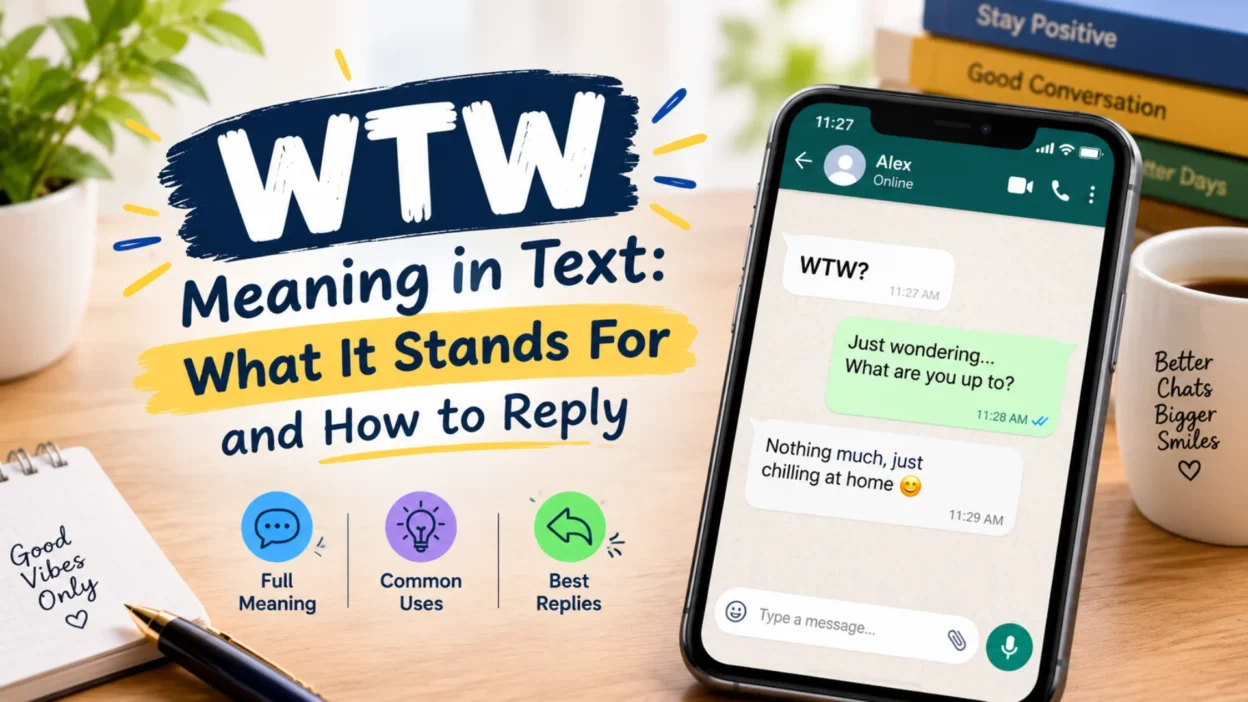
WTW is a texting abbreviation for “What’s the Word?” In everyday messages, it functions as a relaxed check-in. Someone wants to know your status, your plans, or whether anything interesting is happening on your end.
Think of it as a cousin to “What’s up?” The difference is subtle but worth noticing. “What’s up?” invites small talk about anything. WTW carries a slight implication that the sender wants an update or is fishing for plans.
Because it’s so short, WTW often doubles as a soft conversation starter. Sending it on a Friday afternoon usually means “What are you doing this weekend?” rather than “Describe your entire day in detail.”
The Second Meaning Most Guides Forget to Mention
WTW doesn’t always mean “What’s the Word?” A second usage exists, and it shows up more often than you’d expect.
“What the what” is the alternative definition. People use it to express surprise, disbelief, or confusion. It’s a cleaner way of saying “what the heck” without crossing into profanity.
The key difference comes down to context. If WTW follows a shocking piece of news, it’s probably “what the what.” If it stands alone or opens a conversation, it’s almost certainly “what’s the word.”
A quick example makes it clear:
- Message: “Did you hear Jenny got fired?”
- Reply: “WTW!!! She’s the best salesperson on the team!”
Here, WTW reacts to something unexpected. Nobody is asking about weekend plans.
How to Tell Which WTW You’re Reading
Two meanings share the same three letters. Telling them apart takes about two seconds once you know what to look for.
| Clue | What It Suggests |
|---|---|
| WTW stands alone with no prior message | What’s the Word |
| WTW follows shocking or confusing news | What the What |
| WTW appears with a question mark | Usually What’s the Word |
| WTW appears with multiple exclamation points | Usually What the What |
| WTW opens a conversation after silence | What’s the Word |
| WTW responds to a screenshot or wild story | What the What |
The message directly above WTW almost always decides the meaning. Read that first, and the acronym stops being ambiguous.
WTW vs. WTM vs. WYD: Clearing Up the Confusion
These three abbreviations get mixed up constantly. They’re related, but they don’t mean the same thing.
| Abbreviation | Full Meaning | What It Really Asks |
|---|---|---|
| WTW | What’s the Word? | What’s up, what’s new, what’s the plan |
| WTM | What’s the Move? | What are we doing, where are we going |
| WYD | What You Doing? | Current activity, right now |
| WYA | Where You At? | Location or arrival time |
| WYM | What You Mean? | Request for clarification |
WTM leans toward action. It asks about the plan, the location, the decision. WTW is broader and more open-ended. WYD is a snapshot of the present moment. Mixing these up rarely causes real drama, but choosing the right one makes your message cleaner.
A practical rule: if you’re asking what someone is up to with no specific plan in mind, WTW fits. If you’re asking where to meet or what to do next, WTM is the better choice.
Where WTW Came From
Texting abbreviations rarely have a single origin story. They evolve from spoken phrases that people eventually shorten because typing full sentences feels like too much effort.
“What’s the word” existed in casual English long before it became an acronym. People said it out loud as a greeting, a check-in, or a way of asking for updates. The phrase carried a friendly, low-stakes tone that translated perfectly to digital communication.
WTW started appearing in texting dictionaries and slang guides years ago, though its usage likely predates any formal definition. The acronym spread through group chats, Snapchat messages, and Instagram DMs, where quick, low-effort messages thrive. Nobody wanted to type a full sentence to ask a friend what was happening. Three letters did the job fine.
How WTW Behaves Across Platforms
The meaning of WTW stays fairly consistent from app to app. What shifts is the tone and the kind of response people expect.
| Platform | How WTW Appears | Expected Response |
|---|---|---|
| Text messages | Direct check-in between friends | Casual update, plans |
| Snapchat | In DMs or as a story reply | In-the-moment reply |
| Instagram DMs | Conversation opener or reply | Light, low-pressure response |
| TikTok comments | Rare as slang; more common in trends | Depends on context |
| Group chats | Filler to revive a dead thread | Quick acknowledgment |
| Discord | Server chat or DMs | Informal, often gaming-related |
Snapchat tends to produce the most WTW messages because the app rewards constant, low-effort contact. Instagram DMs use it as a gentle icebreaker. Group chats deploy it when the conversation goes quiet and someone wants to stir things up again.
On Discord, WTW sometimes doubles as a gaming check-in. Someone types it to see who’s online and available for a match.
When WTW Isn’t Slang At All
Not every WTW belongs to texting culture. The same three letters appear in other places, and mixing them up can cause genuine confusion.
Worth The Wait. This is a common alternative meaning in product reviews, restaurant ratings, and recommendation threads. Someone might write “WTW” under a post about a new album or a long line at a popular spot. It has nothing to do with asking what’s up.
Walk-Through Walk (gaming). In some gaming communities, WTW refers to a guide or a run-through of a level. This usage is niche, but it shows up in the right corners of the internet.
Organizations and businesses. A handful of companies and groups use WTW as their initials. These are specific and unlikely to appear in everyday texting.
The pattern holds: if the message reads like a chat, it’s slang. If it reads like a review or a title, it’s something else.
When You Shouldn’t Use WTW
WTW belongs to casual conversation. Using it in the wrong setting can make you sound careless or out of touch.
Professional emails. Clients, managers, and colleagues deserve clearer language. “What’s the latest?” does the job without sounding like a group chat.
New acquaintances. WTW assumes a level of familiarity that doesn’t exist yet. Sending it to someone you just met can feel oddly personal.
Formal writing. Essays, reports, and applications never include texting abbreviations. Standard English applies.
Cross-language conversations. WTW hasn’t spread as widely as some internet slang. If the other person isn’t fluent in casual English texting, they may not recognize it at all.
Serious conversations. If you’re working through a disagreement, WTW sounds dismissive. Direct sentences carry more respect.
Common Mistakes People Make With WTW
Most WTW mishaps come from small errors, not big ones.
Assuming it always means “What’s the Word.” The “what the what” meaning is real and common. Ignoring it leads to confused replies.
Replying with a paragraph. A three-letter question doesn’t need five sentences. Short replies keep the rhythm natural.
Using it in a dead group chat. WTW can revive a quiet thread, but only if people are actually around to answer.
Confusing it with WTM. They’re close, but not identical. WTM asks about the plan. WTW asks about the word, which is broader.
Forgetting the “Worth The Wait” meaning. If you see WTW under a restaurant review, don’t reply with your weekend plans.
How to Reply to WTW Without Overthinking It
Your reply should match the sender’s energy. That’s the entire rule.
If you’re free and want to talk:
- “Not much, just chilling. You?”
- “Nothing new here. What’s up with you?”
- “Same old. What’s the word?”
If you’re busy but want to keep it going:
- “Swamped right now, but free later.”
- “Working, can I hit you back?”
- “Crazy day. What’s going on?”
It‘s the “what the what” version:
- “Right?! I can’t believe it either.”
- “No way, when did that happen?”
- “I know, that’s wild.”
If you’re unsure what they want:
- “Not much. What’s on your mind?”
- “Nothing planned. You?”
- “Chilling. Why?”
If it feels like an invitation:
- “Free tonight, actually. Wanna do something?”
- “Nothing planned. What were you thinking?”
- “Bored. Come keep me company?”
Notice how none of these replies overcommit. They leave space for the conversation to go wherever it’s meant to go.
WTW in Real Conversations
Seeing the acronym in context makes its meaning click faster than any definition.
The casual check-in
- Person A: “WTW”
- Person B: “Nothing much, just chilling. You?”
- Result: A conversation starts without effort.
The disguised invitation
- Person A: “WTW tonight?”
- Person B: “Free after 7. Wanna grab food?”
- Result: Plans form inside three messages.
The shock reaction
- Person A: “Did you see the game last night?”
- Person B: “WTW!!! That ending was insane.”
- Result: Shared disbelief, no plans involved.
The group chat revival
- Person A: “WTW”
- Person B: “nm”
- Person C: “same”
- Result: Nobody says anything substantial, but the chat stays alive.
Notice how WTW never demands a long response. It leaves room for the other person to decide how much energy to invest.
Generational and Regional Patterns
WTW is most common among younger texters in the United States. Gen Z and younger millennials use it naturally, especially on Snapchat and Instagram. Older users usually recognize it but rarely adopt it.
Regional differences stay minor. A WTW from California means the same as a WTW from Florida. The only real regional wrinkle involves the “Worth The Wait” meaning, which appears in review contexts regardless of location.
Outside the U.S., WTW appears in Canada, the UK, and Australia, but at lower frequency. Each of those countries has its own texting slang, and WTW hasn’t displaced any of it.
Related Abbreviations Worth Knowing
WTW belongs to a family of short questions that dominate casual texting. Learning the relatives helps you pick the right one.
| Abbreviation | Meaning | Best Situation |
|---|---|---|
| NM | Not Much | Standard reply to WTW or WYD |
| HMU | Hit Me Up | Inviting someone to reach out later |
| LMK | Let Me Know | Asking for an update |
| WYA | Where You At? | Asking for location |
| IMO | In My Opinion | Adding a personal take |
| TBH | To Be Honest | Signaling sincerity |
Texters swap these freely, and no conversation falls apart when one replaces another. Fluency comes from use, not memorization.
FAQ
What does WTW stand for in texting?
WTW most commonly stands for “What’s the Word?” It’s a casual way to ask what’s up, what’s new, or what the plan is. It behaves similarly to “What’s up?” but often carries a slight hint of wanting an update or making plans.
Can WTW mean something other than “What’s the Word?”
Yes. WTW can also mean “what the what,” which expresses surprise or disbelief. It appears after shocking news or a confusing message. Context tells you which meaning applies.
Is WTW the same as WTM?
Not exactly. WTM means “What’s the Move?” and asks about the plan, the location, or the decision. WTW means “What’s the Word?” and is broader and more open-ended. People use them in similar situations, but they aren’t identical.
What does WTW mean on Snapchat?
On Snapchat, WTW almost always means “What’s the Word?” It’s used to initiate a conversation, check in with someone, or ask what’s happening. It’s casual and friendly, and it shows up most often in direct messages.
Should I use WTW at work?
No. WTW belongs to informal conversation. Workplace messages should use clear, standard language instead. Even relaxed offices expect professional phrasing in writing.
How do I reply to WTW?
Match the sender’s energy. If you’re free, say so. you’re busy, say that and offer a later time. If it’s the “what the what” version, react to the news. Short, natural replies work best.
Does WTW have a non-slang meaning?
Yes. In product reviews and recommendation threads, WTW sometimes means “Worth The Wait.” In gaming communities, it can refer to a walk-through. These usages are specific and unlikely to appear in everyday texting.
Is WTW used outside America?
It appears in Canada, the UK, and Australia, but far less often. Each of those regions has its own texting shorthand, and WTW hasn’t replaced any of it.
Final Thoughts on Reading WTW Correctly
WTW is a small abbreviation with a straightforward job. It asks what’s up, what’s new, or what the plan is. Most of the time, that’s all it means. The confusion comes from the rare cases where it signals surprise instead of curiosity, or where it appears in a review as “Worth The Wait.”
The next time those three letters show up in your messages, you won’t need to guess. Read the context, match the tone, and reply like someone who actually understands digital shorthand.

Serhii Dunev is a passionate content creator dedicated to crafting meaningful texts, messages, and word inspirations. He aims to help people express their emotions clearly through simple and impactful words.