Four letters land in your notifications with no context. ISTG. No emoji, no punctuation, no follow-up to explain the intent. The ISTG meaning in text feels obvious to some people and completely baffling to others, which is exactly why the acronym keeps showing up in search bars around the world.
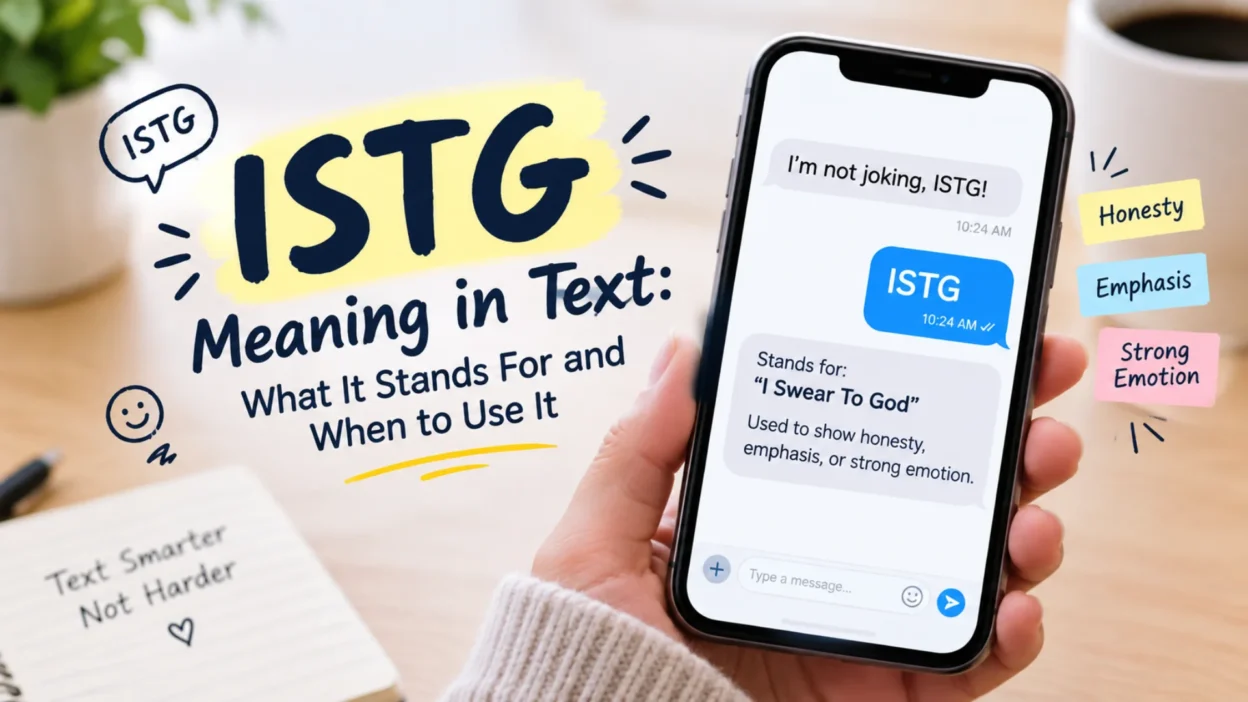
Here’s the direct answer: ISTG stands for “I swear to God.” It works as a casual way of emphasizing sincerity, expressing frustration, or making a promise. Nothing more complicated than that. The confusion starts when the same four letters carry a second meaning, or when someone mistakes it for a completely different acronym.
This breakdown covers every real meaning, explains how the tone shifts across platforms, and shows you the exact reply that keeps a conversation alive.
The Quick Answer: ISTG Unpacked
ISTG is a texting abbreviation for “I swear to God.” In everyday messages, it functions as a way to add weight to whatever you’re saying. Someone uses it to prove they’re not joking, to vent frustration, or to make a promise sound genuine.
Think of it as a cousin to “honestly” or “seriously.” The difference is subtle but worth noticing. “Honestly” can feel neutral. ISTG carries a stronger emotional charge, usually leaning toward frustration, excitement, or a mix of both.
Because it’s so short, ISTG often doubles as a tone-setter. Sending it before a complaint tells the reader you’re at your limit. Sending it before surprising news tells them to believe you. The same four letters do different jobs depending on where they sit.
The Tone Spectrum: From Mild Annoyance to an Earnest Vow
ISTG covers a wide range of emotional temperatures. The surrounding message usually shows which one applies. Three tones cover almost every real use.
| Tone | Example Message | What the Sender Signals |
|---|---|---|
| Frustration | ISTG, if this bus is late again I am walking home | Patience exhausted, often half-joking |
| Emphasis | That was, ISTG, the best meal I have had this year | The claim is sincere, not exaggerated |
| Promise | ISTG I will call you the moment I land | An earnest vow between friends |
Frustration is the most common. In complaints, ISTG signals that the writer’s patience has run out, usually with comic exaggeration rather than real anger. A message like “ISTG, I have been waiting for him for an hour” vents irritation at the situation, not at the person receiving it.
Emphasis comes next. Placed beside a claim, ISTG strengthens it the way “honestly” or “seriously” would. “That was, ISTG, the funniest video I have seen” tells the reader the speaker means every word and is not exaggerating for effect.
Promise is the strongest use. Attached to a commitment, ISTG adds weight: “ISTG I will send you the notes tonight” reads as a genuine vow in casual register. This is the version that carries the most risk, because sending it and then forgetting the promise damages trust exactly as a broken oath would.
How to Tell Which Tone You’re Reading
The message directly above ISTG almost always decides the tone. Read that first, and the acronym stops being ambiguous.
| Clue | What It Suggests |
|---|---|
| ISTG follows a complaint or irritation | Frustration |
| ISTG appears beside surprising or unbelievable news | Emphasis and sincerity |
| ISTG is attached to a commitment or deadline | Promise |
| ISTG appears with “ugh” or multiple exclamation points | Strong frustration |
| ISTG opens a conversation with no prior context | Usually emphasis or sincerity |
The patterns hold across platforms. A frustrated ISTG usually comes with context about something annoying. An emphasis ISTG usually follows a statement the sender wants you to believe. A promise ISTG usually mentions something the sender intends to do.
ISTG vs. Similar Acronyms: Clearing Up the Confusion
ISTG sits inside a family of chat abbreviations that people see daily. They’re related, but they don’t mean the same thing.
| Abbreviation | Full Meaning | Typical Use | Tone |
|---|---|---|---|
| ISTG | I swear to God | Frustration, emphasis, promises | An oath; can feel strong |
| OMG | Oh my God | Surprise or excitement | The most neutral of the group |
| ONG | On God | Expressing sincerity | Similar to ISTG but milder |
| FR | For real | Agreement or emphasis | Casual, low-intensity |
| SMH | Shaking my head | Disapproval or disappointment | Deadpan and judgmental |
OMG reacts to news. SMH expresses disappointment. FR signals agreement. ISTG does something different. It carries the weight of an oath, which makes it stronger than the rest of the group.
ONG and ISTG often get swapped in conversation. Both express sincerity, but ISTG carries more heat. A frustrated ISTG usually signals that the sender is at their limit. ONG is lighter and more casual.
Where ISTG Came From
Texting abbreviations rarely have a single origin story. They evolve from spoken phrases that people eventually shorten because typing full sentences feels like too much effort.
“I swear to God” existed in casual English long before it became an acronym. People said it out loud as an oath, a promise, or a way of emphasizing the truth. The phrase carried a serious, slightly dramatic tone that translated perfectly to digital communication.
ISTG likely originated in the early 2000s as instant messaging programs like AOL Instant Messenger and Yahoo Messenger gained popularity. The first definition on Urban Dictionary appeared in 2007 and simply read: “I swear to God. Promising.”. The acronym became even more popular in the late 2010s with its use on Snapchat and WhatsApp.
An interesting wrinkle: ISTG is not typically used in a religious context, despite the faith-based wording. The phrase is used casually, often with substitutions like “I swear on my life.” When someone uses an “I swear” phrase, they want you to take their word seriously.
The Viral “Instagram” Mistake That Gave ISTG a Second Meaning
In early 2026, ISTG picked up an entirely unrelated meaning thanks to a viral moment from the Bridgerton press tour. Actor Luke Thompson, who plays Benedict Bridgerton, encountered the acronym in a social media comment and confidently pronounced it as “Instagram.”
The moment was caught on camera. His co-star Yerin Ha gently informed him that ISTG actually stands for “I swear to God.” Thompson admitted he was still confused. The internet reacted exactly how you’d expect. Clips circulated everywhere, and for a brief window, ISTG became a running joke about millennial confusion.
Here’s the takeaway: if ISTG appears in a meme or a viral clip, it might be referencing the Instagram joke. In ordinary texts, it still means “I swear to God.” Context decides everything.
Where ISTG Lives: Platform by Platform
The meaning of ISTG stays fairly consistent from app to app. What shifts is the tone and the kind of response people expect.
| Platform | How ISTG Appears | Expected Response |
|---|---|---|
| Text messages | Direct check-in between friends | Casual update, reaction |
| Snapchat | In DMs or as a story reply | In-the-moment reply |
| Instagram DMs | Conversation opener or reply | Light, low-pressure response |
| TikTok comments | Reactions to videos or captions | Quick agreement or disbelief |
| Group chats | Filler to emphasize a point | Acknowledgment or pushback |
| Discord | Server chat or DMs | Informal, often gaming-related |
Snapchat and Instagram produce the most ISTG messages because those apps reward constant, low-effort contact. TikTok comments use it as a reaction tool. Group chats deploy it when someone wants to drive a point home.
On Discord, ISTG sometimes doubles as a sincerity marker during gaming sessions. Someone types it to prove they’re not exaggerating about a play or a glitch.
When You Shouldn’t Use ISTG
ISTG belongs to casual conversation. Using it in the wrong setting can make you sound careless or out of touch.
Professional emails. Clients, managers, and colleagues deserve clearer language. “I promise” or “I assure you” does the job without sounding like a group chat.
Formal writing. Essays, reports, and applications never include texting abbreviations. Standard English applies.
Cross-language conversations. ISTG hasn’t spread globally the way some internet slang has. If the other person isn’t fluent in casual English texting, they may not recognize it at all.
Religious contexts. The phrase includes a reference to God. Some readers find casual use of that wording disrespectful, especially in settings where religious language is held in high regard.
Serious conversations. If you’re working through a disagreement, ISTG can sound dramatic or dismissive. Direct sentences carry more respect.
Common Mistakes People Make With ISTG
Most ISTG mishaps come from small errors, not big ones.
Assuming it always means frustration. The emphasis and promise versions are just as common. Ignoring them leads to confused replies.
Overusing it. Like any slang term, ISTG loses impact when it appears in every other message. Save it for moments that genuinely warrant emphasis.
Confusing it with ONG. They’re close, but not identical. ONG is lighter and more casual. ISTG carries more emotional weight.
Forgetting the “Instagram” joke. If you see ISTG in a Bridgerton meme, don’t reply with your weekend plans. It’s a reference to a viral moment, not a real question.
Using it in professional settings. Even relaxed workplaces expect clearer language in writing. ISTG belongs in the chat window, not the inbox.
How to Reply to ISTG Without Overthinking It
Your reply should match the sender’s energy. That’s the entire rule.
- If it’s the frustration version:
- “That sounds so annoying.”
- “I’d be frustrated too.”
- “Ugh, same.”
2. If it’s the emphasis version:
- “Wait, really?”
- “That’s wild.”
- “No way, tell me more.”
3. If it’s the promise version:
- “I believe you.”
- “Okay, I’m holding you to that.”
- “Thanks, I appreciate it.”
4. If you’re unsure what they mean:
- “Wait, are you serious?”
- “What’s going on?”
- “Tell me more.”
Notice how none of these replies overcommit. They leave space for the conversation to go wherever it’s meant to go.
ISTG in Real Conversations
Seeing the acronym in context makes its meaning click faster than any definition.
The frustrated vent
- Person A: “ISTG if my neighbor plays that song one more time I’m moving.”
- Person B: “I’d be losing my mind too.”
- Result: Shared frustration, no action needed.
The sincere claim
- Person A: “ISTG I just saw a celebrity at the grocery store.”
- Person B: “Wait, who? Tell me everything.”
- Result: Emphasis lands, conversation continues.
The promise
- Person A: “ISTG I’ll send you the notes tonight.”
- Person B: “Okay, I believe you.”
- Result: Trust extended, commitment noted.
The group chat emphasis
- Person A: “ISTG this is the funniest thing I’ve seen all week.”
- Person B: “Send it, send it.”
- Person C: “I need to see this.”
- Result: Shared amusement, no confusion.
Notice how ISTG never demands a long response. It sets a tone and lets the conversation flow from there.
Generational and Regional Patterns
ISTG is most common among younger texters in the United States. Gen Z and younger millennials use it naturally, especially on Snapchat and Instagram. Older users usually recognize it but rarely adopt it.
Regional differences stay minor. An ISTG from California means the same as an ISTG from Florida. The only real regional wrinkle involves the Bridgerton meme, which traveled globally because it originated on social media rather than in a specific community.
Outside the U.S., ISTG appears in Canada, the UK, and Australia, but at lower frequency. Each of those countries has its own texting slang, and ISTG hasn’t displaced any of it.
Related Abbreviations Worth Knowing
ISTG belongs to a family of short phrases that dominate casual texting. Learning the relatives helps you pick the right one.
| Abbreviation | Meaning | Best Situation |
|---|---|---|
| NM | Not Much | Standard reply to WYO or WYD |
| HMU | Hit Me Up | Inviting someone to reach out later |
| LMK | Let Me Know | Asking for an update |
| WYA | Where You At? | Asking for location |
| IMO | In My Opinion | Adding a personal take |
| TBH | To Be Honest | Signaling sincerity |
Texters swap these freely, and no conversation falls apart when one replaces another. Fluency comes from use, not memorization.
FAQ
What does ISTG stand for in texting?
ISTG stands for “I swear to God.” It’s a casual way to emphasize sincerity, express frustration, or make a promise sound genuine. It behaves similarly to “honestly” but carries a stronger emotional charge.
Can ISTG mean something other than “I swear to God”?
Yes. Thanks to a viral 2026 moment from the Bridgerton press tour, ISTG briefly became a joke about the word “Instagram.” In ordinary texts, it still means “I swear to God.” The Instagram meaning only applies in meme contexts.
Is ISTG the same as ONG?
Not exactly. ONG means “on God” and expresses sincerity in a lighter, more casual way. ISTG carries more weight and often signals frustration or a genuine promise. People use them in similar situations, but they aren’t identical.
What does ISTG mean on TikTok?
On TikTok, ISTG almost always means “I swear to God.” It’s used in comments and captions to emphasize a point, express disbelief, or vent frustration. The Bridgerton meme gave it a brief second life as an “Instagram” joke, but that usage is context-specific.
Should I use ISTG at work?
No. ISTG belongs to informal conversation. Workplace messages should use clear, standard language instead. Even relaxed offices expect professional phrasing in writing.
How do I reply to ISTG?
Match the sender’s energy. If they’re frustrated, acknowledge it. They’re emphasizing something, react with interest. If they’re making a promise, show that you believe them. Short, natural replies work best.
Is ISTG offensive or religious?
Not usually. The phrase includes a reference to God, but it’s almost always used casually rather than religiously. Some people may find it disrespectful in formal or religious settings, so context matters.
Does ISTG have a non-slang meaning?
No. Outside of texting and social media, ISTG doesn’t carry a separate everyday meaning. The only exception is the viral Instagram joke, which is a meme rather than a real definition.
Final Thoughts on Reading ISTG Correctly
ISTG is a small abbreviation with a straightforward job. It emphasizes sincerity, expresses frustration, or makes a promise sound genuine. Most of the time, that’s all it means. The confusion comes from the rare cases where it appears in a Bridgerton meme or when someone mistakes it for a different acronym.
The next time those four letters show up in your messages, you won’t need to guess. Read the context, match the tone, and reply like someone who actually understands digital shorthand.

Serhii Dunev is a passionate content creator dedicated to crafting meaningful texts, messages, and word inspirations. He aims to help people express their emotions clearly through simple and impactful words.