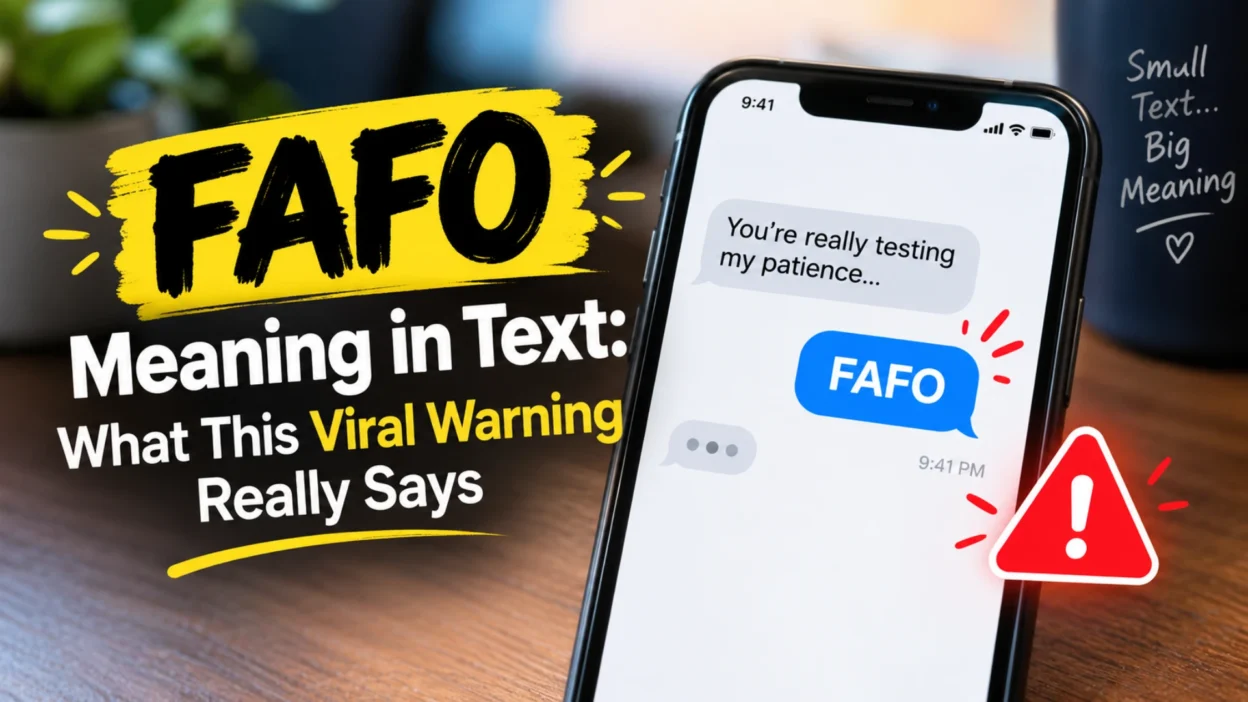
A message pops up in a group chat: FAFO. Four letters, no explanation, and a sudden shift in tone. The fafo meaning in text is blunt and loaded at the same time. It stands for “F*** Around, Find Out”—or, in the polite version, “Fool Around, Find Out.” Merriam-Webster defines it as an expression of warning or schadenfreude.
That definition is accurate, but it barely scratches the surface. FAFO has moved from niche slang into political speeches, parenting debates, TikTok captions, and everyday text threads. It can be a joke between friends, a genuine warning, or a smug observation after someone’s bad decision backfires. Understanding the difference is what separates a confident reader from someone who misreads the room.
The Core Definition: Actions Meet Consequences
FAFO compresses a simple idea into four letters. The first half refers to acting foolishly, provocatively, or without caution. The second half refers to discovering the consequences of that behavior. The phrase is a warning wrapped in an acronym, and it usually signals that actions have consequences.
The polite version replaces the expletive with “fool,” which makes the abbreviation usable in slightly broader settings. However, the underlying message stays the same. FAFO is not a neutral observation. It carries an edge, a hint of satisfaction, and often a quiet “I told you so.”
Interestingly, the acronym works because of its rhythm. Two short halves, each with a verb, create a cause-and-effect structure that’s easy to remember. That cadence is a big reason it spread so quickly through social media and text messaging.
Where FAFO Came From: AAVE Roots and Internet Fame
FAFO may feel like a product of TikTok, but its roots run deeper. Usage of the phrase originated in African American English and has since become widespread in mainstream conversation. The Washington Post traced its use as far back as 2007, and early Urban Dictionary entries linked it to biker slang as a warning that reckless behavior comes with consequences.
The acronym’s breakout moment arrived through social media. A major spike occurred in 2022 after Elon Musk tweeted the term, sending users scrambling to decode it. Around the same time, a viral TikTok video featuring a “fafo chart” showed how much someone has to mess around before finding out, and it racked up millions of views in days. From there, FAFO spread into political discourse, memes, and everyday texting.
That timeline matters for one practical reason. Because the phrase is relatively new to mainstream audiences, older readers and non-native English speakers often encounter it without any context. Recognizing its origin helps explain why it carries such a sharp tone.
How FAFO Works in a Sentence: Adjective, Verb, and Hashtag
FAFO is grammatically flexible, which is part of why it’s so hard to pin down. Merriam-Webster notes that it functions as an adjective (“a FAFO moment”), a verb, a noun, an interjection, and a hashtag. That versatility explains why it appears in so many different conversational shapes.
As an interjection, it stands alone: “FAFO.” That version is the bluntest and often the most confrontational. As a noun, it names the phenomenon itself: “that’s just FAFO in action.” As an adjective, it describes a specific event: “a FAFO situation.” In verb form, people sometimes write it lowercase and treat it as an action: “he fafo’d.”
This flexibility is unusual for an acronym. Most abbreviations stay in one grammatical lane, but FAFO shifts shape depending on the sentence. As a result, readers who only know one usage may misread the others.
The Two Readings: Warning Versus Schadenfreude
The most useful way to understand FAFO is to recognize its two dominant moods. In the first, it’s a warning issued before the fact. Someone is about to do something reckless, and the acronym functions as a heads-up: keep going and you’ll deal with the result.
In the second, it’s a reaction after the fact. The messing around already happened, the finding out already arrived, and the sender is commenting on the outcome with a mix of satisfaction and dark humor. This version often appears in replies to news stories, viral videos, or a friend’s confession about a bad decision.
Both readings share the same logic, but the timing flips the tone. A warning feels tense. A post-mortem feels smug. Reading the moment correctly tells you which one you’re dealing with.
The Polite Version: Fool Around, Find Out
Not every setting tolerates the original wording. That’s where “Fool Around, Find Out” comes in. The substitution softens the phrase without changing the structure or the message, and it makes FAFO usable in classrooms, workplace training, and family conversations.
This version isn’t just a sanitized copy. It’s a genuine adaptation that has spread on its own, particularly in parenting content and safety messaging. A coach might tell a team “fool around in practice, find out on game day.” The meaning is identical, but the delivery fits a wider audience.
Still, the polite version rarely carries the same bite. The original phrase gets its force from bluntness, and softening the language inevitably softens the impact. That trade-off is worth understanding before choosing which version to use.
FAFO in Group Chats and Text Threads
Texting is where FAFO feels most natural, largely because it’s short and emphatic. In a group chat, a single FAFO can shut down a bad idea, roast a friend, or summarize a chaotic situation in four letters. The abbreviation thrives on brevity, and group chats reward speed.
Tone depends heavily on the relationship. Between close friends, FAFO is usually playful, especially when paired with a laughing emoji or an eye-roll. Between acquaintances, the same letters can land harder and read as a genuine warning. Meanwhile, in a chat with family members, the acronym often needs expansion to avoid confusion.
One practical detail stands out. Because FAFO contains profanity in its original form, many people avoid typing it in threads where parents, coworkers, or younger relatives are present. The polite version exists partly to solve that problem.
FAFO on TikTok, X, and Instagram
Each platform gives FAFO a slightly different flavor. On TikTok, the phrase appears in captions, comments, and reaction videos, often as a punchline after someone ignores obvious advice. The platform’s short-video format rewards the kind of cause-and-effect storytelling that FAFO describes perfectly.
On X, formerly Twitter, FAFO is frequently political. Commentators use it to frame policy decisions, legal outcomes, or public scandals as predictable consequences. The acronym fits the platform’s compressed style, and its edge suits the combative tone of many threads.
On Instagram, FAFO shows up in meme carousels and story reposts, usually with more humor than confrontation. The visual format softens the phrase, turning it into a relatable joke rather than a direct challenge. Same four letters, noticeably different energy.
When FAFO Crosses a Line: Work, Family, and Public Settings
The most common mistake with FAFO is forgetting that it contains profanity and aggression. In professional settings, dropping the acronym into an email or a team channel is a serious misstep. Even the polite version can read as condescending when directed at a colleague or a client.
Family settings require similar care. Sending FAFO to a parent or an older relative often creates confusion, and the expanded meaning doesn’t always improve the reaction. In public posts, the phrase can come across as mocking, especially when aimed at a stranger who is already having a bad day.
A practical rule helps here. Use FAFO in private, casual exchanges with people who share your vocabulary. Avoid it in writing that could be forwarded, screenshotted, or read by someone outside the conversation. The acronym is memorable precisely because it’s blunt, and bluntness travels poorly outside its intended audience.
Common Mistakes People Make With FAFO
The first mistake is assuming FAFO is always a threat. In many cases, it’s humor, commentary, or a warning delivered with affection. Treating every instance as hostile leads to unnecessary conflict.
The second mistake is ignoring the timing. FAFO used before an event is a warning. Used after an event, it’s commentary. Confusing the two can make a harmless joke sound like a lecture.
The third mistake is using the acronym with people who don’t know it. Parents, older colleagues, and non-native speakers often read it as a typo or an unfamiliar code. A quick expansion prevents confusion, even if it costs a few extra characters.
Finally, some people overuse FAFO until it loses its impact. Like any slang term, repetition dulls the edge. The phrase works best when it’s used sparingly and at the right moment.
FAFO and Similar Slang Compared
| Term | Common Meaning | Typical Tone |
|---|---|---|
| FAFO | F*** Around, Find Out | Blunt, warning, darkly humorous |
| FAFO (polite) | Fool Around, Find Out | Firm, family-friendly |
| Play stupid games, win stupid prizes | Bad choices bring bad outcomes | Sarcastic, moralizing |
| Leopards ate my face | Self-inflicted consequences | Mocking, political |
| Told you so | Prediction confirmed | Smug, familiar |
| Karma | Consequences return to the doer | Reflective, informal |
FAFO belongs to a family of phrases about cause and effect, but it stands apart because of its compactness and its profanity. The polite version loses some bite, while “play stupid games” loses some speed. Few competitors match the acronym’s ability to summarize a whole situation in four letters.
Generational and Cultural Nuances
Younger texters tend to treat FAFO as ordinary vocabulary, using it without much thought about its origin or its edge. Older users often recognize the phrase but may still find the profanity jarring, even in its shortened form. That gap explains why the acronym sometimes needs a quick explanation in mixed-age conversations.
Cultural background matters too. Because the phrase originated in African American English, some writers have noted that its mainstream adoption came with a loss of context. Others point out that slang naturally travels between communities and that the phrase’s popularity reflects genuine usefulness. Both observations can be true at once.
Regional differences add another layer. In some online communities, FAFO is almost invisible because it’s so common. In others, it still reads as aggressive or unfamiliar. These variations don’t change the definition, but they do change how the message lands.
How to Respond When Someone Sends FAFO
The right response depends on the sender’s intent. If FAFO arrives as a warning before a decision, take it seriously. A short “fair point” or “yeah, I’m rethinking it” acknowledges the message without turning it into an argument.
When FAFO arrives as commentary after the fact, matching the tone usually works. A light “lesson learned” or “I deserved that” keeps the exchange friendly. If the acronym feels mocking or hostile, a calm direct question—”are you warning me or making fun of me?”—clears the air faster than guessing.
In professional contexts, the safest reply is no reply at all. Redirect the conversation to the actual issue and keep the written record clean. Some abbreviations are better left in the chat where they belong.
Frequently Asked Questions About FAFO
What does FAFO stand for in text?
FAFO stands for “F*** Around, Find Out,” or the polite version, “Fool Around, Find Out.” It warns that reckless behavior leads to unpleasant consequences, or it comments on that outcome after the fact.
Is FAFO a threat?
It can be, though not always. Sometimes it’s a genuine warning, sometimes dark humor, and sometimes a smug comment on someone else’s bad decision. Tone, timing, and relationship determine which one applies.
Who uses FAFO?
The phrase originated in African American English and is now used widely across generations and platforms. Younger users tend to treat it as casual slang, while older users often encounter it through news, social media, or politics.
Is FAFO safe to use at work?
Generally, no. The acronym contains profanity and carries an aggressive edge, so it rarely belongs in professional writing. Even the polite version can sound condescending in a workplace message.
What is the polite version of FAFO?
“Fool Around, Find Out” is the family-friendly version. It keeps the same cause-and-effect structure while removing the profanity, which makes it usable in classrooms, coaching, and parenting contexts.
When did FAFO become popular?
The phrase has been documented in slang sources since around 2007, but its mainstream breakout came in 2022 after high-profile social media use and a viral “fafo chart” video on TikTok.
Is FAFO the same as karma?
They’re related but not identical. Karma describes consequences returning to a person, often with a moral or spiritual tone. FAFO is blunter and more immediate, usually focused on a specific decision and its result.
What should I do if I don’t know why someone sent FAFO?
Ask a short, direct question. “What’s this about?” or “Are you warning me?” costs little and prevents assumptions. When context is thin, clarity beats guessing.
Final Thoughts: Four Letters With a Sharp Edge
FAFO is a small acronym with a big personality. At its core, it means that reckless behavior invites unpleasant results. Around that core, usage branches: the warning before a decision, the smug commentary after one, the playful jab between friends, the political shorthand for predictable fallout.
The practical takeaway is simple. Read the timing before deciding what the sender means. Keep the acronym in casual, private conversations with people who share your vocabulary. Use the polite version when the setting calls for it, and skip it entirely when the message could be forwarded or screenshotted.
Four letters shouldn’t create confusion—especially when the context is right there on the screen. Used carefully, FAFO says exactly what it means, and nothing more.

Serhii Dunev is a passionate content creator dedicated to crafting meaningful texts, messages, and word inspirations. He aims to help people express their emotions clearly through simple and impactful words.