A message arrives from a friend you haven’t heard from in weeks. It contains three letters and nothing else: wsg. No question mark. No context. You stare at it and wonder whether you’re being greeted, tested, or invited into a conversation you don’t know how to start. The wsg meaning in text is simpler than that moment suggests, yet the abbreviation carries a social weight that catches plenty of people off guard.
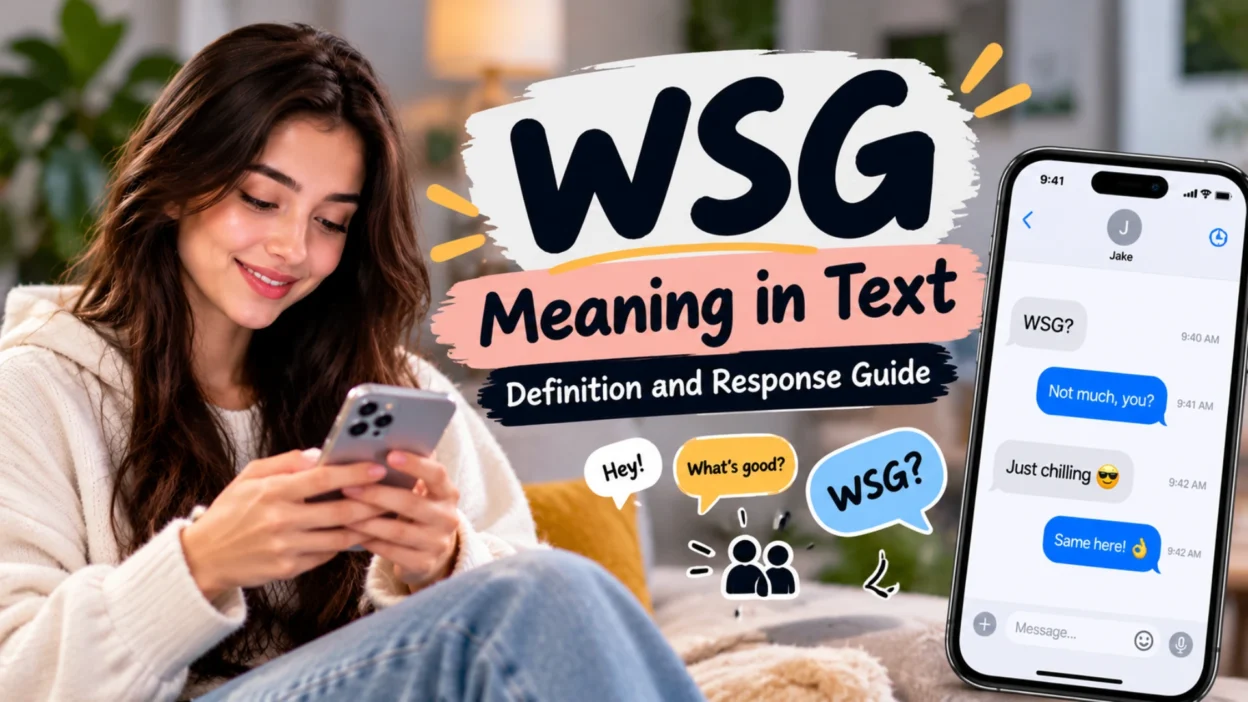
At its core, wsg stands for “what’s good?”—a casual greeting that works like “what’s up?” or “how’s it going?”. That definition is consistent across slang references and everyday usage. However, the way people use it depends on tone, relationship, platform, and timing. A wsg from a close friend is an open door. A wsg from someone you barely know can feel like a low-key challenge. Reading those differences is what separates a smooth reply from an awkward pause.
The Core Definition: What’s Good, Shortened
WSG is an initialism built from three words: What’s and Good. It’s a shorthand for the phrase “what’s good?”, used to ask other people how their life is going. It belongs to the same family of greetings as “what’s up,” “how’s it going,” and “how are you,” and it appears in all the same casual situations.
The abbreviation emerged as a texting-friendly compression of a phrase that already existed in spoken language. “What’s good?” has been part of casual English for decades, especially in African American Vernacular English and hip-hop culture, where it works as both a greeting and, depending on tone, a subtle challenge. Texting simply reduced the phrase to three letters, and social media sent it everywhere.
Lowercase “wsg” appears far more often than uppercase “WSG” in casual messages. The lowercase form blends into the sentence and matches the relaxed rhythm of quick chats. Uppercase exists too, but it tends to appear in more emphatic or stylized contexts.
Why WSG Isn’t a Real Question
The most useful thing to understand about wsg is that it rarely demands a detailed answer. It functions as phatic communication—social filler that keeps a conversation moving rather than requesting specific information. When someone sends wsg, they’re not asking for a report on your week. They’re opening a door and waiting to see whether you walk through it.
This distinction matters because it changes how you should reply. A literal response like “I’m currently sitting on a chair, thinking about my life” misses the point entirely. The sender wants a light, social acknowledgment. “Not much, you?” does the job because it matches the register of the original message.
Interestingly, the same logic applies to “what’s up?” and “how are you?” in English. Those phrases are greetings first and questions second, and most people understand that instinctively. WSG inherits that quality directly. It’s a handshake in text form, not an interview.
Where WSG Came From: AAVE, Hip-Hop, and Social Media
WSG may feel like a recent invention, but its roots run deeper than its abbreviation. The phrase “what’s good?” grew out of African American Vernacular English and hip-hop culture, where it has long functioned as both a friendly greeting and, depending on delivery, a low-key challenge. Tone carries enormous weight in that usage. The same two words can welcome someone or size them up.
The abbreviated form gained traction around 2019 and 2020, spreading through TikTok, Instagram captions, and direct messages. Once the three-letter version became common, it migrated into everyday texting and group chats. The jump from spoken phrase to typed abbreviation follows a familiar pattern in internet slang: compression happens first, then mainstream adoption follows.
That timeline explains why older readers often recognize the phrase but not the abbreviation. “What’s good?” sounds familiar to almost everyone. “Wsg” looks like code to anyone outside the casual texting world.
The Two Moods: Friendly Greeting Versus Subtle Challenge
Most guides define wsg as a simple greeting and stop there. That’s only half the story. In practice, the abbreviation carries two distinct moods, and the same three letters can shift between them depending on who sent the message and how it looks.
The first mood is warm and social. A friend sends “wsg” after a long silence, and the intent is clearly to reconnect. The abbreviation works as a casual opener, a way of checking in without making the conversation feel heavy. In this version, wsg is friendly, low-pressure, and inviting.
The second mood is sharper. When wsg arrives with stretched letters, extra punctuation, or a confrontational context, it can read as a challenge. Someone who feels ignored or disrespected might send “wsg” as a way of saying “where have you been?” or “what’s your problem?”. The greeting frame stays intact, but the emotional content underneath is different.
Context decides which mood applies. Relationship history, the platform, and the timing of the message all provide clues. Reading those clues matters more than memorizing the definition.
Punctuation and Formatting: Where the Tone Hides
WSG is short enough that small formatting choices carry disproportionate weight. A plain lowercase “wsg” with no punctuation usually reads as neutral and friendly. Add a question mark and the greeting becomes more explicitly inquisitive. Add multiple question marks and the tone shifts toward impatience or confrontation.
Stretched letters push the tone in the opposite direction. “wsggg” feels relaxed and playful, often used between friends who are comfortable with each other. Capitalizing the whole thing—”WSG”—can feel louder or more stylized, though capitalization habits vary widely between individuals.
Emojis add another layer. A wsg followed by a laughing emoji softens the greeting into something light. The same letters followed by a side-eye or a neutral emoji sharpen it into a visible challenge. The letters provide the word; the formatting provides the emotional temperature.
WSG on Snapchat, TikTok, and Instagram
Each platform gives wsg a slightly different flavor. On Snapchat, the abbreviation appears most often as a direct opener in a chat thread, especially after a gap in conversation. The app’s fast, casual rhythm rewards short greetings, and wsg fits that environment naturally.
On TikTok, wsg shows up in comments and captions, often as a way of acknowledging a creator or joining a conversation. The public nature of comments softens the tone somewhat, since visible greetings tend to be more playful than private ones.
Instagram leans more toward direct messages and story replies, where wsg functions as a low-effort reconnection tool. Sending wsg to someone you haven’t spoken to in months is less awkward than typing a full “hey, how have you been?” The abbreviation lowers the social cost of reaching out.
Text messaging remains the most common home for wsg, especially in one-on-one threads and group chats. The platform doesn’t change the definition, but it does shape the stakes. A sharp wsg in a private text carries more weight than the same three letters in a public comment.
WSG in Group Chats: The Roll Call Effect
Group chats give wsg a distinct social function. When someone drops wsg into a thread that’s gone quiet, it often works as a roll call—a way of checking who’s still present and engaged. The greeting isn’t directed at one person; it’s an open invitation for anyone to respond.
This usage explains why wsg appears so often at the start of revived conversations. It’s a low-stakes way to test the waters. If someone replies, the chat comes back to life. If nobody does, the sender has lost nothing by trying.
The abbreviation also appears in group settings as a response to good news or a funny moment. A friend announces a new job, and someone replies “wsg, congrats!” In that context, wsg functions as an enthusiastic acknowledgment rather than a literal question. The greeting and the celebration blend together.
When WSG Doesn’t Belong: Professional and Formal Writing
One of the most common mistakes people make is dropping wsg into professional communication. In a work email, a client message, or a note to a manager, the abbreviation can read as overly casual or even disrespectful. A colleague deserves “How are you?” rather than “wsg.”
This isn’t because wsg is inherently rude. It’s about register. Text slang signals informality, and professional settings typically expect fuller language. Using wsg in a job interview follow-up or a client update can make the sender seem careless, even when the intent was friendly.
A practical rule helps here. Keep wsg for friends, peers, and casual chats. In anything that could be forwarded to a manager or saved in a record, write the greeting in full. The extra keystrokes cost little and prevent a lot of misreading.
Common Mistakes People Make With WSG
The first mistake is treating wsg as a literal question. It isn’t. Responding with a detailed life update to a three-letter greeting misses the social cue entirely.
The second mistake is assuming wsg is always friendly. Depending on tone and context, it can carry a challenge. Ignoring that possibility leads to awkward exchanges, especially with someone who feels neglected.
The third mistake is using wsg with people who may not recognize it. Parents, older relatives, or new acquaintances might read it as a typo or an unfamiliar code. A quick expansion prevents confusion without much effort.
Finally, some people reply to wsg with another wsg. That exchange can loop indefinitely, with neither person saying anything of substance. Breaking the loop with a real question or a specific update keeps the conversation moving.
How to Reply to WSG Without Overthinking It
The right reply depends on the sender’s intent. For a friendly greeting, a light response works best. “Not much, you?” or “chilling, what about you?” matches the register and keeps the conversation open.
When wsg feels like a check-in after a long silence, acknowledging the gap helps. “Hey, been a while” or “good to hear from you” responds to the social meaning rather than the literal words. That approach repairs the connection faster than a generic reply.
If the wsg carries a sharper edge, a calm and direct response works better than matching the tension. “All good here, what’s up with you?” keeps things neutral without escalating. In most cases, the sender wasn’t trying to start a fight; they were testing whether the connection was still there.
For professional or unfamiliar settings, skip the abbreviation entirely. Reply with a full sentence that acknowledges the person and moves the conversation forward. Clarity always beats brevity when the stakes are higher.
WSG and Similar Greetings Compared
| Term | Common Meaning | Typical Tone |
|---|---|---|
| WSG | What’s good? | Casual greeting, sometimes challenging |
| WYD | What you doing? | Curious, friendly |
| WYD (variant) | What you doing? | Conversation starter |
| SUP | What’s up? | Light, informal |
| HMU | Hit me up | Inviting future contact |
| SAY LESS | Understood, no need to explain | Agreeable, confident |
| BET | Okay, agreed | Casual confirmation |
WSG belongs to the same family of shorthand as SUP and WYD, but it stands apart because it works as both a greeting and a social test. SUP is usually friendly. WYD is usually curious. WSG can be either, and the ambiguity is part of why it remains popular.
Generational and Cultural Nuances
Younger texters tend to use wsg without much thought, treating it as ordinary vocabulary. Older users often recognize “what’s good?” but may not pick up on the abbreviated form or its sharper undertones, which can create mismatched expectations in mixed-age conversations.
Cultural background matters too. Because the phrase originated in African American Vernacular English, some writers have noted that its mainstream adoption came with a loss of context. Others point out that slang naturally travels between communities and that the phrase’s popularity reflects genuine usefulness. Both observations can be true at once.
Regional differences add another layer. In some online circles, wsg is almost invisible because it’s so common. In others, it still reads as distinctly online slang. These variations don’t change the definition, but they do change how the message lands.
Frequently Asked Questions About WSG
What does WSG stand for in text?
WSG stands for “what’s good?”, a casual greeting similar to “what’s up?” or “how are you?”. It’s used to open a conversation or check in with someone.
Is WSG a real question?
Not usually. WSG functions as a social greeting rather than a request for detailed information. A light response like “not much, you?” matches the register better than a full life update.
Can WSG be rude?
It can be, depending on tone and context. A friendly wsg is warm and casual. A sharp wsg with extra punctuation or stretched letters can read as a challenge or a complaint.
What does WSG mean on Snapchat or TikTok?
On Snapchat and TikTok, wsg usually means “what’s good?” and functions as a casual greeting. The platform doesn’t change the meaning, though public comments tend to read more playfully than private messages.
Does WSG have other meanings?
In most contexts, wsg means “what’s good?”. Occasionally, it appears in music lyrics or meme culture as a standalone phrase, but no widely used alternative definition competes with the greeting.
Is WSG okay to use at work?
Generally, no. WSG is casual slang and can sound overly familiar in professional communication. Work emails and client messages usually call for a full greeting written out.
Why do people use lowercase “wsg” instead of uppercase “WSG”?
Lowercase is more common in casual texting because it blends into the sentence and matches the relaxed rhythm of quick messages. Uppercase appears in more emphatic or stylized contexts.
How should I respond to WSG?
A light, social reply works best. “Not much, you?” or “chilling, what about you?” matches the tone and keeps the conversation open. If the wsg feels like a check-in after a silence, acknowledge the gap and move forward.
Final Thoughts: Three Letters That Open a Door
WSG is a small abbreviation with a clear job. At its core, it compresses “what’s good?” into a fast, friendly greeting that works across texting, social media, and group chats. Around that core, meanings branch: the warm check-in, the subtle challenge, the group roll call, and the low-effort reconnection tool.
The practical takeaway is straightforward. Read the tone before deciding what the sender meant. Use wsg with friends and peers, not in professional writing. And when the greeting arrives, respond to the social meaning rather than the literal words. Three letters shouldn’t create confusion—especially when the conversation is right there waiting for you.

Serhii Dunev is a passionate content creator dedicated to crafting meaningful texts, messages, and word inspirations. He aims to help people express their emotions clearly through simple and impactful words.