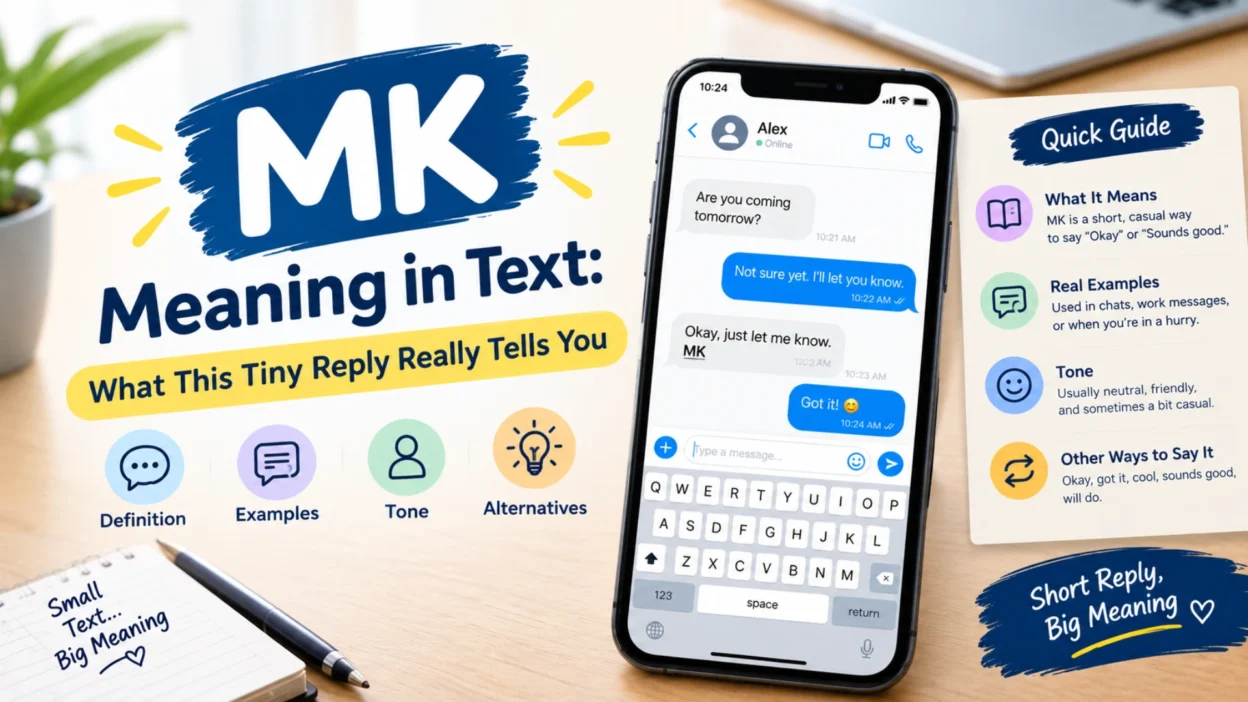
You send a detailed message about weekend plans, and the reply comes back as two letters: mk. No punctuation. No follow-up. Suddenly you’re analyzing a two-letter word as if it were a cryptic puzzle. The mk meaning in text is one of the most misunderstood questions in casual messaging, because those two letters can signal agreement, hesitation, judgment, or simple acknowledgment, and the difference often hides in a single punctuation mark.
At its core, mk stands for “Mmm, okay,” a drawn-out, slightly informal way of saying “okay” or “mkay”. That’s the definition most slang guides agree on. However, the abbreviation carries a tonal range that catches people off guard. It can be warm, neutral, reluctant, or quietly condescending, and misreading it can turn a harmless reply into an unnecessary argument. Understanding those shades is what separates a confident reader from someone who replies with a confused question mark.
The Core Definition: Mmm, Okay, Shortened
MK functions as a phonetic abbreviation. You read it the way it sounds: “mmm-kay,” a stretched version of “okay” that adds a beat of hesitation before the agreement lands. That extra beat is the whole point. A plain “ok” is crisp and neutral; mk is softer, slower, and often loaded with something the sender isn’t fully spelling out.
The abbreviation works interchangeably with “ok” in many contexts, which is why it spreads so easily through text threads and comment sections. People use it to confirm plans, acknowledge a message, or signal that they’ve read something without committing to enthusiasm. The brevity matters in fast conversations, but the tone matters more.
Interestingly, mk appears in lowercase far more often than uppercase. The lowercase form blends into a sentence and matches the relaxed rhythm of quick messages. Uppercase “MK” exists too, but it tends to point toward entirely different meanings, which is a distinction worth keeping in mind.
Beyond Agreement: The Three Moods of MK
Most guides stop at “it means okay” and move on. That’s a mistake. In real conversations, mk does at least three different jobs, and the same two letters can shift between them without warning.
The first mood is neutral acknowledgment. Someone shares a plan, and mk confirms receipt without adding emotion. This version is the closest to a plain “ok” and usually appears in logistical exchanges where neither person expects a long reply.
The second mood is reluctant agreement. You wanted Chinese food, your friend wanted Mexican, and you reply “mk” to concede the point without pretending to be thrilled. This reading is extremely common and often carries a visible shrug. The sender is saying yes, but the yes comes with a small sigh attached.
The third mood is judgment. A reply of “mk” after someone announces a questionable decision can read as condescending, as if the sender is raising an eyebrow through the screen. This version is the one that causes misunderstandings, largely because it looks identical to the neutral version on the surface.
Punctuation and Formatting: Where the Tone Hides
MK is short enough that tiny formatting choices carry disproportionate weight. A lowercase “mk” with no punctuation usually reads as neutral or mildly hesitant. Add a period and the message feels flatter, almost clipped. Add an ellipsis—”mk…”—and the hesitation becomes unmistakable, often shading into judgment.
Stretched letters push the tone in a different direction. “Mmmk” feels slower and more deliberate, while “mkay” spells out the sound and reads slightly warmer. Capitalizing the whole thing—”MK”—can feel louder or more formal, though capitalization habits vary widely between individuals.
Emojis add another layer entirely. An mk followed by a laughing emoji softens the hesitation into playfulness. The same letters followed by a neutral or eye-roll emoji sharpen the reply into visible disinterest. The letters provide the word; the punctuation provides the mood. Read the delivery before deciding what the sender meant.
MK on Snapchat, TikTok, and Instagram
Each platform gives mk a slightly different flavor. On Snapchat, the abbreviation appears most often as a direct reply to a message, confirming plans or acknowledging something quickly. The app’s fast, casual rhythm rewards short replies, and mk fits that environment naturally. A response of “MK” to a meetup suggestion signals that the plan has been received and accepted.
On TikTok and Instagram, mk shows up in comment sections and direct messages, usually in reactions to posts or casual exchanges between friends. The public nature of comments softens the tone somewhat, since visible replies tend to be more playful than private ones.
Text messaging remains the most common home for mk, especially in one-on-one threads and group chats. The platform doesn’t change the definition, but it does shape the stakes. A hesitant mk in a private text carries more weight than the same two letters in a public comment thread.
The Other Meanings: When MK Isn’t “Okay”
MK is a remarkably crowded abbreviation. Outside casual texting, the same two letters point toward a wide range of unrelated things, and context is the only reliable guide.
In gaming communities, MK usually refers to the Mortal Kombat franchise, a fighting game series that began in 1992. Disney fandom, MK often stands for the Magic Kingdom theme park at Walt Disney World. In fashion, MK is shorthand for Michael Kors, the designer brand. .In music, MK is the stage name of DJ and producer Marc Kinchen. In automotive and engineering contexts, Mk is a written abbreviation for “mark,” used to denote a model or version of a car or machine.
Some meanings are regional or cultural. MK can refer to Mong Kok, a bustling area of Hong Kong, or to the CIA’s MK Ultra program. In Turkish internet slang, mk is a vulgar abbreviation with an entirely different meaning, which is a reminder that the same letters can travel very differently across languages.
None of these secondary meanings competes with “Mmm, okay” in everyday texting. They simply show how much weight context carries.
When MK Doesn’t Belong: Professional and Formal Writing
One of the most common mistakes people make is dropping mk into professional communication. In a work email, a client message, or a note to a manager, “mk” can read as careless or disengaged. A colleague asking whether a deadline is achievable deserves a clear answer, not a two-letter shrug that sounds like reluctant agreement.
This isn’t because mk is inherently rude. It’s about register. Text slang signals informality, and professional settings typically expect fuller language. Using mk in a job interview follow-up or a client update can make the sender seem uncertain or dismissive, even when the intent was simply to acknowledge a message quickly.
A practical rule helps here. Keep mk for friends, peers, and casual chats. In anything that could be forwarded to a manager or saved in a record, write “okay” in full or, better yet, give a definitive response. The extra keystrokes cost little and prevent a lot of misreading.
Common Mistakes People Make With MK
The first mistake is assuming mk always means the same thing. It doesn’t. Neutral acknowledgment, reluctant agreement, and judgment are all valid readings, and ignoring the context leads to confusion.
The second mistake is sending a long, heartfelt message and receiving only “mk” in return, then interpreting that reply as a personal slight. Sometimes the sender is genuinely busy. Sometimes they’re being dismissive. The reply alone doesn’t tell you which, and treating every short response as hostility can damage otherwise healthy conversations.
The third mistake is using mk with people who may not recognize it. Parents, older relatives, or new acquaintances might read it as a typo or an unfamiliar code. A quick expansion—”mk (okay)”—can prevent confusion without much effort.
Finally, some people use mk so often that it loses all warmth. A reply that always sounds hesitant can make the sender seem perpetually unimpressed, even when they’re perfectly happy. Varying the response with a fuller “sounds good” or “works for me” keeps the tone honest.
How to Reply to MK Without Guessing Back
The right reply depends on which mood the mk is carrying. If it’s a neutral acknowledgment, a simple “cool” or a follow-up detail keeps the conversation moving. There’s no need to overanalyze a reply that was never meant to be analyzed.
When the mk feels reluctant, a gentle check-in works well. “You sure?” or “We can do your pick next time” gives the sender room to clarify without turning the exchange into a confrontation. This approach acknowledges the hesitation without demanding an explanation.
If the mk reads as judgmental, the safest response is a direct but calm question. “Is something wrong with the plan?” surfaces the issue faster than matching the sarcasm. In most cases, the sender wasn’t trying to start a fight; they were just being lazy with their punctuation.
For professional or high-stakes messages, skip mk entirely. Reply with a full sentence that confirms understanding and adds a clear next step. Clarity always beats brevity when the stakes are higher.
MK and Similar Text Abbreviations Compared
| Abbreviation | Common Meaning | Typical Tone |
|---|---|---|
| MK | Mmm, okay | Neutral, hesitant, or judgmental |
| K | Okay | Crisp, sometimes cold |
| OK | Okay | Neutral, standard |
| IDK | I don’t know | Uncertain, casual |
| IMO | In my opinion | Casual, opinionated |
| TBH | To be honest | Candid, informal |
| NGL | Not gonna lie | Candid, confessional |
MK belongs to the same family of shorthand as K and OK, but it stands apart because of its phonetic spelling. The extra “m” adds a beat that changes the emotional temperature. A single “k” can feel abrupt; “mk” sounds like someone considering the message before agreeing. That small difference explains why people react to the two replies so differently.
Generational and Cultural Nuances
Younger texters tend to use mk without much thought, treating it as ordinary vocabulary alongside ok and kk. Older users often recognize “okay” in the abbreviation but may not pick up on the hesitant or judgmental undertones, which can create mismatched expectations in mixed-age conversations.
Cultural background matters too. Because mk is a phonetic rendering of spoken English, it translates awkwardly into other languages, and non-native speakers may read it as a typo rather than a tone marker. Meanwhile, in communities where the acronym has unrelated meanings—gaming, Disney fandom, fashion, Turkish slang—the same letters can point somewhere entirely different.
Regional variation adds another layer. In some online circles, mk is almost invisible because it’s so common. In others, it still reads as distinctly online shorthand. These differences don’t change the definition, but they do change how the message lands.
Frequently Asked Questions About MK
What does MK stand for in text?
MK stands for “Mmm, okay,” a drawn-out way of saying “okay” or “mkay”. It’s used in casual messaging to acknowledge a message, confirm plans, or signal reluctant agreement.
Is MK rude?
It can be, depending on tone and punctuation. A plain “mk” is usually neutral or mildly hesitant. A clipped “mk.” after someone shares news can read as dismissive or judgmental. Context and formatting matter more than the letters themselves.
Is MK the same as OK?
They’re close but not identical. OK is the standard, neutral form. MK is phonetic and carries an extra beat of hesitation, which often makes it sound less enthusiastic. In many casual conversations, the two are used interchangeably.
What does MK mean on Snapchat or TikTok?
On Snapchat and TikTok, mk usually means “okay” and functions as a quick acknowledgment. The platform doesn’t change the meaning, though public comments tend to read more playfully than private messages.
Does MK have other meanings?
Yes. In gaming, MK usually refers to Mortal Kombat. Disney contexts, it often means Magic Kingdom. In fashion, it’s Michael Kors, and in music, it’s the DJ and producer Marc Kinchen. Automotive and engineering writing uses Mk to mean “mark.”
Is MK okay to use at work?
Generally, no. MK is casual slang, and professional communication usually calls for “okay” written in full or a clearer, more definitive response. Client emails and formal reports are not the place for it.
Why do people use lowercase “mk” instead of uppercase “MK”?
Lowercase is more common in casual texting because it blends into the sentence and matches the relaxed rhythm of quick messages. Uppercase appears too, but it doesn’t make the abbreviation more formal.
How should I respond to MK?
If it’s a neutral acknowledgment, keep the conversation moving with a simple follow-up. If it feels reluctant or judgmental, a calm question like “You sure?” or “Is something wrong?” clears things up faster than guessing.
Final Thoughts: Two Letters With a Lot of Shrug
MK is a small abbreviation with an unusually wide range. At its core, it shortens “Mmm, okay” for faster digital conversation. Around that core, moods branch: the neutral nod, the reluctant concession, the raised eyebrow through the screen. Add the unrelated meanings—Mortal Kombat, Magic Kingdom, Michael Kors—and the phrase becomes a lesson in how much context matters.
The practical takeaway is straightforward. Read the punctuation before deciding what someone meant. Use mk with friends and peers, not in professional writing. And when the tone feels off, ask a calm question instead of matching the sarcasm. Two letters shouldn’t create confusion—especially when the context is right there on the screen.

Serhii Dunev is a passionate content creator dedicated to crafting meaningful texts, messages, and word inspirations. He aims to help people express their emotions clearly through simple and impactful words.