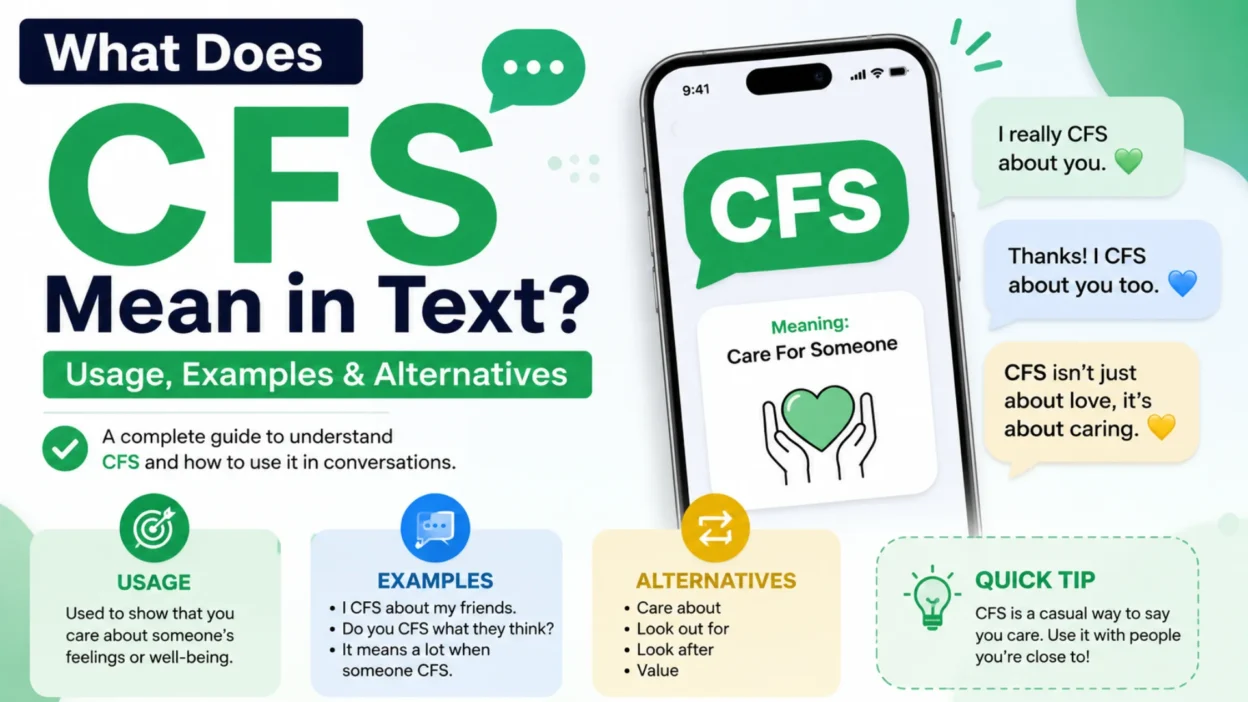
Have you ever received a message with the acronym “CFS” and found yourself completely lost? You are not alone. Millions of texters, social media users, and gamers encounter unfamiliar slang every day. In fact, understanding these shortcuts can feel like learning a new language. Fortunately, decoding cfs meaning in text is easier than you might think. This guide will explain everything you need to know, from primary definitions to real-world examples. We will also explore how context changes interpretation and offer polite alternatives. By the end, you will confidently understand and use this popular abbreviation. So, let us dive right in. 😉
Definition & Core Meaning of CFS in Text
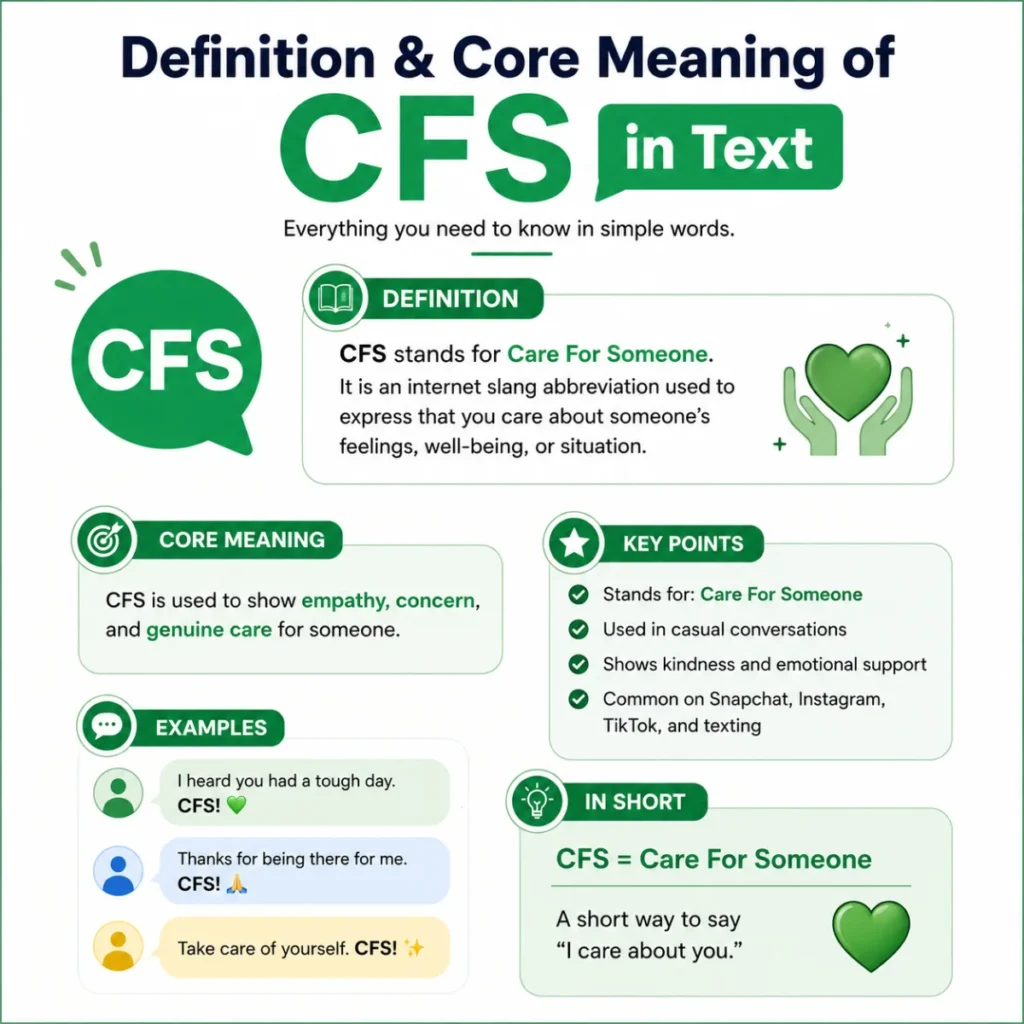
What does cfs meaning in text actually stand for? In most casual texting and online conversations, CFS has two dominant interpretations. The first and most common meaning is “Crying For Sympathy.” People use this acronym to describe someone who is exaggerating a problem or seeking pity. For example, if a friend posts a dramatic story about a minor issue, you might reply, “Stop the CFS.”
The second major definition is “Comment For Share,” primarily used on social media platforms like Instagram, Facebook, and TikTok. Users write “CFS” in comment sections to ask for engagement. When someone comments “CFS,” they want the original poster to share something in return, typically a post or shoutout. This meaning is very popular among influencers and content creators.
Additionally, cfs meaning in text can occasionally refer to “Chronic Fatigue Syndrome” in medical discussions. Nevertheless, within pure texting and chat contexts, the slang meanings dominate. Therefore, you must pay attention to the conversation’s setting. A message about health likely means the medical condition. A message about drama or attention-seeking probably means “Crying For Sympathy.” A comment under a photo likely means “Comment For Share.”
Typically, cfs meaning in text is lowercase (“cfs”) but uppercase is also common. The tone is often casual, sarcastic, or transactional. Now that we have the core definitions, let us explore where this slang originated.
History & Origin of CFS Meaning in Text
Where did cfs meaning in text first appear? The “Crying For Sympathy” definition emerged from early internet forums and chat rooms in the late 1990s and early 2000s. Users wanted a quick way to call out dramatic behavior without writing full sentences. For instance, on platforms like AOL Instant Messenger and IRC, people typed “cfs” to mock friends who complained excessively. Over time, this usage spread to SMS texting and later to social media.
On the other hand, the “Comment For Share” meaning came from Instagram engagement pods around 2014-2016. Influencers and small businesses needed a fast method to request reciprocal promotion. Consequently, “CFS” became a standard comment on posts, meaning “I will comment on your post if you share mine.” This practice also migrated to TikTok and Facebook groups.
Interestingly, the medical term “Chronic Fatigue Syndrome” has been used since the 1980s. However, cfs meaning in text as slang has no direct connection to that condition. Instead, young internet users repurposed the same letters for humor and efficiency. As a result, the slang meanings now overshadow the medical meaning in casual digital conversations.
Real-World Examples of CFS in Conversations
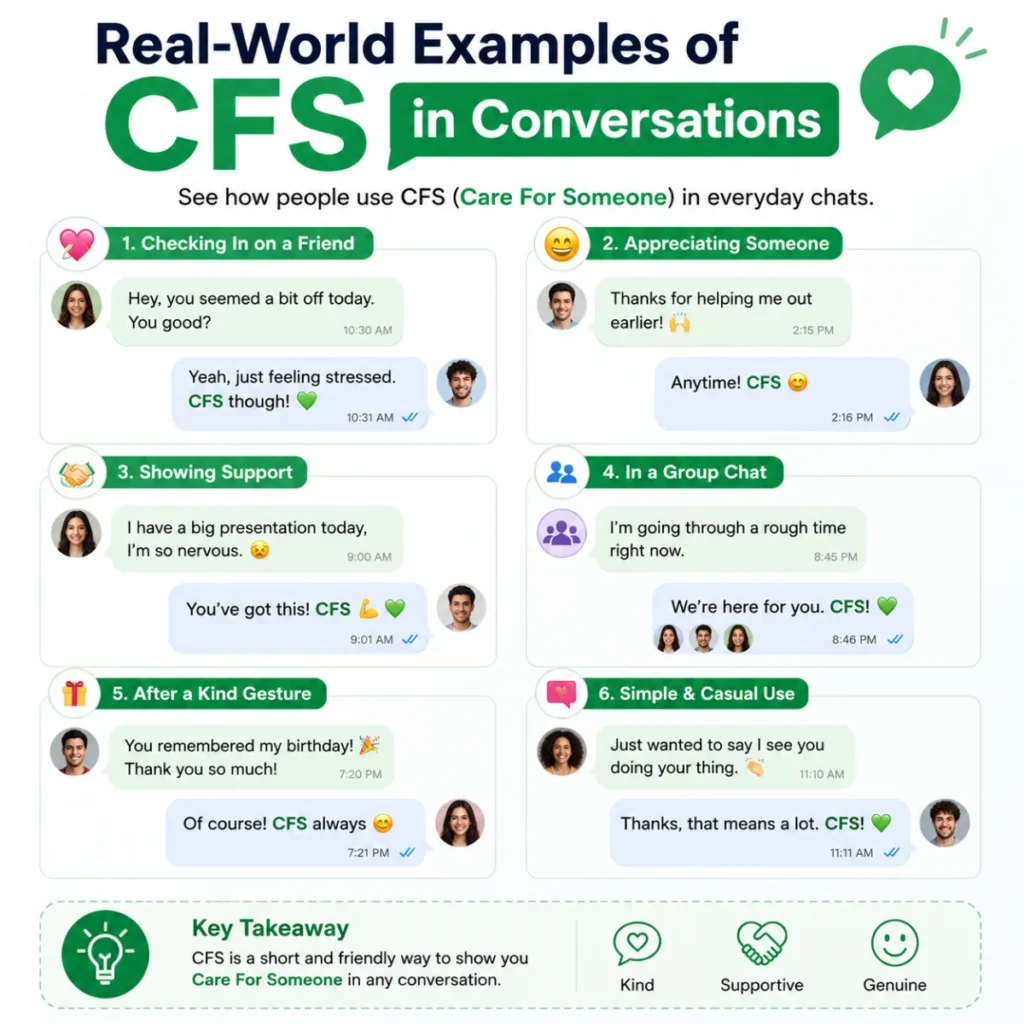
To truly grasp cfs meaning in text, nothing beats seeing it in action. Below are four realistic examples showing how people use this acronym daily.
Example 1: Calling Out Drama (Crying For Sympathy)
Person A: “I only got 8 hours of sleep instead of 9. My day is ruined. 😭”
Person B: “Wow, the cfs is strong with this one.”
Example 2: Reacting to a Minor Complaint
Person A: “My coffee is slightly colder than usual. I cannot function.”
Person B: “Enough with the cfs, please. It is just coffee.”
Example 3: Asking for Engagement (Comment For Share)
Instagram Post Caption: “New photo dump! Comment CFS if you want a share back.”
User Comment: “cfs” (meaning: I will comment on yours if you share my post)
Example 4: Sarcastic Self-Awareness
Person A: “I know I am being dramatic, but I just spilled my drink. CFS mode activated.”
Person B: “At least you admit it. 😅”
Notice how cfs meaning in text changes based on situation and punctuation. In examples 1, 2, and 4, it refers to “Crying For Sympathy.” In example 3, it clearly means “Comment For Share.” Context truly makes all the difference.
How Context Changes Meaning of CFS
CFS meaning in text is highly flexible. The same three letters can signal very different intentions. Let us break down how context varies across four common digital environments.
Texting (Friends and Family)
In private one-on-one texts, CFS almost always means “Crying For Sympathy.” Friends use it sarcastically to tease each other about whining. For example, “You are upset about a 2-minute late delivery? That is pure cfs.” The tone is usually lighthearted or gently mocking. Rarely would someone use “Comment For Share” in a private text unless they are coordinating social media growth.
Social Media (Instagram, TikTok, Twitter)
Here, cfs meaning in text splits roughly 50/50. In captions and tweets, “Crying For Sympathy” appears when users mock attention-seeking behavior. Meanwhile, in comment sections, “Comment For Share” is extremely common. For instance, influencers write “CFS for engagement” or “Drop a CFS and I’ll share your post.” Therefore, always check if the message is a post caption or a comment.
Gaming (Discord, Twitch Chat, In-Game Chat)
Gamers use CFS primarily as “Crying For Sympathy.” When a player complains about lag, bad teammates, or losing a match, others might type “cfs” to shut down the whining. Additionally, some gaming communities use it to mean “Can’t Finish Spin” or “Clutch Failed Sadly,” but these are rare. The dominant cfs meaning in text within gaming is still “Crying For Sympathy.”
Dating Apps (Tinder, Bumble, Hinge)
On dating platforms, CFS is less common but still appears. Usually, it means “Crying For Sympathy” when someone shares a sob story too early. For example, a match might say, “I hate my job, my life is terrible.” You could reply, “That’s a lot of cfs for a first message.” However, be careful—using it too harshly can seem rude. Consequently, many daters avoid CFS entirely and instead use polite alternatives (covered later).
Tone Nuances: Is CFS Rude or Friendly?
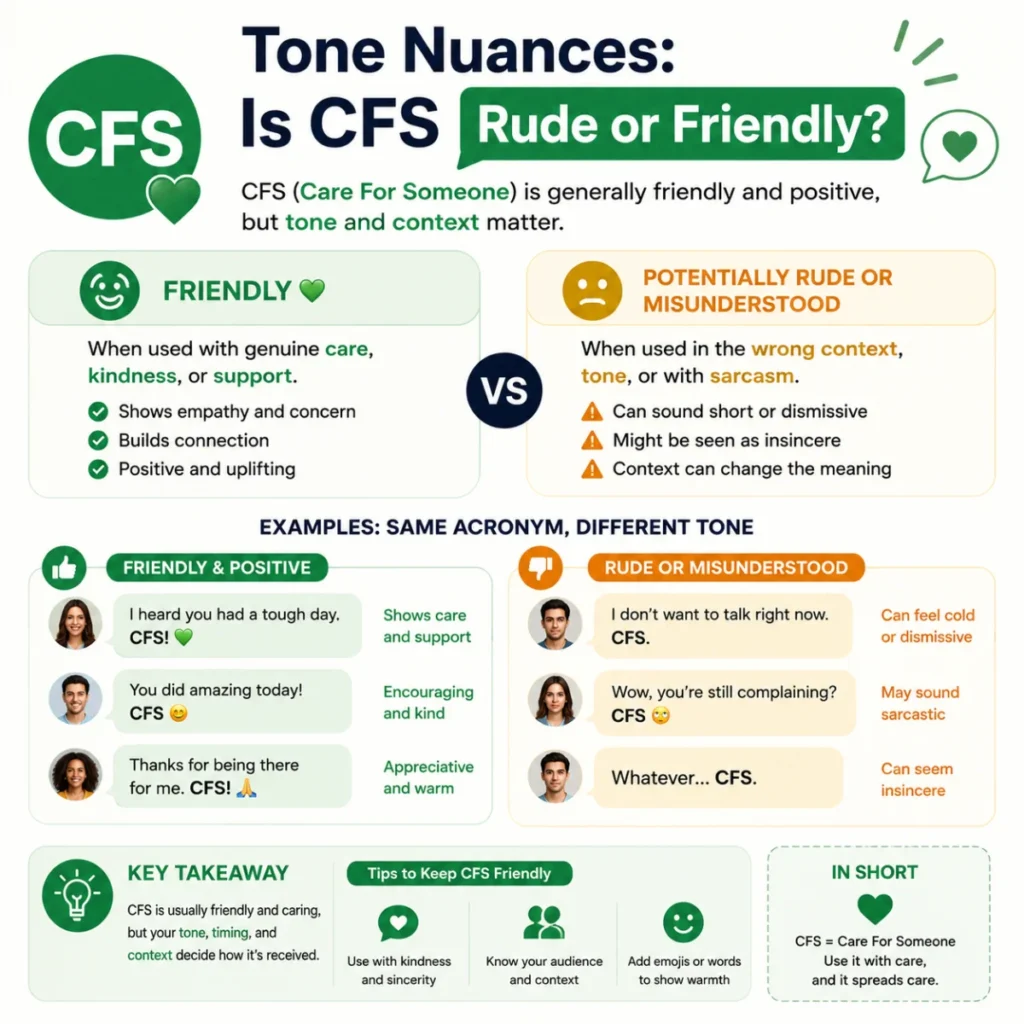
Many people wonder: Is cfs meaning in text inherently offensive? The answer depends entirely on tone and relationship. Let us break down the nuance.
When used among close friends, CFS is usually playful and friendly. For instance, if your best friend jokes about a tiny inconvenience, responding with “cfs” signals affectionate teasing. It is like saying, “You are being a bit dramatic, but I still like you.” In this context, the acronym strengthens bonds through shared humor.
Nevertheless, using CFS with acquaintances or strangers can be rude. Without established trust, calling someone “Crying For Sympathy” dismisses their feelings. They might interpret it as you saying, “Stop pretending to be sad for attention.” That can easily start an argument. Similarly, “Comment For Share” in the wrong context (like on a serious post about illness) appears tone-deaf and self-promotional.
As a general rule, avoid CFS unless you know the person well and they appreciate sarcasm. When in doubt, choose a gentler phrase. The following table compares CFS to similar slang terms so you can see where it falls on the politeness spectrum.
CFS vs Similar Slang Terms (Comparison Table)
Understanding cfs meaning in text becomes easier when compared to related acronyms. Below is a comparison table highlighting differences in meaning, tone, and typical usage.
| Slang Term | Full Meaning | Typical Tone | Best Used In | Level of Rudeness |
|---|---|---|---|---|
| CFS | Crying For Sympathy | Sarcastic, teasing | Close friends, gaming | Medium (can be rude) |
| CFS | Comment For Share | Neutral, transactional | Social media comments | Very low (polite request) |
| FFS | For F***’s Sake | Frustrated, angry | Venting, complaints | High (profane) |
| IDC | I Don’t Care | Dismissive, blunt | Any casual chat | Medium-high |
| SMH | Shaking My Head | Disapproving, disappointed | Responding to poor choices | Low-medium |
| TMI | Too Much Information | Grossed out, amused | Oversharing situations | Low (usually playful) |
| IMO | In My Opinion | Neutral, respectful | Debates, advice | Very low |
As shown, cfs meaning in text varies most in tone. “Crying For Sympathy” can be friendly or harsh depending on delivery. “Comment For Share” remains purely functional and rarely offends. Meanwhile, similar terms like FFS carry obvious profanity. Therefore, choose your acronyms wisely based on audience and platform.
What Does “If CFS CFS” Mean? (Double Usage)
Occasionally, you might see a phrase like “If CFS CFS” in a message. What does this repetition mean for cfs meaning in text? This structure is rare but appears in certain online communities. Typically, “If CFS CFS” is shorthand for “If you are crying for sympathy, then you are crying for sympathy.” In other words, the speaker is calling out a logical loop: complaining about complaining.
For example:
Person A: “Stop using CFS to mock me!”
Person B: “If CFS CFS, then maybe you should stop being dramatic.”
However, this usage is not standard. Most native texters will not understand “If CFS CFS” unless they frequent very specific subreddits or Discord servers. Consequently, you should avoid using this double form. Stick to single “CFS” to ensure clarity. If someone else uses it, simply recognize it as an exaggerated or ironic way to emphasize the “Crying For Sympathy” meaning.
How to Respond to CFS (3 Common Scenarios)
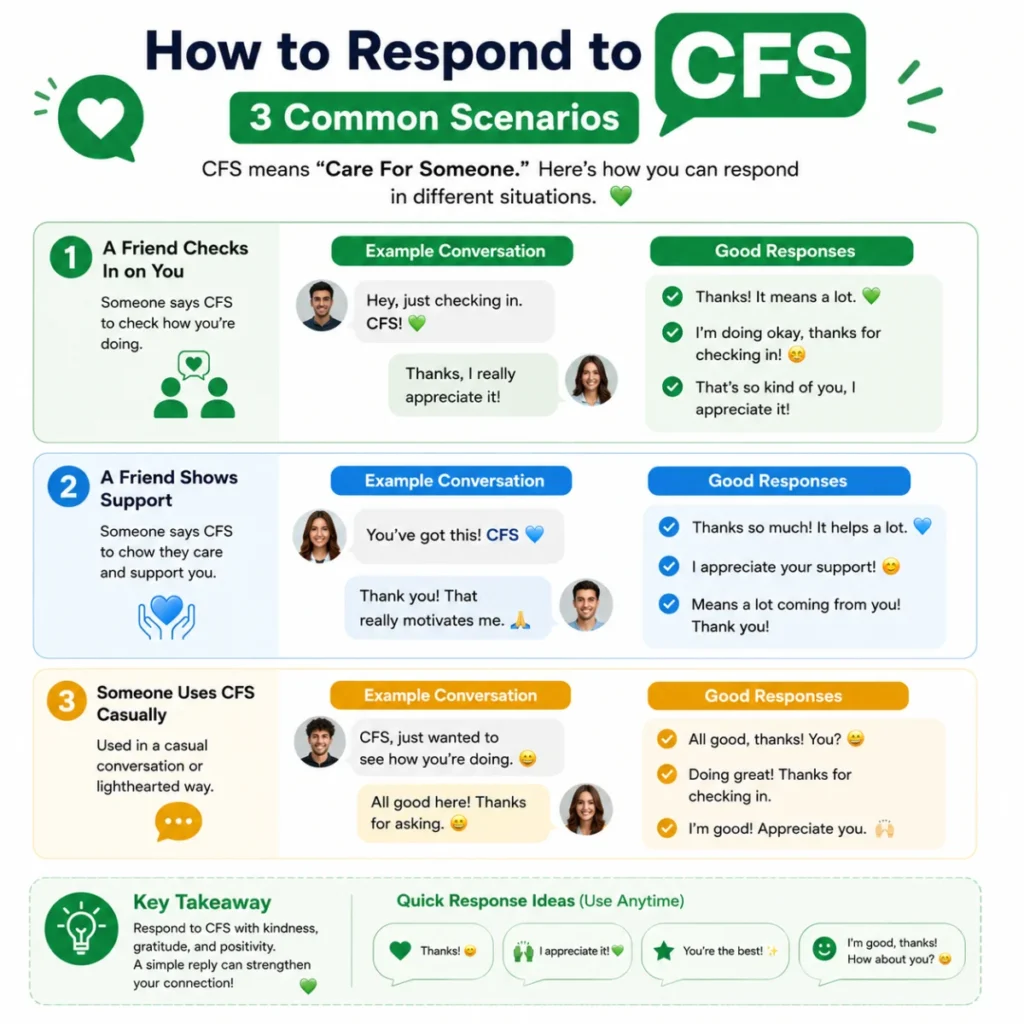
Receiving a message with CFS can be confusing. Your response should match the intended meaning and your relationship with the sender. Below are three scenarios with suggested replies.
Scenario 1: A Close Friend Jokes “CFS” at You
Friend: “You are complaining about a papercut? That is serious cfs.”
Your Response (playful): “Haha, guilty as charged! 😅 But it really stings!”
Why it works: Acknowledging the joke keeps the mood light. You do not get defensive.
Scenario 2: An Acquaintance Uses “CFS” (Crying For Sympathy) Dismissively
Acquaintance: “Stop with the cfs, nobody cares.”
Your Response (polite but firm): “I was just sharing how I feel. No need to be dismissive.”
Alternative response (if you want to end the conversation): “Okay, I will talk to someone else then.”
Why it works: You set a boundary without escalating conflict.
Scenario 3: Someone Comments “CFS” on Your Social Media Post
Instagram Comment: “cfs” (meaning Comment For Share)
Your Response (if you want engagement): “Sure, share my post and I will comment on yours! 😊”
Your Response (if you ignore): No reply needed. Many commenters spam “CFS” without follow-through.
Why it works: Respond only if you benefit from the exchange. Otherwise, ignore.
In all cases, understanding cfs meaning in text helps you choose the right tone. Never assume bad intent; sometimes the sender is just using slang casually.
Professional Use: Can You Say CFS at Work?
Now, a critical question: Is cfs meaning in text appropriate for professional environments? The short answer is no. You should never use CFS in work emails, Slack channels, or meetings. Here is why.
First, the “Crying For Sympathy” definition sounds unprofessional and dismissive. Telling a coworker “That is cfs” after they express stress about a deadline could lead to HR complaints. Workplaces value emotional intelligence and respect. Sarcastic acronyms undermine that culture.
Second, the “Comment For Share” meaning has no relevance in business communication. Even in marketing roles, professionals would write full requests like “Please share this post and I will do the same.” Acronyms like CFS appear lazy and unclear.
Third, outside parties may misunderstand cfs meaning in text as “Chronic Fatigue Syndrome,” which is a serious medical condition. Using it flippantly could offend someone who actually suffers from that illness. Therefore, avoid CFS entirely at work. Instead, use clear, respectful language. Save slang for after-hours chats with friends.
Common Misconceptions About CFS (3-4 Myths Debunked)
Several myths surround cfs meaning in text. Let us clear them up once and for all.
Myth 1: CFS Always Means “Chronic Fatigue Syndrome”
Reality: In medical and scientific writing, yes. However, in everyday texting, social media, and gaming, the slang meanings (“Crying For Sympathy” and “Comment For Share”) are far more common. Always check context.
Myth 2: Using CFS Is Always Rude
Reality: Among close friends, CFS is often affectionate teasing. The rudeness depends on tone, relationship, and whether the recipient is genuinely struggling. If someone is actually upset, avoid CFS. If everyone is joking, it is fine.
Myth 3: CFS Is Outdated Slang
Reality: While “Crying For Sympathy” originated in the early 2000s, it remains widely used on platforms like TikTok, Reddit, and Discord. “Comment For Share” is actively growing on Instagram and Facebook. Neither is dead.
Myth 4: You Can Use CFS Interchangeably with FFS
Reality: FFS (“For F***’s Sake”) expresses frustration at a situation, not at someone’s attention-seeking behavior. CFS specifically targets whining or drama. They are not synonyms. Using CFS when you mean FFS will confuse readers.
5 Polite Alternatives to CFS (With Table)
Sometimes you want to express the same idea as cfs meaning in text but without sounding harsh. Below are five alternatives, each with a suggested context and example.
| Alternative Phrase | Best For | Example |
|---|---|---|
| “You might be overthinking this.” | Friends who complain about minor issues | “I know you are stressed, but you might be overthinking this little mistake.” |
| “I understand you feel upset.” | Validating emotions before redirecting | “I understand you feel upset. How can we actually solve the problem?” |
| “Let’s focus on solutions instead.” | Moving past complaints productively | “Instead of rehashing what went wrong, let’s focus on solutions.” |
| “Would you like to share your post?” | Social media engagement (polite version) | “Would you like to share your post? I can share mine too.” |
| “I hear you, but this feels a bit dramatic.” | Close friends only, gentler than CFS | “I hear you, but this feels a bit dramatic for a 5-minute wait.” |
These alternatives keep conversations respectful while still addressing the core issue behind cfs meaning in text (excessive complaining or requesting reciprocity). Use them whenever you are unsure how the other person will react.
Frequently Asked Questions (FAQs) About CFS Meaning in Text
What does CFS mean on TikTok?
A: On TikTok, cfs meaning in text is usually “Crying For Sympathy” in comments or captions. However, some creators also use “Comment For Share” in video descriptions to request engagement. Check if the phrase appears in a comment section (likely “Comment For Share”) or as a reply to a story (likely “Crying For Sympathy”).
Is CFS the same as “sad fishing”?
A: Not exactly. “Sad fishing” refers to posting sad content specifically to get compliments or attention. CFS meaning in text as “Crying For Sympathy” can describe sad fishing, but CFS is broader. It also covers whining about minor inconveniences, not just deep sadness.
Can CFS be used in a positive way?
A: Rarely. The “Comment For Share” meaning is neutral or positive because it promotes collaboration. The “Crying For Sympathy” meaning is almost always negative or sarcastic. Nevertheless, close friends might use it self-deprecatingly (“I know, such cfs from me”) as a form of humor, which is positive in a bonding sense.
How do you know which meaning someone intends?
A: Look at the platform and surrounding words. On a social media post: likely “Comment For Share.” In a private chat about feelings: likely “Crying For Sympathy.” If the message mentions health or doctors: likely “Chronic Fatigue Syndrome.” When unsure, simply ask, “What do you mean by CFS?”
Is CFS considered Gen Z or Millennial slang?
A: Actually, both. “Crying For Sympathy” originated with older Millennials (early 2000s). “Comment For Share” emerged with Gen Z (mid-2010s). Today, both generations use both meanings. Therefore, cfs meaning in text crosses age groups, making it a rare intergenerational acronym.
Conclusion
Understanding cfs meaning in text is now straightforward. You have learned that CFS primarily stands for “Crying For Sympathy” or “Comment For Share,” depending on context. You saw real examples from texting, social media, gaming, and dating apps. Additionally, you discovered how tone changes between friendly teasing and outright rudeness. We compared CFS to similar slang, debunked common myths, and offered five polite alternatives for professional or sensitive situations.
The next time you see “CFS” pop up in a message, you will know exactly how to interpret it—and how to respond appropriately. Remember to consider your relationship with the sender before using CFS yourself. When in doubt, choose a clearer phrase. Now go forth and text with confidence! 😊

Serhii Dunev is a passionate content creator dedicated to crafting meaningful texts, messages, and word inspirations. He aims to help people express their emotions clearly through simple and impactful words.