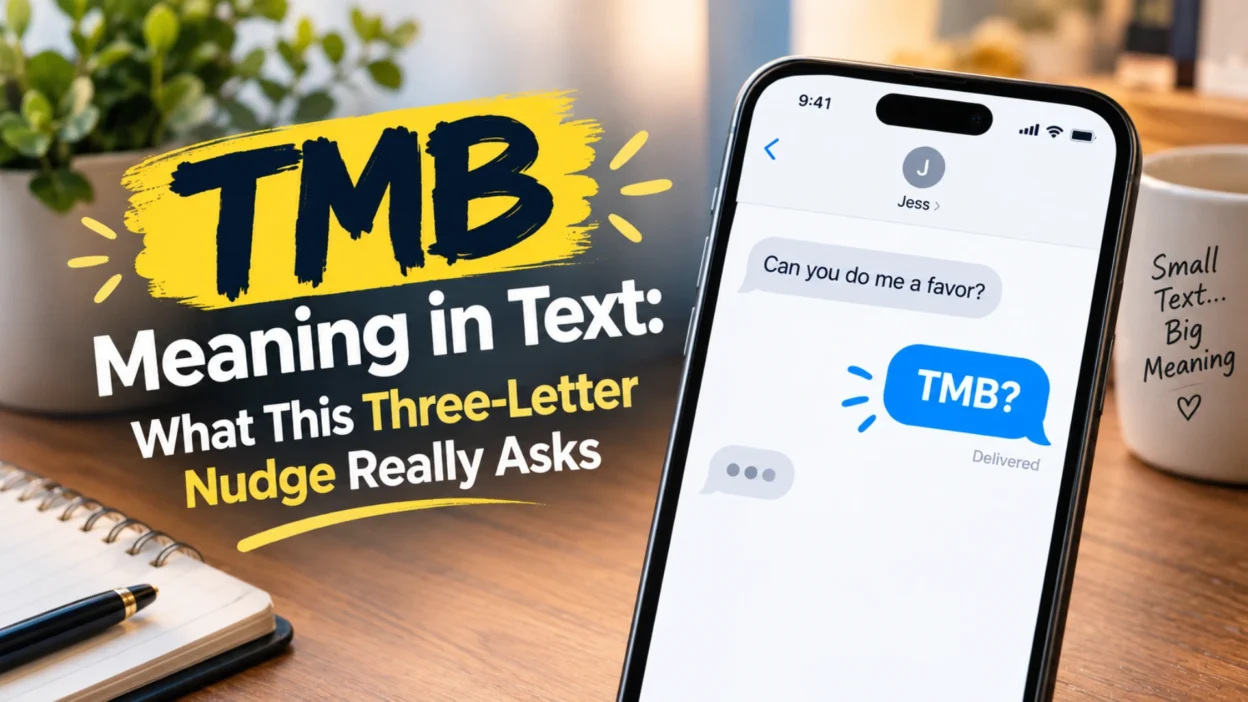
You send a message, watch the delivered receipt appear, and then… nothing. Minutes pass. The silence stretches. Finally, you type three letters and hit send: tmb. The tmb meaning in text is direct enough on the surface—it stands for “text me back”—but the abbreviation carries more social weight than its simple definition suggests. It’s a nudge, a soft deadline, and sometimes a quiet sign of frustration, all compressed into three keystrokes.
Most people encounter tmb at the end of a message that hasn’t received a reply. That placement matters. Unlike a standalone question, tmb attaches itself to something already sent, turning the original message into a request for acknowledgment. Understanding when that request feels friendly, when it feels pushy, and when it means something else entirely is what separates a confident reader from someone who replies with a confused “what?”.
The Core Definition: Text Me Back, Shortened
TMB is an initialism built from three words: Text, Me, Back. Each letter maps to a word, which makes the abbreviation easy to decode once you’ve seen it explained. The phrase itself predates smartphones, but the three-letter compression caught on inside texting culture in the early 2010s as character limits and fast conversations rewarded brevity.
Functionally, tmb performs one clear job. It asks the recipient to respond to the message it’s attached to. That’s a narrower request than “hit me up,” which invites future contact, or “let me know,” which waits on information. TMB is anchored to the present thread. It says: this message needs an answer, and the answer hasn’t arrived yet.
The abbreviation appears in lowercase far more often than uppercase. Lowercase “tmb” blends into the sentence and matches the relaxed rhythm of quick messages. Uppercase “TMB” exists too, but it tends to appear in more emphatic or frustrated contexts—and in technical fields, it points toward entirely different meanings.
Why TMB Exists: The Economics of a Reply
Every text abbreviation solves a small problem. TMB solves the problem of silence. When someone sends a message and receives no reply, they face a choice: wait patiently, send a follow-up question, or type something short that signals the silence has been noticed. TMB is the third option, and its efficiency is the reason it survives.
Typing “text me back” takes thirteen characters. Typing “tmb” takes three. That difference matters in fast exchanges, but the real value is tonal. A full sentence like “Please text me back” can sound formal or needy. A bare “tmb” sounds casual, almost throwaway, even when the sender genuinely wants an answer. The abbreviation lets people apply pressure without appearing to apply pressure.
Interestingly, the phrase has been tracked as the dominant definition on Urban Dictionary since at least 2012, and mainstream glossaries place it alongside hmu, lmk, and idk in the same cluster of reply-oriented shorthand. That company tells you something about how it functions: tmb belongs to the vocabulary of people who are waiting.
Beyond the Nudge: When TMB Means Take Me Back
Texting isn’t the only context where those three letters appear. In nostalgic conversations, tmb commonly stands for “take me back.” The phrase expresses longing for a past moment, often a shared memory that the sender wishes they could revisit.
This reading shows up in captions, comments, and late-night chats. Someone posts an old photo and writes “tmb to summer 2019.” A friend reminisces about a childhood trip and adds “tmb, honestly.” The abbreviation works as a more logical cousin of tbt, the familiar “throwback Thursday” tag, except tmb isn’t tied to a specific day of the week.
Context makes the distinction clear. If the message references a memory, a photo, or a period of life, “take me back” is almost certainly the intended meaning. If the message is a direct request for a reply, “text me back” applies. The same three letters serve two completely different conversational jobs, and the surrounding words do all the explaining.
The Aggressive Reading: Text Me, B*tch
A less common but documented meaning turns tmb into something sharper: “text me, b*tch.” This version appears in slang dictionaries and in conversations where the participants use profanity casually with each other. It’s a joking insult wrapped around the same request for a reply.
This reading rarely appears in neutral exchanges. It surfaces between close friends, in group chats with established banter, or in messages where the tone is deliberately provocative. Urban Dictionary also lists a separate aggressive reading—”try me, btch”—along with variants like dtmb (“don’t try me, btch”). That cluster of meanings shows how flexible three letters can become when a community adopts them.
For most readers, the aggressive version is not the default. It’s a contextual possibility, not a universal definition. Assuming hostility when none was intended can turn a harmless nudge into an argument.
TMB on Snapchat: Where Disappearing Chats Made It Necessary
Snapchat is where tmb feels most at home, and the platform’s design explains why. Chats disappear by default, streaks depend on consistent replies, and the whole experience is built around real-time presence. In that environment, adding tmb to a Snap is the cheapest way to ask the other person to keep the thread alive.
A tmb on Snapchat often carries a mild urgency that the same letters wouldn’t carry in a standard text. The sender can see whether the message was opened. They know you’re active. When they type tmb, they’re not just asking for a reply; they’re acknowledging that the silence is visible. That visibility adds a layer of social pressure the abbreviation doesn’t create on its own.
This doesn’t mean every Snapchat tmb is confrontational. Plenty of people use it casually to coordinate plans or check whether a friend is nearby. However, the platform amplifies the sense of a clock ticking, even when the sender didn’t intend to create pressure.
Tag Me Back: The Instagram Comment Variant
On Instagram, a secondary meaning has stuck around in comment threads: tag me back. When one user tags another on a meme, a photo, or a giveaway, the tagged person sometimes replies “tmb” to ask for a tag on the next one. The abbreviation becomes a small social contract, a request for reciprocity in a public space.
The two readings rarely collide because the contexts are visibly different. A tmb at the end of a direct message asks for a reply. A tmb under a tagged comment asks for a future tag. One lives in private conversation; the other lives in public comment chains. Recognizing which setting you’re in solves the ambiguity before it starts.
TikTok adds another wrinkle. There, tmb lives mostly in comments under videos with a question hook, functioning as a casual request for follow-up information or a reply from the creator. The platform’s comment culture rewards short, punchy replies, and tmb fits that rhythm.
Punctuation and Placement: How TMB Changes Tone
TMB is short enough that formatting choices carry disproportionate weight. A lowercase “tmb” tacked onto the end of a message usually reads as casual and mildly insistent. It’s the equivalent of a gentle tap on the shoulder. Add a question mark and the request becomes more explicit. Add two or three and the tone shifts toward impatience, as if the sender is counting the minutes.
Stretched letters push the tone in a different direction. “tmbbb” feels playful and exaggerated, often used between friends who aren’t genuinely annoyed. Capitalizing the whole thing—”TMB”—can feel louder or more demanding, though capitalization habits vary widely between individuals.
Emojis add another layer. A tmb followed by a laughing emoji softens the nudge into a joke. The same letters followed by a clock or an eye-roll sharpen it into a visible complaint. The letters provide the request; the punctuation and emojis provide the emotional temperature.
When TMB Doesn’t Belong: Professional and Formal Writing
One of the most common mistakes people make is dropping tmb into professional communication. In a work email, a client message, or a note to a manager, the abbreviation can read as impatient or overly familiar. A colleague who hasn’t replied yet deserves a follow-up question, not a three-letter nudge that sounds like a text from a friend.
This isn’t because tmb is inherently rude. It’s about register. Text slang signals informality, and professional settings typically expect fuller language. Using tmb in a job interview follow-up or a client update can make the sender seem demanding, even when the intent was simply to prompt a response.
A practical rule helps here. Keep tmb for friends, peers, and casual chats. In anything that could be forwarded to a manager or saved in a record, write the request in full or, better yet, ask a specific question that makes replying easy. Clarity always beats abbreviation when the stakes are higher.
Common Mistakes People Make With TMB
The first mistake is assuming tmb always means the same thing. It doesn’t. “Text me back,” “take me back,” “tag me back,” and the sharper “text me, b*tch” all exist, and ignoring context leads to confusion.
The second mistake is overusing tmb as a nudge. Sending it once after a reasonable wait is fine. Sending it repeatedly, especially with added question marks, turns a casual request into pressure. The abbreviation is designed to be light; stacking it changes what it communicates.
The third mistake is using tmb with people who may not recognize it. Parents, older relatives, or new acquaintances might read it as a typo or an unfamiliar code. A quick expansion—”tmb (text me back)”—prevents confusion without much effort.
Finally, some people misread nostalgia as a demand. If a friend writes “tmb to that trip” while sharing an old photo, they’re not asking you to text them back. They’re expressing longing for a memory. Replying with “I just did?” misses the point entirely.
How to Reply to TMB Without Overthinking It
The right reply depends on which meaning is in play. If tmb is a request for a response, answer the original message directly. There’s no need to acknowledge the nudge itself; the sender wants the answer, not an apology for the delay.
When the tmb feels impatient, a short time estimate closes the loop without forcing a full reply. “Back in 30” or “swamped, will reply properly later” acknowledges the request and buys space. On Snapchat or Instagram, a quick voice note or a one-frame acknowledgment can serve the same purpose with even less effort.
If the tmb appears in a nostalgic context, match the sentiment. A shared memory deserves a shared reaction: “those were the days” or “take me back too.” Treating a “take me back” as a “text me back” creates an awkward mismatch.
For aggressive or pushy tmb messages—especially from unfamiliar accounts—ignoring them is a legitimate option. A nudge from a brand-new profile with no mutual connections is often fishing for engagement rather than seeking a genuine reply.
TMB and Similar Reply Nudges Compared
| Abbreviation | Common Meaning | What It Asks For |
|---|---|---|
| TMB | Text me back | A reply to the current message |
| HMU | Hit me up | Future contact, any method |
| LMK | Let me know | Information you’re waiting on |
| WYD | What you doing? | A status update or conversation starter |
| NRS | No replies, sorry | A warning that silence is coming |
| BRB | Be right back | A temporary pause, not a reply request |
| TBH | To be honest | A candid opinion, not a nudge |
TMB stands apart in this group because it’s the only abbreviation that asks for a reply to the message it’s attached to. HMU invites future contact. LMK waits on information. WYD opens a conversation. TMB points backward at something already sent and says, essentially, “this one still needs an answer.” That backward-pointing quality is what makes it feel like a nudge rather than an opener.
The Unrelated Meanings: When TMB Isn’t About Texting at All
Outside casual messaging, TMB is a crowded acronym. In medical and laboratory contexts, it commonly stands for tetramethylbenzidine, a chemical compound used in diagnostic tests. In travel and outdoor circles, it refers to the Tour du Mont Blanc, a long-distance walking trail through the Alps. In Malaysian business contexts, it points to Telekom Malaysia Berhad. In Indian banking, it can mean Tamilnad Mercantile Bank. In corporate governance, it sometimes stands for Technical Management Board.
These meanings rarely collide with texting because the contexts are so different. A laboratory report mentioning TMB has nothing to do with a friend waiting for a reply. Still, the overlap is a useful reminder that abbreviations are community property. The same three letters can mean wildly different things depending on who is using them and why.
Generational and Platform Nuances
Younger texters tend to treat tmb as ordinary vocabulary, using it without much thought about its origin or its edge. Older users often recognize “text me back” but may not pick up on the nostalgic “take me back” reading, which can create mismatched expectations in mixed-age conversations.
Platform culture shapes usage as much as age does. Snapchat encourages tmb because chats disappear and streaks depend on replies. Instagram splits the meaning between private nudges and public tag requests. TikTok favors the comment-section variant. Plain SMS hosts the most literal version, where tmb functions as a soft deadline attached to a concrete plan.
These differences don’t change the core definition. They simply show how much context matters. The same three letters can feel native to one conversation and foreign to another, and reading the room is always more reliable than reading the letters alone.
Frequently Asked Questions About TMB
What does TMB stand for in text?
TMB most commonly stands for “text me back,” a nudge added to the end of a message when the sender wants a reply. It can also mean “take me back” in nostalgic contexts or “tag me back” in Instagram comments.
Is TMB rude?
It can be, depending on tone and repetition. A single lowercase “tmb” is usually casual and mildly insistent. Repeated tmb messages with extra question marks can feel pushy. Context and frequency matter more than the letters themselves.
What does TMB mean on Snapchat?
On Snapchat, tmb almost always means “text me back.” The platform’s disappearing chats and visible activity make the nudge feel more urgent than it would in a standard text, even when the sender’s intent is casual.
How is TMB different from HMU and LMK?
TMB asks for a reply to the message it’s attached to. HMU invites future contact by any method. LMK waits on specific information. TMB is the only one that points backward at an existing message and asks for acknowledgment.
Can TMB mean something other than texting?
Yes. In medical and laboratory contexts, TMB often stands for tetramethylbenzidine. In travel, it refers to the Tour du Mont Blanc. In business, it can mean Telekom Malaysia Berhad or Tamilnad Mercantile Bank. Context decides the reading.
Is TMB okay to use at work?
Generally, no. TMB is casual slang and can sound impatient in professional communication. Work emails and client messages usually call for a specific follow-up question rather than a three-letter nudge.
Why do people use lowercase “tmb” instead of uppercase “TMB”?
Lowercase is more common in casual texting because it blends into the sentence and matches the relaxed rhythm of quick messages. Uppercase appears in more emphatic contexts and in technical writing, where it points to different meanings.
How should I respond to TMB?
Answer the original message directly if you can. If you’re busy, a short time estimate like “back in 30” closes the loop. For nostalgic “take me back” messages, match the sentiment instead of treating it as a request for a reply.
Final Thoughts: Three Letters, One Backward Glance
TMB is a small abbreviation with a surprisingly specific job. At its core, it points backward at a message that hasn’t been answered and asks for acknowledgment. Around that core, meanings branch: the nostalgic “take me back,” the Instagram “tag me back,” the sharper “text me, b*tch,” and a crowded field of technical acronyms that have nothing to do with texting at all.
The practical takeaway is straightforward. Read the context before deciding what someone meant. Use tmb with friends and peers, not in professional writing. And when the nudge arrives, answer the message rather than the abbreviation. Three letters shouldn’t create confusion—especially when the message they’re pointing at is right there on the screen.

Serhii Dunev is a passionate content creator dedicated to crafting meaningful texts, messages, and word inspirations. He aims to help people express their emotions clearly through simple and impactful words.