You’re texting a friend when they suddenly add “JP meaning in text” to the end of a message. Now you’re not sure if they’re joking or serious. That tiny addition can flip the whole tone of a conversation. Fortunately, JP is one of the most common acronyms online. Its meaning is usually easy to figure out once you know what to look for.
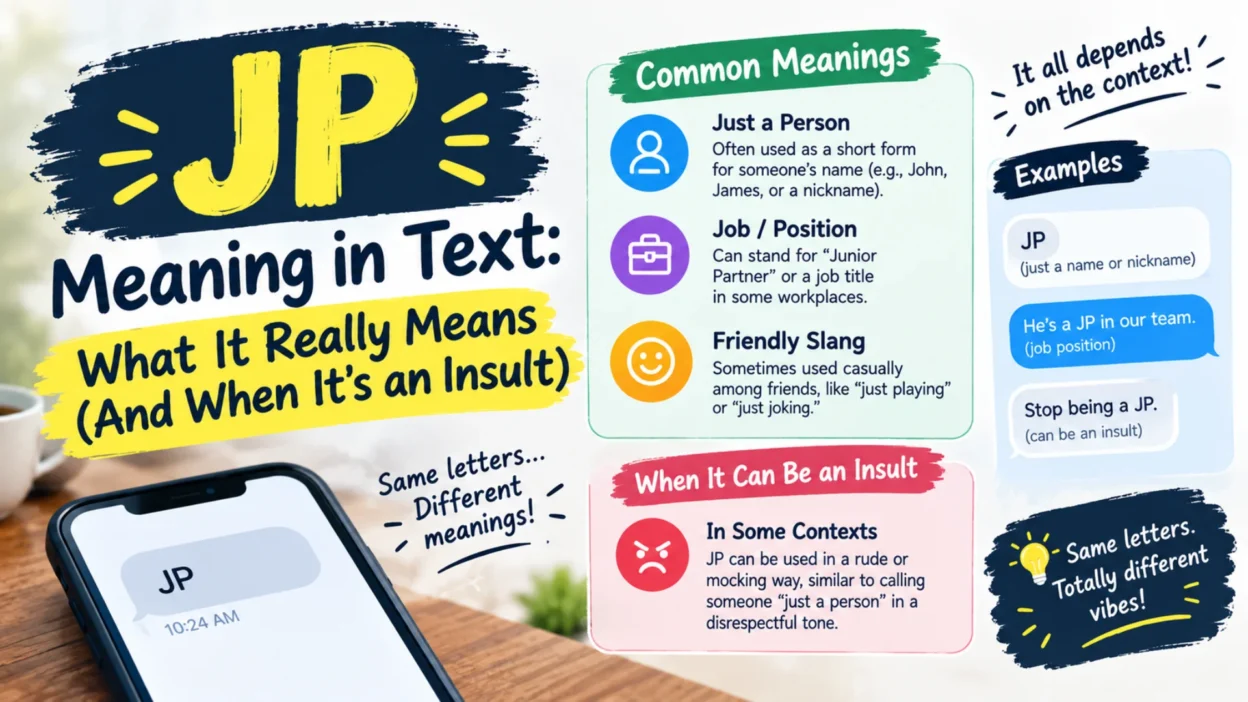
In most casual texts, JP stands for “Just Playing.” It acts as a tone marker. Basically, it signals that whatever came before wasn’t serious. However, that’s only the beginning. Depending on where you see it, JP can also mean Japan, Justice of the Peace, or a gaming statistic. Therefore, context does most of the work here.
What JP Usually Means in Text
When JP shows up in a text, a Snapchat caption, or an Instagram comment, it almost always means “Just Playing.” Think of it as a digital wink. The sender is telling you that the statement before it was a joke. It might be a tease, a playful jab, or a lighthearted roast. Either way, it isn’t meant to cause real harm.
This phrase works because texting strips away tone. In person, you can hear sarcasm in someone’s voice. You can also see a smirk on their face. In a text, those signals disappear. Without a marker like JP, a playful insult can read as genuine cruelty. Consequently, JP solves that problem in just two letters.
You’ll see this version of JP in several common situations. A friend might text “You have the worst taste in movies JP” after you recommend a film. Someone might say “I’m never talking to you again JP” after a minor disagreement. In a group chat, a member might drop a bold opinion and then add “JP” to soften the blow. Two people bantering might use JP to keep the exchange friendly.
Placement matters, too. JP usually comes at the end of the sentence it’s clarifying. That position makes the intent clear. The words before it weren’t serious.
Why “Just Playing” Isn’t Always Innocent
Here’s where things get tricky. JP often signals a joke, but it can also be a way to escape accountability. Someone says something mean, waits to see how people react, then decides whether they were joking. This behavior is sometimes called “Schrödinger’s douchebag.” The person keeps both options open until they know which one is safer.
If someone uses JP after a comment that hurt you, the acronym doesn’t erase the impact. It might even make things worse. Using JP suggests that a two-letter fix is enough to undo real damage. In healthy conversations, JP works for light teasing. It’s not a tool for crossing boundaries and then backtracking.
So while JP usually signals a joke, pay attention to the pattern. If someone consistently says cruel things and then tacks on JP, the problem isn’t the acronym. It’s the behavior behind it.
JP vs JK vs JS: What’s the Difference?
JP isn’t the only acronym people use to clarify tone. JK (just kidding) and JS (just saying) do similar work. However, they’re not interchangeable. Choosing the right one changes how your message lands.
JK is the most direct. It labels a statement as a joke without any extra flavor. JP carries a more playful, almost performative energy. “Just playing” suggests a game or a bit. “Just kidding” is more neutral. If you’re teasing a close friend, JP often feels warmer. If you’re correcting a factual mistake, JK is safer.
JS serves a different purpose. It signals that you’re sharing an opinion you don’t want to defend aggressively. For example, “That restaurant is overrated JS” means the speaker is offering a take without inviting a debate. JP, by contrast, is about intent rather than opinion ownership.
| Acronym | Meaning | Best Used When |
|---|---|---|
| JP | Just Playing | Teasing friends or light banter |
| JK | Just Kidding | Clarifying a joke or false statement |
| JS | Just Saying | Sharing an opinion without commitment |
Using the wrong one can shift the tone of a message. JP after a serious comment might feel dismissive. JK after a playful tease might feel overly formal. Therefore, matching the acronym to the moment matters.
When JP Means Something Completely Different
Texting is only one domain where JP appears. The acronym has a surprisingly wide footprint across other areas of life and work.
JP as Japan. In travel discussions or international news, JP refers to Japan. It’s the two-letter country code for the country. You’ll see it on regional domains, in shipping addresses, and in financial transactions involving the Japanese yen. If someone texts “I’m flying to JP next month,” they’re talking about a trip. They’re not making a joke.
JP as Justice of the Peace. In legal and wedding contexts, JP stands for Justice of the Peace. This is a local official authorized to perform marriage ceremonies. They also handle minor legal matters and certify documents. A text like “We’re meeting the JP on Saturday” has nothing to do with joking around. It’s about wedding planning.
JP as Jungle Proximity. In gaming, JP is shorthand for “Jungle Proximity.” This advanced statistic tracks how often a jungler spends time near a specific lane. Players use it to analyze performance and improve team coordination.
JP as a superior item in Chinese gaming. In Chinese gaming communities, JP describes an item with superior stats. It’s a way of saying something is top-tier or exceptional.
JP as Jean-Pierre. In some French-speaking circles, JP is a nickname for someone named Jean-Pierre. You might see it in a group chat when friends refer to a person by their initials.
JP as Jamaica Plain. In Boston-area conversations, JP refers to the Jamaica Plain neighborhood. It’s a local shorthand that makes sense to residents and confuses everyone else.
The lesson here is simple. Context is everything. A JP in a wedding planning chat is not the same as a JP in a gaming server.
How the Platform Changes the Meaning
The platform you’re using often determines which meaning of JP is in play. Understanding these patterns saves you from confusion.
Snapchat and Instagram. On these visual platforms, JP almost always means “Just Playing.” The acronym thrives in quick reactions to photos, stories, and DMs. You’ll see it in comments on selfies and in response to playful roasts.
Text messages. SMS conversations follow the same pattern. Between friends, JP is the playful clarifier. In family group chats, it’s less common. The generational divide matters here.
Gaming chats. This is where JP gets complicated. In one game it might mean Jungle Proximity. In another, it could be a player’s initials. Gaming communities develop their own dialects, and JP’s meaning shifts from server to server.
School settings. In emails from your child’s school, JP is unlikely to appear as slang. If it does show up, it’s probably part of a name or an official title.
Business communication. In workplace messages, JP might refer to a “Junior Partner.” It could also appear as part of a company name. The slang meaning has no place in professional correspondence.
JP in Gaming Communities
Gaming communities have their own language, and JP is a perfect example. In competitive titles with a jungle role, JP often stands for “Jungle Proximity.” This statistic measures how often a jungler is near a specific lane. As a result, it helps teams coordinate ganks and objective control.
But that’s not the only gaming meaning. In some Chinese gaming circles, JP describes an item with superior stats. It’s a badge of quality. In other games, JP might simply be a player’s initials or a clan tag.
What makes gaming JP tricky is its variability. A term common in one game’s chat might be meaningless in another. If you’re new to a gaming community and see JP, your best bet is to ask. Most players are happy to explain their shorthand.
When You Should Avoid Using JP
Knowing when not to use a term is just as important as knowing what it means. JP has a casual energy that doesn’t belong in every situation.
Avoid JP in professional emails and work chats. Don’t use it in any message that a manager might forward to a client. Even in relaxed workplaces, slang can read as unprofessional. The same goes for messages to teachers, doctors, or strangers.
Don’t use JP after genuinely hurtful comments. If you said something mean and then tacked on JP, the acronym won’t undo the damage. It might make things worse. Using JP suggests you think a two-letter fix is enough.
Be cautious with JP in cross-cultural conversations. Someone from another country might read JP as Japan. They might not recognize it as slang at all. When in doubt, spell out your intent.
Finally, avoid JP when tone is already clear. If you’re obviously joking, adding JP is redundant. The acronym works best when there’s genuine ambiguity to resolve.
Mistakes People Make with JP
A few misunderstandings pop up repeatedly when people encounter JP for the first time.
Assuming it always means “Just Playing.” That’s the most common interpretation in casual texting. However, it’s not the only one. The same two letters can signal a country, a legal official, or a gaming stat.
Using it in professional messages. JP is slang. Dropping it into a work email sends the wrong signal. Even if your workplace is casual, it’s safer to spell out “just kidding.”
Confusing JP with JK. They’re similar but not identical. JK is a direct clarification. JP is more performative and playful. Using one when the other fits better can make your message feel off.
Forgetting the generational gap. If you text JP to a grandparent, they’re likely to be confused. The acronym is widely understood among younger generations. It hasn’t fully crossed into older vocabulary.
Overusing it. Like any slang term, JP loses its impact when it’s everywhere. If every message ends with JP, the clarifier stops clarifying anything. Save it for moments when tone genuinely needs a signal.
How to Reply When Someone Says JP
Responding to JP depends on what came before it. If the preceding message was a playful tease, a lighthearted reply keeps the energy going. A laughing emoji, a “lol,” or a playful comeback all work well.
If the message before JP genuinely stung, you have options. You can acknowledge the joke and move on. You can also say “That one actually hurt a little.” This tells the other person the tease landed harder than intended. JP softens the blow, but it doesn’t erase the impact of the words it follows.
In a group chat, the best response is often to match the tone. If everyone’s joking around, keep it light. If the JP feels out of place in a serious conversation, it’s okay to ask. A simple “Wait, were you joking?” clears things up without drama.
The Psychology Behind Short Tone Markers
Why do people use JP instead of just saying “just playing”? The answer comes down to speed, rhythm, and social signaling.
Text conversations move fast. Group chats often have multiple people typing at once. Typing “just playing” takes longer than tapping out two letters. Therefore, JP keeps the conversational flow intact without forcing the sender to slow down.
There’s also a social function at play. Using JP signals that you’re fluent in digital communication norms. It’s the kind of shorthand that builds rapport. When someone uses JP, they’re not just clarifying intent. They’re also showing they understand the unwritten rules of casual online conversation.
Additionally, JP offers plausible deniability. If a joke lands badly, the sender can point to JP as evidence they were never serious. It’s a small safety net woven into digital conversation. This dual purpose, clarity plus protection, explains why the acronym has stuck around.
FAQs
What does JP stand for in texting?
In casual texting, JP most commonly stands for “Just Playing.” It signals that the preceding message was a joke, a tease, or not meant to be taken seriously.
Is JP the same as JK?
They’re similar but not identical. JK means “Just Kidding” and directly labels a statement as a joke. JP means “Just Playing” and carries a more playful tone. Both clarify intent, but JP often feels warmer.
Can JP mean Japan in a text?
Yes. JP is the two-letter country code for Japan. In travel discussions or international conversations, JP refers to the country rather than the slang phrase.
What does JP mean in online gaming?
In some competitive games, JP stands for “Jungle Proximity.” This statistic measures how much time a jungler spends near a specific lane. In Chinese gaming communities, it can also describe an item with superior stats.
Is JP appropriate for work messages?
No. JP is casual slang and doesn’t belong in professional communication. Use it only in informal settings with friends, family, or peers who understand it.
How do I respond when someone says JP?
If the message was playful, respond in kind with a joke or an emoji. If it stung, you can acknowledge that. If you’re unsure whether they were serious, ask for clarification.
Why do people use JP instead of saying “just playing”?
Speed and rhythm. JP is faster to type and keeps the conversation flowing. It also signals fluency in digital communication norms.
Does JP have other meanings I should know?
Yes. JP can mean Justice of the Peace, a person’s initials like Jean-Pierre, a neighborhood in Boston, or a superior item in Chinese gaming slang.
Final Thoughts
jp meaning in text is a small acronym with a surprisingly large footprint. In most casual texts, it means “Just Playing.” It’s a two-letter tone marker that keeps jokes from landing wrong. However, the same letters can point to Japan, a Justice of the Peace, or a gaming statistic. The meaning lives in the context, not the letters themselves.
The next time you see JP and you’re not sure what it means, look at where it appears. A Snapchat comment suggests a playful clarification. A wedding planning email points toward a legal official. A gaming chat might mean something tactical. Reading the room is the skill that makes acronyms like JP feel intuitive.
And if you’re still unsure? Ask. Digital communication moves fast, and no one expects you to decode every abbreviation on sight. A quick “what does JP mean here?” saves more time than guessing wrong ever will.

Serhii Dunev is a passionate content creator dedicated to crafting meaningful texts, messages, and word inspirations. He aims to help people express their emotions clearly through simple and impactful words.