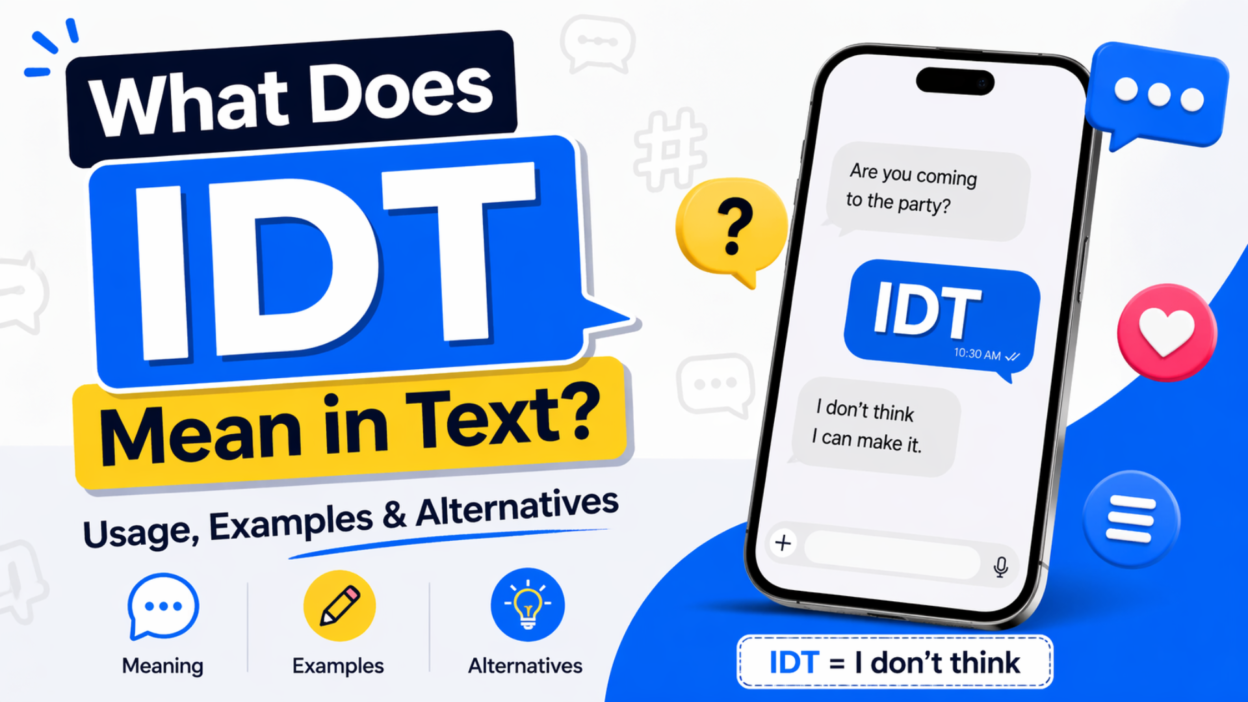
Have you ever received a text message saying “IDT” and found yourself staring at your phone screen in confusion? You are definitely not alone in this situation. Texting abbreviations have exploded in popularity over the past decade. Consequently, keeping up with every new acronym can feel like learning a completely different language. IDT meaning in text is actually quite simple once you understand it. This abbreviation appears frequently in casual conversations across various messaging platforms. For instance, you might see it in WhatsApp chats, Instagram DMs, or even work-related Slack channels. In this comprehensive guide, we will explore everything you need to know about this handy abbreviation. Specifically, we will cover its definition, origin, real-world examples, and common alternatives. By the end of this article, you will confidently use and understand IDT meaning in text like a true digital native. 😉
Definition & Core Meaning of IDT
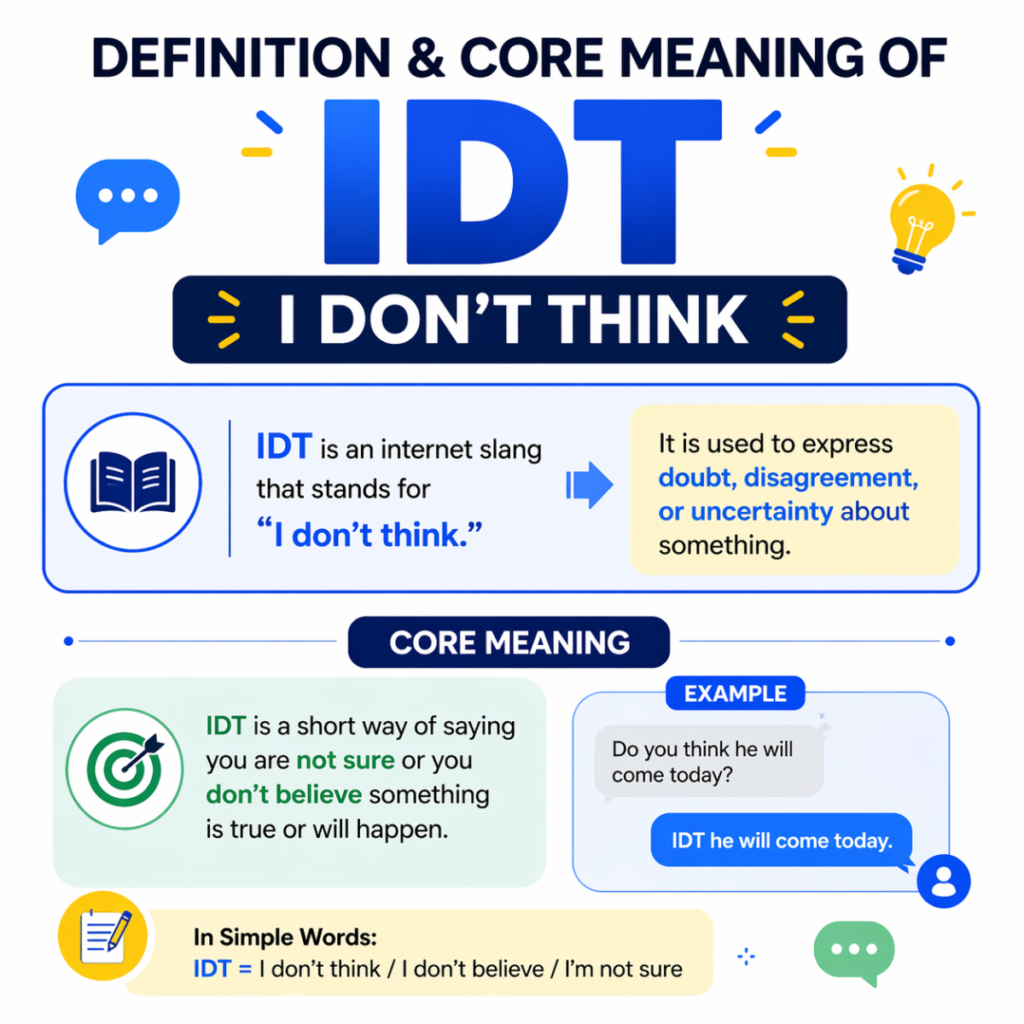
IDT meaning in text stands for “I Don’t Think.” This abbreviation serves as a quick way to express doubt, disagreement, or uncertainty in written communication. Typically, people use IDT to soften their statements when they are not completely sure about something. For example, instead of writing “I don’t think we should go to that restaurant,” someone might simply text “IDT we should go there.” Similarly, you might see IDT used to politely disagree with someone’s opinion without sounding too harsh.
Nevertheless, understanding the precise meaning requires paying attention to the surrounding context. IDT often precedes a prediction, opinion, or judgment that the speaker holds tentatively. For instance, “IDT it will rain tomorrow” shows uncertainty about the weather forecast. Alternatively, “IDT that’s a good idea” expresses a polite objection. Therefore, the core function of IDT is to communicate hesitation or mild disagreement in an efficient manner.
Interestingly, IDT differs from other abbreviations like “IDK” (I Don’t Know) which signals a complete lack of information. Meanwhile, “IDC” (I Don’t Care) shows indifference rather than doubt. Consequently, IDT occupies a unique middle ground where the speaker has an opinion but lacks full confidence in that opinion.
History & Origin of IDT in Text Messaging
The abbreviation IDT emerged during the early 2000s alongside the rise of SMS text messaging. Specifically, when mobile phones had character limits and physical keyboards, users needed shortcuts to type faster. Consequently, common phrases like “I don’t think” naturally got compressed into IDT. This trend followed the same pattern as other popular abbreviations such as “LOL” (Laughing Out Loud) and “BRB” (Be Right Back).
As instant messaging platforms like AOL Instant Messenger (AIM) and MSN Messenger gained popularity, IDT became more widespread. Teenagers and young adults especially embraced these shorthand forms to keep conversations flowing quickly. Subsequently, the abbreviation carried over into early social media platforms like MySpace and eventually Twitter, where character limits were strictly enforced.
Moreover, the rise of smartphones with full keyboards did not kill texting abbreviations. In fact, abbreviations like IDT became even more common as typing speed remained a priority for many users. Interestingly, different generations use IDT with varying frequency. Research suggests that millennials and Gen Z use IDT most often, while older generations may prefer typing the full phrase “I don’t think.”
Nevertheless, IDT has maintained steady usage over two decades. Unlike some slang terms that fade away quickly, IDT remains relevant because it solves a genuine communication need. People frequently express doubt or tentative opinions in daily conversations. Hence, having a three-letter shortcut for this common phrase proves genuinely useful.
Real-World Examples of IDT in Conversations
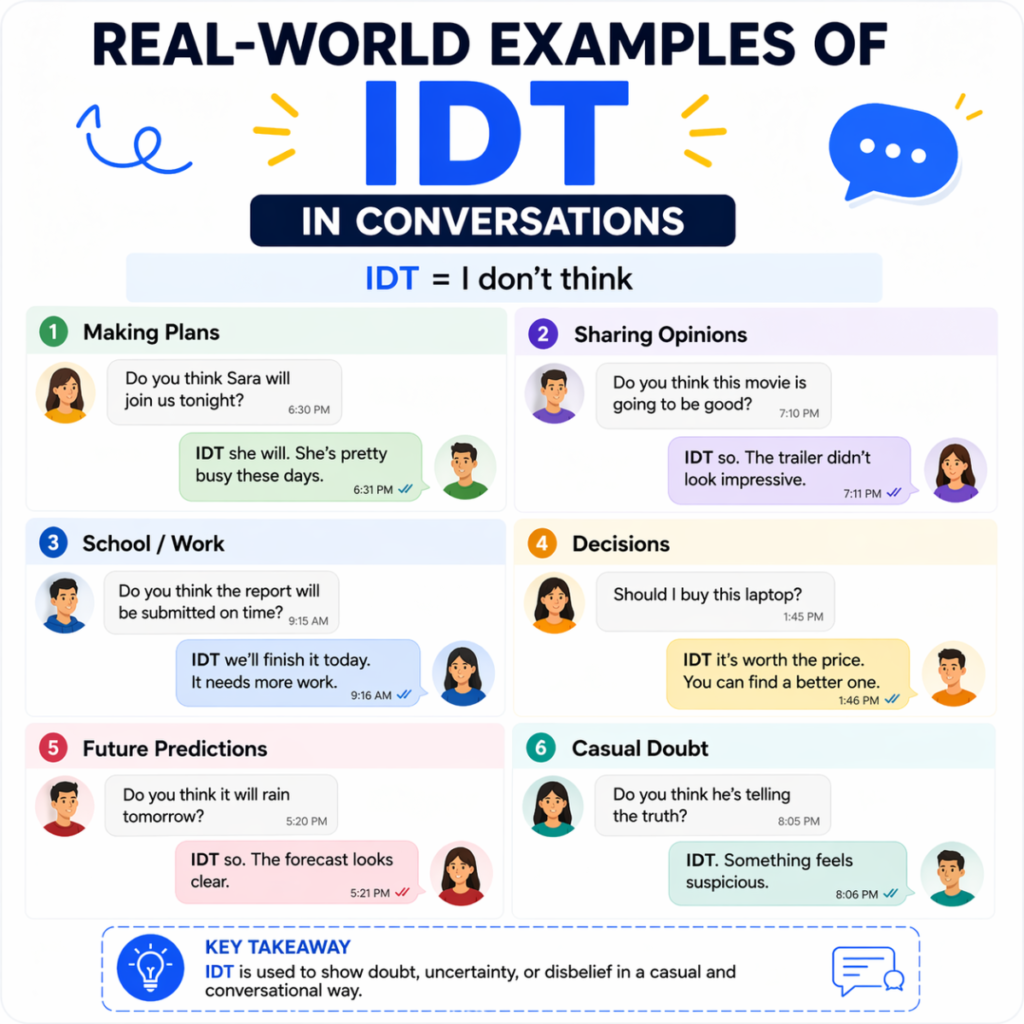
Let us explore how IDT meaning in text appears in actual conversations. Below are four realistic examples that demonstrate typical usage patterns.
Example 1: Making Plans with Friends
Person A: “Should we go to the beach tomorrow? The forecast says sunny!”
Person B: “IDT that’s a good idea. It’s supposed to be 95 degrees with no clouds. We will get burned.”
Person A: “Good point. Maybe the indoor mall instead?”
Person B: “IDT the mall will be less crowded on Saturday. What about a movie?”
Analysis: In this exchange, Person B uses IDT twice to express disagreement politely. Notice how the abbreviation softens the refusal without sounding aggressive.
Example 2: Discussing a TV Show
Person A: “Did you watch the season finale last night? I thought it was amazing!”
Person B: “IDT it was their best episode. The ending felt rushed to me.”
Person A: “Really? I loved the plot twist!”
Person B: “IDT the twist made logical sense though. Too many plot holes.”
Analysis: Here, IDT allows Person B to disagree respectfully about subjective entertainment opinions. The abbreviation prevents the conversation from becoming confrontational.
Example 3: Workplace Chat Scenario
Colleague A (Slack): “Can we finish this project by Friday?”
Colleague B: “IDT that’s realistic given our current workload. Tuesday seems more feasible.”
Colleague A: “Fair point. Let me check with the manager.”
Analysis: Even in professional settings, IDT appears occasionally. Notice how the abbreviation maintains politeness while expressing a realistic assessment.
Example 4: Dating App Conversation
User A (Hinge): “Are you free for drinks this Friday night?”
User B: “IDT Friday works for me. How about Saturday afternoon instead?”
User A: “Saturday works perfectly! Coffee or lunch?”
Analysis: In dating contexts, IDT helps avoid outright rejection. The speaker suggests an alternative rather than simply saying no.
How Context Changes IDT Meaning
The interpretation of IDT meaning in text shifts significantly depending on the platform and relationship between speakers. Let us examine how context influences this abbreviation.
Texting Between Friends
Among close friends, IDT typically carries a casual and friendly tone. Friends use it to disagree playfully or express uncertainty without formality. For example, “IDT you should dye your hair blue” sounds like caring advice rather than criticism. Similarly, “IDT I can make the party” expresses regret naturally. Consequently, IDT helps maintain harmony in friendships by softening disagreements.
Social Media Comments
On platforms like Twitter, Instagram, or TikTok, IDT often introduces respectful counter-arguments. For instance, someone might comment “IDT this take is accurate” on a controversial post. Alternatively, “IDT people realize how hard this challenge actually is” shows empathy. Nevertheless, social media contexts require extra care since tone is easily misinterpreted. Without vocal inflection, even IDT can sometimes seem passive-aggressive.
Gaming Chat (Discord, Twitch)
In gaming communities, IDT appears frequently during strategy discussions. Gamers might say “IDT we should push the objective yet” or “IDT that loadout works for this map.” Interestingly, gaming culture embraces efficiency, so abbreviations like IDT are extremely common. Consequently, new players should learn IDT along with other gaming slang to communicate effectively with teammates.
Dating Apps
On Tinder, Bumble, or Hinge, IDT serves as a polite rejection tool. For example, “IDT we are a match” or “IDT this will work out” softens the blow of declining someone. However, overusing IDT on dating apps can appear indecisive or wishy-washy. Therefore, balance IDT with clear statements when appropriate. A better approach might be “IDT we have chemistry, but I wish you the best” followed by unmatching.
Tone Nuances: Is IDT Rude or Friendly?
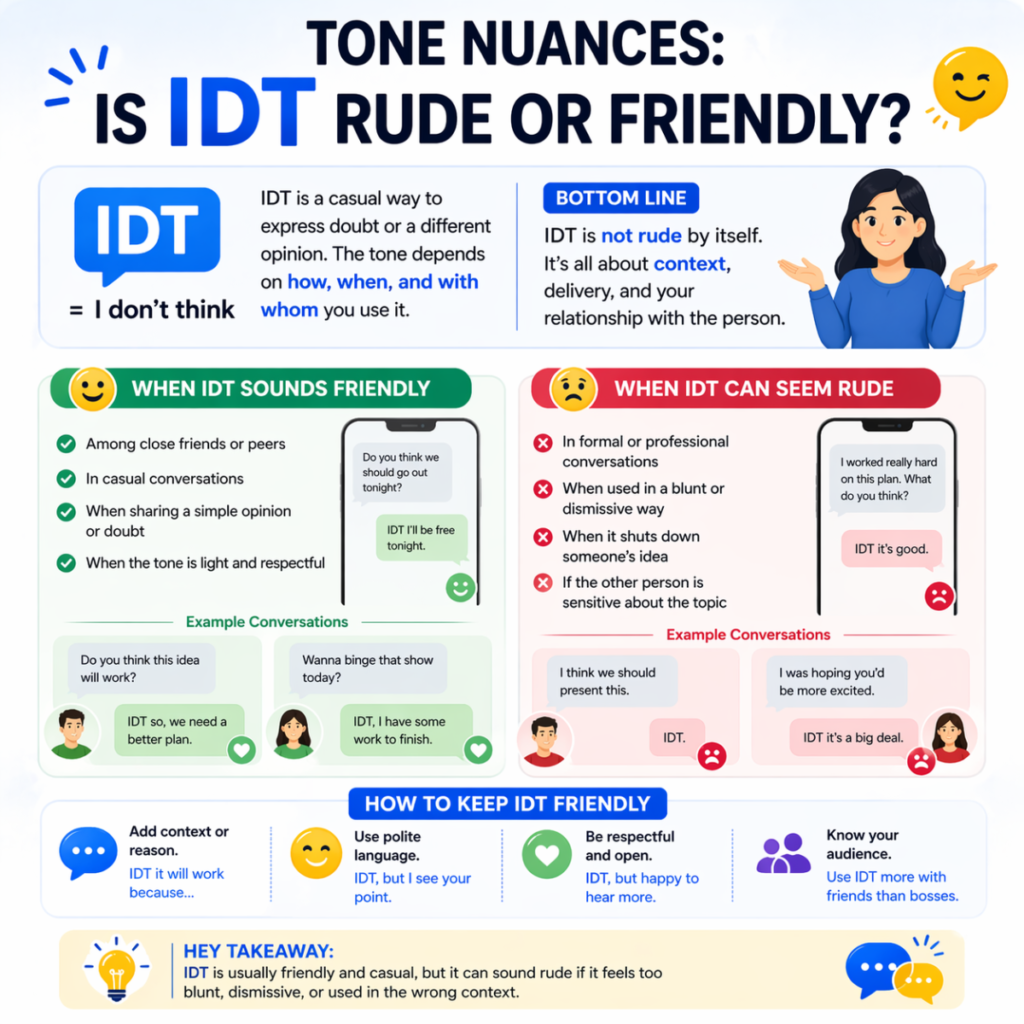
Many people wonder whether using IDT comes across as rude or friendly. The honest answer is that it depends entirely on context and delivery. Let us break down the nuances.
IDT is generally friendly when:
- You are disagreeing about subjective topics (movies, food, music)
- You follow IDT with a constructive alternative suggestion
- The conversation involves close friends or family members
- You use IDT to express personal uncertainty rather than judging others
IDT can seem rude when:
- You use it to dismiss someone’s feelings or experiences
- The topic is serious or sensitive (politics, religion, personal trauma)
- You overuse IDT in every sentence, making you sound indecisive
- You write IDT in all caps (“IDT THAT’S RIGHT”) which appears aggressive
Consequently, we recommend matching your language to the situation. For casual chats about weekend plans, IDT works perfectly. For serious discussions about someone’s life choices, consider typing the full phrase “I don’t think” or adding softening words like “personally” or “respectfully.”
Interestingly, research on digital communication shows that abbreviations like IDT can actually increase perceived friendliness in some contexts. Specifically, using casual abbreviations signals that you view the recipient as an in-group member or friend. Therefore, IDT might strengthen social bonds rather than harm them.
IDT vs Similar Slang Terms
Understanding how IDT differs from other common abbreviations prevents confusion. Below is a comparison table showing IDT meaning in text alongside similar terms.
| Abbreviation | Full Phrase | Meaning | When to Use |
|---|---|---|---|
| IDT | I Don’t Think | Expresses doubt or mild disagreement | When you have an opinion but lack full confidence |
| IDK | I Don’t Know | Indicates complete uncertainty or lack of information | When you genuinely cannot answer a question |
| IDC | I Don’t Care | Shows indifference or lack of preference | When the outcome truly doesn’t matter to you |
| IMO/IMHO | In My Opinion / In My Humble Opinion | Signals a subjective perspective | When stating a personal viewpoint respectfully |
| TBH | To Be Honest | Introduces candid or blunt statements | When you want to emphasize sincerity |
| NGL | Not Gonna Lie | Similar to TBH, often before criticism | When admitting something slightly embarrassing |
| IMO | In My Opinion | States personal perspective without doubt | When you are confident in your view |
As the table shows, IDT meaning in text is most similar to “IMO” but with an added layer of uncertainty. Specifically, IDT suggests your opinion is tentative or could change with new evidence. Meanwhile, “IMO” simply labels something as an opinion without indicating confidence level.
How to Respond to IDT in Conversations
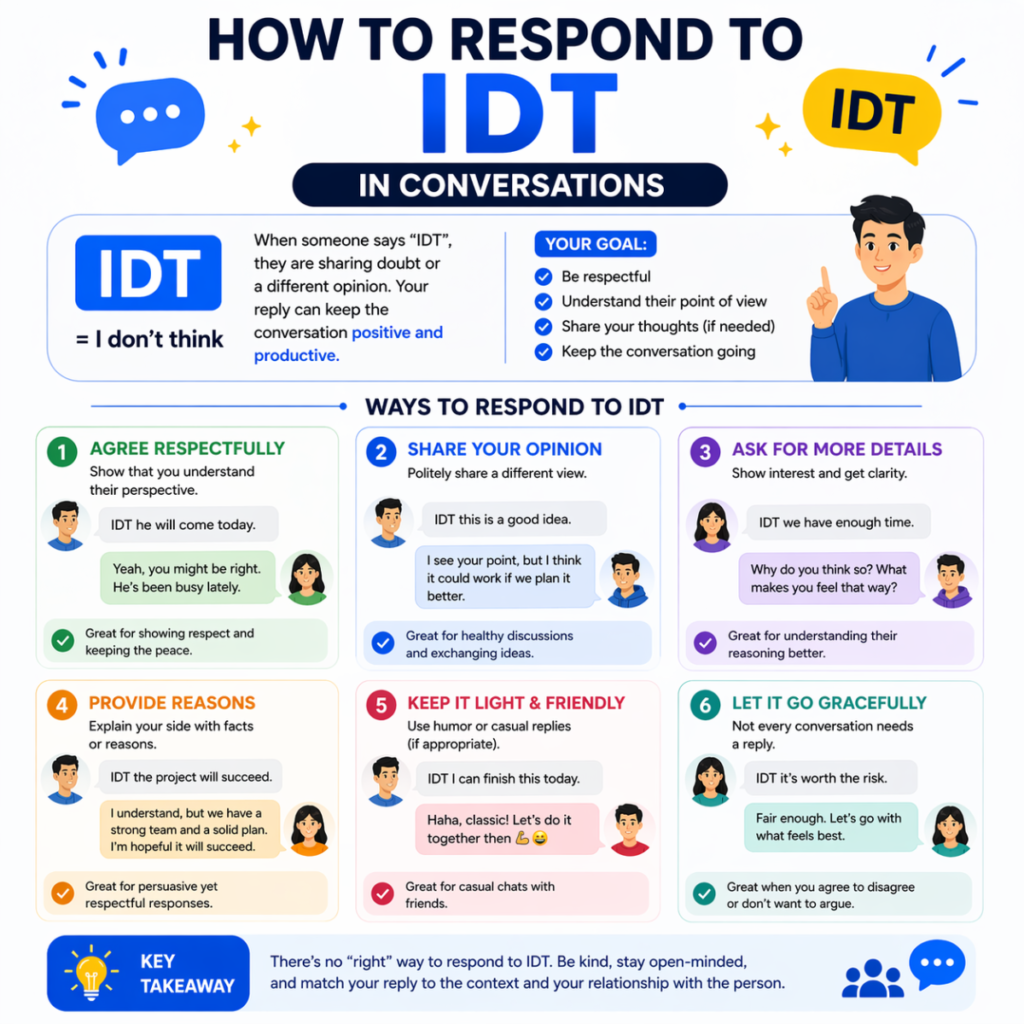
When someone sends you a message containing IDT, your response should match the context and your relationship with the speaker. Below are three common scenarios with appropriate responses.
Scenario 1: IDT Used for Mild Disagreement
Their message: “IDT that movie was as good as everyone says.”
Good responses:
- “Interesting! What didn’t you like about it?” (Encourages discussion)
- “Fair enough. I personally loved it though.” (Respectful disagreement)
- “Yeah, I can see why you would think that.” (Validating their perspective)
Poor responses:
- “You’re wrong.” (Too aggressive)
- “IDC what you think.” (Rude and dismissive)
Scenario 2: IDT Used for Uncertainty
Their message: “IDT I can make it to your party. I have to check my schedule.”
Good responses:
- “No worries! Just let me know when you figure it out.” (Understanding)
- “Hope you can come! Keep me posted.” (Positive and encouraging)
Poor responses:
- “Why not? You always cancel on me.” (Guilt-tripping)
- “Whatever.” (Passive-aggressive)
Scenario 3: IDT Used for Polite Rejection
Their message (dating app): “IDT we are a good match. Best of luck though!”
Good responses:
- “Thanks for being honest. Good luck to you too!” (Graceful acceptance)
- “I appreciate your candor. Take care!” (Polite and mature)
Poor responses:
- “Why not? What’s wrong with me?” (Desperate)
- “You’re ugly anyway.” (Immature and cruel)
Generally, responding to IDT requires matching the original tone. If someone used IDT politely, respond politely. If they used it sarcastically or rudely, you can choose to disengage from the conversation entirely.
Professional Use: Can You Say IDT at Work?
Using IDT meaning in text in professional settings requires careful judgment. While IDT might be acceptable in casual workplace chats, formal communications demand full phrases. Let us explore appropriate versus inappropriate contexts.
Appropriate Professional Use of IDT
- Internal Slack or Teams channels with close colleagues
- Quick status updates where efficiency matters
- Informal brainstorming sessions recorded in chat
- Responses to non-urgent questions from coworkers you know well
Example (appropriate): “IDT we have the budget for that. Let me double-check with finance.”
Inappropriate Professional Use of IDT
- Emails to clients or external partners
- Official reports or proposals
- Performance reviews or disciplinary communications
- Messages to senior executives or upper management
- Any communication where ambiguity could cause problems
Example (inappropriate): “IDT our quarterly targets are achievable.” (Better to write: “Based on current data, I do not believe our quarterly targets are achievable.”)
Consequently, we recommend avoiding IDT in formal written business communication. The small amount of time saved by typing three letters is not worth the potential damage to your professional image. Instead, write “I do not think” or “I believe” to maintain professionalism.
Common Misconceptions About IDT
Several myths and misunderstandings surround IDT meaning in text. Let us debunk the most common misconceptions.
Misconception 1: IDT Means the Same as IDK
False. IDT expresses a tentative opinion or mild disagreement. IDK indicates complete lack of knowledge. For example, “IDT it will rain” means you believe rain is unlikely. Meanwhile, “IDK if it will rain” means you have no idea about the weather forecast. These are fundamentally different statements.
Misconception 2: IDT Is Always Rude or Passive-Aggressive
False. In most contexts, IDT actually softens disagreements and prevents conflict. Think of IDT as a linguistic tool for politeness rather than rudeness. However, tone of voice (which is absent in text) affects perception. Adding an emoji or exclamation point can clarify friendly intent. For instance, “IDT that’s right 🙂” reads much friendlier than “IDT that’s right.”
Misconception 3: Only Teenagers Use IDT
False. While younger generations popularized texting abbreviations, adults across all age groups now use IDT. Professionals in their 30s, 40s, and even 50s commonly use IDT in casual digital communication. Nevertheless, usage frequency does decrease with age. According to linguistic research, people over 60 are least likely to use IDT.
Misconception 4: IDT Is Grammatically Incorrect
False. Abbreviations are not grammatical errors; they are stylistic choices for specific contexts. Just as you would not wear a tuxedo to the beach, you would not use IDT in a formal essay. However, in text messages between friends, IDT is perfectly acceptable and widely understood. Language evolves to meet user needs, and efficiency is a legitimate need.
5 Polite Alternatives to IDT
Sometimes you want to express doubt or disagreement without using abbreviations. Below is a table of polite alternatives to IDT meaning in text, ranked from most casual to most formal.
| Alternative Phrase | Formality Level | Best Used When |
|---|---|---|
| “I’m not sure” | Casual | Expressing genuine uncertainty without strong opinion |
| “I don’t really think” | Casual to neutral | Softening disagreement even more than IDT |
| “It seems to me that” | Neutral | Offering an opinion humbly |
| “My impression is that” | Neutral to formal | Professional settings where humility matters |
| “Based on available information, I do not believe” | Formal | Business emails or official communications |
Example sentences using alternatives:
- “I’m not sure that’s the best approach.” (Soft and humble)
- “I don’t really think we need to order more supplies yet.” (Gentle suggestion)
- “It seems to me that the data tells a different story.” (Respectful disagreement)
- “My impression is that the client wants a faster timeline.” (Professional opinion)
- “Based on available information, I do not believe we can meet the deadline.” (Formal and clear)
Consequently, choosing the right alternative depends on your audience and communication channel. When in doubt, err on the side of more formal language. You can always become more casual in future messages, but recovering from overly casual language is difficult.
Frequently Asked Questions About IDT Meaning in Text
FAQ 1: What does IDT stand for in texting?
IDT stands for “I Don’t Think” in text messaging and online communication. People use this abbreviation to express doubt, uncertainty, or mild disagreement efficiently. For example, “IDT we will be late” means “I don’t think we will be late.”
FAQ 2: Is IDT the same as IDK?
No, IDT and IDK have different meanings. IDT (I Don’t Think) expresses a tentative opinion or prediction. IDK (I Don’t Know) indicates a complete lack of information or knowledge. For instance, “IDT she is coming” suggests you believe she is not coming. Meanwhile, “IDK if she is coming” means you have no information about her plans.
FAQ 3: Can I use IDT in professional emails?
Generally, no. Avoid using IDT in formal professional emails, client communications, or official documents. Instead, write the full phrase “I do not think” or use alternatives like “It seems to me that.” However, IDT might be acceptable in casual internal chats with close coworkers on platforms like Slack or Teams.
FAQ 4: How should I respond when someone texts me IDT?
Your response depends on context. If someone uses IDT to disagree politely, acknowledge their perspective by saying “Interesting point” or “I see what you mean.” If someone uses IDT to express uncertainty, offer patience by saying “No worries, let me know when you decide.” Avoid aggressive or dismissive responses like “You’re wrong” or “IDC.”
FAQ 5: Is using IDT considered lazy or uneducated?
Not at all. Using abbreviations like IDT reflects adaptation to digital communication norms, not laziness or lack of education. Every generation develops shorthand for efficient communication. However, good communicators know when abbreviations are appropriate and when full phrases are necessary. Using IDT with friends shows social awareness. Using IDT in a job application would show poor judgment.
Conclusion
Understanding IDT meaning in text unlocks smoother digital conversations across messaging platforms, social media, and even casual workplace chats. As we have explored throughout this guide, IDT stands for “I Don’t Think” and serves as a valuable tool for expressing doubt, mild disagreement, or tentative opinions efficiently. Consequently, mastering this abbreviation helps you communicate more naturally in text-based environments.
Nevertheless, effective communication requires knowing your audience. Using IDT with close friends builds rapport and speeds up conversations. However, formal professional settings demand the full phrase “I do not think” or polite alternatives. Therefore, we encourage you to practice using IDT appropriately while remaining aware of context.
Similarly, remember that IDT differs significantly from similar abbreviations like IDK and IDC. Mixing these up can confuse your conversation partner or change your intended meaning entirely. For instance, saying “IDT I care” sends a very different message than “IDC” (which sounds indifferent) or “IDK” (which sounds uninformed).
Finally, do not fear using abbreviations like IDT in appropriate settings. Digital communication continues evolving, and flexibility remains a valuable skill. By understanding IDT meaning in text and its nuances, you become a more adaptable and effective communicator. Now go forth and text with confidence! 😊

Serhii Dunev is a passionate content creator dedicated to crafting meaningful texts, messages, and word inspirations. He aims to help people express their emotions clearly through simple and impactful words.