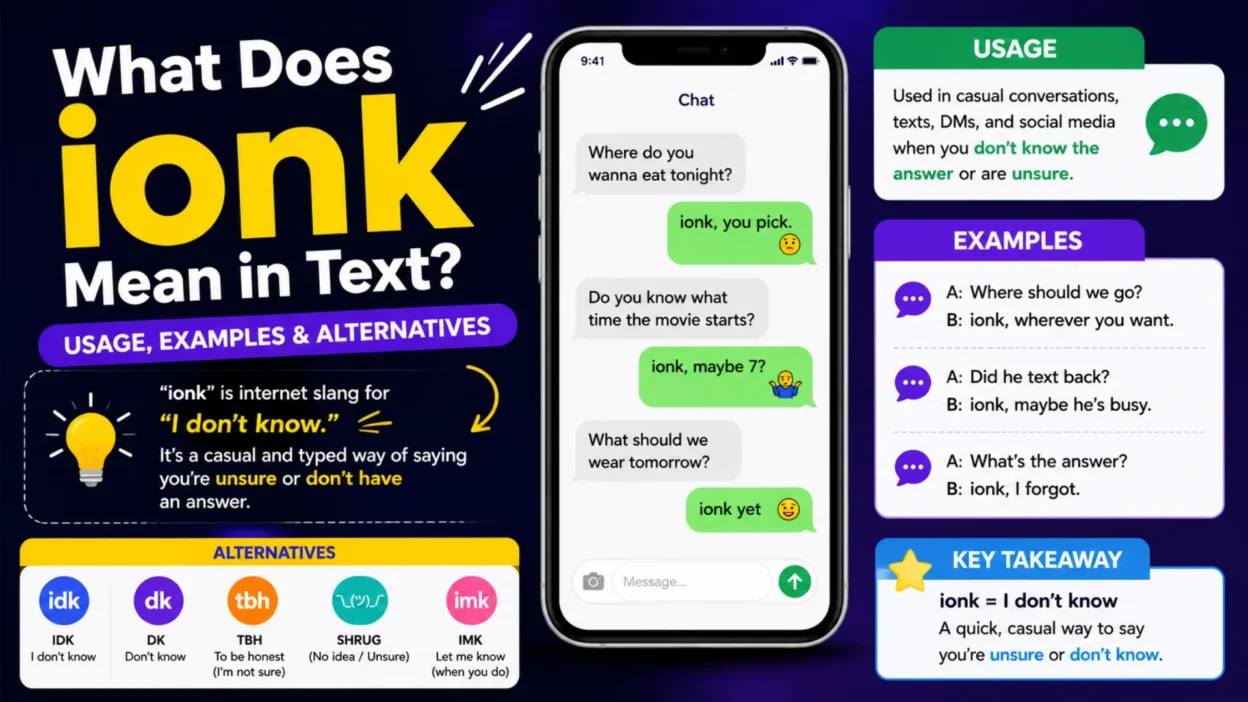
Have you ever received a text that simply said “ionk” and felt completely lost? You are not alone. This quirky abbreviation has popped up everywhere from Instagram DMs to group chats. Understanding ionk meaning in text can save you from awkward misinterpretations. In short, “ionk” is a slang contraction of “I don’t know” or sometimes “I don’t.” Specifically, it blends “I” + “on” (a phonetic spelling of “don’t”) + “k” (the first letter of “know”). Consequently, it has become a fast, casual way to express uncertainty or lack of knowledge. This article will unpack everything you need to know. We will explore its origin, real-life examples, tone nuances, and polite alternatives. By the end, you will confidently decode and even use this trendy term. Let’s dive in.
Definition & Core Meaning of ionk meaning in text
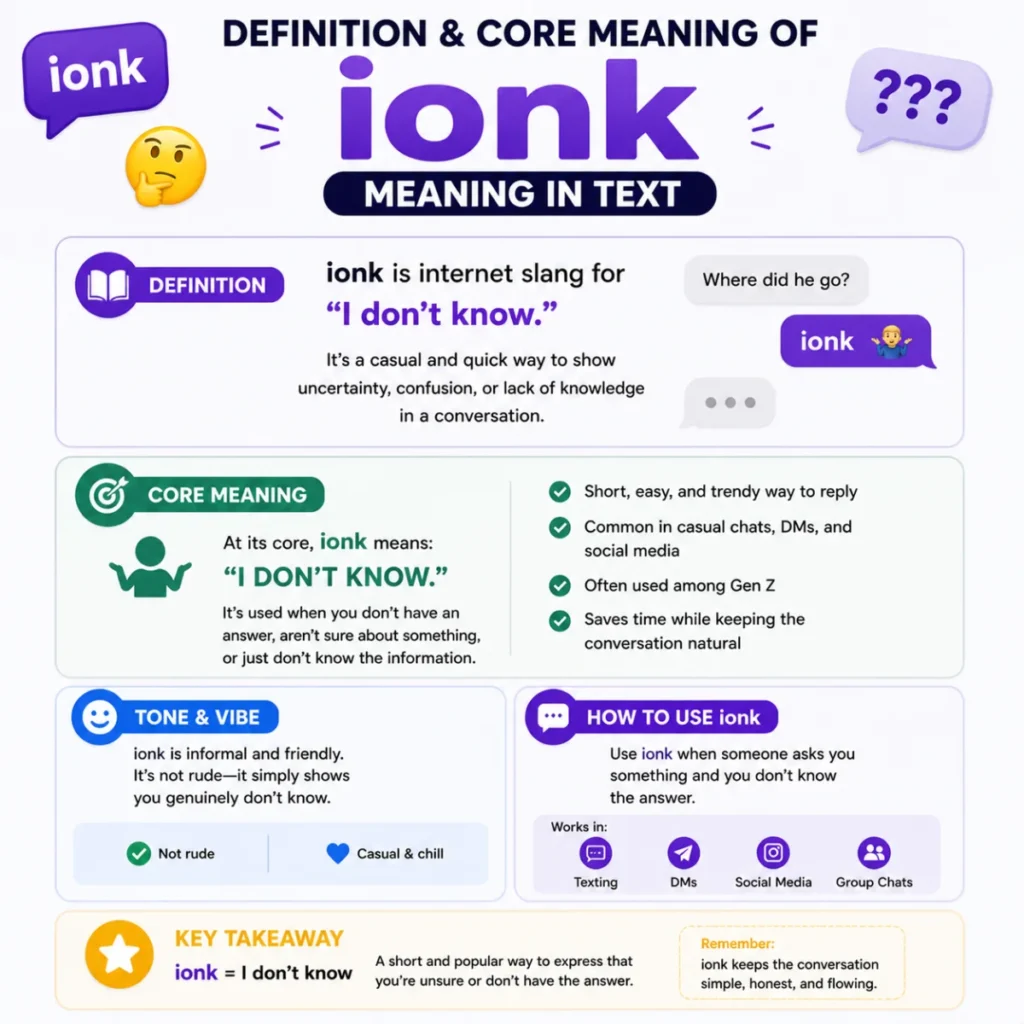
What exactly does ionk meaning in text refer to? At its core, “ionk” is an informal, text-based abbreviation. It primarily stands for “I don’t know.” However, some users also employ it as a quicker form of “I don’t” (e.g., “Ionk wanna go”). The term is phonetic. It mimics how “I don’t know” sounds when spoken quickly in casual conversation. For example, say “I dunno” fast, then drop the ‘d’ sound – you get “ionk.” Alternatively, it can be broken down as:
- I = I
- on = a slurred version of “don’t” (dropping the ‘d’ and ‘t’)
- k = the first letter of “know”
Thus, ionk meaning in text revolves around expressing ignorance, uncertainty, or indifference. Typically, it appears in lowercase without punctuation. Interestingly, it carries a slightly more laid-back or even dismissive tone than the standard “IDK.” Many Gen Z and millennial texters prefer “ionk” because it feels more organic and less robotic. Nevertheless, its meaning remains consistent: the speaker lacks an answer or opinion.
History & Origin of ionk meaning in text
Tracing ionk meaning in text reveals fascinating roots in digital linguistics. The term emerged from African American Vernacular English (AAVE) and early internet slang. Specifically, “ion” (meaning “I don’t”) appeared on forums and SMS as early as the 2000s. For instance, phrases like “ion know” or “ion care” became common in Black Twitter and texting communities. Over time, speakers further compressed “ion know” into “ionk.” This evolution follows a natural pattern: efficiency drives slang. Consequently, “ionk” gained traction on platforms like TikTok, Snapchat, and Discord.
Moreover, the rise of predictive text and autocorrect may have contributed. Typing “ionk” is faster than “idk” on some keyboards. Additionally, it carries a distinct cultural flavor. Many young people adopted it to signal informality and belonging. By 2015, Urban Dictionary had multiple entries defining “ionk” as “I don’t know.” Today, ionk meaning in text is widely recognized among teens and young adults. However, older generations might still find it puzzling. Nevertheless, its usage continues to spread across social media and private messaging.
Real-World Examples of ionk meaning in text in Conversations
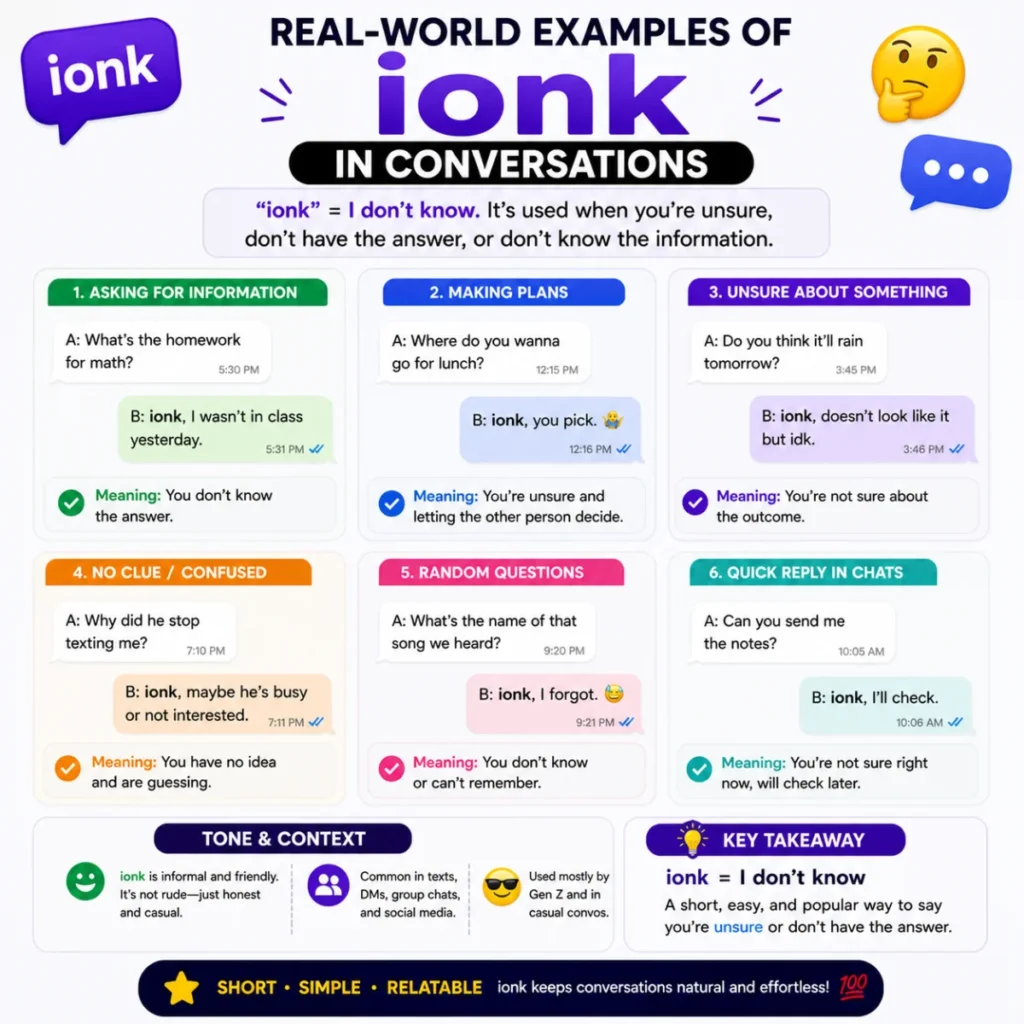
To truly grasp ionk meaning in text, let’s examine authentic examples. Below are four common scenarios where “ionk” appears naturally.
Example 1: Casual Uncertainty Between Friends
Friend A: “What time does the movie start?” Friend B: “Ionk, lemme check real quick.”
Here, “ionk” replaces “I don’t know” in a low-stakes situation. The response is helpful but immediate.
Example 2: Expressing Indifference
Person 1: “Do you want pizza or burgers for dinner?” Person 2: “Ionk, either is fine.”
In this context, “ionk” signals a lack of strong preference rather than ignorance. It softens the reply.
Example 3: Responding to a Complex Question
Classmate: “Why did the professor cancel office hours?” You: “Ionk, maybe she’s sick?”
Here, ionk meaning in text shows honest uncertainty. The speaker offers a guess but admits not knowing.
Example 4: Quick Acknowledgment in a Group Chat
Group member: “Who broke the coffee machine?” Another member: “Ionk but it wasn’t me lol”
The term deflects responsibility while keeping the tone light. It’s a fast way to avoid blame without over-explaining.
How Context Changes the Meaning of ionk meaning in text
Context dramatically shapes ionk meaning in text. The same four letters can convey different emotions depending on where and how you use them. Let’s break down four key environments.
Texting (One-on-One)
In private SMS or iMessage conversations, “ionk” often feels neutral or slightly lazy. It suggests the sender is typing quickly. For example, a partner might text “ionk” when asked about dinner plans – this could be gentle disinterest. Alternatively, a close friend using “ionk” usually means no harm. Transition: Nevertheless, overusing it might seem evasive.
Social Media (Comments & DMs)
On platforms like Instagram, Twitter, or TikTok, ionk meaning in text shifts toward performative casualness. People use it in replies to memes or polls. For instance, “ionk what this means but it’s funny.” Here, it builds rapport with followers. Additionally, it can signal relatability. However, in a heated comment section, “ionk” might come off as dismissive or passive-aggressive.
Gaming (Voice & Text Chat)
Among gamers, “ionk” is efficient during fast-paced matches. For example: “Where’s the enemy?” – “Ionk, check radar.” The term prioritizes speed over politeness. Consequently, it rarely causes offense. Nevertheless, in competitive ranked games, repeatedly saying “ionk” might frustrate teammates who expect solid callouts.
Dating Apps (Tinder, Bumble, Hinge)
Using “ionk” in dating app conversations is risky. Ionk meaning in text here often signals low effort or lack of interest. For example, if someone asks “What’s your favorite hobby?” and you reply “ionk,” that could end the chat. Therefore, avoid “ionk” when you want to impress. Save it for after you’ve established a playful, informal dynamic.
Tone Nuances: Is ionk meaning in text Rude or Friendly?
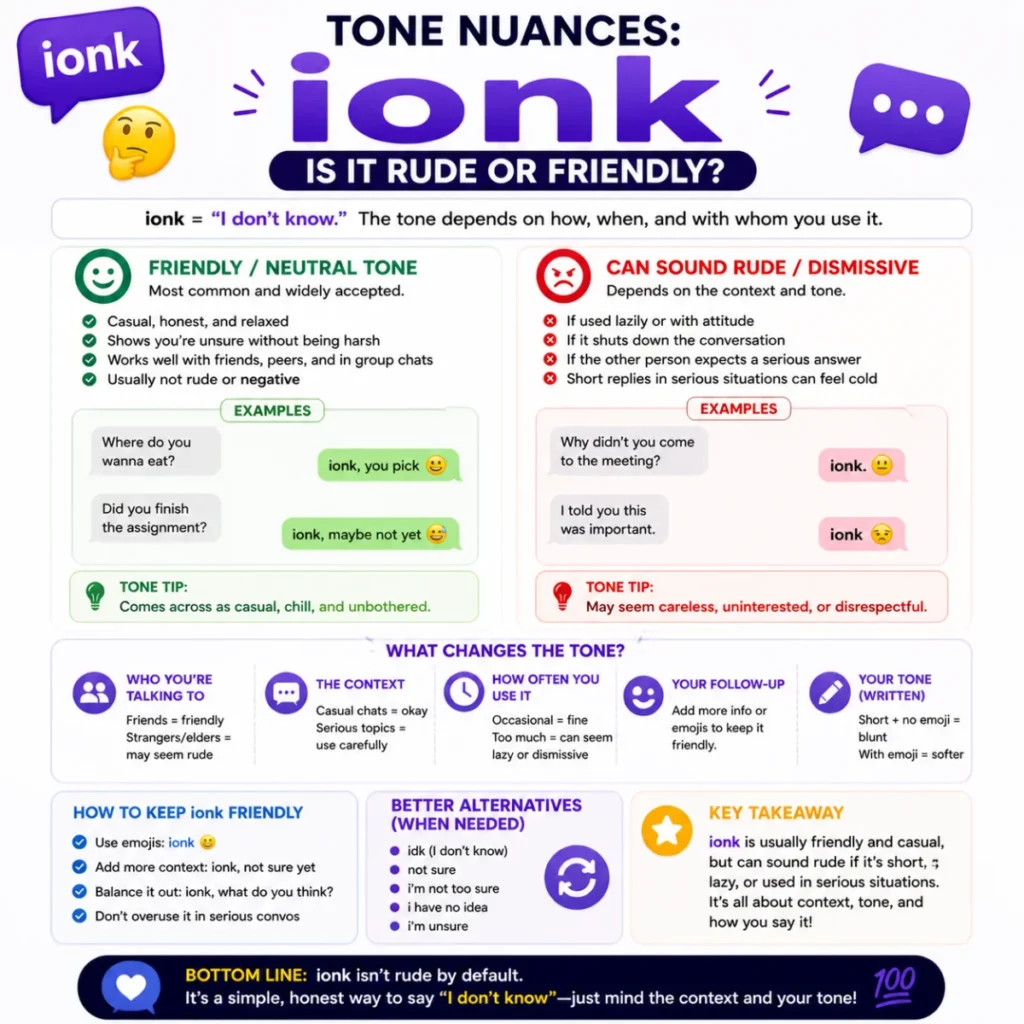
Many people wonder: is ionk meaning in text inherently rude? The answer depends on tone, relationship, and frequency. Let’s analyze three layers.
Friendly scenarios: Between close friends or siblings, “ionk” is almost always neutral or affectionate. For instance, “Ionk what I’d do without you” sounds endearing. Similarly, using “ionk” after a long day feels relatable. On the other hand, if you use it with an acquaintance, it may seem abrupt.
Rude scenarios: “Ionk” becomes problematic when you repeatedly answer with it. Imagine someone asks three thoughtful questions, and you reply “ionk” each time. That signals disinterest or laziness. Likewise, adding “ionk” to dismiss a serious concern (e.g., “Ionk care about your problem”) is clearly hostile.
Indifferent scenarios: Often, “ionk” simply means “I have no opinion.” For example, “Which restaurant?” – “Ionk, you choose.” This is neither rude nor friendly – it’s neutral. Thus, the key is moderation. Use “ionk” occasionally and with people who understand modern slang. When in doubt, default to “I don’t know” or “I’m not sure.”
ionk meaning in text vs Similar Slang Terms
Ionk meaning in text overlaps with several other abbreviations. However, subtle differences exist. The table below compares “ionk” to five common alternatives.
Slang TermFull MeaningTypical ToneKey Difference from “ionk”ionkI don’t knowCasual, lazy, sometimes indifferentMost compressed; very informalidkI don’t knowNeutral, universalMore standard; less slangyionI don’tVery casual, AAVE-rootedMissing the “know” part; often precedes a verbiunoI don’t know (phonetic)Playful, childlikeSlightly more deliberatedunnoDon’t knowFriendly, low-keyOlder slang; less trendy🤷 (shrug emoji)Non-verbal “I don’t know”Visual, universalNo words; leaves more ambiguity
As shown, ionk meaning in text is unique because it combines extreme brevity with a specific cultural flavor. Unlike “idk,” it feels more organic in fast, spoken-style texting. However, avoid using it in formal or cross-generational chats.
How to Respond to ionk meaning in text (3 Scenarios)
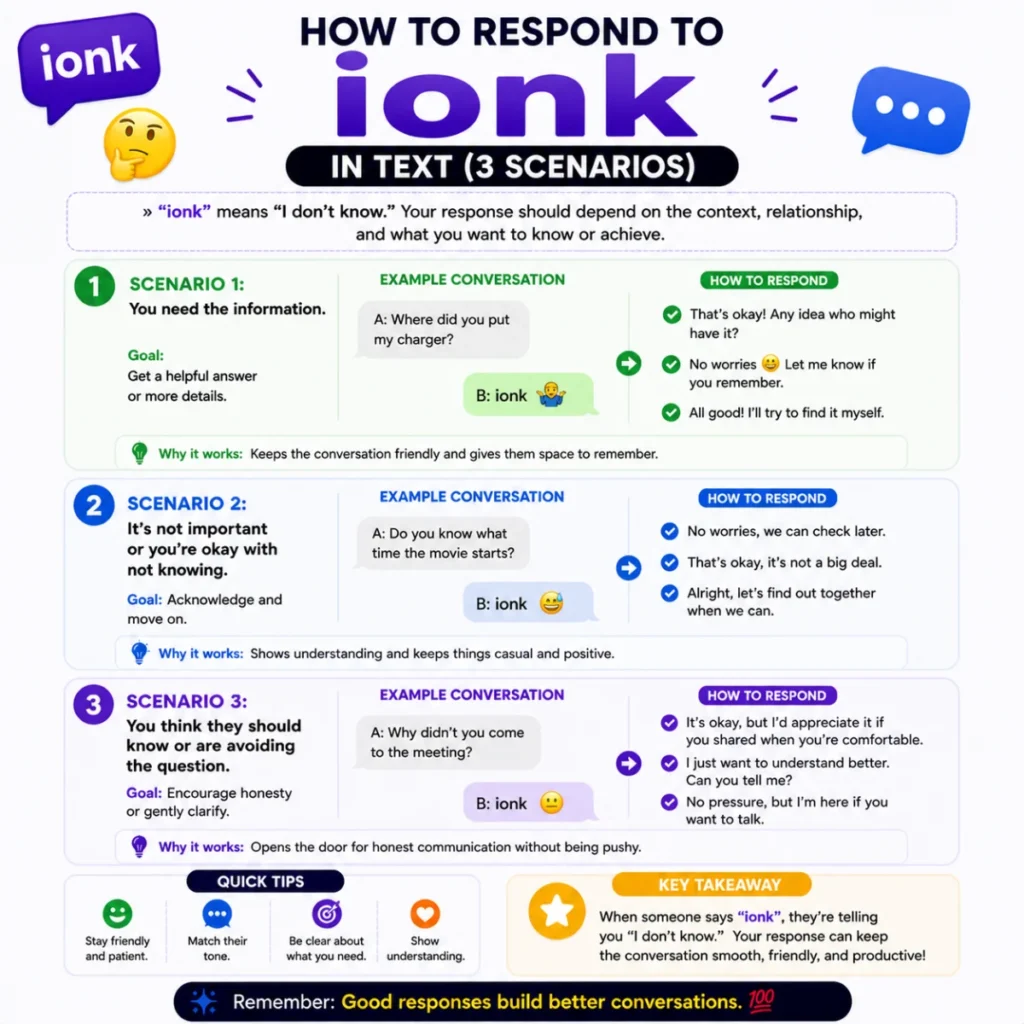
Receiving “ionk” can be confusing. Your response should depend on the context and your relationship. Here are three practical scenarios.
Scenario 1: Friendly Chat – Respond Playfully
Them: “Want to see the new Marvel movie?” You: “Ionk, haven’t heard reviews.” Your Reply: “Lol okay, I’ll send you the trailer. Lmk after!”
Here, you acknowledge their uncertainty without pressure. Pro tip: Offer a small next step to help them decide.
Scenario 2: Important Question – Gently Ask for Clarification
Them: “Can you cover my shift tomorrow?” You: “Ionk, maybe?” Your Reply: “No worries if you’re unsure. Can you check your schedule and get back to me by 8pm?”
This response respects their hesitation while moving toward a decision. Avoid getting frustrated.
Scenario 3: Repeated “ionk” – Address the Pattern
You: “What do you want for your birthday?” → “Ionk.” You: “Which color do you like?” → “Ionk.” Your Reply: “Haha, you keep saying ionk! Want me to choose for you?”
By calling it out lightly, you break the cycle. Most people don’t realize they’re overusing the term.
Professional Use: Can You Say ionk meaning in text at Work?
The short answer: No, avoid using “ionk” in professional settings. Ionk meaning in text is inherently informal and slang-driven. Consequently, it has no place in work emails, Slack channels with managers, or client messages. Here’s why:
- Perception of laziness: Colleagues may see “ionk” as unprofessional or careless.
- Ambiguity: Unlike “I don’t know” or “I’ll find out,” “ionk” offers no commitment.
- Generational gaps: Older coworkers or clients likely won’t understand the term.
That said, exceptions exist. In very casual startup environments or among close work friends on internal chat, occasional use might be tolerated. Nevertheless, even then, stick to “idk” or “not sure.” For instance: “I don’t have that info yet, but I’ll check” is always better. When in doubt, spell it out. Your professional reputation is worth more than saving two keystrokes.
Common Misconceptions About ionk meaning in text
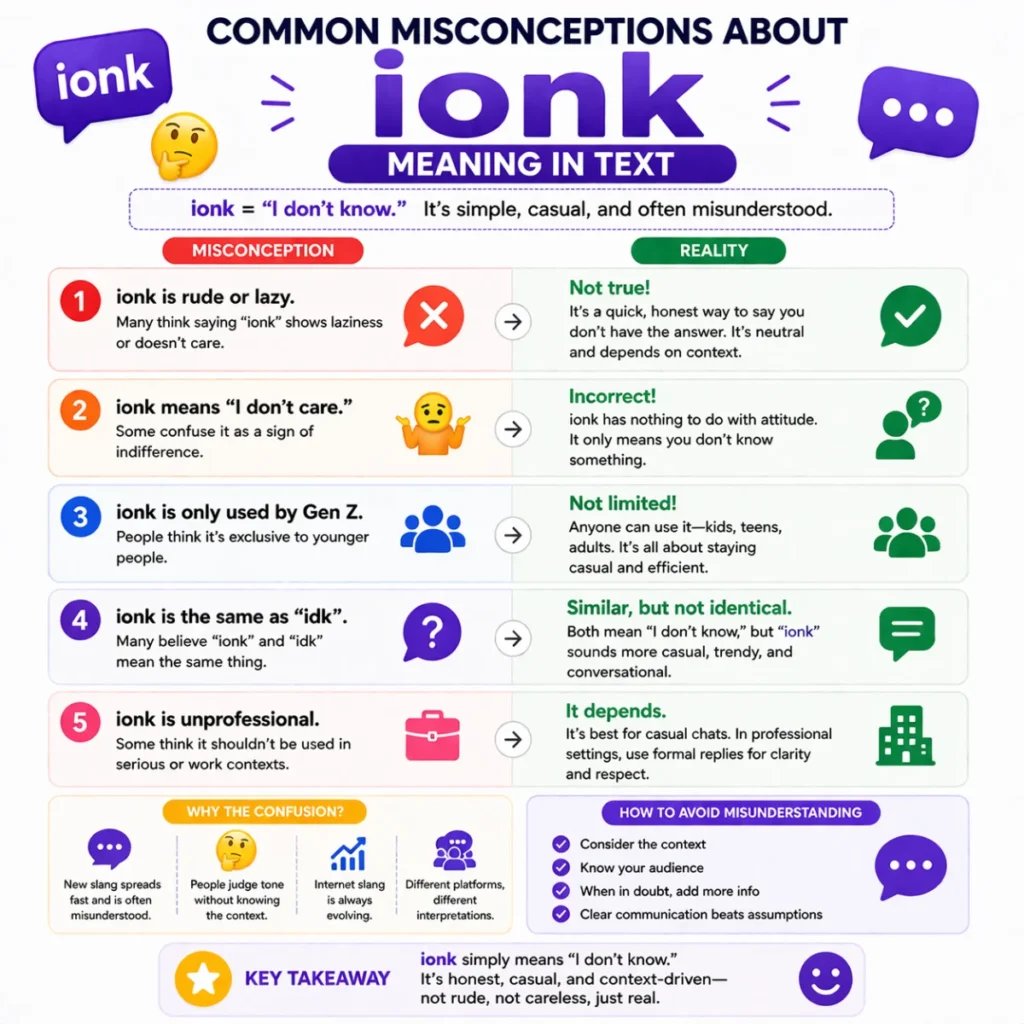
Several myths surround ionk meaning in text. Let’s debunk four of the most persistent misconceptions.
Misconception 1: “Ionk is just a typo for ‘I don’t’”
Reality: While it may look like a typo, “ionk” is a deliberate slang contraction. Users choose it for speed and style. In fact, it follows the same pattern as “ion” + “k.” Therefore, treat it as intentional, not an error.
Misconception 2: “Only uneducated people use ionk”
Reality: This is false and classist. People of all education levels use slang to build rapport and express identity. Many college graduates and professionals use “ionk” casually with friends. Slang does not measure intelligence.
Misconception 3: “Ionk always means ‘I don’t know’ – never ‘I don’t’”
Reality: Context matters. On occasion, “ionk” substitutes for “I don’t.” For example: “Ionk eat meat” means “I don’t eat meat.” However, this usage is rarer. Always check the surrounding words to be sure.
Misconception 4: “Using ionk makes you sound rude no matter what”
Reality: As covered earlier, tone and relationship determine rudeness. Among close friends, “ionk” can be affectionate or humorous. The problem arises only when overused or directed at strangers. So don’t fear the word – just use it wisely.
5 Polite Alternatives to ionk meaning in text
Sometimes you need to express uncertainty without sounding lazy or abrupt. Below are five polite alternatives to ionk meaning in text. Each one maintains clarity and respect.
Alternative PhraseWhen to UseWhy It’s Better“I’m not sure, but I’ll find out.”Work or serious questionsShows proactive attitude“Let me think about that.”When you need timeAvoids pressure to answer immediately“I don’t have that information right now.”Professional or academic settingsHonest and neutral“Good question – I’ll need to check.”Customer service or help chatsBuilds trust“Hmm, what do you think?”Collaborative decisionsInvites input instead of shutting down
Pro tip: Reserve “ionk” for fast, low-stakes texts to close friends. For all other situations, pick an alternative from the table. Your communication will be clearer, and you’ll avoid misunderstandings.
Frequently Asked Questions About ionk meaning in text
1. Is “ionk” the same as “idk”?
No, but they share the same core meaning (“I don’t know”). Ionk meaning in text is more informal and rooted in AAVE and texting culture. “IDK” is universal and works in almost any casual writing. Use “idk” if you’re unsure about your audience.
2. Can “ionk” be used in a question?
Yes, occasionally. For example: “You ionk what happened?” means “You don’t know what happened?” However, this is rare. Most people use “ionk” as a statement, not a question. Stick to standard question forms for clarity.
3. Do people pronounce “ionk” differently from “idk”?
Yes. “Ionk” is pronounced like “eye-ohnk” (one syllable, rhyming with “honk” but with a long ‘i’ sound). “IDK” is pronounced as three separate letters (“eye-dee-kay”). Some say “ionk” aloud in casual speech, especially among younger groups.
4. Is “ionk” accepted in school essays or formal writing?
Absolutely not. Ionk meaning in text is strictly informal. Teachers and professors will mark it as incorrect. Always use “I do not know” or “I don’t know” in academic writing. Even “IDK” is too casual for essays.
5. Why do some people write “ionk” instead of “ion know”?
Efficiency and phonetic spelling. “Ion know” requires a space and more characters. “Ionk” feels faster and mimics the slurred pronunciation. Over time, the compressed version became trendy. Both forms are valid in casual texting, but “ionk” is more modern.
6. What does “ionk ionk” mean? (Bonus FAQ)
Occasionally, you might see “ionk ionk” in memes or tweets. This repetition is used for emphasis or comedic effect. For example: “Ionk ionk what you’re saying lol.” It does not change the meaning – it just exaggerates uncertainty. However, this usage is rare. Do not worry about it unless you encounter heavy internet slang.
Conclusion
Understanding ionk meaning in text unlocks a common piece of modern digital language. In short, “ionk” stands for “I don’t know” (or sometimes “I don’t”). It originated from AAVE and early texting, gaining popularity through social media and gaming. As we have seen, context dramatically affects its tone – from friendly indifference to potential rudeness. Therefore, always consider your audience and relationship before using “ionk.” For professional or serious conversations, choose polite alternatives like “I’m not sure” or “Let me check.” Remember that overusing any slang can frustrate others. Nevertheless, when used correctly among friends, “ionk” is a quick, authentic way to say “I don’t know.” Now you can confidently decode and deploy this trendy abbreviation. Happy texting! 😊

Serhii Dunev is a passionate content creator dedicated to crafting meaningful texts, messages, and word inspirations. He aims to help people express their emotions clearly through simple and impactful words.