If you’ve come across SMFH in a text message, on social media, or during an online conversation, you may have wondered what it actually means. Internet slang evolves quickly, and new abbreviations appear almost every day. Some become popular for years, while others fade after a short trend. SMFH is one of those expressions that has remained common across texting apps, gaming communities, and social media platforms because it quickly conveys frustration or disbelief.
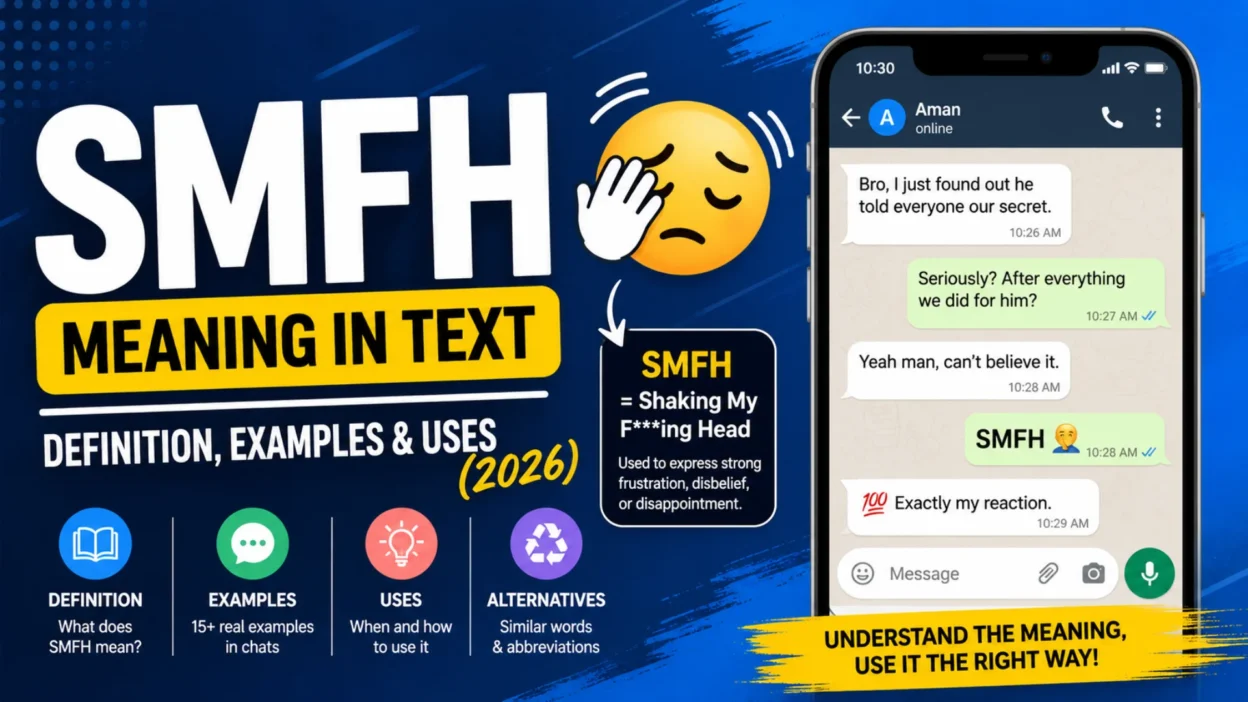
The SMFH meaning in text is usually “Shaking My F*ing Head.”** It’s a stronger version of SMH (Shaking My Head) and is often used when someone finds a situation extremely disappointing, ridiculous, or unbelievable.
However, context still matters. In many online conversations, people use SMFH humorously rather than aggressively. Understanding the tone behind the message helps you interpret it correctly.
This guide explains what SMFH means, where it’s commonly used, when you should avoid using it, and how people naturally include it in everyday digital conversations.
What Does SMFH Mean in Text?
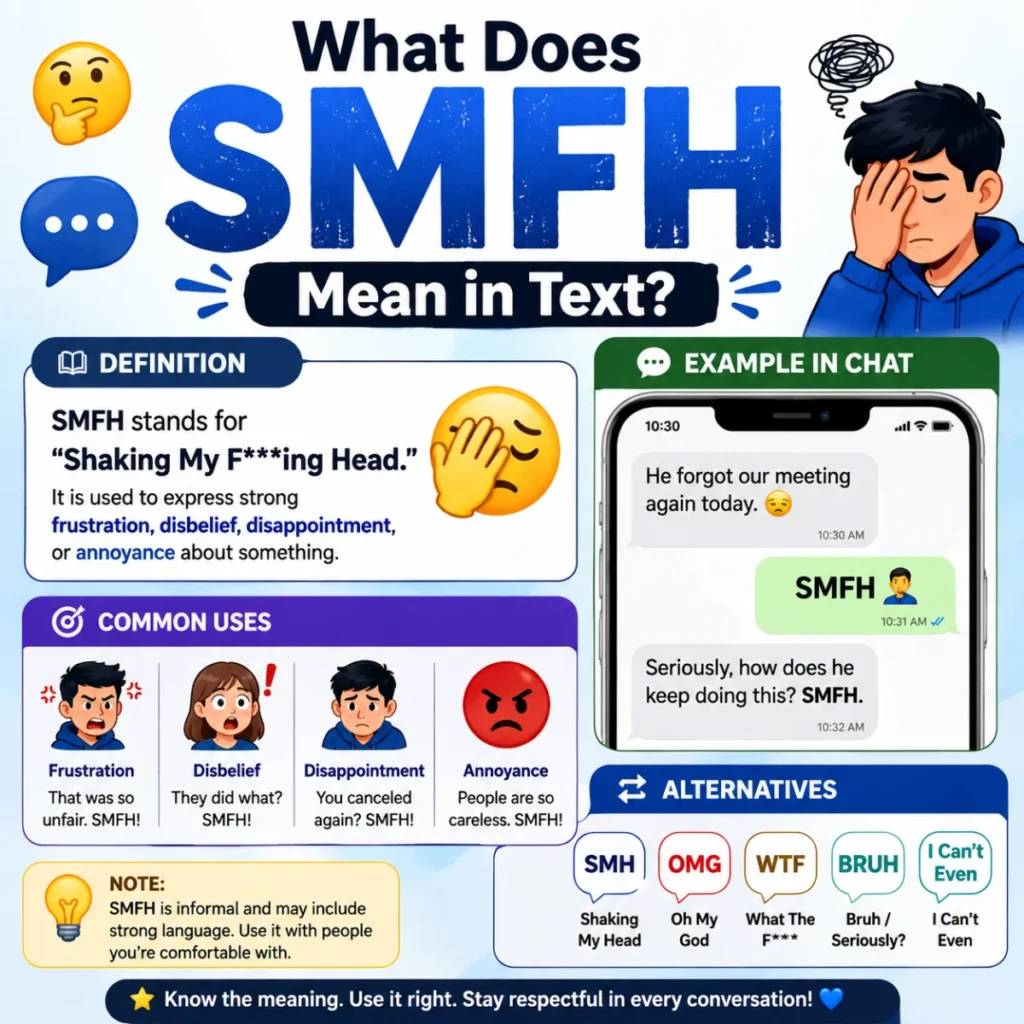
In texting and online communication, SMFH commonly stands for “Shaking My F*ing Head.”**
People use it to show a stronger emotional reaction than the shorter abbreviation SMH. Instead of expressing mild disappointment, SMFH usually emphasizes frustration, disbelief, annoyance, or embarrassment about something another person said or did.
Unlike many internet abbreviations, SMFH doesn’t usually require a long explanation because its meaning has become widely recognized across online communities.
For example:
- “You forgot your passport again? SMFH.“
- “He spoiled the movie ending for everyone. SMFH.“
- “They canceled the event five minutes before it started. SMFH.“
In each example, the sender isn’t literally shaking their head. Instead, they’re expressing disappointment in a quick, informal way.
Why Do People Use SMFH?
Digital conversations move fast. Typing a short abbreviation saves time while still expressing emotion.
People often choose SMFH because it can instantly communicate:
- Strong frustration
- Disbelief
- Disappointment
- Annoyance
- Mild sarcasm
- Emotional reactions to unexpected situations
Additionally, abbreviations like SMFH help messages sound more conversational, especially in casual chats.
Real Examples of SMFH in Text Messages
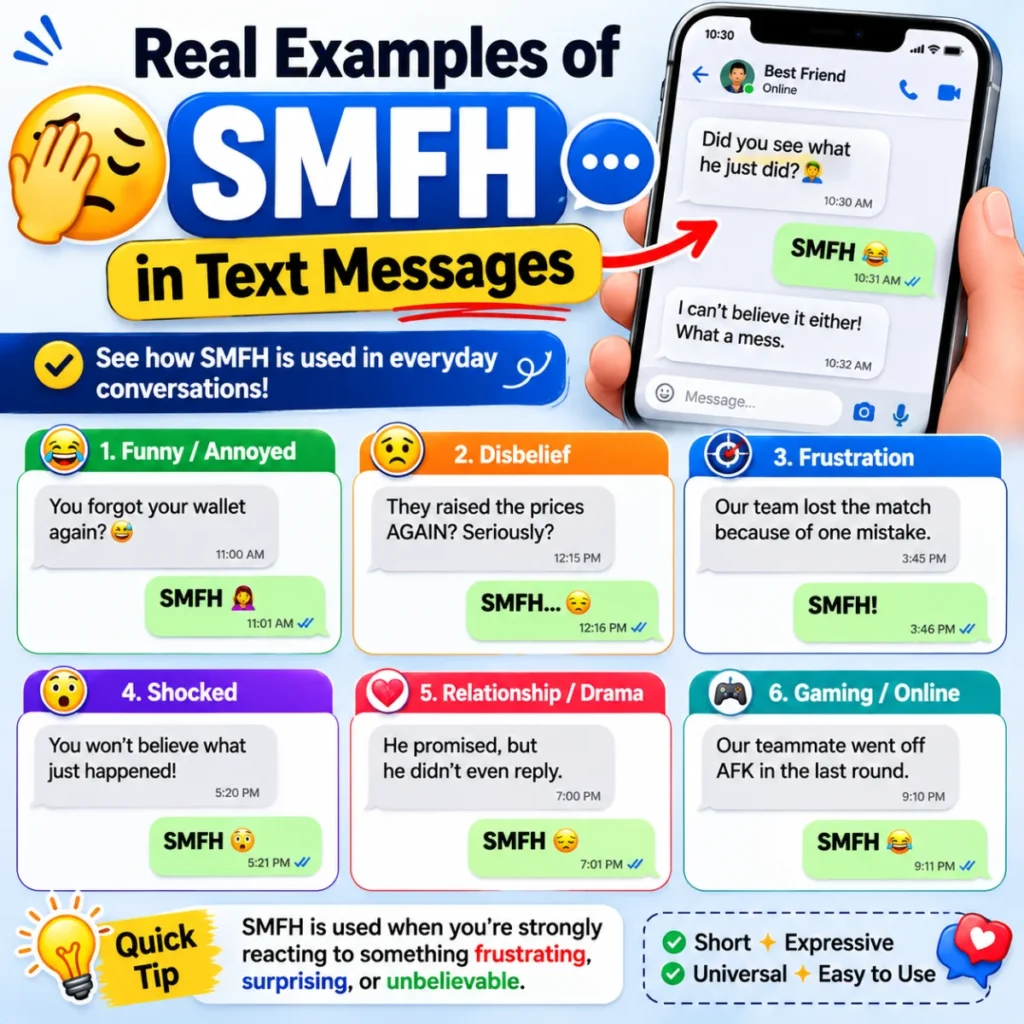
Seeing SMFH in context makes it much easier to understand.
Example 1: Friends Chatting
Alex: I left my wallet at home again.
Jordan: SMFH 😂
Here, Jordan is teasing a friend rather than criticizing them seriously.
Example 2: Social Media
“I waited two hours and they canceled the concert. SMFH.“
The user expresses frustration about an unexpected situation.
Example 3: Gaming Chat
“Our teammate quit during the final round. SMFH.“
Gamers often use SMFH after teammates make poor decisions.
Example 4: Workplace Conversation
“The meeting could’ve been an email… SMFH.”
Although humorous, this phrase may sound unprofessional depending on the workplace culture.
Example 5: Family Group Chat
Mom: Your brother forgot his birthday cake.
Sister: SMFH 😂
The abbreviation is being used playfully instead of angrily.
Is SMFH Rude?
Not necessarily.
Whether SMFH sounds rude depends on three important factors:
Your Relationship
Friends often understand playful sarcasm.
However, strangers may interpret it as disrespectful.
The Situation
A casual gaming chat is very different from a business conversation.
Using SMFH in professional settings can appear inappropriate because it includes implied profanity.
The Overall Tone
Sometimes people use SMFH alongside laughing emojis to soften the message.
For example:
“SMFH 😂 That’s the funniest mistake I’ve seen today.”
Meanwhile, writing only “SMFH.” without additional context can seem much harsher.
Where Is SMFH Commonly Used?
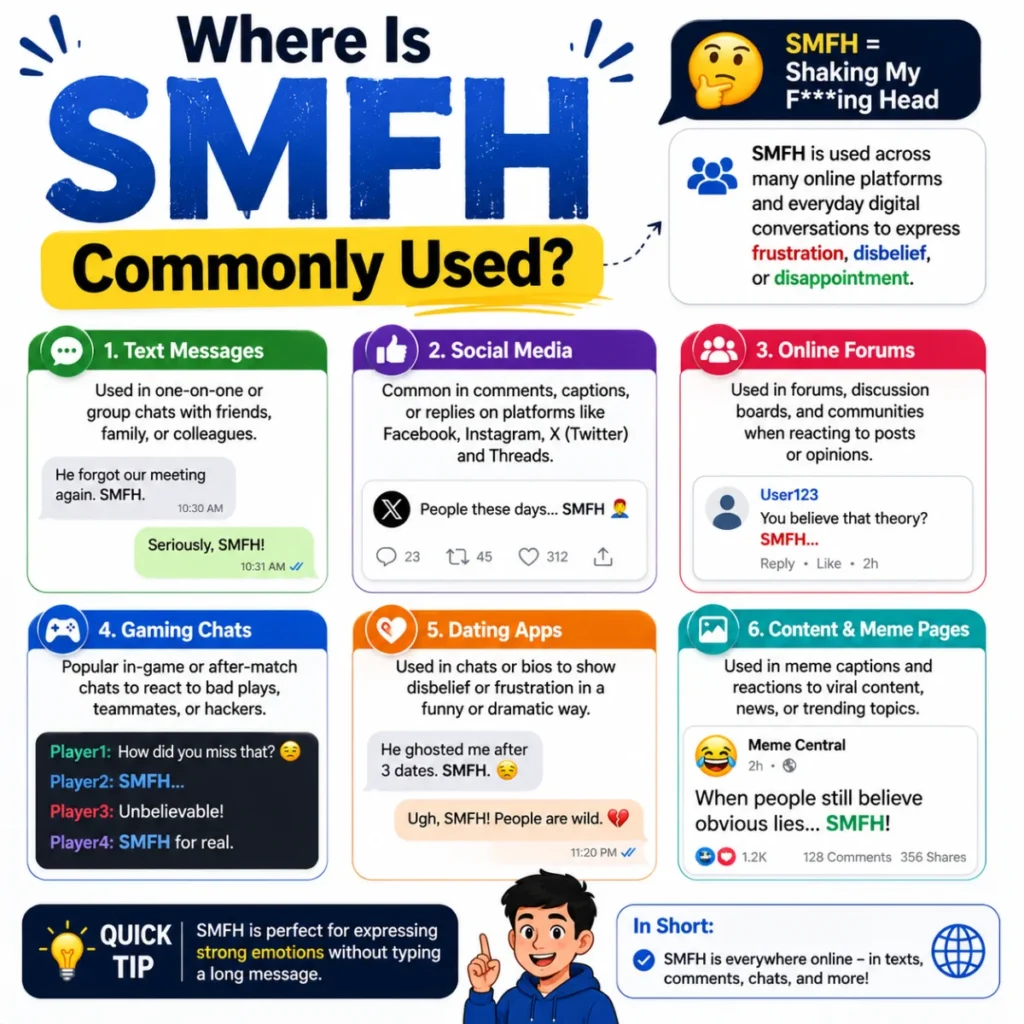
You’ll usually encounter SMFH on platforms where casual conversations happen quickly.
Common places include:
- Text messages
- Instagram comments
- TikTok replies
- Snapchat chats
- X (formerly Twitter)
- Reddit discussions
- Discord servers
- Facebook comments
- Online gaming chats
- Group messaging apps
Because each platform has a different audience, the tone may vary slightly. Nevertheless, the core meaning generally stays the same.
SMH vs. SMFH: What’s the Difference?
Many people confuse these two abbreviations because they’re closely related.
| Feature | SMH | SMFH |
|---|---|---|
| Full meaning | Shaking My Head | Shaking My F***ing Head |
| Emotion | Mild disappointment | Strong frustration |
| Profanity | No | Yes (implied) |
| Professional use | Sometimes | Generally not recommended |
| Casual texting | Very common | Common among close friends |
Choosing between them depends on how strongly you want to express your reaction.
When Should You Use SMFH?
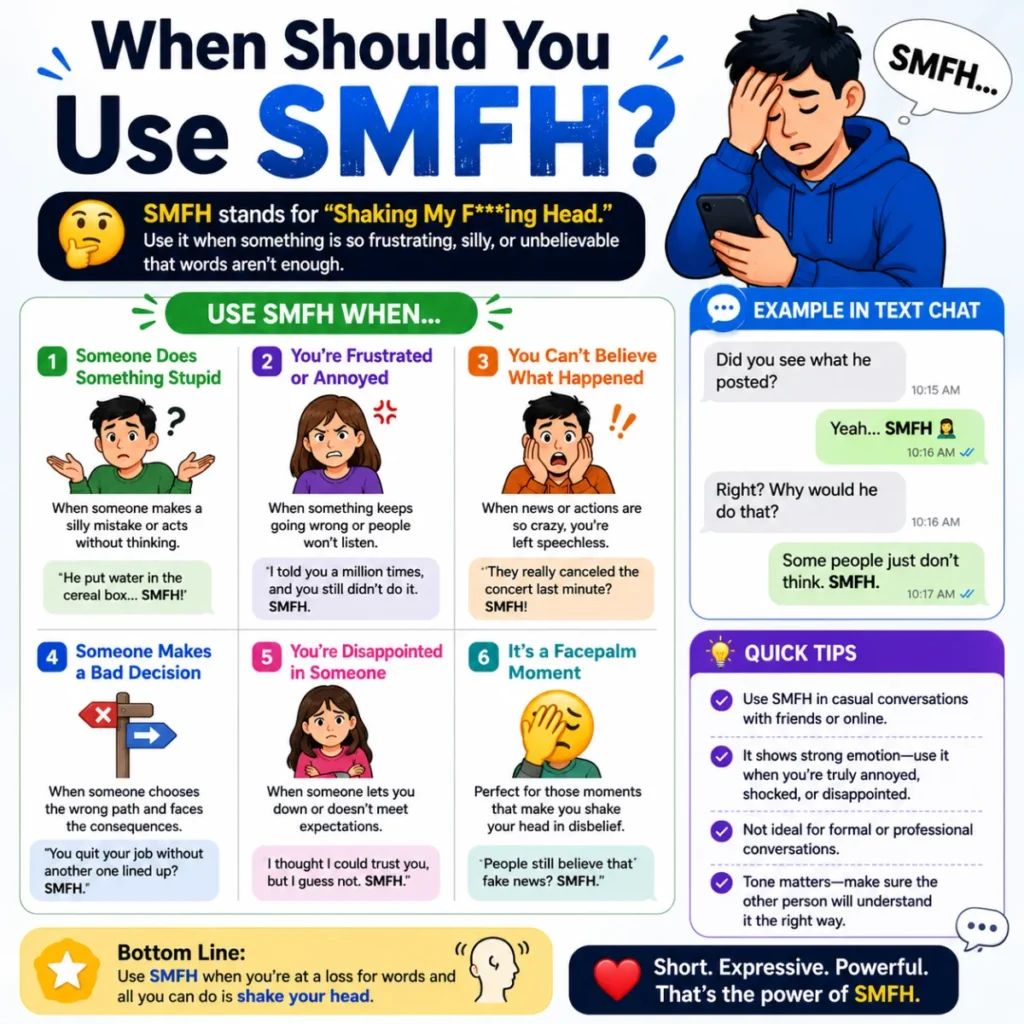
SMFH works best in casual conversations where everyone understands internet slang and informal language. It’s commonly used to react to frustrating, surprising, or unbelievable situations without writing a long explanation.
Here are some situations where using SMFH feels natural:
Someone Makes a Repeated Mistake
If a friend keeps making the same mistake, SMFH can express playful frustration.
Example:
Friend: “I locked my keys in the car again.”
You: “SMFH 😂”
In this case, the emoji softens the message and makes it sound lighthearted.
Reacting to Strange News
People also use SMFH when responding to shocking or disappointing news online.
Example:
“They increased ticket prices again. SMFH.”
The abbreviation quickly communicates disbelief without needing extra words.
During Gaming Sessions
Gaming communities frequently use SMFH after unexpected mistakes or poor teamwork.
Example:
“Our squad ignored the objective again. SMFH.”
Players often understand this as part of competitive banter rather than a personal attack.
When You Should Avoid Using SMFH
Although SMFH is popular, it isn’t suitable for every conversation.
Consider avoiding it in these situations:
- Professional emails
- Job interviews
- Customer support chats
- Academic writing
- Business meetings
- Conversations with people who may not understand internet slang
Additionally, because the abbreviation includes implied profanity, some readers may find it offensive. Choosing a more neutral expression often creates a better impression in formal settings.
Different Meanings of SMFH
The most widely accepted meaning of SMFH is “Shaking My F*ing Head.”** However, internet slang sometimes develops slight variations depending on the community or platform.
Some users interpret it as:
- Shaking My Freaking Head
- Shaking My Frustrated Head
These alternatives avoid profanity while expressing the same feeling. Even so, the original version remains the most commonly recognized meaning across texting, gaming, and social media.
How Context Changes the Meaning
Like many texting abbreviations, SMFH depends heavily on context. The same word can sound humorous, sarcastic, or genuinely annoyed depending on the conversation.
| Situation | Possible Tone |
|---|---|
| Friend forgot homework | Playful teasing |
| Team lost an easy match | Frustration |
| Viral internet video | Disbelief |
| Unexpected mistake | Mild annoyance |
| Serious argument | Strong criticism |
Reading the entire conversation before interpreting SMFH helps you understand the sender’s intent more accurately.
Common Alternatives to SMFH
Not everyone enjoys using profanity, even in abbreviated form. Fortunately, several alternatives communicate similar emotions.
| Alternative | Meaning | Strength |
| SMH | Shaking My Head | Mild |
| OMG | Oh My God | Surprise |
| WTF | Strong disbelief | Very strong |
| BRUH | Frustration or disbelief | Casual |
| Seriously? | Direct reaction | Neutral |
| Unbelievable | Expresses shock | Moderate |
| I can’t believe this | Disappointment | Moderate |
Choosing the right alternative depends on your audience and the tone you want to create.
How to Reply When Someone Sends “SMFH”
Receiving SMFH doesn’t always mean someone is angry. In many conversations, it’s simply a reaction to something surprising or frustrating.
Here are a few natural responses:
If They’re Joking
Them: “SMFH 😂”
You: “Okay, I deserved that!”
If They Sound Annoyed
Them: “SMFH.”
You: “Yeah, that wasn’t my best decision.”
If They’re Reacting to News
Them: “SMFH… they canceled it.”
You: “That’s really disappointing.”
Matching the tone of the conversation usually leads to a better response than overreacting.
Common Mistakes People Make With SMFH
Many users misunderstand SMFH because they assume every abbreviation has only one meaning. Avoid these common mistakes:
- Using it in professional communication.
- Assuming it’s always meant as an insult.
- Sending it to people unfamiliar with texting abbreviations.
- Confusing SMFH with SMH.
- Using it in sensitive conversations where empathy is more appropriate.
Understanding your audience helps you decide whether the abbreviation fits the situation.
Is SMFH Still Popular in 2026?
Yes. Although internet slang changes quickly, SMFH continues to appear across social media, messaging apps, discussion forums, and gaming communities.
That said, younger users sometimes prefer emojis, GIFs, or newer slang terms to express the same emotions. Even so, SMFH remains widely recognized and understood, making it a useful abbreviation in casual online conversations.
SMFH Across Different Platforms
Although the meaning of SMFH stays largely the same, the way people use it can vary depending on the platform.
Text Messages
In private chats, SMFH often expresses disappointment or playful frustration between friends and family.
Example:
“I told you to set an alarm. SMFH 😂”
Social Media
On platforms like Instagram, TikTok, and X, users frequently include SMFH in posts about trending news, sports, or viral videos.
Example:
“Another app outage on a Monday… SMFH.”
Gaming Communities
Gamers commonly use SMFH when reacting to poor teamwork, unexpected losses, or frustrating gameplay.
Example:
“We had the win, then everyone left the objective. SMFH.”
Online Forums
Discussion boards and community forums often use SMFH to respond to surprising opinions or controversial topics. In these cases, it usually reflects disbelief rather than direct anger.
Tips for Using SMFH Naturally
If you’re new to internet slang, these simple tips can help you use SMFH appropriately.
- Use it only in casual conversations.
- Consider your audience before sending it.
- Avoid it in professional or academic communication.
- Pair it with emojis if your intention is humorous.
- Read the conversation first to understand the tone.
- Don’t overuse it, or it may lose its impact.
Using abbreviations naturally makes online conversations feel more authentic without creating confusion.
Frequently Asked Questions
What does SMFH mean in text?
SMFH usually stands for “Shaking My F*ing Head.”** People use it to express stronger frustration or disbelief than the abbreviation SMH.
Is SMFH the same as SMH?
Not exactly. Both express disappointment, but SMFH adds stronger emphasis because it includes implied profanity. SMH is generally considered the milder version.
Is SMFH considered offensive?
It depends on the audience. Since it contains an implied swear word, some people may find it inappropriate. For that reason, it’s best reserved for casual conversations with people who are comfortable with informal language.
Can I use SMFH at work?
Generally, no. Professional emails, workplace chats, and business communication are better suited to clear, respectful language rather than slang abbreviations with implied profanity.
Why do people use SMFH instead of writing the full phrase?
The abbreviation saves time and quickly communicates emotion. It’s a convenient way to react during fast-moving conversations on messaging apps and social media.
Does SMFH always mean someone is angry?
No. In many cases, it’s used jokingly or sarcastically among friends. The surrounding conversation usually reveals whether the tone is playful or genuinely frustrated.
Are there cleaner alternatives to SMFH?
Yes. Many people prefer using SMH, “Seriously?”, “I can’t believe this,” or “Unbelievable” when they want to avoid profanity while expressing a similar reaction.
Final Thoughts
The SMFH meaning in text is most commonly “Shaking My F*ing Head.”** It’s a popular internet abbreviation used to express frustration, disbelief, or disappointment in casual digital conversations. While it’s widely recognized across texting apps, gaming communities, and social media, it’s important to remember that the implied profanity makes it unsuitable for professional settings.
Before using SMFH, think about your audience and the tone of the conversation. Friends may see it as humorous or relatable, whereas colleagues or unfamiliar contacts could interpret it differently. Understanding the context ensures you communicate clearly and avoid misunderstandings.
As online language continues to evolve, abbreviations like SMFH remain a quick and expressive way to share reactions. Knowing when—and when not—to use them helps you communicate more naturally and confidently.

Serhii Dunev is a passionate content creator dedicated to crafting meaningful texts, messages, and word inspirations. He aims to help people express their emotions clearly through simple and impactful words.