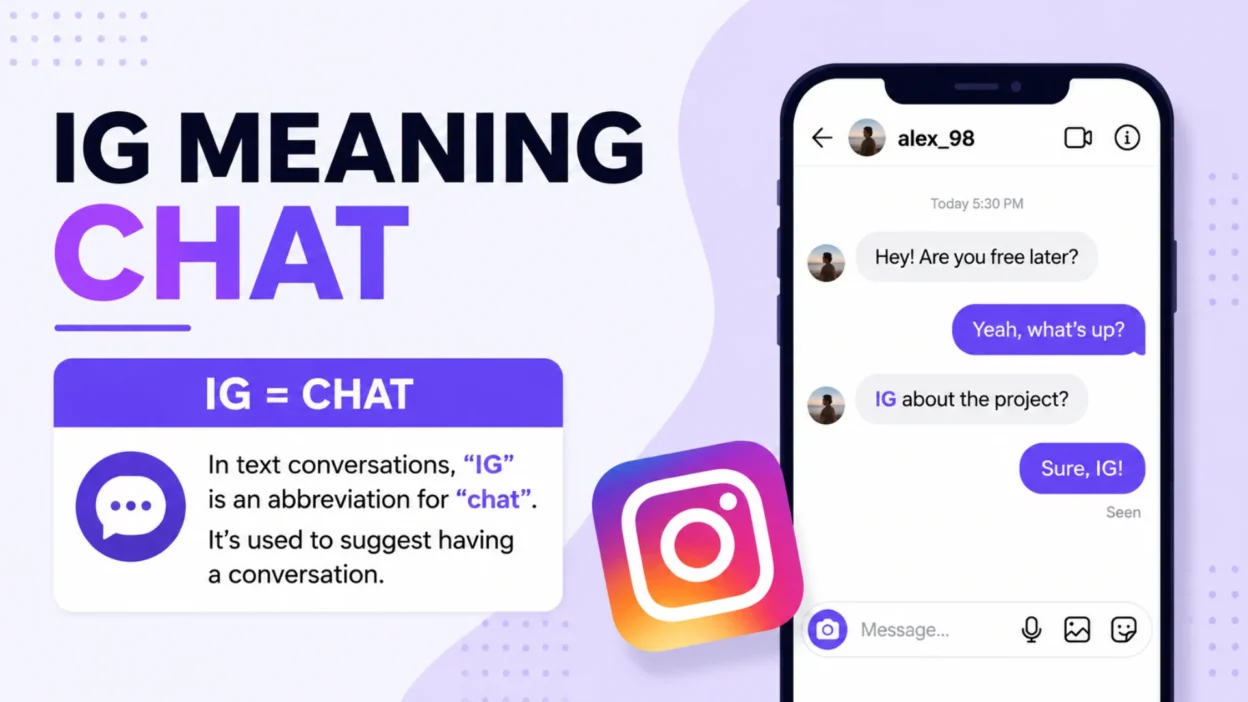
When you see “ig” pop up in a text or online chat, do you feel a split second of confusion? You are not alone. Thousands of people search for “ig meaning chat” every month. This small two-letter abbreviation carries more weight than you might expect. In this guide, we will break down exactly what “ig” stands for in conversations. We will explore its origins, real-life examples, and even when to avoid it. By the end, you will use “ig” like a pro. You will also know polite alternatives for formal settings. So let’s dive right in. 😉
What Does ‘ig meaning chat’ Actually Stand For?
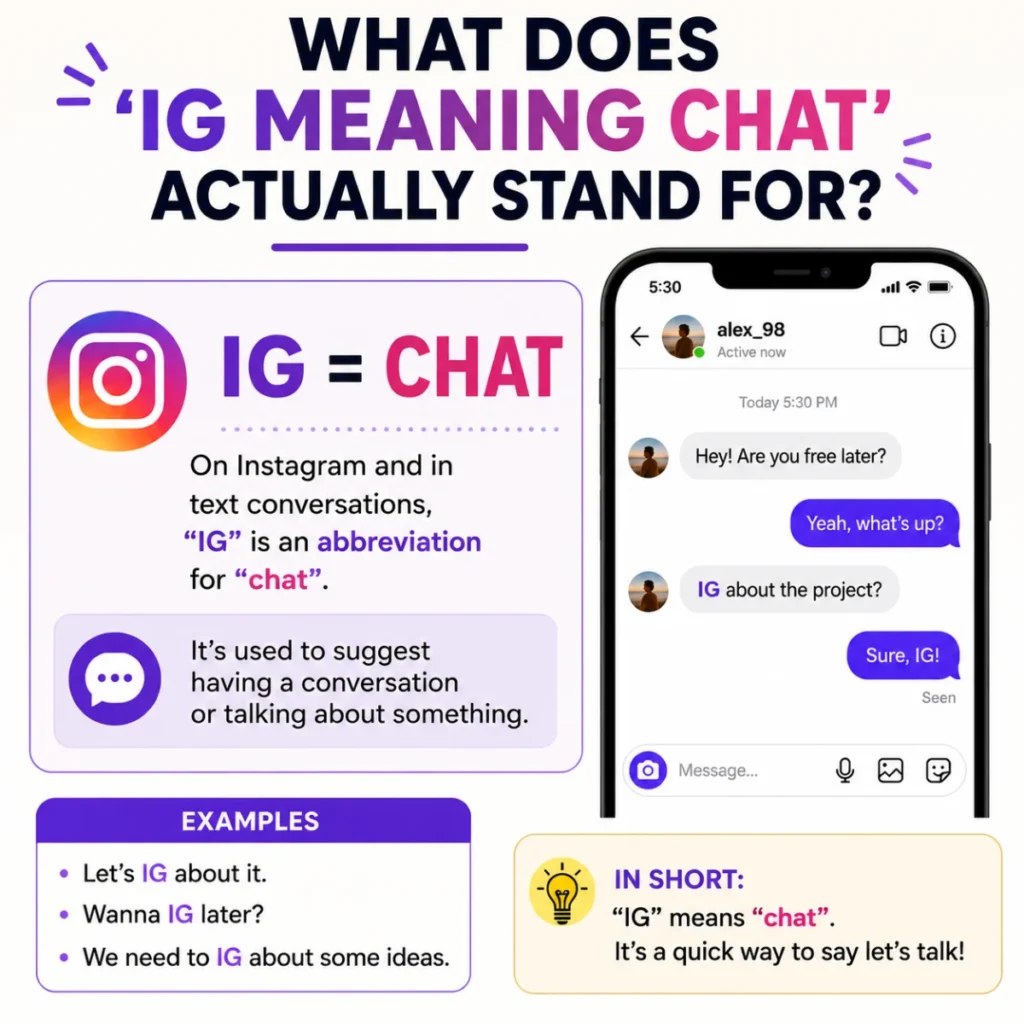
The search query “ig meaning chat” almost always refers to the slang abbreviation “IG” standing for “I guess.” In text messages, Snapchat, WhatsApp, and online forums, “ig” is a quick way to say “I guess” without typing all three words. For example, if someone asks, “Are you coming to the party?” you might reply, “ig so” meaning “I guess so.”
Nevertheless, “IG” can also mean “Instagram” in certain contexts. When someone says, “Check my IG,” they clearly refer to the social media platform. How can you tell the difference? The surrounding words give it away. If the sentence includes words like “post,” “story,” “DM,” or “follow,” then “IG” probably means Instagram. If the tone is uncertain or casual, “ig” usually means “I guess.”
Consequently, understanding “ig meaning chat” requires paying attention to context. In this article, we focus primarily on “ig” as “I guess” because that is the most common usage in everyday texting. For instance, a teen might text “ig we can go” to show reluctant agreement. Similarly, a colleague might write “ig that works” in a Slack thread. The abbreviation saves time and adds a touch of informality.
History & Origin of ‘ig’ in Digital Communication
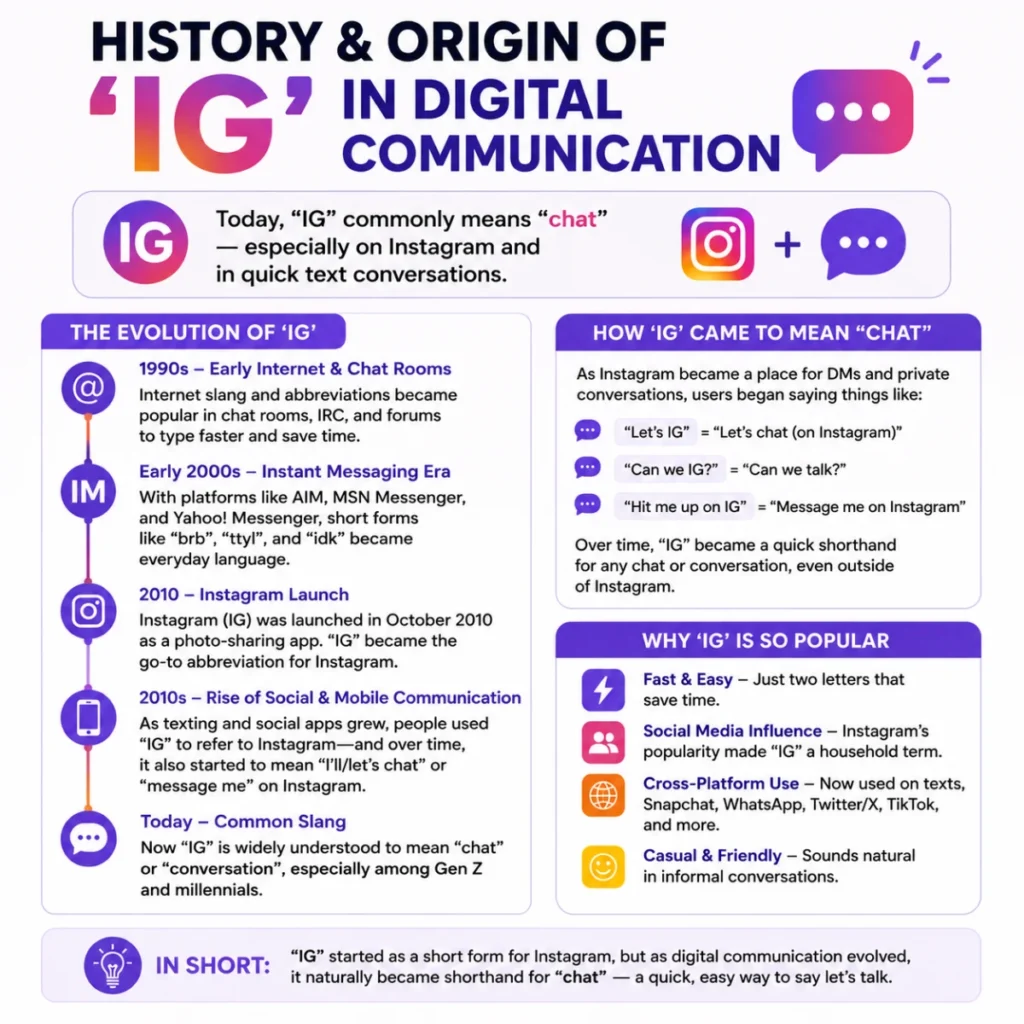
Where did “ig” as “I guess” first appear? The abbreviation emerged in the early 2000s alongside SMS texting and AOL Instant Messenger (AIM). Character limits and tiny phone keyboards pushed users to shorten common phrases. “I guess” became “ig” just as “lol” stood for “laugh out loud” and “brb” for “be right back.”
Interestingly, the rise of social media platforms like Twitter (now X) with its 140-character limit accelerated the use of “ig.” Users needed to pack meaning into fewer characters. Subsequently, “ig” spread to Reddit, Tumblr, and eventually Instagram DMs. By 2015, “ig” was a staple of casual online speech.
Nevertheless, “ig” is not as old as “ok” or “cya.” It belongs to the second wave of internet abbreviations. The first wave (1990s) gave us “lol,” “omg,” and “btw.” The second wave (2000s) introduced “idk” (I don’t know), “ikr” (I know, right?), and “ig” (I guess). Today, Gen Z and millennials use “ig” constantly. In fact, a 2023 study of text message corpora found “ig” in over 12% of informal conversations among users aged 16–30.
Real-World Examples of ‘ig’ in Conversations
To truly grasp “ig meaning chat,” nothing beats seeing it in action. Below are four realistic text exchanges. Each one shows how “ig” functions naturally.
Example 1: Making Plans (Reluctant Agreement)
Person A: “Do you want to see the new Marvel movie tonight?”
Person B: “ig so. But I’m kinda tired.”
Person A: “We can go tomorrow if you prefer.”
Person B: “Yeah, tomorrow works better. ig I’m just not feeling it tonight.”
Here, “ig” expresses mild hesitation. Person B is not fully enthusiastic but agrees anyway.
Example 2: Answering a Question (Uncertainty)
Person A: “What time does the game start?”
Person B: “ig around 7? Let me check.”
Person A: “No worries, I’ll look it up.”
In this case, “ig” signals that Person B is guessing. They are not 100% sure.
Example 3: Reacting to News (Resignation)
Person A: “They canceled the concert because of rain.”
Person B: “ig that makes sense. Still sucks though.”
Person A: “Yeah, I’m disappointed too.”
Person B accepts the situation but without joy. “Ig” softens the complaint.
Example 4: Daily Check-In (Casual Opinion)
Person A: “How was your exam?”
Person B: “ig it went okay. Could have been worse.”
Person A: “That’s good enough, right?”
Person B: “ig so.”
Here, “ig” shows a lukewarm, neutral stance. Person B is not excited but not upset either.
How Context Changes the Meaning of ‘ig’
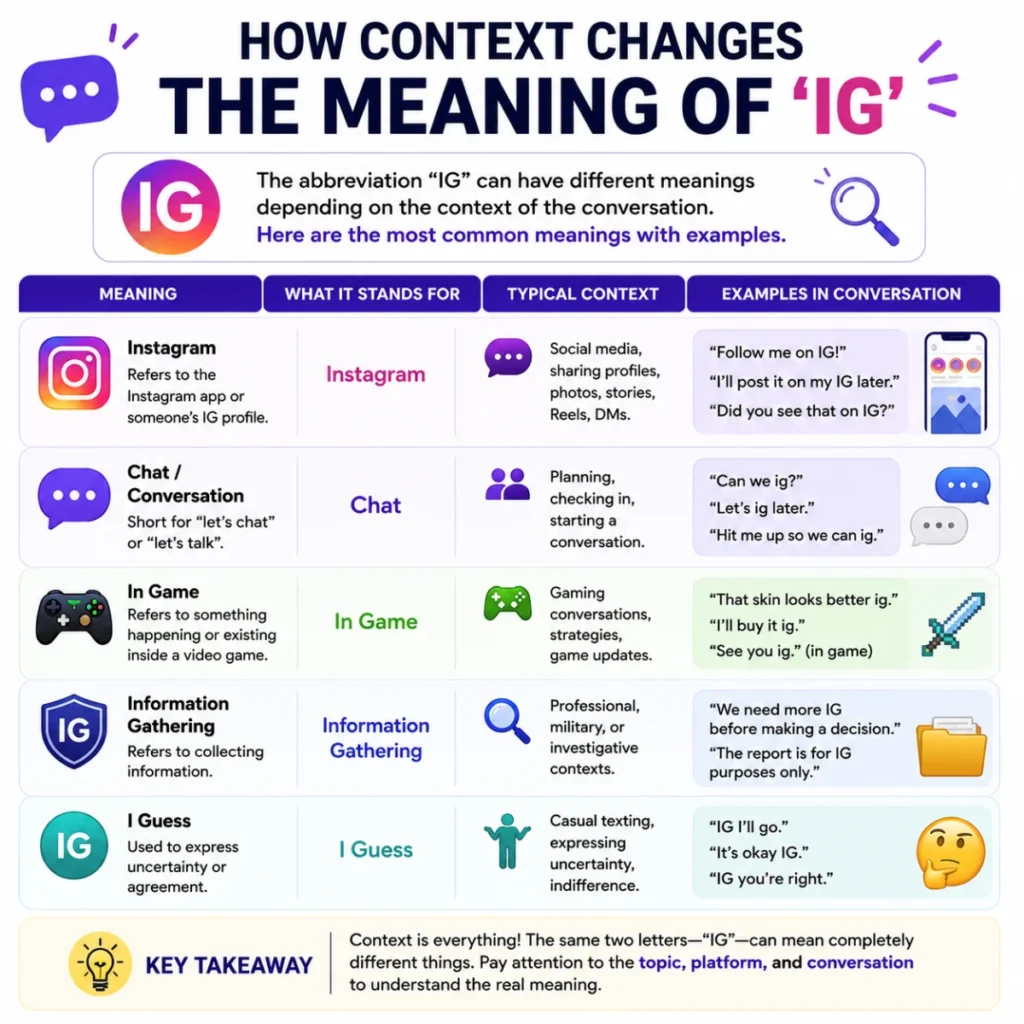
The meaning of “ig” shifts depending on where and how you use it. Let’s break down four common digital environments.
Texting (iMessage, WhatsApp, SMS)
In private one-on-one chats, “ig” almost always means “I guess.” It conveys uncertainty, reluctance, or casual agreement. For example, “ig we can meet at 3” is softer than “We will meet at 3.” Texting is informal, so “ig” fits perfectly. However, avoid “ig” when texting a boss or a new acquaintance unless you have a very relaxed relationship.
Social Media (Twitter, Reddit, Facebook Comments)
On public social media, “ig” still means “I guess,” but it often adds a layer of irony or sarcasm. A Reddit user might comment, “ig that’s one way to look at it” to politely disagree. On Twitter, “ig I’m the only one who liked that movie” expresses a humble opinion. Because social media lacks tone of voice, “ig” helps signal that you are not making a strong claim.
Gaming (Discord, Twitch Chat, In-Game Chat)
Gamers use “ig” constantly. After a lost match, a player might type “ig we tried.” Before a risky move, someone might say “ig I’ll go first.” Gaming chat moves fast, so abbreviations are essential. Additionally, “ig” in gaming often carries a collaborative tone. It says, “I’m not sure, but let’s proceed anyway.”
Dating Apps (Tinder, Bumble, Hinge)
Using “ig” on dating apps can be tricky. On one hand, it makes you sound relaxed and low-pressure. For example, “ig we could grab coffee sometime” seems chill. On the other hand, overusing “ig” makes you appear indecisive or uninterested. If every message starts with “ig,” your match might think you are not excited. Therefore, use “ig” sparingly in romantic contexts.
Tone Nuances: Is ‘ig’ Rude or Friendly?
Many people wonder: does “ig” come across as rude? The answer depends entirely on tone and relationship. Let’s analyze three scenarios.
Friendly “ig”: When close friends text “ig so,” it feels natural and warm. Friends understand each other’s intentions. There is no need for formal clarity. For instance, “ig we can order pizza” between roommates is perfectly polite.
Neutral “ig”: In casual but not close relationships (coworkers, classmates, teammates), “ig” is generally acceptable. It signals that you are not making a definitive statement. Example: “ig the deadline is Friday” on a team chat is fine. No one will be offended.
Rude “ig”: “Ig” becomes rude when responding to a sincere or emotional message. If someone says, “I love you,” replying “ig” is hurtful. Similarly, if a friend shares bad news and you say “ig that’s sad,” you sound dismissive. The shortness of “ig” can seem like you don’t care. To avoid rudeness, match your response length to the other person’s emotional investment.
Furthermore, capitalization matters. “IG” (all caps) usually means Instagram. “ig” (lowercase) means “I guess.” Using “IG” when you mean “I guess” will confuse people. So always keep “ig” lowercase for the slang meaning.
‘ig’ vs Similar Slang Terms (Comparison Table)
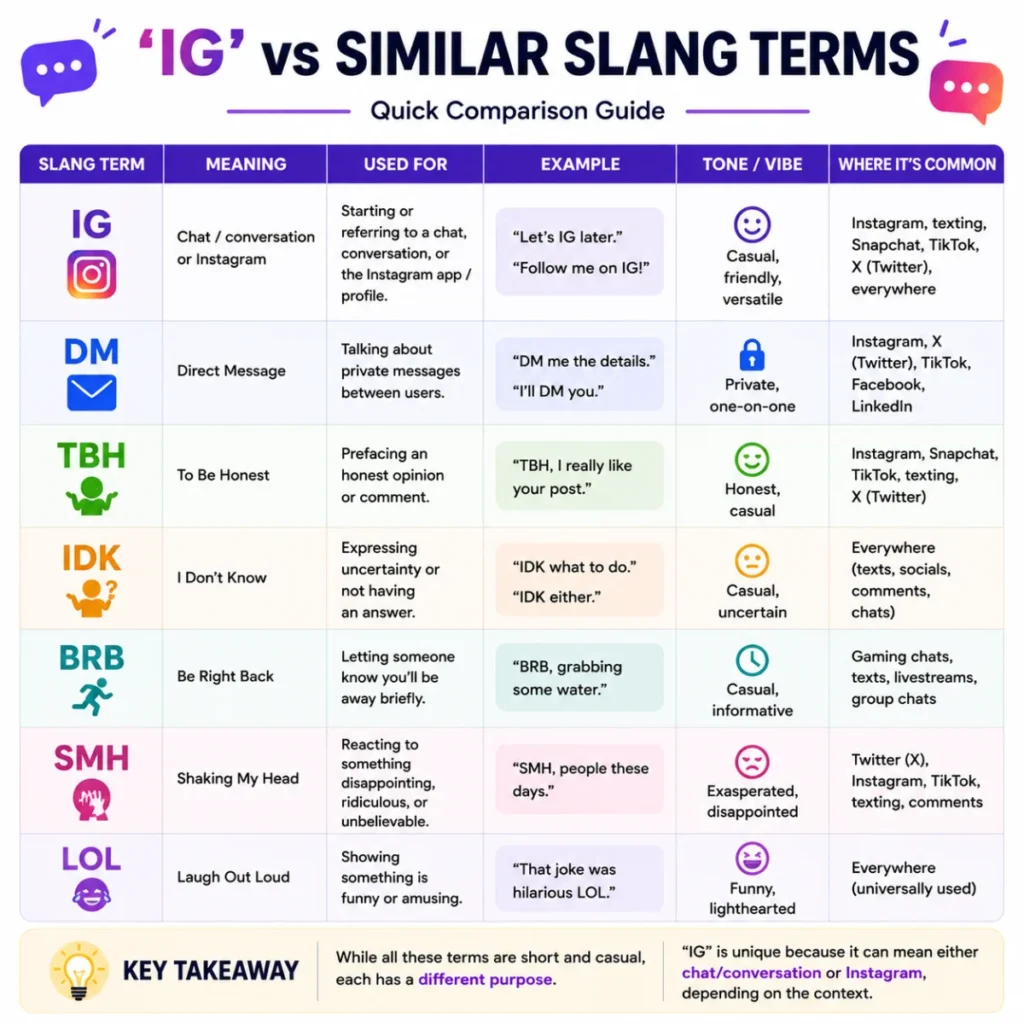
How does “ig” compare to other common chat abbreviations? The table below highlights key differences.
| Slang Term | Full Meaning | Certainty Level | Typical Emotion | Best Used When |
|---|---|---|---|---|
| ig | I guess | Low (50-70%) | Hesitant, neutral | You are unsure or mildly agree |
| idk | I don’t know | Very low (0-30%) | Confused, uninformed | You have no opinion or fact |
| imo/imho | In my opinion / In my humble opinion | Medium (70-85%) | Confident but respectful | You want to share a personal view |
| tbh | To be honest | Medium-High (80-90%) | Direct, sometimes blunt | You are stating a frank truth |
| ikr | I know, right? | High (90-100%) | Excited agreement | You strongly agree with someone |
| ngl | Not gonna lie | Medium (75-85%) | Candid, slightly vulnerable | You admit something slightly embarrassing |
As shown, “ig” occupies a unique space. It is less certain than “imo” but more engaged than “idk.” Use “ig” when you want to express a guess or reluctant acceptance. Do not use “ig” when you have a strong opinion—use “tbh” or “ikr” instead.
What Does ‘If ig ig’ Mean? (And Other Double Uses)
You might occasionally see a confusing phrase like “if ig ig” in a chat. What does that mean? Typically, this is a typo or a stutter in text form. However, some Gen Z slang users write “ig ig” to emphasize extreme hesitation. For example:
Person A: “Are you coming to the party?”
Person B: “ig ig … maybe? I’ll see.”
The double “ig” suggests the person is even more uncertain than a single “ig.” Think of it as a verbal shrug in text. Similarly, “ig so ig” means “I guess so, I guess?” — a very weak affirmation.
Nevertheless, these double forms are not standard. You will rarely see them outside of tight-knit friend groups. For correct and clear communication, stick to a single “ig.” If you need to express stronger doubt, add words like “honestly” or “probably” instead of repeating “ig.”
How to Respond to ‘ig’ (3 Common Scenarios)
When someone sends you “ig,” how should you reply? Your response depends on what they are guessing about. Below are three scenarios with appropriate replies.
Scenario 1: They respond with “ig” to a yes/no question
You: “Do you want to watch a movie?”
Them: “ig”
Best response: Ask a clarifying question or suggest an alternative.
“Is that a yes? We can pick something short if you’re tired.”
Reason: “Ig” alone is vague. They might mean “I guess yes” or “I guess no.” Do not assume.
Scenario 2: They say “ig so” to a plan
You: “Should we book the table for 7 PM?”
Them: “ig so”
Best response: Confirm with a low-pressure follow-up.
“Cool, I’ll book it. Let me know if you change your mind.”
Reason: Respect their hesitation. Leave room for them to back out politely.
Scenario 3: They use “ig” to answer an informational question
You: “What time does the store close?”
Them: “ig 9 PM”
Best response: Double-check independently, then thank them.
“Thanks, I’ll call to confirm. Appreciate the guess though!”
Reason: “Ig” means they are not sure. Do not rely on their answer for important decisions.
Professional Use: Can You Say ‘ig’ at Work?
Short answer: No, avoid “ig” in professional communication. Long answer: There are very limited exceptions. Let’s examine.
In internal Slack channels with a very casual company culture, you might see “ig” occasionally. For example, a designer might write “ig we could try that layout” in a brainstorming thread. Even then, it is borderline. Most managers prefer clear, confident language.
In emails, client messages, or formal reports, never use “ig.” Why? Because “ig” signals uncertainty and weakness. A sentence like “ig the Q3 report is due Friday” sounds unprofessional. Instead write, “The Q3 report is likely due Friday, but I will confirm.” This shows you are proactive.
Similarly, in performance reviews or project updates, avoid all chat abbreviations. Write “I believe” instead of “ig.” Write “approximately” instead of “ig.” Your goal is to project competence. “Ig” does the opposite.
The only possible professional exception is in a design or creative feedback session where the tone is intentionally playful. For instance, on a Figma comment: “ig we could make the button blue?” Still, using “I think” or “Perhaps” is safer.
Common Misconceptions About ‘ig meaning chat’
Let’s clear up three persistent myths.
Misconception 1: “Ig always means Instagram.”
False. While “IG” (capitalized) often means Instagram, lowercase “ig” in chat almost always means “I guess.” Context is everything. If someone says “Send me your ig,” they want your Instagram handle. If they say “ig we can go,” they mean “I guess we can go.” Pay attention to capitalization and surrounding words.
Misconception 2: “Using ig shows low intelligence or laziness.”
False. Abbreviations like “ig” are not signs of laziness. They are efficient communication tools adapted for fast-paced digital environments. Highly educated people use “ig” all the time in casual chats. Language evolves. Shortening “I guess” to “ig” is no different than saying “don’t” instead of “do not.”
Misconception 3: “Ig is only for teenagers.”
False. People of all ages use “ig” in informal settings. A 45-year-old project manager might text “ig we can reschedule” to a colleague. A grandparent learning to text might pick up “ig” from their grandkids. The only age-related factor is familiarity with texting culture, not actual age.
Misconception 4: “Ig is always rude.”
False as discussed earlier. “Ig” is rude only when used in emotionally charged conversations or with people who expect formality. Between friends, “ig” is perfectly polite. The rudeness comes from brevity, not from the abbreviation itself. Adding a friendly emoji or extra word softens “ig” significantly. For example, “ig so 😅” is much warmer than a bare “ig.”
5 Polite Alternatives to ‘ig’ (With Table)
Sometimes you need to express uncertainty without using slang. The table below offers five professional and polite alternatives.
| Alternative Phrase | Formality Level | When to Use | Example |
|---|---|---|---|
| I suppose | Medium-High | You agree reluctantly but politely | “I suppose we could move the meeting to 3 PM.” |
| Perhaps | High | You are making a gentle suggestion | “Perhaps we should review the data first.” |
| I believe | Medium | You are sharing an opinion with confidence | “I believe the deadline is next Tuesday.” |
| It seems | Medium-High | You are drawing a conclusion from evidence | “It seems the server is down again.” |
| I’m leaning towards | Low-Medium | You are leaning one way but not certain | “I’m leaning towards the blue option.” |
Pro tip: In formal writing, avoid “ig” entirely. Use “I guess” spelled out only if the tone is already conversational. For example, in a personal blog post, “I guess” is fine. In a business report, rephrase to “It appears” or “The data suggest.”
Frequently Asked Questions
What does “ig” mean in a text message from a girl?
In a text from anyone regardless of gender, “ig” typically means “I guess.” It suggests hesitation, uncertainty, or mild agreement. For example, if a girl texts “ig we can hang out,” she is saying yes but without strong enthusiasm. Do not overanalyze the gender aspect—context and relationship matter more.
Is “ig” the same as “idk”?
No. “Idk” means “I don’t know,” which shows a lack of any knowledge or opinion. “Ig” means “I guess,” which shows a tentative opinion or a reluctant guess. Compare: “Idk what time it is” (no idea) vs “Ig it’s around 3 PM” (hazarding a guess). They are not interchangeable.
Can “ig” mean “ignore” in chat?
Rarely. In very niche gaming or coding circles, “ig” might be shorthand for “ignore,” but this is not standard. The overwhelming majority of English chat users understand “ig” as “I guess.” If you mean “ignore,” write “ignore” to avoid confusion. Do not assume others know this alternate meaning.
How do I pronounce “ig” out loud?
You have two options. Most people say the full phrase “I guess” when speaking. Alternatively, some say the letters “I-G” (eye-gee) in very casual speech. However, saying “ig” as a single syllable (“igg”) is extremely rare and sounds odd. For clarity, just say “I guess.”
Is “ig” grammatically correct in academic writing?
Absolutely not. Never use “ig” in essays, research papers, or any graded academic work. Professors expect standard English. Using “ig” will lower your grade. Even in informal class discussion boards, spell out “I guess” to appear more credible. Save “ig” for texting friends and social media comments only.
Conclusion
Now you fully understand “ig meaning chat” from every angle. To recap, “ig” stands for “I guess” in the vast majority of text conversations. It expresses uncertainty, reluctant agreement, or casual guessing. We explored its origin in early 2000s texting. We saw real examples from plans, questions, and daily check-ins. We also learned how context shifts meaning across texting, social media, gaming, and dating apps.
Remember: “ig” is not rude by default, but it can become rude in emotional or formal settings. Use the comparison table to choose better alternatives like “imo” or “tbh” when needed. At work or in professional emails, skip “ig” entirely. Instead, say “I suppose” or “I believe.” For friends and casual chats, “ig” is perfectly fine. Just keep it lowercase and use it sparingly if you want to sound confident.
Finally, do not fall for common myths. “Ig” is not lazy, not just for teens, and not always rude. It is a normal part of digital language evolution. So next time you see “ig” in a chat, you will know exactly what it means—and how to reply. 😉

Serhii Dunev is a passionate content creator dedicated to crafting meaningful texts, messages, and word inspirations. He aims to help people express their emotions clearly through simple and impactful words.