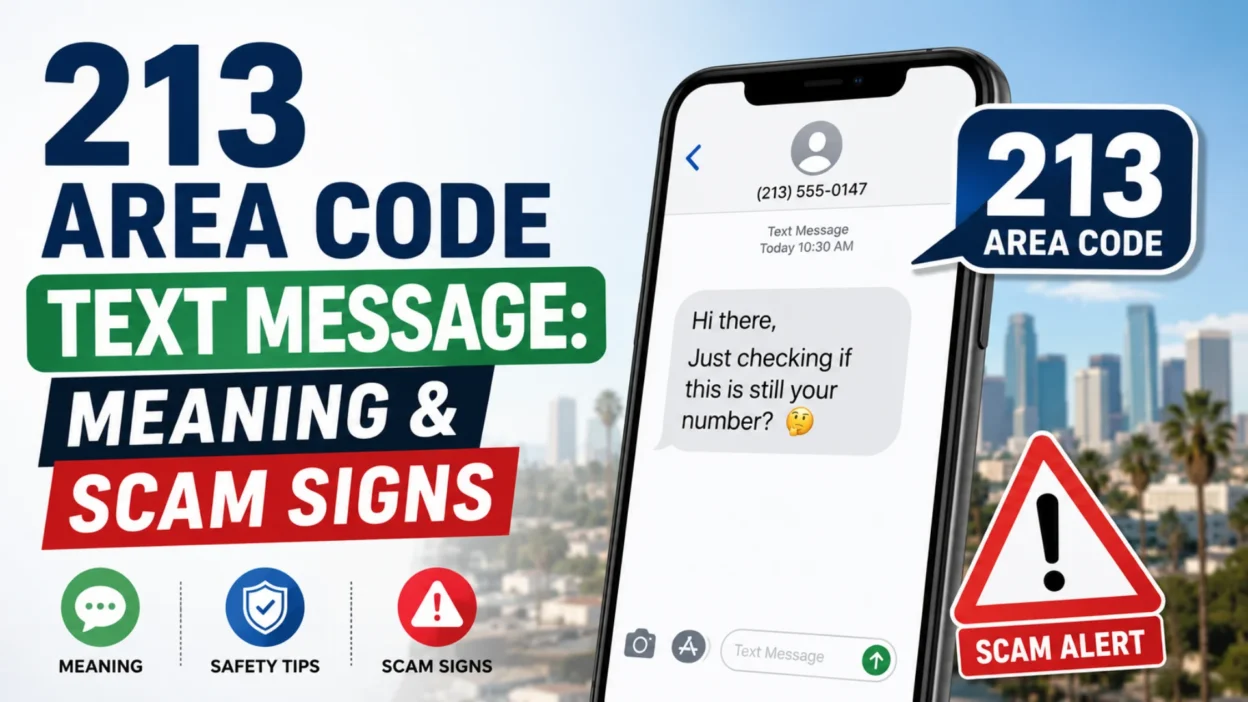
Getting a 213 area code text message from an unfamiliar number can make you wonder who sent it, why they contacted you, and whether you should respond. The good news is that 213 is a legitimate U.S. area code associated with the Los Angeles area. However, scammers can also use local-looking numbers to make unexpected messages seem trustworthy.
Therefore, seeing “213” on your screen doesn’t automatically mean the message is a scam. The content, sender behavior, links, and requests matter much more than the area code itself.
What Does a 213 Area Code Text Message Mean?
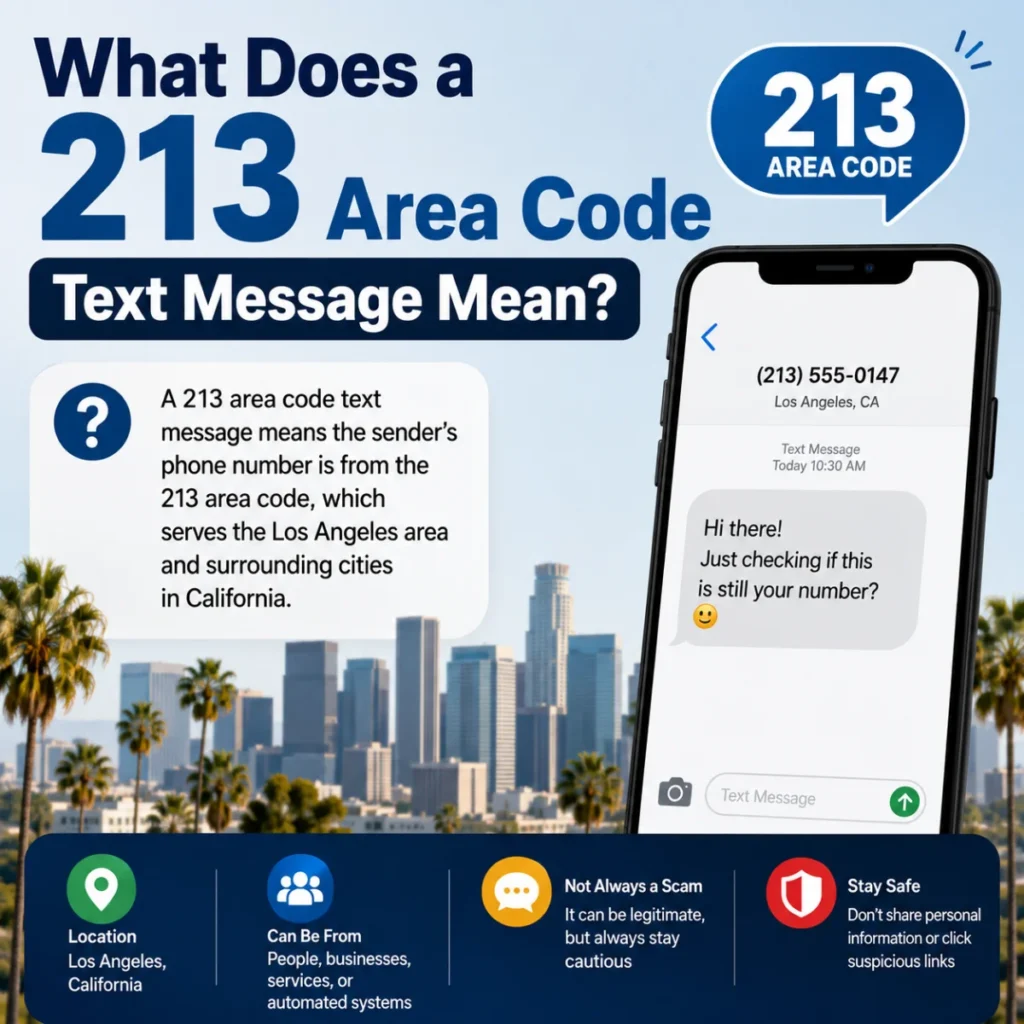
A 213 area code text message simply means the sender’s phone number displays the 213 area code. It doesn’t tell you why the person contacted you or whether the sender is legitimate.
The 213 area code is associated with central Los Angeles and surrounding communities. It has been part of California’s telephone numbering system for decades and now operates alongside other area codes serving the same broader region.
A message from a 213 number could come from:
- A genuine person living in Los Angeles
- A business using a Los Angeles phone number
- Someone who previously owned the number
- A legitimate automated service
- A marketing company
- A spammer
- A scammer using number spoofing
Consequently, the number alone isn’t enough to determine whether you should trust the message.
Why Are People Receiving Unexpected Texts From 213 Numbers?
Unexpected messages can happen for several reasons. Sometimes someone genuinely has the wrong number. In other cases, automated systems send promotional messages to large groups of people.
However, unexpected “Hello” or “wrong number” messages can also be used in scam campaigns. These messages often begin with casual conversation before the sender attempts to build trust or introduce a suspicious request.
A typical pattern may look like this:
- You receive a casual message from an unknown 213 number.
- The sender asks a harmless question.
- You reply because the message appears friendly.
- The sender continues the conversation.
- They eventually introduce a link, investment opportunity, payment request, or another unusual action.
This approach can seem more convincing than an obvious scam because the first message doesn’t necessarily ask for anything.
Is Every 213 Text Message a Scam?
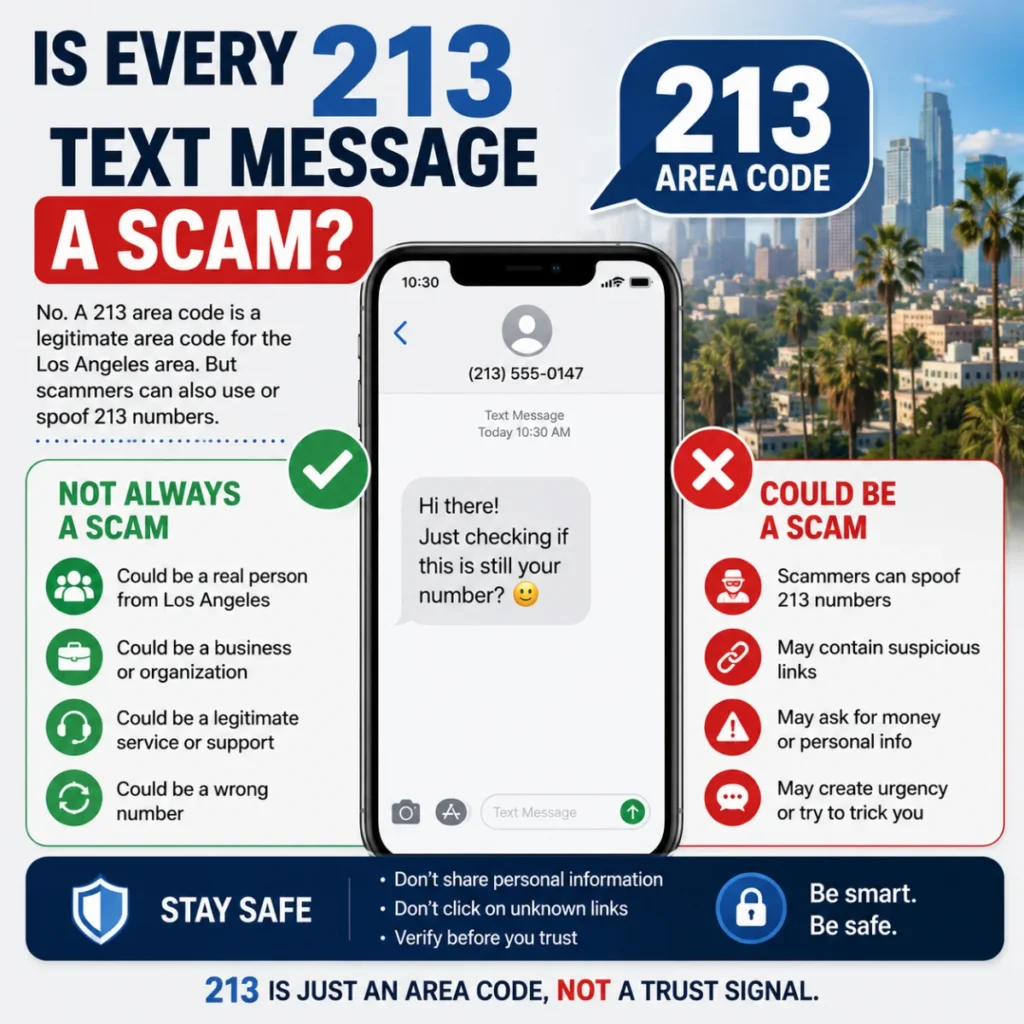
No. A 213 number is a legitimate telephone number associated with California.
This distinction matters. Treating every 213 number as fraudulent could cause you to ignore legitimate messages from people and businesses in the Los Angeles area.
At the same time, you shouldn’t assume a message is genuine simply because the number looks local. Scammers can manipulate caller identification and use numbers that appear familiar.
The safest rule is simple: judge the message by its behavior, not by the first three digits.
Common Signs of a 213 Text Scam
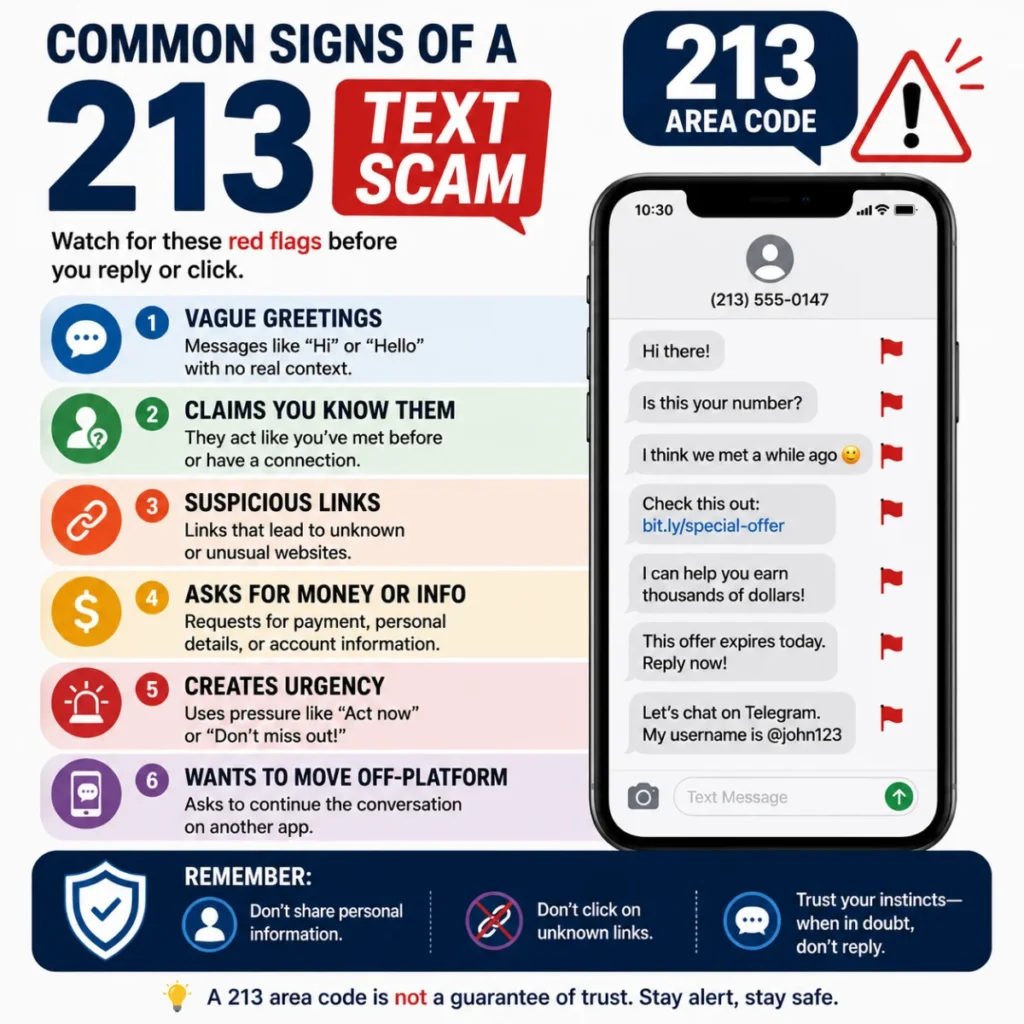
Certain patterns should make you more cautious. No single sign proves that a message is fraudulent, but several warning signs together can indicate a problem.
1. The Message Starts With a Vague Greeting
Messages such as “Hello,” “Hi,” or “Are you busy?” provide almost no context.
A genuine contact who knows you will usually have a clear reason for messaging. When an unknown person starts with a vague greeting, avoid feeling obligated to respond.
2. The Sender Claims You Know Each Other
The person might write:
“Hey, is this Mike?”
Or:
“Long time no talk. How have you been?”
If you don’t recognize the number, don’t confirm your identity simply because the sender uses a familiar name.
3. The Conversation Quickly Becomes Personal
Some suspicious messages attempt to create familiarity unusually fast. The sender may ask where you live, what you do, whether you’re available, or other personal questions.
That information can later support social engineering.
4. The Sender Sends a Link
An unexpected link deserves extra caution.
The link might supposedly lead to:
- A delivery update
- A bank account
- A prize
- A job application
- A social media page
- A payment request
- An account verification page
Don’t click simply because the message looks professional.
5. The Sender Creates Urgency
Words such as “immediately,” “final notice,” or “your account will close today” are designed to push you into acting before you think.
Legitimate organizations can use urgent language too. Therefore, verify the claim independently instead of trusting the message.
6. The Sender Requests Money or Sensitive Information
Be especially careful if an unknown sender asks for:
- Passwords
- Verification codes
- Bank details
- Credit card information
- Government identification numbers
- Cryptocurrency
- Gift cards
- Direct payments
An unexpected text isn’t a safe place to provide sensitive information.
Examples of Suspicious 213 Text Messages
The wording can change frequently, but suspicious messages often follow recognizable patterns.
Message PatternWhy It Deserves Caution“Hello, are you free today?”Provides no clear context“Is this still your number?”May test whether the number is active“I think I saved your number incorrectly.”Can be used as a conversation opener“Your package is waiting. Confirm here.”May lead to a phishing page“You won a reward. Claim it now.”Unexpected prize request“Your account needs verification.”Could imitate a legitimate company“Can we continue on another app?”May move the conversation elsewhere“I have an investment opportunity for you.”Possible financial scam
These examples don’t prove that a particular message is fraudulent. Instead, they show patterns that deserve careful attention.
What Should You Do After Receiving a Suspicious 213 Text?
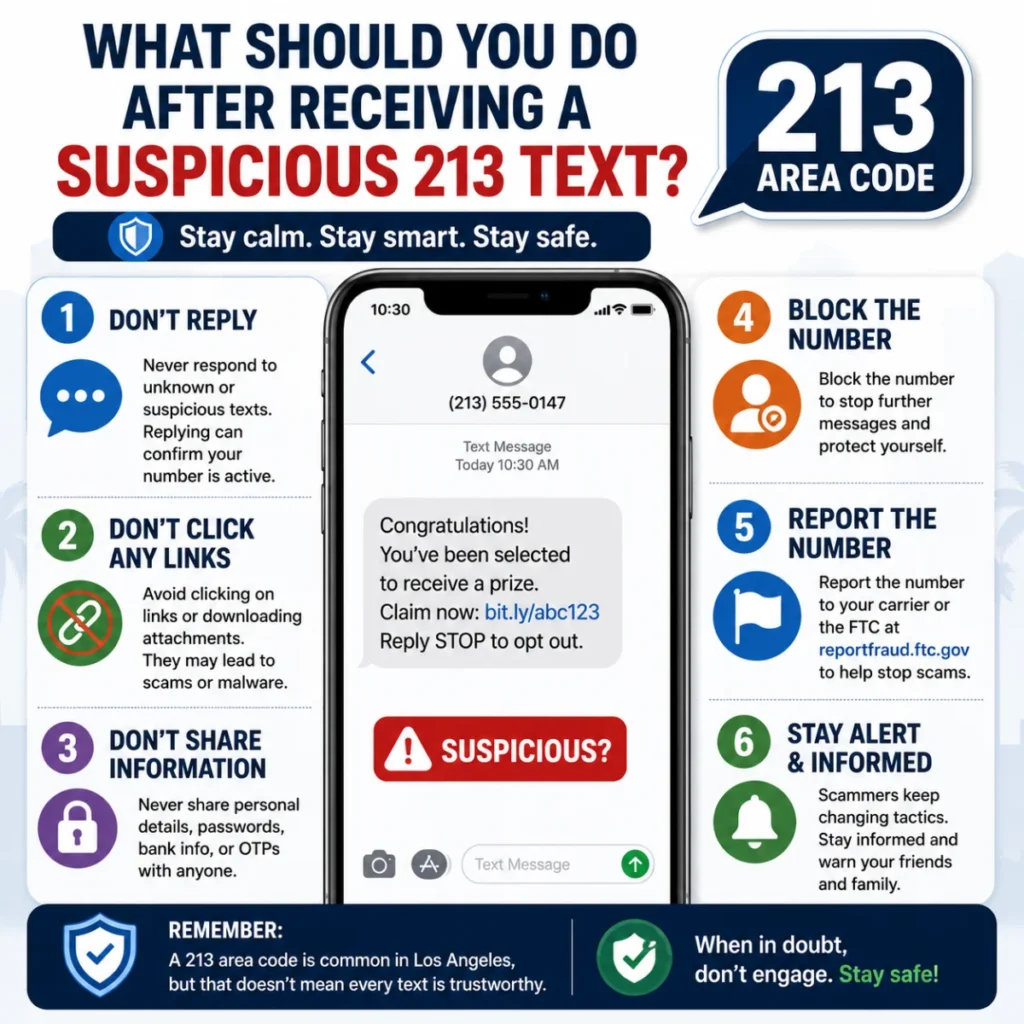
The safest response is often no response at all.
Start by checking whether you recognize the sender. If you don’t, avoid clicking links or opening unexpected attachments.
Next, consider whether you were actually expecting a message from the person or company mentioned. If a text claims to come from your bank, delivery company, employer, or another service, contact that organization through a trusted channel instead of using information contained in the message.
If the message clearly looks like spam, block the sender and use your phone’s spam-reporting feature when available.
Most importantly, don’t reply simply to ask who the person is. A response may confirm that your number is active and encourage additional messages.
Should You Reply to a 213 Area Code Text?
Usually, you don’t need to reply to an unknown 213 number.
If the message comes from someone you genuinely recognize, normal conversation is fine. However, if the sender is unknown and the message seems vague, promotional, threatening, or unusually personal, silence is safer.
Consider these situations:
Known contact: Reply normally if you recognize the person and the context makes sense.
Possible wrong number: You can ignore it. You don’t have to correct a stranger.
Suspicious link: Don’t click or reply.
Financial request: Stop communicating and verify independently.
Threatening message: Preserve evidence and consider reporting it through an appropriate channel.
Expected business message: Verify the company independently before taking action.
Why “Wrong Number” Texts Can Become Dangerous
A wrong-number message may look innocent because it doesn’t immediately ask for money.
That’s part of what can make the tactic effective.
A scammer may first create a friendly conversation. After several exchanges, they might introduce an investment opportunity, ask for personal information, or suggest moving the conversation to another messaging platform.
The important point is that the first message may not contain the actual scam.
Instead, it can serve as an opening.
This is why an innocent-looking conversation shouldn’t automatically earn your trust.
213 Area Code vs. the Actual Phone Number
An area code tells you very little about the current identity of a caller or texter.
For example, a number displaying 213 may have been assigned to a legitimate subscriber in the Los Angeles area. Yet scammers can use techniques that make their numbers appear local.
The same principle applies to other area codes. A familiar-looking number should never be treated as proof of identity.
Therefore, if someone claims to represent a company, verify the claim through a separate and trusted channel.
For example, if a text supposedly comes from your bank, don’t use the phone number or link in the message. Open your bank’s official app yourself and check your account there.
How to Check Whether a 213 Number Is Suspicious
You can investigate without engaging with the sender.
First, consider whether you recognize the complete number. Then think about whether you were expecting contact from anyone in the Los Angeles area.
Public caller-reporting services may contain complaints about particular numbers. However, such reports aren’t perfect. Numbers can change owners, and databases can contain outdated or user-submitted information.
A better approach combines several clues:
- Do you recognize the sender?
- Were you expecting the message?
- Does the message contain a suspicious link?
- Does it request money or personal information?
- Does it create unusual urgency?
- Does the sender avoid answering basic questions?
- Does the conversation quickly become financial or romantic?
- Does the sender pressure you to move to another app?
The more warning signs you see, the less reason you have to continue the conversation.
What If You Already Replied?
Don’t panic.
Replying to a suspicious text doesn’t automatically mean your phone or accounts have been compromised.
If you only responded with something harmless, stop engaging and block the number. Avoid giving additional information.
If you clicked a suspicious link, take extra precautions. Close the page and avoid entering any further information.
If you entered a password, change it through the legitimate website or app. Use a unique password where possible, and enable multi-factor authentication if the service supports it.
If you provided financial information, contact your bank or card provider through an official channel as soon as possible.
The appropriate response depends on what information or access you actually provided.
How to Block a Suspicious 213 Number
Blocking an unwanted number is usually straightforward.
On iPhone
Open the conversation, tap the contact or number at the top, and look for the option to block the caller. You may also see a spam-reporting option depending on your messaging setup.
On Android
The exact steps vary by phone manufacturer and messaging application. In many Android messaging apps, you can open the conversation, access the message options, and select the block or report-spam option.
Because Android interfaces differ, the wording may not look identical on every device.
Blocking prevents further ordinary communication from that number, but it doesn’t guarantee that the same scammer can’t contact you from another number.
How to Report a Suspicious Text
If a message appears to be spam or fraud, reporting it can help your mobile provider and messaging service identify abusive activity.
Your phone’s messaging app may provide a Report Spam option. Some carriers also provide methods for reporting unwanted messages.
When reporting a suspicious message, keep useful evidence such as:
- The sender’s number
- The original message
- Screenshots
- Suspicious URLs
- Payment instructions
- Dates and times
- Any follow-up messages
Don’t delete important evidence before saving it if you believe you’ve encountered fraud.
Common Mistakes People Make With Unknown Texts
Several reactions can make a suspicious message more effective.
Mistake 1: Assuming a local number is trustworthy. A 213 number can be legitimate, but its appearance doesn’t verify the sender.
Mistake 2: Clicking before thinking. A link can lead to a fake login or payment page.
Mistake 3: Replying out of curiosity. Even a simple response can encourage further communication.
Mistake 4: Sharing verification codes. Never provide a one-time security code to an unknown texter.
Mistake 5: Continuing because the sender seems friendly. Scammers often rely on conversation and trust-building rather than immediate demands.
Mistake 6: Assuming every unexpected message is harmless. Some scams begin with nothing more than a casual greeting.
A Quick Safety Checklist for 213 Text Messages
When an unfamiliar 213 number contacts you, use this quick test:
- Recognize the sender? If not, stay cautious.
- Expecting the message? If not, don’t rush.
- Contains a link? Don’t open it until verified.
- Requests information? Don’t provide it.
- Requests money? Stop and verify independently.
- Creates urgency? Take a step back.
- Feels like a wrong-number conversation? Don’t engage unnecessarily.
- Seems fraudulent? Block and report it.
This approach works because it focuses on the sender’s behavior instead of making assumptions based solely on geography.
213 Area Code Text Message: Myths vs. Facts
MythFactEvery 213 text is a scam.213 is a legitimate California area code.A local-looking number proves the sender is local.Numbers can be spoofed or used through internet-based services.Replying “Who is this?” is always harmless.It can encourage further communication from a suspicious sender.Every wrong-number text is fraudulent.Some can be genuine mistakes, although scammers also use this approach.Blocking one number ends every scam.A scammer may use another number later.A search result proves a number is fraudulent.Public reports are useful clues, not definitive identity verification.
Is 213 Used Only for Los Angeles?
The 213 area code is strongly associated with Los Angeles, particularly the central Los Angeles region. However, the broader 213/323 region covers multiple communities, and additional overlay numbering has expanded available numbers in the area.
So, if someone has a 213 number, the area code alone doesn’t establish their exact current location.
Someone could keep a 213 number after moving elsewhere. Likewise, a business may use a 213 number while serving customers far beyond the local area.
When a 213 Text Message May Be Legitimate
Not every unexpected text deserves suspicion.
A 213 message may be legitimate if:
- You recently contacted a Los Angeles business.
- A friend or colleague has a 213 number.
- You requested a service using that number.
- Someone changed their phone number.
- A company you already use has a 213 customer-service number.
- You recognize the sender and the conversation makes sense.
Even then, follow normal security practices if the message asks you to log in, pay money, or disclose sensitive information.
A legitimate-looking message can still contain an incorrect or compromised link, so independent verification remains useful.
The Safest Way to Handle an Unknown 213 Number
You don’t need to become an expert in phone scams to protect yourself.
Pause before responding. Look at the message objectively. Ask why an unknown person would be contacting you and what they want you to do.
If there’s no clear reason for the message, you can simply ignore it. If the sender introduces money, personal information, links, urgency, or unusual requests, increase your caution.
Ultimately, 213 is an area code, not a trust rating.
The safest approach is to verify unexpected claims independently, avoid suspicious links, protect personal information, and report messages that appear fraudulent.
FAQs About 213 Area Code Text Messages
Is a 213 area code text message always a scam?
No. 213 is a legitimate California area code associated with the Los Angeles region. However, scammers can also use or spoof 213 numbers, so evaluate the message itself.
Why did a 213 number text me “Hello”?
It could be a genuine wrong number, but generic greetings can also be used in scam campaigns. If you don’t recognize the sender, there’s usually no need to continue the conversation.
Should I text back to a 213 number?
If you don’t recognize the sender, ignoring the message is generally safer. Don’t respond simply to satisfy your curiosity, especially if the message contains other warning signs.
Can a 213 number be spoofed?
Yes. The displayed phone number isn’t reliable proof of the sender’s identity. Spoofing can make a message or call appear to come from a familiar or local number.
What should I do if a 213 text contains a link?
Don’t click it immediately. If the message claims to come from a company, visit that company’s official app or website independently and verify the claim.
What if I already clicked the link?
What you should do depends on what happened afterward. If you entered a password or financial information, secure the affected account or contact the relevant provider through an official channel.
Does blocking a 213 number stop the scam?
Blocking can stop that particular number from contacting you through normal messaging, but scammers can use different numbers. Reporting the message can also be useful.
Is 213 a Los Angeles area code?
Yes. The 213 area code is associated with the Los Angeles region, particularly central Los Angeles and nearby communities. The area also uses other overlay area codes.
Final Thoughts
A 213 area code text message isn’t automatically dangerous, but an unexpected message deserves a closer look. The area code is legitimate, while scammers can use local-looking numbers to make their messages appear more credible.
If you don’t recognize the sender, don’t feel pressured to respond. Check for vague greetings, suspicious links, urgent demands, requests for money, and attempts to collect personal information.
When something feels unusual, pause and verify it through a trusted channel. A few extra seconds can prevent a much bigger problem.

Serhii Dunev is a passionate content creator dedicated to crafting meaningful texts, messages, and word inspirations. He aims to help people express their emotions clearly through simple and impactful words.