When a colleague loses a loved one, finding the right words feels impossible. You want to show you care without overstepping. You want to be supportive without sounding rehearsed. A short condolence message professional in tone can bridge that gap. It acknowledges the loss, offers genuine sympathy, and respects the boundary between personal grief and workplace relationships. Whether you’re writing to a coworker, a client, or your boss, the goal remains the same: communicate compassion in a way that feels sincere and appropriate. This guide will walk you through exactly how to do that, with practical examples you can adapt for any situation.
What Makes a Condolence Message “Professional” in the First Place
A professional condolence message is not cold or distant. That’s a common misunderstanding. Professionalism in this context means being respectful, appropriate, and mindful of the relationship you share with the recipient. It means avoiding overly casual language, unsolicited advice, or invasive questions about the death. At the same time, it should not read like a template. A truly effective message balances warmth with restraint. It says “I see your loss, I care, and I’m here” without demanding anything in return. The tone is compassionate, not clinical. The length is short, not sprawling. And the focus stays on the recipient, not on your own feelings or experiences.
The Four Elements Every Short Professional Condolence Message Needs
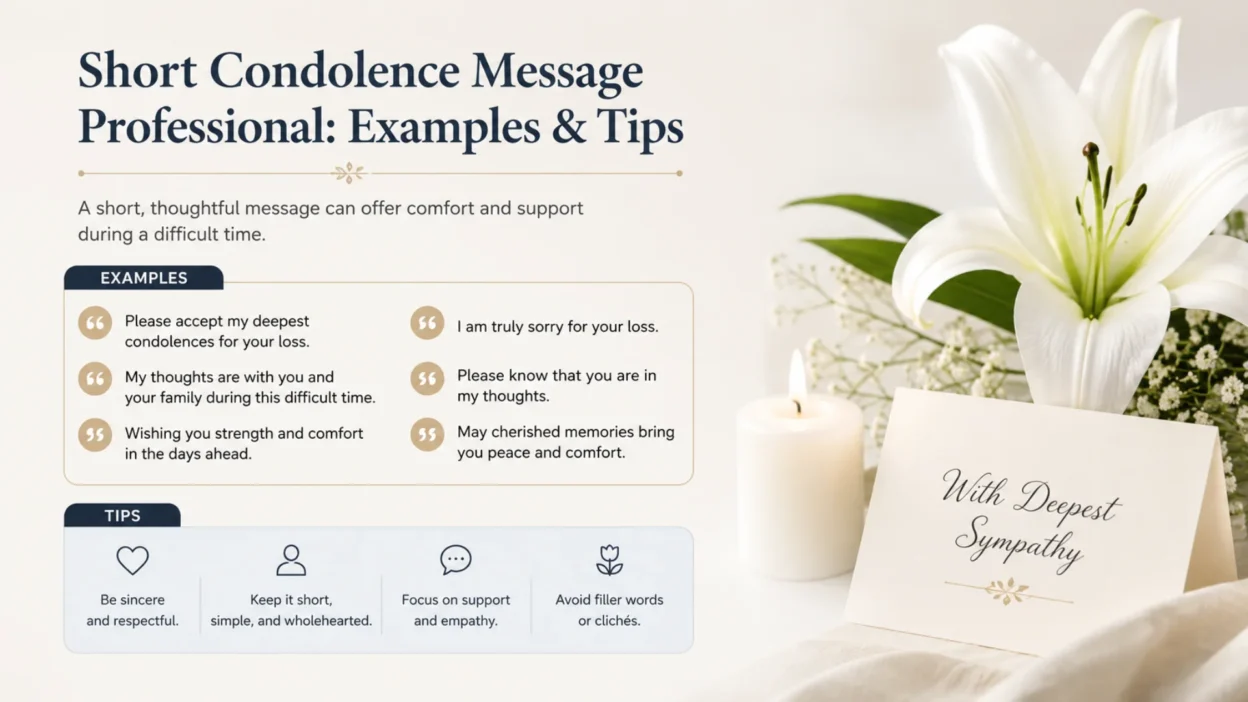
Most effective condolence messages share four core components. First, they acknowledge the loss directly. A simple statement like “I was so sorry to hear about your mother” accomplishes this. Second, they express sympathy. “Please accept my heartfelt condolences” or “My thoughts are with you” works well. Third, they offer support in a realistic, workplace-appropriate way. Instead of saying “Let me know if you need anything,” which puts the burden on the grieving person, try “I can cover your Friday calls if that helps.” Fourth, they close with a brief, warm sign-off. “Thinking of you,” “With sympathy,” or “Take care” all work. You don’t need all four elements in every message, but including at least two or three makes the note feel complete. Career experts consistently note that these elements help create a message that is both empathetic and work-appropriate.
Short Condolence Messages for a Coworker or Peer
Peer relationships are usually more relaxed than those with managers or clients. You can be a bit warmer, though you should still avoid overly personal language. Here are examples that work well for a coworker:
“Our condolences on the loss of your father. Please accept our deepest sympathies from everyone on the team.”
“Sorry for your loss. We’re thinking of you at this difficult time.”
“I just heard the news. I’m so sorry. Please don’t worry about anything here—we’ve got you covered.”
“My heart goes out to you and your family. Take all the time you need.”
“Thinking of you and your family this week. We’re here when you’re ready.”
These messages are short, genuine, and respectful. They don’t pry, and they don’t offer empty promises. Sending condolences via text is typically acceptable, especially if it’s the fastest way to reach someone who is away from the office.
If You’re Sending on Behalf of a Team
Group messages carry a different weight. They signal collective support. Use language that includes the whole team:
“On behalf of everyone here, please accept our sincere condolences.”
“Our deepest sympathies go out to you and your loved ones during this difficult time.”
“The whole team is thinking of you. We’re here to support you however we can.”
Short Condolence Messages for a Boss or Senior Leader
Writing to a manager or executive requires a slightly more formal register. You want to be respectful without being stiff. Avoid casual phrasing like “Hey, so sorry to hear.” Instead:
“I was deeply saddened to hear about your loss. Please accept my sincere condolences.”
“My thoughts are with you and your family during this difficult time.”
“Please know that you and your loved ones are in my thoughts. I’m here if there’s anything I can assist with.”
“With deepest sympathy to you and your family.”
These messages acknowledge the professional hierarchy while still conveying genuine care. They don’t assume familiarity that may not exist.
Short Condolence Messages for Clients or Business Contacts
Condolence messages to clients or external partners require careful calibration. You want to maintain the business relationship while showing human decency. The message should be brief, respectful, and free of any sales pitch or agenda. For example:
“Please accept our deepest sympathies during this difficult time. Please let us know how we can assist.”
“Our thoughts are with you and your family. We’re here to support you in any way we can.”
“We were sorry to hear of your loss. Our sincere condolences to you and your loved ones.”
Keep business sympathy messages to three or four lines and avoid any discussion of the cause of death. The goal is to acknowledge the loss and offer support, not to extend a business conversation.
When a Text Message Is Appropriate—and When It Isn’t
Text messages have become a normal part of professional communication. In many workplaces, sending a brief condolence text is perfectly acceptable, especially if it’s the fastest way to reach someone. However, there are situations where a text may feel too informal. If you have a close working relationship with the person, a card or a personal email might be more appropriate. If the loss is particularly devastating—such as the death of a child or a spouse—a text can still work, but it should be followed up with a more formal gesture like a card or flowers. The key is to match the medium to the relationship and the circumstances. When in doubt, a short email or a card tends to carry more weight than a text.
Common Mistakes That Undermine Professional Condolence Messages
Even well-intentioned messages can miss the mark. One frequent mistake is offering unsolicited advice. Saying “You should take time for yourself” or “You’ll feel better soon” can come across as dismissive. Another is comparing losses. Phrases like “I know exactly how you feel” or “I lost my father too” shift the focus to you and minimize the recipient’s experience. Clichés like “They’re in a better place” or “Everything happens for a reason” can also cause pain, especially if the recipient doesn’t share your beliefs. Perhaps the biggest mistake is saying nothing at all because you’re afraid of getting it wrong. People are more often hurt by silence than by imperfect words.
How to Personalize a Short Message Without Overstepping
Personalization makes a condolence message feel genuine. But you need to be careful about what you share. If you knew the deceased, a brief fond memory is appropriate: “I’ll always remember how kind your mother was when she visited the office.” If you didn’t know them, you can still personalize the message by referencing your relationship with the recipient: “You’ve been such a supportive colleague to me, and I want you to know I’m thinking of you.” Avoid asking for details about the death or the funeral arrangements. If the recipient wants to share that information, they will. Your role is to offer support, not to satisfy your own curiosity.
Cultural and Generational Differences to Keep in Mind
Condolence customs vary widely across cultures and generations. In some cultures, sending flowers is expected; in others, it’s inappropriate. Some religious traditions have specific mourning periods or phrases that should be used. If you’re unsure, a neutral message that focuses on sympathy and support is the safest approach. Being aware of cultural differences and avoiding religious or cultural references that may not align with the recipient’s beliefs is a wise move. Generational differences matter too. Older colleagues may prefer a formal card, while younger colleagues might be more comfortable with a text or a direct message. Observing how your workplace typically handles such situations can give you useful cues.
How to Follow Up After the Initial Message
A condolence message is not a one-time event. Grief doesn’t follow a schedule, and support that disappears after a week can feel hollow. A simple follow-up a few weeks later can mean a great deal: “I’ve been thinking of you. No need to reply—just wanted you to know.” If you offered specific help, follow through. If you said you’d cover a meeting, make sure it’s covered. People often find it helpful when colleagues remember difficult dates like birthdays and anniversaries. A brief note on those days can show that your support is ongoing, not performative.
What Not to Say: Phrases to Avoid in Professional Condolences
Certain phrases appear in condolence messages so often that they’ve become automatic. Unfortunately, many of them cause more harm than comfort. Here’s a quick reference of what to avoid:
| Avoid This | Why It Hurts | Say This Instead |
|---|---|---|
| “I know how you feel” | Assumes you understand their unique grief | “I can’t imagine what you’re going through” |
| “They’re in a better place” | Assumes shared religious beliefs | “My thoughts are with you and your family” |
| “At least they lived a long life” | Minimizes the pain of loss | “I’m so sorry for your loss” |
| “Everything happens for a reason” | Feels dismissive and preachy | “I’m here for you” |
| “Let me know if you need anything” | Puts the burden on the grieving person | “I can bring dinner on Thursday—does that work?” |
This table isn’t exhaustive, but it covers the most common pitfalls. The principle is simple: focus on the recipient’s pain, not on your own discomfort or beliefs.
Condolence Messages for Specific Relationships: A Quick Reference
Different relationships call for slightly different tones. Here’s a breakdown you can use as a starting point.
For a Direct Report or Team Member
“I was so sorry to hear about your loss. Please take the time you need—we’ll manage things here.”
“Thinking of you and your family. Let me know if there’s anything I can take off your plate.”
For a Close Colleague You Consider a Friend
“I’m heartbroken for you. I’m here whenever you want to talk, or if you just want quiet company.”
“Sending you so much love. Don’t worry about work—we’ve got it.”
For a New Colleague You Barely Know
“I heard about your loss. I’m so sorry. Please know the team is thinking of you.”
“Please accept my condolences. We’re here to support you.”
For a Vendor or External Partner
“Our sincere condolences to you and your team. Please let us know if there’s anything we can do.”
“We were saddened to hear of your loss. Our thoughts are with you.”
Frequently Asked Questions About Professional Condolence Messages
Is it okay to send a condolence message via text?
Yes, in most professional settings, a brief text is acceptable, especially if it’s the fastest way to reach someone. However, if you have a close relationship or the loss is particularly severe, consider following up with a card or a more formal message.
How long should a professional condolence message be?
Three to four sentences is usually sufficient. The message should acknowledge the loss, express sympathy, and offer support. Anything longer risks feeling overwhelming or self-focused.
Should I mention the deceased by name?
If you knew the deceased, yes. Using their name makes the message more personal. If you didn’t know them, you can refer to them as “your father,” “your mother,” or “your loved one.”
What if I don’t know the person’s religious beliefs?
Avoid religious references unless you are certain of their faith. Neutral phrases like “My thoughts are with you” or “Sending you strength” work across belief systems.
Can I send a condolence message on LinkedIn or social media?
It’s generally better to send condolences through a private channel like email or a direct message rather than a public comment. Public condolences can feel performative and may expose the recipient’s grief to an audience they didn’t choose.
What should I do if I already said the wrong thing?
If you realize you said something inappropriate, a brief correction can help: “I’m sorry—I realize that might have come out wrong. I’m just so sorry for your loss.” Acknowledging the misstep shows humility and care.
How soon should I send a condolence message?
Send it as soon as you learn the news. If you learn about the loss weeks later, it’s still appropriate to send a message. Saying “I just heard” is perfectly fine.
Is it appropriate to send flowers along with a condolence message?
It depends on the workplace culture and the recipient’s preferences. Some people appreciate flowers; others find them overwhelming. A card or a message is always appropriate. If you’re unsure, ask a colleague or HR for guidance.
Final Thoughts: The Power of Saying Something Simple
The hardest part of writing a short condolence message professional in tone is often just starting. You worry about saying the wrong thing, so you say nothing. But silence is rarely the answer. A brief, sincere message—even one that feels imperfect to you—can mean the world to someone navigating grief. Keep it simple. Acknowledge the loss. Offer sympathy. Provide practical support. Then step back and let the person grieve in their own way. You don’t need perfect words. You just need to show up with genuine care. That’s what professionalism in condolence really means: respect, empathy, and the willingness to be present without making it about you.

Serhii Dunev is a passionate content creator dedicated to crafting meaningful texts, messages, and word inspirations. He aims to help people express their emotions clearly through simple and impactful words.