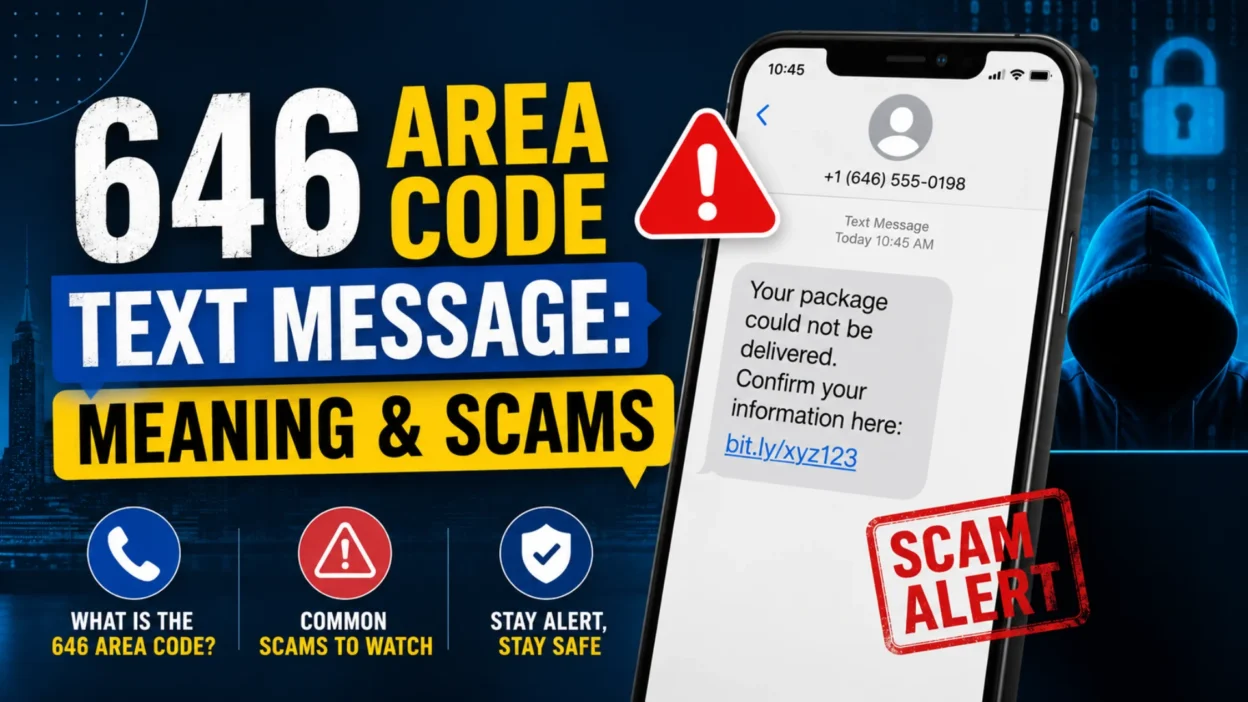
Receiving a 646 area code text message from an unfamiliar number can make you wonder who is contacting you. You may recognize 646 as a New York number, but that doesn’t tell you whether the message is legitimate. A 646 number can belong to an individual, business, service, or unknown sender.
At the same time, scammers can use legitimate-looking phone numbers to make unexpected messages appear trustworthy. Therefore, the safest approach is to look beyond the area code. Check the message, consider why someone would contact you, and avoid clicking links or sharing sensitive information until you’ve verified the sender.
What Does a 646 Area Code Text Message Mean?
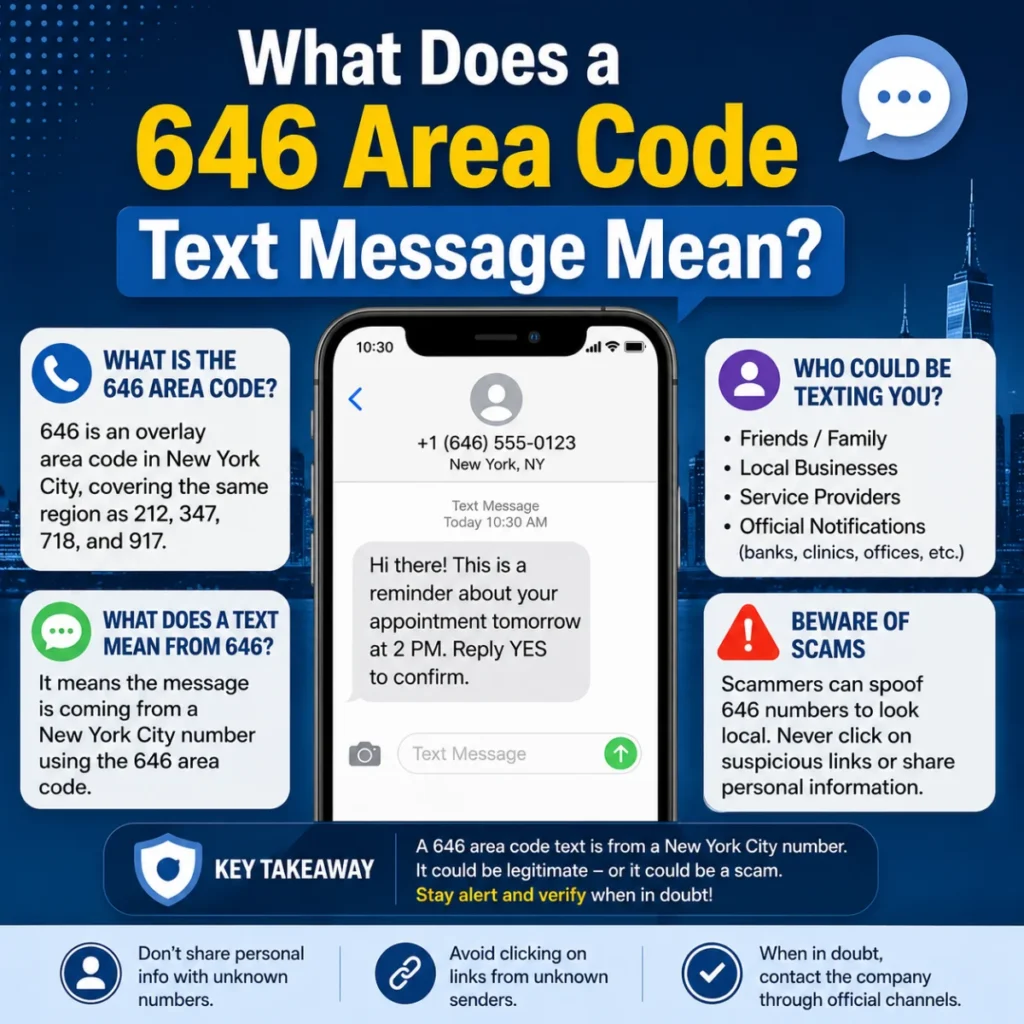
A 646 area code text message means the displayed phone number uses the 646 area code.
Area code 646 is associated primarily with New York City, especially Manhattan. It operates as an overlay with other New York City area codes, meaning different area codes can serve the same geographic region.
A message from a 646 number could be completely ordinary. For example, it might come from:
- A friend or relative
- A coworker
- A local business
- A doctor’s office
- A delivery service
- A customer-support team
- An automated notification
- A wrong-number sender
- A marketing service
- A spammer
- A scammer
So, seeing 646 on your phone doesn’t automatically mean you’ve received a scam.
Where Is Area Code 646 Located?
Area code 646 is associated with New York City, particularly Manhattan.
It was introduced as an overlay for the Manhattan area and shares the region with other area codes. Because several codes can serve the same area, you shouldn’t use 646 to determine someone’s exact neighborhood.
The number is also associated with the Eastern Time Zone.
However, a phone number doesn’t necessarily show where the person currently lives. Someone can move away from New York while keeping a 646 mobile number.
Likewise, businesses may use virtual phone systems.
Is a 646 Area Code Text Message a Scam?
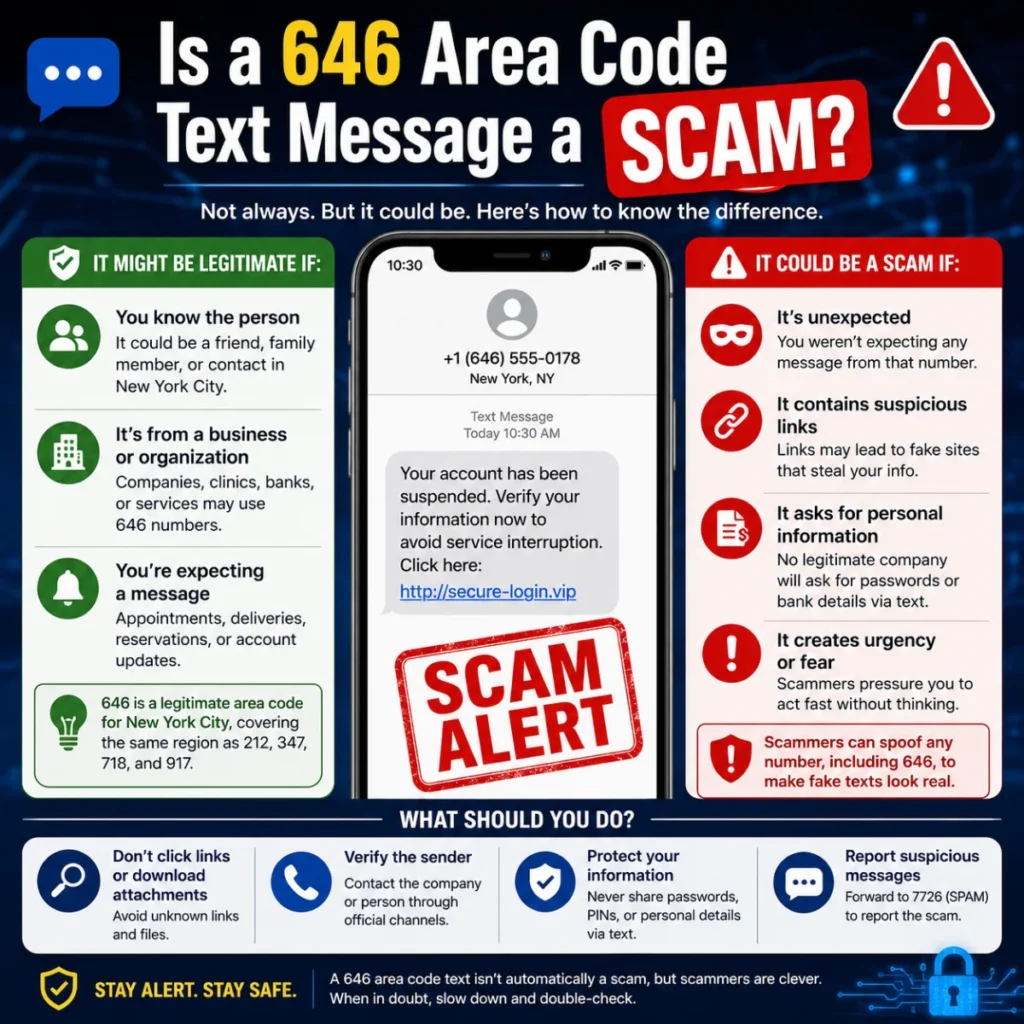
Not automatically.
646 is a legitimate New York City area code. Thousands of normal phone users and businesses can have numbers with this code.
The concern comes from the behavior of the sender.
A message deserves more attention when it:
- Comes from someone you don’t recognize
- Contains an unexpected link
- Requests money
- Asks for private information
- Requests a verification code
- Creates unusual urgency
- Claims your account has been compromised
- Offers an unrealistic prize
- Promises guaranteed investment profits
- Tries to start a strange conversation
One warning sign doesn’t always prove that a message is fraudulent. However, several warning signs together should make you stop and verify the message.
Why Am I Getting a Text From a 646 Number?
There are several possible explanations.
Someone You Know Has a 646 Number
A friend, family member, former coworker, or acquaintance may have a 646 phone number.
You may not recognize the number immediately, especially if you recently changed phones or haven’t spoken to that person in a while.
A New York Business Is Contacting You
Businesses can use 646 numbers for customer communication.
You might receive a message about an appointment, reservation, order, delivery, or customer-service issue.
You Received a Wrong-Number Text
Someone could have entered your number by mistake.
Wrong-number messages aren’t automatically dangerous.
Still, you don’t need to continue a conversation with someone you don’t know.
It’s Spam
Some unwanted messages are promotional or automated.
They might advertise products, services, loans, jobs, or other offers.
It’s a Scam
A scammer may use a 646 number to make an unsolicited message look local.
That can make the message seem more believable, especially if you have some connection to New York.
Can a 646 Number Be Spoofed?
Yes.
Spoofing is a technique that can make a phone number appear differently on the recipient’s device.
This means a scammer may make a message look as if it came from a 646 number even when the sender isn’t actually located in New York.
That’s why the area code shouldn’t be your only way of judging a message.
A local-looking number can still be suspicious.
Similarly, an unfamiliar area code isn’t automatically dangerous.
The content and context matter more.
Common 646 Area Code Text Message Scams
Scammers can use different stories to get recipients to respond or take action.
Fake Bank Alerts
A message may claim that your bank detected unusual activity.
It might say:
“Suspicious activity was detected. Verify your account immediately.”
The message may then include a link.
Don’t click the link.
Instead, open your bank’s official app and check your account directly. If you’re concerned, contact the bank using a trusted number.
Fake Package Delivery
Another common tactic involves a supposed delivery problem.
The message may claim that:
- Your address is incomplete.
- Your package is being held.
- A delivery fee is required.
- You need to confirm your information.
- Your package will be returned.
If you’re expecting a package, check the order through the retailer or delivery service you already use.
Wrong-Number Conversation
Some suspicious messages begin with a simple question:
“Is this David?”
You might respond that they have the wrong number.
The sender may then apologize and continue chatting.
If the conversation eventually shifts toward investments, cryptocurrency, money, jobs, or personal information, stop responding.
Fake Job Offers
An unknown 646 number may send a message about an easy remote job.
The offer might promise unusually high earnings for very little work.
Later, the sender may request personal details, banking information, or an upfront payment.
An unexpected job offer should be independently verified before you provide anything.
Investment Scams
A stranger may begin with casual conversation before mentioning an investment opportunity.
They might claim that they have discovered a reliable way to make fast profits.
Be especially cautious about guaranteed returns or pressure to invest quickly.
Fake Government Messages
Scammers may pretend to represent a government agency.
They could claim that you owe money, have violated a rule, or must verify your identity.
Don’t respond to government-related threats through an unexpected text.
Verify the claim independently before doing anything.
How Can You Tell if a 646 Text Is Suspicious?
The message itself usually gives you more information than the area code.
The Sender Is Unknown
If you don’t recognize the number, take your time.
An unknown sender isn’t automatically a scammer, but there’s no reason to trust the message immediately.
The Message Feels Urgent
Scammers often use pressure to stop people from thinking carefully.
Watch for phrases such as:
- Act now
- Final warning
- Immediate response required
- Your account will be closed
- Payment due today
- Verify immediately
Legitimate businesses can use urgent language sometimes. However, unexpected urgency deserves verification.
The Text Contains a Link
An unexpected link is another reason to slow down.
The link may lead to a fake website designed to collect passwords or financial information.
Instead of using the link, access the supposed company’s app or website directly.
It Asks for Sensitive Information
Be careful if an unknown sender asks for:
- Passwords
- Bank account information
- Credit card numbers
- Social Security information
- Security codes
- Account recovery codes
- Identification documents
Never assume a text message is trustworthy simply because it uses the name of a familiar company.
It Requests Payment
Money requests deserve extra attention.
Be especially cautious if the sender wants payment through gift cards, cryptocurrency, wire transfers, or another difficult-to-reverse method.
What Should You Do After Receiving a Suspicious 646 Text?
Don’t respond immediately.
Instead, follow a few simple steps.
First, stop and read the message carefully.
Don’t let the sender’s urgency control your decision.
Next, check whether you recognize the number.
Think about whether you recently gave your number to a business or person.
Then, examine the request.
Ask why the sender needs you to click, pay, verify, or provide information.
Avoid unexpected links.
Don’t open them until you’ve independently confirmed the message.
Protect your private information.
Never share passwords or security codes with an unexpected texter.
Verify important claims.
If the sender claims to represent a company, contact that organization through a trusted channel.
Block and report suspicious messages.
Your phone or carrier may provide spam-reporting tools.
Should You Reply to an Unknown 646 Number?
If you don’t recognize the sender, it’s generally safer not to reply immediately.
A response such as “Who is this?” may appear harmless. However, it can confirm that your number is active.
That may encourage more unwanted messages.
If you can identify the sender and the message makes sense, replying is different.
For a completely random message, ignoring it is often the better choice.
What If the 646 Text Only Says “Hi”?
A simple “Hi” isn’t proof of a scam.
However, an unexpected greeting from a stranger can be a conversation starter.
Some scammers avoid mentioning money or suspicious links in their first message. Instead, they try to establish a friendly conversation first.
The conversation may later move toward:
- Investment opportunities
- Cryptocurrency
- Job offers
- Loans
- Personal relationships
- Money requests
If you don’t recognize the number, you don’t have to respond.
What If the Sender Says “Sorry, Wrong Number”?
Wrong-number texts can happen naturally.
Someone may have typed the wrong number or selected the wrong contact.
You don’t need to investigate the situation.
If the sender says:
“Sorry, I thought this was my friend.”
You can simply stop responding.
Be more cautious if the sender keeps talking despite supposedly contacting you by mistake.
A conversation that becomes personal, financial, or unusually friendly deserves extra caution.
Does a 646 Number Mean the Person Is in New York?
Not necessarily.
Area code 646 is associated with New York City, but it doesn’t reveal someone’s current physical location.
A person can move while keeping the same mobile number.
Businesses can also use virtual phone systems.
Furthermore, spoofing can make a message display a 646 number even when the sender has no actual connection to New York.
Therefore, 646 tells you about the number’s numbering region, not the sender’s current location.
Does 646 Mean Manhattan?
646 is strongly associated with Manhattan and the New York City area.
However, the area code doesn’t identify a precise address or neighborhood.
New York City uses multiple overlapping area codes. As a result, different numbers can serve the same general region.
You should never assume that a 646 number tells you exactly where someone lives or works.
646 Area Code vs. 212 Area Code
Both 646 and 212 are associated with Manhattan, but they’re different area codes.
Feature646212StateNew YorkNew YorkMain AssociationManhattanManhattanTime ZoneEasternEasternTypeGeographic area codeGeographic area codeRelationshipOverlay with other NYC codesPart of NYC numbering system
The presence of 646 rather than 212 doesn’t make a message more or less trustworthy.
Scammers can use either type of number.
646 Area Code vs. 917 Area Code
Both area codes are associated with New York City.
The important difference is that 917 was introduced as a broader New York City overlay, while 646 is especially associated with Manhattan.
Still, neither area code proves the sender’s identity.
If an unknown number contacts you, focus on the message rather than trying to judge its legitimacy from the digits alone.
Is It Safe to Call a 646 Number Back?
If you don’t recognize the number, there’s usually no need to call it back immediately.
A legitimate person may leave a voicemail or provide enough information to explain why they contacted you.
If the message claims to come from your bank, a government agency, delivery company, or another important organization, use a trusted contact method instead.
Don’t assume the number included in an unexpected message is the correct number to call.
What If a 646 Text Claims to Be From Your Bank?
Don’t use the message’s link to investigate.
Instead:
- Open your bank’s official app.
- Review your recent transactions.
- Check for security notifications.
- Contact the bank using a trusted phone number if necessary.
- Follow the bank’s normal security procedures.
This protects you from fake login pages.
The same approach works for credit cards, payment services, online shopping accounts, and other important services.
What If a 646 Text Claims Your Package Is Delayed?
If you’re expecting a package, the message may appear convincing.
Still, verify it independently.
Open the retailer’s app or website and check your order status.
If the text asks you to pay a fee, confirm the charge through your existing order information.
Don’t provide card details simply because an unexpected text says a delivery is waiting.
What If You Already Replied to a 646 Text?
Don’t panic.
If your reply contained nothing sensitive, simply stop the conversation if it becomes suspicious.
Don’t provide additional information.
If you shared a password, change it through the legitimate service.
If you shared banking information, contact your financial institution.
If you provided a verification code, secure the affected account immediately.
Your next step should depend on exactly what information you shared.
What If You Clicked a Link in the Message?
Take the situation seriously, but don’t panic.
If you opened the page and didn’t enter anything, close it.
If you entered a password, change it through the legitimate website or app.
If you provided payment information, contact your bank or card provider.
If you downloaded an unfamiliar file or application, check your device and remove anything you don’t recognize.
The key is to act based on what actually happened rather than assuming the worst.
How to Block a 646 Text on iPhone
On an iPhone, open the unwanted conversation and access the sender’s information.
Use the available option to block the sender.
Depending on the message and your device settings, you may also see an option for reporting spam.
Blocking stops messages from that particular number, but it won’t necessarily prevent future messages from different numbers.
How to Block a 646 Text on Android
Android devices generally offer blocking and reporting features inside the messaging app.
Open the unwanted conversation and access its options.
Choose the available block or report feature.
The exact steps can vary depending on your phone manufacturer and messaging application.
If unwanted messages continue, use your device’s spam-filtering features when available.
Should You Report a Suspicious 646 Text?
Yes, particularly if the message appears fraudulent or repeatedly targets you.
Before deleting the message, consider saving a screenshot.
Keep details such as:
- Sender number
- Exact message
- Date and time
- Suspicious links
- Payment requests
- Information you shared
You can then use the spam-reporting tools offered by your phone or carrier.
If the incident involves financial loss or identity theft, take additional steps to secure your accounts.
Common Mistakes People Make With 646 Texts
Trusting the Area Code
A New York number doesn’t automatically mean the sender is legitimate.
Clicking a Link Out of Curiosity
You don’t need to open a suspicious link to discover where it leads.
Sharing a Verification Code
Security codes should stay private.
Sending Money Because the Amount Is Small
A small payment can still be part of a larger scam.
Continuing a Wrong-Number Conversation
You don’t owe a stranger a conversation simply because they claim they made a mistake.
Assuming a Company Name Proves Authenticity
Scammers can impersonate recognizable businesses.
Always verify important claims independently.
646 Area Code Text Message Safety Checklist
When an unfamiliar 646 number contacts you, ask yourself:
- Do I know the sender?
- Was I expecting the message?
- Does it contain a link?
- Does it ask for money?
- Does it request personal information?
- Does it create urgency?
- Can I verify the claim independently?
- Does the sender want me to move the conversation elsewhere?
If several answers concern you, don’t respond.
Instead, block and report the message.
When a 646 Text May Be Legitimate
An unfamiliar 646 text isn’t automatically dangerous.
It may be legitimate if:
- You recently contacted a New York business.
- You’re expecting an appointment reminder.
- You’re waiting for a delivery.
- A friend recently gave you their number.
- The message matches an action you recently took.
- You can independently verify the sender.
- The message doesn’t request anything unusual.
Even legitimate messages should be treated carefully when they involve sensitive information.
When a 646 Text Deserves Extra Caution
Pay close attention if the sender:
- Demands immediate payment
- Requests a verification code
- Sends an unexpected login link
- Claims you’ve won a prize
- Promises guaranteed investment returns
- Threatens legal consequences
- Requests your password
- Pretends to be a government agency
- Asks you to install an unfamiliar application
- Wants you to keep the conversation secret
These behaviors are much more meaningful than the area code itself.
Can a 646 Number Be Used by a Business?
Yes.
A business may use a 646 number for:
- Customer support
- Appointment reminders
- Order notifications
- Delivery updates
- Reservations
- Marketing
- Service alerts
However, the business name displayed in a text isn’t enough to establish authenticity.
If the message asks you to perform an unusual action, verify the request independently.
Is a 646 Number Safe to Text Back?
The area code doesn’t determine whether replying is safe.
If you know the person, responding may be completely normal.
If the number is unfamiliar, consider whether you have a reason to communicate with that sender.
A suspicious message doesn’t become safe simply because the number looks local.
What If 646 Texts Keep Coming?
Repeated messages may indicate spam or an unwanted messaging campaign.
If this happens:
- Don’t engage with suspicious senders.
- Block individual numbers.
- Report unwanted messages.
- Turn on available spam filters.
- Avoid clicking links.
- Don’t share personal information.
- Watch for similar messages from other numbers.
Scammers may change numbers frequently, so blocking one sender may not completely solve the problem.
Final Thoughts on 646 Area Code Text Messages
A 646 area code text message isn’t automatically a scam. Area code 646 is a legitimate New York City area code, particularly associated with Manhattan.
The number alone can’t tell you whether the sender is trustworthy.
A legitimate person or business may contact you from a 646 number. However, scammers can also use local-looking numbers or spoof the number displayed on your phone.
That’s why the safest strategy is to focus on the message itself.
If the sender is unknown, don’t rush to respond. Avoid unexpected links, protect your passwords and verification codes, and independently verify important claims.
When a message asks for money, personal information, or immediate action, take extra care.
Pause, verify, and then decide whether a response is necessary.
FAQs About 646 Area Code Text Messages
Is 646 a real area code?
Yes. 646 is a legitimate U.S. area code associated with New York City, particularly Manhattan.
Is a 646 area code text message a scam?
Not necessarily. A 646 number can belong to a genuine person or business. However, scammers can use or spoof numbers with this area code.
Why am I receiving random texts from 646 numbers?
The message could be a wrong-number text, business notification, spam, or scam. If you don’t recognize the sender, verify the reason for the message before responding.
Can a 646 number be spoofed?
Yes. Phone-number spoofing can make a message appear to come from a number that isn’t actually being used by the sender.
Should I reply to an unknown 646 number?
If you don’t recognize the sender, it’s usually safer not to respond immediately. A reply can confirm that your number is active.
Where is area code 646 located?
Area code 646 is primarily associated with Manhattan and the broader New York City numbering system.
Does a 646 number mean the person currently lives in New York?
No. Someone can keep a mobile number after moving to another location. Spoofing can also make the displayed number misleading.
What should I do if a 646 text contains a link?
Don’t click it immediately. Verify the sender and the reason for the message first. If it claims to be from a company, access the company’s service independently.
Should I block a suspicious 646 number?
Yes. If the message is unwanted or suspicious, blocking the number can prevent further messages from that particular sender.
What if I gave personal information to a 646 sender?
Secure the affected account immediately. Change compromised passwords, contact your financial institution if necessary, and monitor your accounts for unusual activity.
Is it safe to call back an unknown 646 number?
It’s better to verify why the sender contacted you before calling back. If the message claims to represent an organization, use a trusted contact method instead.
Conclusion
Receiving a 646 area code text message doesn’t automatically mean you’ve received a scam. The 646 area code is legitimate and is commonly associated with New York City, particularly Manhattan.
Still, an unexpected message should never be trusted solely because it has a familiar area code.
Check the sender, read the message carefully, and consider what the person is asking you to do. If there’s an unexpected link, payment request, security-code request, or urgent warning, verify the claim independently before taking action.
When you don’t recognize the sender, you don’t have to reply. Ignoring, blocking, and reporting suspicious messages can be safer than starting a conversation.

Serhii Dunev is a passionate content creator dedicated to crafting meaningful texts, messages, and word inspirations. He aims to help people express their emotions clearly through simple and impactful words.