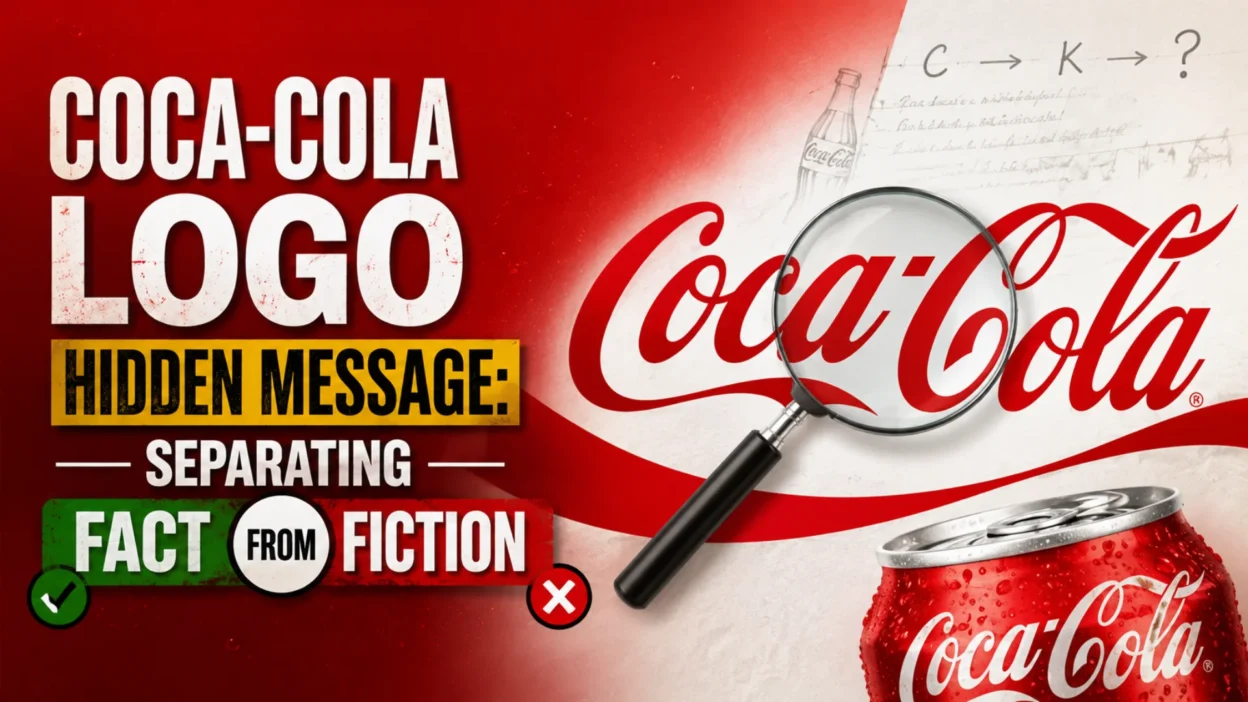
Few brand marks are as instantly recognizable as the Coca-Cola script. For well over a century, that flowing white lettering on a red background has been a constant in advertising, pop culture, and everyday life. Yet in recent years, a persistent claim has circulated online: that the Coca-Cola logo contains a hidden message. Specifically, many people believe the elongated tail on the first “C” forms a subtle smile. It’s an appealing idea, especially for a brand that has spent decades linking itself to happiness and good times. But is it a genuine design secret, or just a case of wishful thinking? This guide will examine the evidence, explore the logo’s real history, and help you decide what to believe. By the end, you’ll have a clear understanding of what the Coca-Cola logo hidden message theory actually claims—and whether it holds up to scrutiny.
What Is the Coca-Cola Logo Hidden Message Theory?
The most popular version of the theory focuses on the sweeping tail of the first “C” in the Coca-Cola script. According to this idea, the curve of that letter subtly forms the shape of a smile. Because Coca-Cola has long marketed itself around themes of joy, refreshment, and togetherness, the smile would fit perfectly with the brand’s identity. Some versions of the theory suggest the smile is on the first “C,” while others point to the second “C.” The exact location shifts depending on who is telling the story. What remains consistent is the core claim: that a smile is hidden somewhere in the lettering. Interestingly, this theory gained major traction only in the 2020s, even though the logo has existed in roughly its current form since the late 1880s. That timing alone raises questions about whether the smile was always there or whether modern viewers are simply projecting a familiar shape onto an old design.
The History of the Coca-Cola Logo: What the Company Actually Says
To evaluate any hidden message claim, you need to understand how the logo was created. Coca-Cola was invented in 1886 by Dr. John S. Pemberton, an Atlanta pharmacist. His bookkeeper, Frank Mason Robinson, is credited with both the name and the original script design. According to Coca-Cola’s own historical accounts, Robinson suggested the name because he believed “the two Cs would look well in advertising.” He then penned the words “Coca-Cola” in Spencerian script, a popular handwriting style of the era. The logo has undergone several refinements over the decades. In 1890, extra swirls were added. In 1969, the famous white “Dynamic Ribbon Device”—often called the wave—was introduced beneath the script. At no point in Coca-Cola’s official trademark chronology does the company mention a smile, a hidden message, or any symbolic shape embedded in the lettering. That absence is significant, though not entirely conclusive.
Why the Smile Theory Feels So Convincing
Even without official confirmation, the smile theory has emotional appeal. Coca-Cola’s advertising has long leaned into happiness. Slogans like “Have a Coke and a Smile,” “Open Happiness,” and “Taste the Feeling” have reinforced the association between the brand and positive emotions. When a brand tells you for decades that it stands for smiles, your brain starts looking for smiles in its imagery. This is a well-documented psychological phenomenon. Humans are pattern-seeking creatures, and we tend to find familiar shapes in abstract forms. A branding expert quoted by Reader’s Digest noted that the “positive curvatures” of the logo can feel like smiles, even if that wasn’t the original intent. In other words, the smile may be real in the sense that people genuinely perceive it—but that doesn’t mean the designer put it there on purpose.
The 2013 “Open Happiness” Campaign: Did Coca-Cola Admit the Secret?
One piece of evidence often cited by believers is a 2013 advertising campaign. Design agency McCann Berlin created a print ad for Coca-Cola’s “Open Happiness” campaign that zoomed in on the bottom of the “C” to reveal a smile. To some, this seemed like a tacit admission that the smile had been there all along. However, there’s a crucial detail that undermines this interpretation. According to Creative Bloq, the agency had to edit the logo so that the tail curled upward in order to create the smile effect. If the original design already contained a smile, no edit would have been necessary. The fact that the agency modified the logo suggests the smile was a creative addition for that specific campaign, not a hidden feature of the original artwork. That distinction matters when evaluating the Coca-Cola logo hidden message claim.
The Cocaine Conspiracy: A Different Kind of Hidden Message
The smile isn’t the only hidden message people claim to see in the Coca-Cola logo. A far older and more controversial theory suggests that when the logo is tipped on its side, it reveals a figure snorting a line of cocaine. This claim is rooted in the historical fact that early Coca-Cola did contain trace amounts of cocaine, derived from coca leaf extract. The conspiracy theory argues that the logo’s designer deliberately embedded this image as a sly reference to the drink’s original ingredients. However, fact-checking organizations have investigated this claim and found no evidence to support it. Coca-Cola’s own Turkish website has addressed the rumor directly, stating that the logo holds no hidden meaning when viewed from different angles. The cocaine theory persists because it’s titillating, but it lacks any credible historical documentation.
Did the Designer Ever Mention a Hidden Smile?
Frank Mason Robinson, the man who created the original script, left no records suggesting he intended to hide a smile in the logo. His stated motivation was purely practical: he thought the two “C”s would look good together in advertising. There’s no diary entry, interview, or design note where he mentions a hidden symbol. Similarly, Coca-Cola’s corporate archives contain no reference to a deliberate smile. This silence doesn’t definitively prove the absence of a hidden message—designers sometimes embed secrets without documenting them. But in the case of a logo that has been scrutinized for over a century, the lack of any contemporaneous evidence is telling. If Robinson had hidden a smile, you’d expect someone at Coca-Cola to have mentioned it at some point during the past 130 years.
The Psychology of Seeing Faces in Logos
Why do so many people see a smile in the Coca-Cola script? The answer lies in a cognitive bias called pareidolia. This is the tendency to perceive meaningful patterns—especially faces—in random or ambiguous stimuli. It’s why people see animals in clouds or a man in the moon. The Coca-Cola logo, with its flowing curves and organic lines, is particularly susceptible to this effect. The Spencerian script style uses sweeping strokes and loops that the brain can easily interpret as facial features. Once you’ve been told to look for a smile, it becomes difficult not to see one. This doesn’t mean the smile is an illusion. It means the perception is real, even if the intent behind it wasn’t deliberate. The Coca-Cola logo hidden message may be a case of collective pareidolia rather than a secret design choice.
What Other Logos Have Genuine Hidden Messages?
To put the Coca-Cola debate in context, it helps to look at logos where hidden messages are definitively documented. The FedEx logo contains a famous negative-space arrow between the “E” and “x,” a detail that designer Lindon Leader has confirmed was intentional. The Amazon logo features an arrow that doubles as a smile, pointing from “A” to “Z” to suggest the company sells everything. The Toblerone logo hides a bear within the Matterhorn mountain, a nod to the brand’s Swiss origins. These examples share a key trait: the designers or companies have openly acknowledged the hidden elements. Coca-Cola has never done so. That difference doesn’t prove the smile theory is false, but it does place it in a different category from logos with confirmed Easter eggs. The Coca-Cola smile remains in the realm of speculation rather than verified fact.
Why Coca-Cola Has Never Officially Confirmed or Denied the Smile
You might wonder why Coca-Cola hasn’t simply issued a statement clarifying the matter. The company’s silence is likely strategic. If Coca-Cola confirmed the smile was intentional, it would be a charming piece of brand trivia. But it would also invite endless scrutiny and questions about other supposed hidden messages. If the company denied it, it would disappoint fans who enjoy the mystery and might even seem defensive. By staying quiet, Coca-Cola allows the legend to flourish without committing to a position. That ambiguity is often more valuable to a brand than a definitive answer. The Coca-Cola logo hidden message, whether real or imagined, generates free publicity and keeps people talking about the brand. From a marketing perspective, that’s a win either way.
How to Evaluate Hidden Message Claims Like a Skeptic
If you want to assess any hidden message claim—whether it’s about Coca-Cola or another brand—here’s a practical framework. First, check whether the designer or company has ever acknowledged the hidden element. Second, look for contemporaneous evidence from the time the logo was created. Third, examine whether the “hidden” shape requires manipulating the image—flipping it, rotating it, or zooming in—to become visible. Fourth, consider whether the hidden message aligns with the brand’s known identity and marketing. Finally, ask yourself whether the claim is being promoted by credible sources or by clickbait articles. Applying these tests to the Coca-Cola smile theory yields mixed results. The smile aligns with the brand’s identity, but there’s no acknowledgement, no contemporaneous evidence, and the shape isn’t obvious without someone pointing it out first.
Coca-Cola’s Own History: What the Archives Reveal
Coca-Cola maintains a detailed public archive of its logo’s evolution. The company’s trademark chronology traces every major change from the 1880s through the present day. It documents the introduction of the fishtail logo in the 1950s, the Dynamic Ribbon Device in 1969, and various campaign-specific modifications. Nowhere in these archives is there any mention of a smile, a hidden face, or a subliminal symbol. For a company that takes obvious pride in its design heritage, the omission is notable. If the smile were a deliberate feature, you’d expect it to appear in at least one internal document or design brief. Its absence from the official record doesn’t disprove the theory, but it weakens the case for intentionality.
The Role of Social Media in Spreading the Smile Theory
The Coca-Cola smile theory didn’t gain widespread attention until the 2020s. Social media platforms played a central role in its spread. A single viral post suggesting the hidden smile was enough to trigger a wave of articles, videos, and debates. This pattern is common with hidden message claims. They tend to spread quickly because they’re shareable, surprising, and easy to understand. The Coca-Cola logo, being one of the most recognizable images in the world, was a perfect candidate for this kind of viral speculation. But virality doesn’t equal accuracy. The fact that millions of people have seen a claim doesn’t make it true. It simply means the claim is compelling. When evaluating the Coca-Cola logo hidden message, it’s worth remembering that social media amplifies speculation far more effectively than it verifies facts.
How Branding Experts View the Smile Claim
Branding professionals tend to approach the smile theory with cautious interest. Some, like Reilly Newman of Motif Brands, acknowledge that the logo’s curves can evoke positive feelings and even resemble smiles, but they stop short of calling it a deliberate hidden message. Others are more skeptical. Daniel John, a design editor, has publicly stated that he doesn’t believe the smile was intentional, pointing out that no official history mentions it. The consensus among experts leans toward the view that any smile-like quality is a happy accident—or perhaps a subconscious design choice that even the original designer didn’t fully articulate. This middle-ground position is probably the most honest: the logo may feel like a smile, but that doesn’t mean it was designed as one.
Frequently Asked Questions About the Coca-Cola Logo Hidden Message
Is there really a hidden smile in the Coca-Cola logo?
Many people believe the tail of the “C” forms a smile, but Coca-Cola has never confirmed this. The resemblance is subtle and may be a result of pareidolia rather than intentional design.
Did the original designer intend to hide a smile?
There’s no historical evidence that Frank Mason Robinson intended to embed a smile. His documented motivation was simply that the two “C”s looked good together in advertising.
What about the cocaine hidden message theory?
Fact-checkers and Coca-Cola itself have debunked the claim that the logo reveals a cocaine-snorting figure when turned sideways. The logo has no verified hidden imagery.
Why did a 2013 ad show a smile in the logo?
That campaign edited the logo to create a smile effect. If the smile had already been present, no edit would have been needed.
Is the smile theory dangerous or harmful?
No. It’s a harmless piece of brand folklore. Believing it doesn’t affect anything practical, though it’s worth understanding that it’s not officially verified.
Do other Coca-Cola logos contain hidden messages?
Coca-Cola has released many logo variations over the years, but none have been officially documented as containing hidden messages.
How can I tell if a hidden logo message is real?
Look for designer acknowledgement, contemporaneous evidence, and whether the hidden shape is visible without manipulation. If none of those exist, treat the claim as speculative.
Why does Coca-Cola stay silent about the smile theory?
Silence allows the mystery to generate free publicity without forcing the company to take a position it might later regret.
Final Thoughts: Enjoy the Mystery, But Know the Facts
The Coca-Cola logo hidden message is one of those stories that’s more fun to believe than to debunk. The idea of a secret smile tucked into one of the world’s most famous designs is charming, and it fits neatly with Coca-Cola’s decades of happiness-themed marketing. But when you dig into the history, the evidence for intentionality is thin. The designer never mentioned a smile. The company’s archives contain no reference to one. And a 2013 ad campaign had to edit the logo to produce a smile effect. None of this proves the theory is wrong. It’s possible that Robinson embedded a subtle smile without documenting it, or that Coca-Cola has simply chosen not to confirm it. What’s certain is that the smile, whether real or perceived, has become part of how people see the brand. And in a strange way, that makes it real in the only way that matters: the minds of consumers. Enjoy the mystery. Just don’t mistake a compelling story for a confirmed fact.

Serhii Dunev is a passionate content creator dedicated to crafting meaningful texts, messages, and word inspirations. He aims to help people express their emotions clearly through simple and impactful words.