Three letters land in your notifications with zero context. IMO. No emoji, no punctuation, no follow-up to explain the intent. The IMO meaning in text feels obvious to some people and completely baffling to others, which is exactly why the acronym keeps showing up in search bars around the world.
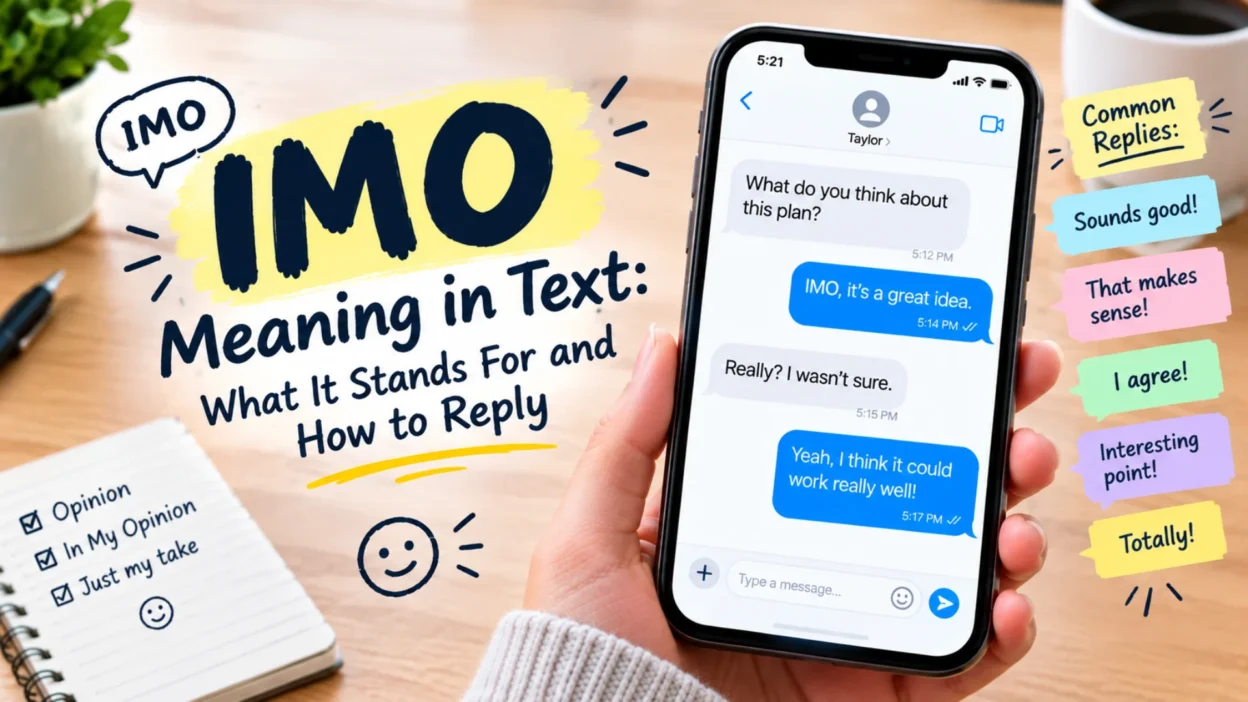
Here’s the direct answer: IMO usually stands for “in my opinion.” It works as a casual way of flagging that whatever follows is a personal take, not a hard fact. Nothing more complicated than that. The confusion starts when the same three letters carry a second meaning, or when someone mistakes it for a completely different acronym.
This breakdown covers every real meaning, explains how the tone shifts depending on where it appears, and shows you the exact reply that keeps a conversation alive.
The Quick Answer: IMO Unpacked
IMO is a texting abbreviation for “in my opinion.” In everyday messages, it functions as a soft disclaimer. Someone uses it to share a view without sounding like they’re claiming absolute truth.
Think of it as a verbal hedge. The phrase signals that what follows is subjective, open to debate, and not meant to start a war in the comments. On Twitter, people use IMO to avoid appearing confrontational. A statement like “Fozzie Bear is the best Muppet” sounds like a challenge. Add IMO, and it becomes a conversation starter instead of a fight.
Because it’s so short, IMO often doubles as a tone-setter. Placed at the start of a sentence, it frames everything that follows. Placed at the end, it retroactively softens a claim. The same three letters do different jobs depending on where they sit.
The Five Faces of IMO: From Humble to Not-So-Humble
IMO covers a wide range of confidence levels. The surrounding message usually shows which one applies. Five variations cover almost every real use.
| Variation | Full Meaning | What It Signals |
|---|---|---|
| IMO | In My Opinion | Standard, neutral flag for a personal take |
| IMHO | In My Humble Opinion | Softer, more courteous, self-aware |
| IMHO | In My Honest Opinion | Blunt, sometimes critical, “don’t take offense” |
| IMNSHO | In My Not-So-Humble Opinion | Jokingly arrogant, ironic |
| JMHO | Just My Humble Opinion | Extra-cautious, almost apologetic |
IMO is the workhorse. It does the job without adding emotional color. “IMO, that restaurant is overrated” reads as a simple opinion, nothing more.
IMHO adds humility. When someone writes “IMHO, this is a bad product,” they’re trying to avoid sounding arrogant. The phrase reinforces that others should take the statement with a grain of salt.
IMHO can also mean “in my honest opinion.” In this version, the tone shifts toward bluntness. Someone might write “IMHO, that movie was a waste of time” to signal that they’re not sugarcoating anything. This meaning overlaps with TBH, or “to be honest”.
IMNSHO is the ironic version. It stands for “in my not-so-humble opinion” and is usually used jokingly. Someone who writes IMNSHO is admitting they have a strong view and don’t care about sounding modest.
JMHO is the softest option. It stands for “just my humble opinion” and appears when someone wants to share a take with maximum caution. It’s less common than the others, but it shows up in forums and comment threads where people are tiptoeing around a sensitive topic.
Where IMO Came From
Texting abbreviations rarely have a single origin story. They evolve from spoken phrases that people eventually shorten because typing full sentences feels like too much effort.
The phrases “in my opinion” and “in my humble opinion” have been used for hundreds of years to preface personal views. The acronyms, however, likely trace back to the early days of internet messaging and chat rooms. During the 1980s and ’90s, people had much less screen real estate and smaller bandwidth, which impacted the language used on platforms like Internet Relay Chat. As a result, many phrases, including “in my opinion,” were abbreviated to acronyms.
IMO has been documented since at least the 1980s, with standard usage on Usenet and bulletin board systems. Over the decades, it spread from those early text-based communities to message boards, comment sections, social networking sites, and eventually every major messaging app. The acronym is now one of the most recognizable pieces of digital shorthand in the English-speaking internet.
Where IMO Lives: Platform by Platform
The meaning of IMO stays consistent from app to app. What shifts is the tone and the kind of response people expect.
| Platform | How IMO Appears | Expected Response |
|---|---|---|
| Text messages | Casual opinion between friends | Agreement or pushback |
| Twitter / X | Quote tweets, replies, hot takes | Debate or “don’t @ me” energy |
| TikTok comments | Reactions to videos or captions | Quick agreement or disagreement |
| Instagram DMs | Reply to a story or post | Light, low-pressure response |
| Comments and posts | Discussion, often lengthy | |
| Gaming chats | Server chat or DMs | Fast reactions, often tactical |
Twitter and Reddit produce the most IMO messages because both platforms reward opinion-sharing. A controversial take, a hot sports opinion, or a movie review all invite an IMO in the replies.
In private texts, IMO lands much softer. It feels more like a quick way to share a view between friends than a formal disclaimer. People drop it into DMs when they want to say “here’s what I think” without making a big deal of it.
On TikTok, IMO appears constantly in comments. “IMO, that transition was clean” or “IMO, the original was better” — short, reactive takes that don’t demand a long response. The acronym fits the platform’s fast, low-effort communication style perfectly.
IMO Isn’t Always “In My Opinion”: Other Meanings
Not every IMO belongs to texting culture. The same three letters appear in other places, and mixing them up can cause genuine confusion.
International Maritime Organization. This is the most prominent non-slang meaning. The IMO is a United Nations agency concerned with international maritime activities. If you see IMO in a news article about shipping, safety regulations, or ocean policy, it almost certainly refers to this organization.
Imo State, Nigeria. Imo is a state in southeastern Nigeria. Its capital is Owerri. The state has a population of roughly 3.9 million people and covers about 5,100 square kilometers. In geographic or news contexts, IMO can refer to this region.
IMO Messenger. There’s also a fairly popular messaging app called imo, which is sometimes written as IMO. This usage is niche and unlikely to appear in everyday texting.
International Meteorological Organization. A less common usage, but it exists in scientific and weather-related contexts.
IMO number. In shipping, an IMO number is a unique identity number issued to seacraft. The pattern looks like “1234567” and has nothing to do with opinions.
The pattern holds: if the message reads like a chat, it’s slang. If it reads like a news report or a geographic reference, it’s something else.
When You Shouldn’t Use IMO
IMO belongs to casual and semi-casual conversation. Using it in the wrong setting can make you sound careless or out of touch.
Professional emails. Clients, managers, and colleagues deserve clearer language. “In my view” or “I believe” does the job without sounding like a group chat. That said, IMO sometimes appears in relaxed workplace chats where everyone already knows each other.
Formal writing. Essays, reports, and applications never include texting abbreviations. Standard English applies.
Cross-language conversations. IMO hasn’t spread globally the way some internet slang has. If the other person isn’t fluent in casual English texting, they may not recognize it at all.
Serious conversations. If you’re working through a disagreement, IMO can sound dismissive. Direct sentences carry more respect. “I feel strongly about this” lands better than “IMO, you’re wrong.”
Academic or legal contexts. In any setting where precision matters, spell out “in my opinion” or avoid the phrase entirely. Abbreviations introduce ambiguity that doesn’t belong in formal documents.
Common Mistakes People Make With IMO
Most IMO mishaps come from small errors, not big ones.
Mistake 1: Assuming it always means “in my opinion.” The International Maritime Organization and Imo State are real meanings that show up in the right contexts. Ignoring them leads to confused replies.
Mistake 2: Overusing it. Like any slang term, IMO loses impact when it appears in every other message. Save it for moments when you genuinely want to flag a personal take.
Mistake 3: Confusing it with IMHO. They’re close, but not identical. IMO is neutral. IMHO adds humility or honesty, depending on the sender’s intent.
Mistake 4: Using it as a weapon. IMO can be used passive-aggressively. “IMO, they have no idea what they’re talking about” reads as a put-down dressed up as an opinion. The acronym doesn’t magically make a harsh statement kind.
Mistake 5: Forgetting the punctuation. IMO can appear at the start or end of a sentence. Both work, but the placement changes the rhythm. “IMO, that’s the best pizza in the city” hits differently than “That’s the best pizza in the city, IMO.”
How to Reply to IMO Without Overthinking It
Your reply should match the sender’s energy. That’s the entire rule.
1. If you agree:
- “Totally agree.”
- “Yeah, I see it the same way.”
- “100%.”
2. If you disagree politely:
- “I see it differently, but I get where you’re coming from.”
- “Fair take, but I’d say the opposite.”
- “Interesting. I actually think the opposite.”
3. If you’re unsure what they want:
- “What makes you say that?”
- “Tell me more.”
- “Why do you think so?”
4. If it’s a hot take and you want to push back:
- “Hard disagree, but respect.”
- “That’s a bold take.”
- “I don’t know about that one.”
5. If you want to playfully dismiss it:
- “Okay, noted.”
- “Sure, if you say so.”
- “We’ll agree to disagree.”
Notice how none of these replies overcommit. They leave space for the conversation to go wherever it’s meant to go.
IMO in Real Conversations
Seeing the acronym in context makes its meaning click faster than any definition.
The casual opinion
- Person A: “IMO, the second season was way better than the first.”
- Person B: “Really? I thought the first was stronger.”
- Result: A friendly debate starts without anyone taking offense.
The softened hot take
- Person A: “IMO, that movie was overrated.”
- Person B: “Fair. I liked it, but I get it.”
- Result: Disagreement lands gently.
The passive-aggressive version
- Person A: “IMO, they have no idea what they’re talking about.”
- Person B: “That’s a bit harsh.”
- Result: The acronym didn’t hide the bite.
The gaming callout
- Player A: “IMO, we should push mid.”
- Player B: “Nah, we flank.”
- Result: Tactical opinions exchanged, game continues.
Notice how IMO never demands a long response. It sets a tone and lets the conversation flow from there.
Generational and Regional Patterns
IMO is most common among younger texters in the United States, though it has spread widely across age groups and platforms. Gen Z and millennials use it naturally. Older users often recognize it but rarely adopt it in casual chat.
Regional differences stay minor. An IMO from California means the same as an IMO from Florida. The acronym originated online rather than in a specific geographic community, so it travels well.
Outside the U.S., IMO appears in Canada, the UK, and Australia, but at lower frequency. Each of those countries has its own texting slang, and IMO hasn’t displaced any of it. That said, the acronym is recognizable enough that most English-speaking internet users understand it even if they don’t use it themselves.
Related Abbreviations Worth Knowing
IMO belongs to a family of short phrases that dominate casual texting. Learning the relatives helps you pick the right one.
| Abbreviation | Meaning | Best Situation |
|---|---|---|
| TBH | To Be Honest | Signaling candor |
| NGL | Not Gonna Lie | Similar to TBH, more casual |
| FR | For Real | Agreement or emphasis |
| SMH | Shaking My Head | Disappointment or disbelief |
| YMMV | Your Mileage May Vary | Reminding others experiences differ |
| TBH | To Be Honest | Adding sincerity |
TBH and IMO solve different problems. IMO distinguishes a personal view from claimed fact. TBH signals candor that might otherwise be softened. You could use both in the same sentence without redundancy: “TBH, IMO it wasn’t worth the price”.
FAQ
What does IMO stand for in texting?
IMO stands for “in my opinion.” It’s a casual way to flag that what follows is a personal view, not a hard fact. It behaves similarly to “I think” but shorter and more casual.
Is IMO the same as IMHO?
Not exactly. IMO means “in my opinion” and is neutral. IMHO means “in my humble opinion” or “in my honest opinion” and adds either humility or bluntness, depending on the sender’s intent.
Can IMO mean something other than “in my opinion”?
Yes. IMO can also stand for the International Maritime Organization, Imo State in Nigeria, or a messaging app called imo. In news and geographic contexts, it usually refers to one of those meanings.
What does IMO mean on TikTok?
On TikTok, IMO almost always means “in my opinion.” It’s used in comments and captions to share a personal take on a video, a trend, or a product. It’s one of the most common acronyms on the platform.
Should I use IMO at work?
It depends on the workplace. IMO sometimes appears in relaxed team chats where everyone already knows each other. In formal emails or communication with clients, spelling out “in my opinion” or using “I believe” reads better.
How do I reply to IMO?
Match the sender’s energy. If you agree, say so. You disagree, do it politely. If you’re unsure what they want, ask for more context. Short, natural replies work best.
Where did IMO come from?
IMO traces back to the 1980s and the early days of internet messaging and chat rooms. The phrase “in my opinion” was abbreviated to save screen space and typing effort on platforms like Usenet and IRC.
Is IMO used outside America?
It appears in Canada, the UK, and Australia, but less frequently. Each of those regions has its own texting shorthand, and IMO hasn’t replaced any of it. Most English-speaking internet users still recognize it.
Final Thoughts on Reading IMO Correctly
IMO is a small abbreviation with a straightforward job. It flags a personal opinion without claiming absolute truth. Most of the time, that’s all it means. The confusion comes from the rare cases where it refers to a shipping organization, a Nigerian state, or a messaging app.
The next time those three letters show up in your messages, you won’t need to guess. Read the context, match the tone, and reply like someone who actually understands digital shorthand.

Serhii Dunev is a passionate content creator dedicated to crafting meaningful texts, messages, and word inspirations. He aims to help people express their emotions clearly through simple and impactful words.