
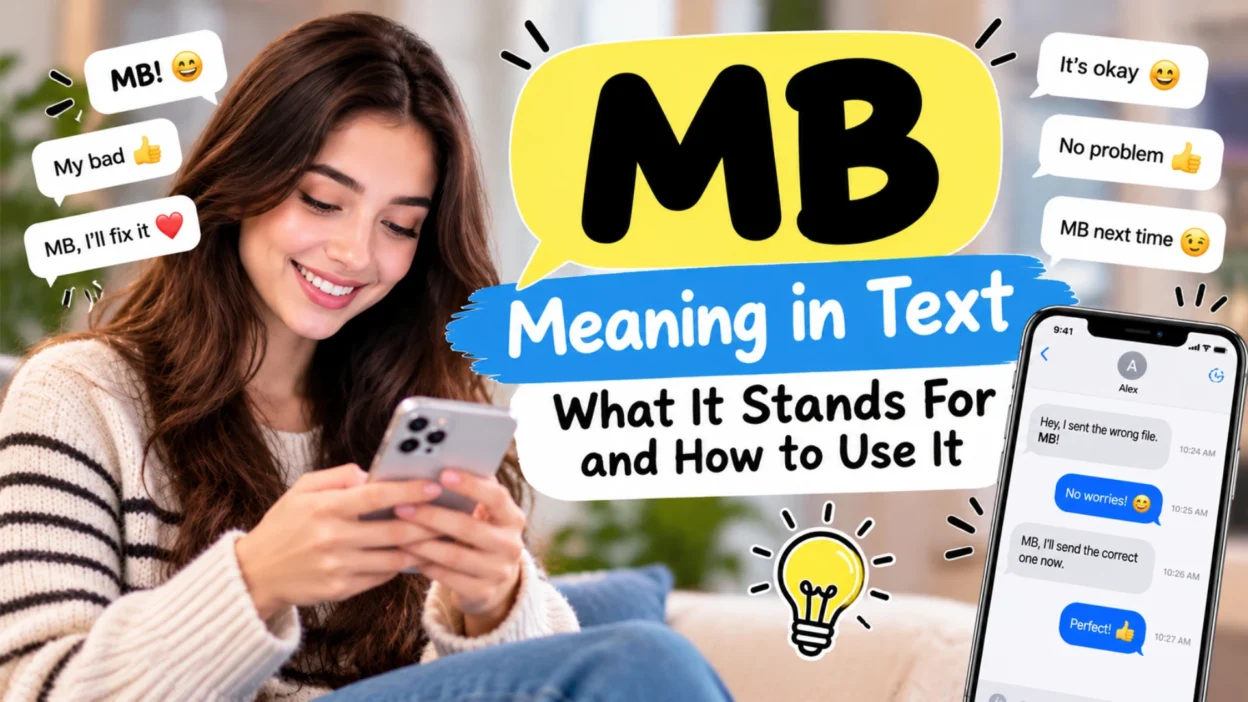
If someone sends you “mb” after a minor mix-up, they are almost certainly saying “my bad.” The mb meaning in text is a quick, casual apology for a small mistake, an oversight, or a brief lapse in judgment. It is not a formal apology, and it is rarely used for serious offenses. Think of it as the digital equivalent of a shrug and a quick “oops, that’s on me.”
Understanding this tiny abbreviation matters more than it might seem. A single “mb” can shift the tone of a conversation, signal self-awareness, or even prevent unnecessary tension in a group chat. But it is not the only meaning of those two letters, and misreading the context can lead to confusion. This guide breaks down the primary meaning, the common alternatives, and the practical signals that help you tell them apart.
The Most Common Meaning: My Bad
“MB” stands for “my bad” in the vast majority of casual text messages, direct messages, and social media comments. It is used when someone wants to acknowledge a mistake without turning the moment into a heavy or dramatic exchange.
The phrase “my bad” itself has roots in American street slang and gained wider popularity in the 1990s. It originally circulated in basketball culture as a way to acknowledge a bad pass or a missed play without slowing down the game. Over time, it shortened into the two-letter abbreviation that fits neatly into character-limited platforms and fast-paced chats. You can read more about the phrase’s informal usage on Merriam-Webster’s entry for “my bad”.
When People Use “MB” in Conversation
The abbreviation appears in everyday situations where the stakes are low and the tone is relaxed. A friend might send “mb” after forgetting to reply to a message. A teammate might type it after missing an obvious pass in a game. A colleague might use it informally after sending an email without the promised attachment.
The key distinction is scale. “MB” fits a forgotten detail, a typo, a late response, or a small scheduling error. It does not suit a genuine harm or a mistake that requires a real conversation.
Examples in Context
- Forgotten plan: “I thought we were meeting at 7. MB, I totally mixed up the time.”
- Missed message: “Sorry, I left you on read yesterday. MB.”
- Minor mistake: “MB, I sent that to the wrong group chat.”
- Gaming slip: “MB, I should have covered that angle.”
In each case, “MB” keeps the exchange light. It acknowledges the error and moves the conversation forward without demanding a lengthy exchange of apologies.
Other Meanings of “MB” in Text
“My bad” dominates casual texting, but context matters. A few other meanings appear often enough that it is worth knowing how to spot them.
Maybe
When “MB” appears in response to a yes-or-no question, it can stand for “maybe.” The tone is usually uncertain rather than apologetic.
Example:
Person A: “Are you coming to the movie tonight?”
Person B: “Idk, mb. I’ll let you know later.”
If the message reads like a tentative answer rather than an admission of fault, “maybe” is the likely meaning.
Megabyte
In technical or file-related conversations, “MB” is the standard abbreviation for megabyte, a unit of digital storage. This usage is not slang, and it rarely appears in the same sentence as “my bad.” You can see the standard definition in Dictionary.com’s entry for “MB”.
Example:
“That photo is almost 8 MB, so it might take a second to upload.”
If the conversation involves files, downloads, storage limits, or data plans, “MB” almost certainly refers to megabytes.
Less Common Slang Meanings
A few other interpretations exist, though they appear far less frequently. Some people use “MB” for “mind blown” in reaction to something surprising, such as “MB 🤯 that ending was wild.” Others may type it as shorthand for “message back” in older texting shorthand, though this is rare today. In medical or academic contexts, MB can also refer to a Bachelor of Medicine degree, but this is unlikely to appear in a casual text exchange.
These uses depend heavily on the topic and the people involved, so read the surrounding words before assuming.
How to Tell Which Meaning Is Being Used
Context solves most confusion. A few quick signals make the intended meaning clear.
- Tone: An apologetic tone points to “my bad.” A hesitant tone points to “maybe.”
- Topic: Files, storage, and tech specs point to megabyte.
- Grammar: “MB” standing alone after a mistake usually means “my bad.” “MB” answering a question usually means “maybe.”
- Platform: Casual chats and gaming lobbies favor slang. Work emails and tech forums favor the technical meaning.
When in doubt, ask. A simple “mb as in my bad?” clears things up without awkwardness.
Is “MB” Appropriate in Every Situation?
“MB” works well in informal settings: texts, group chats, gaming, and quick messages between friends or close colleagues. It is too casual for formal apologies, professional emails to clients, or situations where someone has been seriously inconvenienced.
If the mistake matters, spell it out. “I’m sorry, that was my mistake” carries more weight than a two-letter abbreviation. Reserve “MB” for moments when a light acknowledgment is enough. This is particularly relevant for younger texters, who often use “MB” to keep the energy low-key in group chats and DMs. The abbreviation signals self-awareness without making the vibe too heavy. For broader guidance on informal messaging etiquette, Grammarly’s guide to text abbreviations is a useful reference.
Common Mistakes to Avoid
A few habits cause confusion when using “MB.”
- Overusing it: Constant “mb” messages can feel dismissive, as if the person is not taking responsibility seriously.
- Using it for serious errors: A quick “mb” after a real problem can come across as flippant.
- Assuming one meaning: In mixed conversations, especially tech chats, confirm the context before replying.
- Mixing up case: Lowercase “mb” usually signals slang, while uppercase “MB” often signals the technical unit. This is a tendency, not a rule, but it helps.
MB on Different Platforms
The meaning stays consistent across platforms, but the context shifts slightly depending on where you see it.
On Snapchat, “MB” usually appears in direct messages or story captions as a quick apology or admission of a mistake. On TikTok and Instagram, creators might use it in captions to acknowledge a minor error in a video, such as “MB for the audio glitch.” In Discord and WhatsApp group chats, “MB” often follows a typo, a missed message, or a forgotten detail in a fast-moving conversation.
The common thread is speed and informality. “MB” fits the rhythm of platforms where messages disappear, chats move quickly, and users prefer not to interrupt the flow with a full sentence of apology.
A Note on Origin and Evolution
The phrase “my bad” has been part of American English since at least the late 1970s, with early written usage appearing in a 1986 book about pickup basketball. Its transition into the abbreviation “MB” is a more recent development, driven by the character limits and fast pace of modern messaging.
What makes “MB” interesting is how it has retained its casual, low-stakes character even as it spread across platforms and generations. Unlike some slang that fades or shifts meaning, “my bad” and its abbreviation have stayed remarkably stable. The word “bad” here functions as a noun meaning “mistake” or “fault,” a usage that remains primarily informal but is widely understood.
FAQs
What does MB mean in a text from a friend?
In most friendly conversations, “MB” means “my bad.” It is a casual way to apologize for a small mistake, a late reply, or a minor oversight.
Can MB mean “maybe”?
Yes. When “MB” is used as an answer to a question, it often stands for “maybe.” The tone is uncertain rather than apologetic, which makes it easy to distinguish from “my bad.”
Is MB the same as “my bad”?
Yes, in casual texting the two are interchangeable. “MB” is simply the shortened form of “my bad.”
When should I not use MB?
Avoid “MB” in formal apologies, professional emails, or situations where the mistake caused real inconvenience. In those cases, write out a clear and sincere apology instead.
Does MB always mean megabyte in tech conversations?
Not always, but usually. If the discussion involves file sizes, storage, or data, “MB” almost certainly means megabyte. In casual chat that happens to mention tech, slang usage is still possible.
Why do people say “MB” instead of “sorry”?
“MB” is faster and lighter than a full apology. It acknowledges the mistake without making the conversation feel heavy or formal, which suits the tone of casual texting and group chats.
Conclusion
The mb meaning in text is simple: it is almost always “my bad,” a light and quick way to own a small mistake. Watch the tone, the topic, and the question being answered, and you will rarely misread it. Keep “MB” for casual moments, and save the full apology for the situations that deserve it.

Serhii Dunev is a passionate content creator dedicated to crafting meaningful texts, messages, and word inspirations. He aims to help people express their emotions clearly through simple and impactful words.