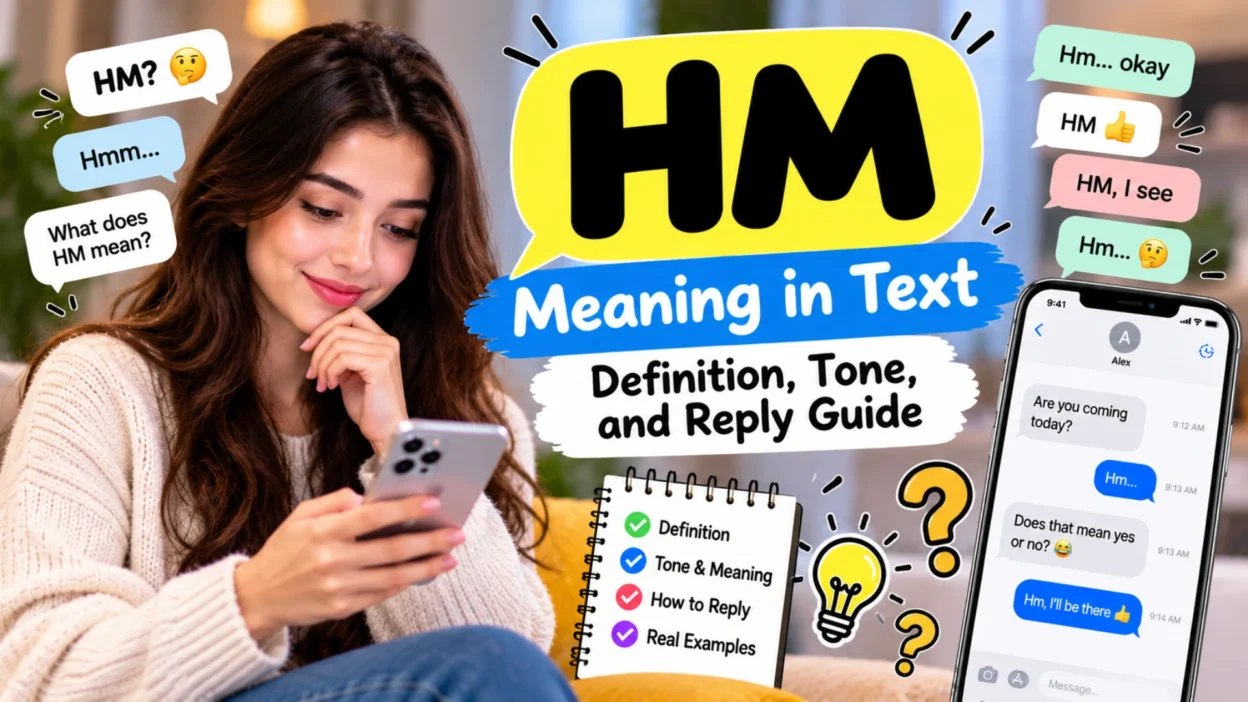
A friend sends you a long story about their day, and you reply with two letters: hm. The screen goes quiet. Now they’re staring at your response, wondering whether you’re thinking, judging, or simply too tired to type. The hm meaning in text is one of the most misunderstood questions in casual messaging, because those two letters are not really an acronym at all—they’re a written sound, and that sound can carry almost any emotion depending on how it’s spelled and where it lands.
At its core, hm represents the noise people make when they’re thinking, hesitating, or reacting without committing to a full sentence. However, in texting and social media, that single sound has splintered into a wide range of tones: curiosity, doubt, boredom, skepticism, and even subtle judgment. Understanding those shades is what separates a confident reader from someone who misreads a pause as a personal slight.
The Core Definition: A Written Sound, Not an Acronym
HM is usually considered an abbreviation rather than a true acronym. Unlike IDK or BRB, which map letters to specific words, hm is simply a shortened way of writing the sound “hmm”—the noise a person makes when they’re thinking or hesitating. That distinction matters because it explains why hm feels so flexible. You can’t decode it word by word; you have to hear it in your head.
In everyday conversation, hm functions as a placeholder. It lets someone acknowledge that they’ve read a message without promising a full reply. Think of it as a casual nod in text form: present, but quiet. That neutrality is exactly why it spreads so easily across messaging apps.
Lowercase “hm” appears far more often than uppercase “HM” in casual chats. The lowercase form blends into the sentence and matches the relaxed rhythm of quick messages. Uppercase exists too, but it tends to point toward acronyms and formal titles rather than the thinking sound.
Beyond the Pause: The Five Moods of HM
Most guides stop at “it means you’re thinking” and move on. That’s incomplete. In real conversations, hm performs at least five distinct jobs, and the same two letters can shift between them without warning.
The first mood is genuine thought. Someone asks a complicated question, and hm signals that the answer is still forming. The second mood is mild doubt. A friend shares a questionable claim, and hm becomes a polite way of saying “I’m not convinced.” The third mood is curiosity. When hm appears with a question mark, it often invites the other person to explain more.
The fourth mood is boredom or disengagement. A stretched-out “hmmm” after a long message can read as “I read it, but I have nothing to add.” The fifth mood is judgment. A flat “hm.” followed by silence often lands harder than any insult, because it forces the other person to fill in the blanks.
Context decides which mood applies. Relationship history, punctuation, and the length of the “m” all provide clues.
How Spelling Changes Everything
HM is short enough that tiny formatting choices carry disproportionate weight. The number of m’s is the first clue. A single “hm” is neutral and quick. Two or three m’s—”hmm” or “hmmm”—signal that the person is actually thinking or becoming skeptical. String it out to six m’s with periods, and the tone shifts toward visible judgment.
Punctuation adds another layer. A plain “hm” with no punctuation reads as casual. “Hm?” becomes a question, often curious or confused. “Hm.” with a flat period feels clipped, almost cold. Multiple question marks push the tone toward impatience.
Capitalization matters less, but it isn’t meaningless. “HM” can feel louder or more formal, while “hm” blends in. Emojis flip the script entirely. A smiling emoji softens the reply into something light. A neutral or side-eye emoji sharpens it into silent disapproval.
HM Versus Hmm: The Difference Nobody Explains
Most people use hm and hmm interchangeably, but the spelling carries a subtle distinction. “Hmm” is the fuller, more deliberate version. It suggests actual thinking—a genuine pause while the person processes something. “Hm” is faster and flatter. It can still mean thinking, but it can also mean “I have no strong reaction” or “I’m not going to engage with that.”
This difference matters in emotional conversations. A “hmm” after someone shares difficult news feels more engaged than a bare “hm.” The shorter version can read as dismissive, even when the sender didn’t intend it that way. Choosing between them is a small decision with a noticeable social impact.
HM on Snapchat, TikTok, and Instagram
Each platform gives hm a slightly different flavor. On Snapchat, hm appears most often as a quick reply in fast chats, often when someone is considering an answer or reacting thoughtfully. The app’s disappearing messages and casual rhythm make brevity natural.
On TikTok, hm shows up in comments under videos, usually when someone is questioning something or reacting to surprising content. The public nature of comments keeps the tone playful, though stretched-out versions can read as skeptical.
Instagram leans more toward direct messages and story replies, where hm functions as a low-effort acknowledgment. WhatsApp conversations use it constantly because it’s quick and casual. Traditional text messages host the most literal version, where hm works as a neutral pause in an otherwise active thread.
The Other Meanings: When HM Isn’t a Thinking Sound
Outside casual texting, HM is a crowded abbreviation. In British English, HM is the written abbreviation for Her Majesty or His Majesty, and it often precedes the name of the monarch or a government department. In slang, HM commonly stands for “high maintenance,” referring to a person with expensive tastes or heavy emotional needs.
In gaming communities, HM can refer to Hidden Machine in Pokémon, a tool used to teach moves outside of battle. In music, HM is shorthand for heavy metal. In medical and demographic contexts, it occasionally stands for Hispanic male. In educational settings, it can mean honorable mention.
None of these secondary meanings competes with the thinking sound in everyday texting. They simply show how much weight context carries. A message containing “hm” after a question is almost certainly the thinking sound. A message about a British monarch is not.
When HM Doesn’t Belong: Work, Family, and Difficult Conversations
One of the most common mistakes people make is dropping hm into professional communication. In a work email, a client message, or a note to a manager, “hm” can read as uncertain or unprofessional. A colleague asking whether a deadline is achievable deserves a clear answer, not a two-letter pause.
This isn’t because hm is inherently rude. It’s about register. The sound signals hesitation, and professional settings typically expect decisiveness. Using hm in a job interview follow-up or a client update can make the sender seem unsure, even when the intent was simply to buy time.
Family settings require similar care. Sending “hm” to a parent or an older relative often creates confusion, especially if they don’t recognize it as a thinking sound. In difficult emotional conversations, hm can land as cold. When someone shares something vulnerable, a fuller response almost always works better than a two-letter pause.
Common Mistakes People Make With HM
The first mistake is assuming hm always means the same thing. It doesn’t. Thinking, doubt, boredom, and judgment are all valid readings, and ignoring the context leads to unnecessary anxiety.
The second mistake is overusing hm as a filler. A reply that always looks like a pause can make the sender seem disengaged, even when they’re listening carefully. Varying the response with a fuller “let me think” or “interesting” keeps the tone honest.
The third mistake is misreading a flat “hm.” as hostility. Sometimes the sender is genuinely busy. Sometimes they’re being lazy with punctuation. Treating every short reply as a personal slight can damage otherwise healthy conversations.
Finally, some people use hm in professional settings without realizing how it sounds. A quick “hm” to a boss or a client rarely lands the way it does in a chat with friends.
How to Reply to HM Without Overthinking It
The right reply depends on which mood the hm is carrying. If it’s a genuine thinking sound, give the person time. A short “take your time” or “no rush” acknowledges the pause without adding pressure.
When the hm feels like doubt, a gentle follow-up works well. “You sure?” or “What’s your gut saying?” invites the person to explain without turning the exchange into a confrontation. If the hm reads as judgmental, a calm direct question—”Is something wrong?”—surfaces the issue faster than guessing.
For casual, low-stakes hms, matching the energy is usually enough. A simple “yeah, I get that” or a topic change keeps the conversation moving without overanalyzing two letters. In professional or high-stakes messages, respond to the substance rather than the sound.
HM and Similar Text Reactions Compared
| Term | Common Meaning | Typical Tone |
|---|---|---|
| HM | Thinking sound | Neutral, hesitant, sometimes skeptical |
| Hmm | Fuller thinking sound | Deliberate, curious |
| Hmmm | Stretched thinking sound | Skeptical, judgmental |
| IDK | I don’t know | Uncertain, casual |
| IMO | In my opinion | Casual, opinionated |
| TBH | To be honest | Candid, informal |
| NGL | Not gonna lie | Candid, confessional |
HM belongs to the same family of shorthand as IDK and TBH, but it stands apart because it isn’t an acronym. It’s a sound, and sounds carry emotion more directly than letters do. That’s why a single “hm” can feel warmer or colder than a full sentence depending on how it’s delivered.
Generational and Cultural Nuances
Younger texters tend to use hm without much thought, treating it as ordinary vocabulary alongside hmm and idk. Older users often recognize the thinking sound but may not pick up on its skeptical or judgmental undertones, which can create mismatched expectations in mixed-age conversations.
Cultural background matters too. Because hm is a phonetic rendering of a universal human sound, it translates more easily than most slang. However, its secondary meanings—Her Majesty, high maintenance, heavy metal—are culturally specific and can confuse readers who encounter them outside their usual context.
Regional differences add another layer. In some online circles, hm is almost invisible because it’s so common. In others, it still reads as distinctly online shorthand. These variations don’t change the primary definition, but they do change how the message lands.
Frequently Asked Questions About HM
What does HM mean in text?
HM most commonly represents the thinking sound “hmm.” It signals that the sender is processing information, hesitating, or reacting without committing to a full reply. It is an abbreviation of a sound, not a true acronym.
Is HM rude?
It can be, depending on tone and punctuation. A plain “hm” is usually neutral. A flat “hm.” or a stretched “hmmmm” can read as skeptical or judgmental. Context and formatting matter more than the letters themselves.
What’s the difference between HM and Hmm?
They mean the same thing, but the spelling changes the feel. “Hmm” is fuller and more deliberate, suggesting genuine thought. “Hm” is faster and flatter, and it can read as disengaged or dismissive.
Does HM have other meanings?
Yes. In British English, HM stands for Her Majesty or His Majesty. In slang, it can mean “high maintenance.” In gaming, it refers to Hidden Machine in Pokémon. In music, it can mean heavy metal.
Is HM okay to use at work?
Generally, no. HM signals hesitation, and professional communication usually calls for clear, decisive answers. Work emails and client messages are not the place for a two-letter pause.
Why do people use lowercase “hm” instead of uppercase “HM”?
Lowercase is more common in casual texting because it blends into the sentence and matches the relaxed rhythm of quick messages. Uppercase appears in more formal or acronym-heavy contexts, where it points to different meanings.
How should I respond to HM?
If it’s a thinking sound, give the person time. A short “no rush” or “take your time” works well. If it feels doubtful or judgmental, a calm question like “Is something wrong?” clears things up faster than guessing.
Can HM be flirtatious?
It can be, depending on the emoji and the relationship. A “hm” paired with a teasing or smiling emoji often reads as playful rather than serious. The same letters without warmth can feel cold.
Final Thoughts: Two Letters That Make You Think
HM is a small abbreviation with an unusually wide range. At its core, it writes out a sound—the pause people make when they’re thinking or hesitating. Around that core, moods branch: the genuine pause, the polite doubt, the bored acknowledgment, the silent judgment.
The practical takeaway is straightforward. Read the spelling and punctuation before deciding what someone meant. Use hm with friends and peers, not in professional writing. And when the two letters arrive, respond to the pause rather than the anxiety it creates. Two letters shouldn’t make you spiral—especially when the conversation is right there waiting for you.

Serhii Dunev is a passionate content creator dedicated to crafting meaningful texts, messages, and word inspirations. He aims to help people express their emotions clearly through simple and impactful words.