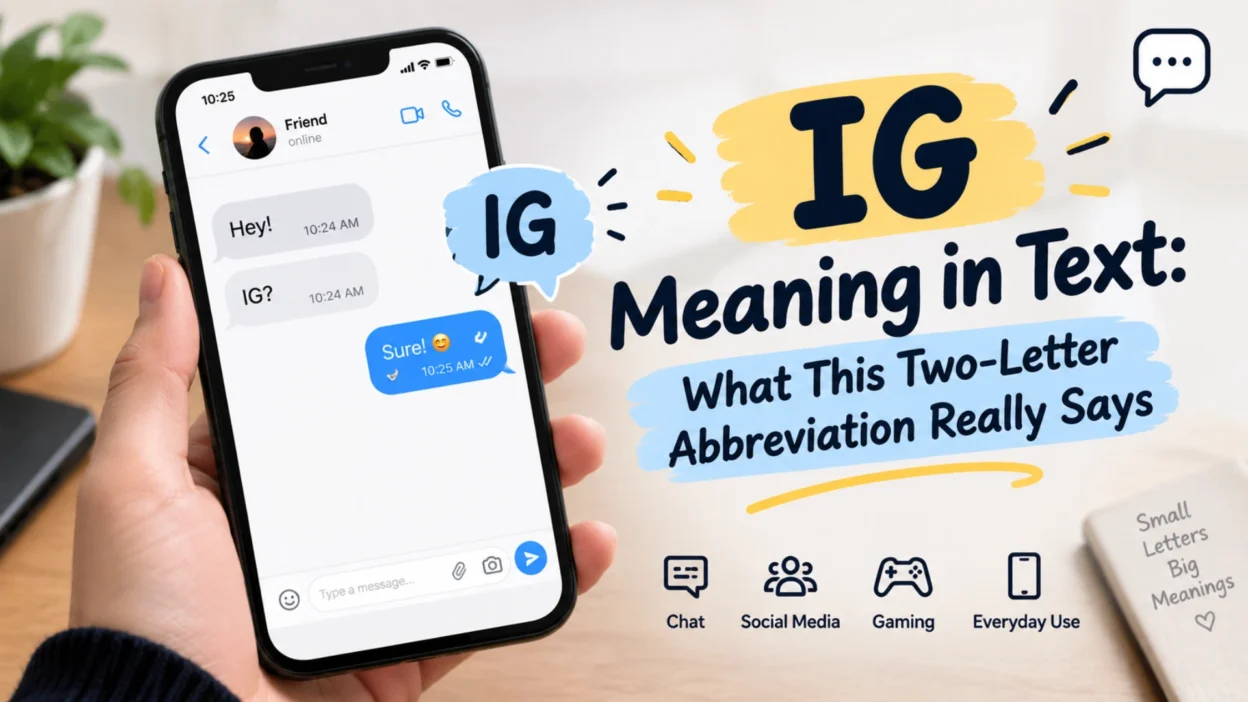
A friend replies to your dinner invitation with a single word: ig. No punctuation. No follow-up. You stare at the screen and wonder whether they’re excited, indifferent, or quietly annoyed. The ig meaning in text is one of the most context-dependent questions in modern messaging, because those two letters can point in two completely different directions: toward a social media platform or toward a hesitant, half-hearted agreement.
At its core, ig stands for either “I guess” or “Instagram,” and the surrounding sentence almost always tells you which one applies. That sounds simple enough. However, the “I guess” version carries a tonal range that catches people off guard. It can be casual, reluctant, sarcastic, or passive-aggressive, and misreading it can turn a harmless reply into an awkward misunderstanding. Understanding those shades is what separates a confident reader from someone who guesses back.
The Two Core Meanings: I Guess and Instagram
IG functions as an initialism, with each letter standing for a word. In one reading, the I comes from “I” and the G from “guess.” In the other, the letters simply abbreviate the name of the social media platform Instagram, which launched in 2010 and quickly became one of the most referenced apps in everyday conversation. Both meanings are valid, and neither is a fringe interpretation.
Determining which one applies depends entirely on context. If someone says “check out my IG,” the reference is clearly the platform. If someone replies “ig” to a question about weekend plans, the reference is almost certainly “I guess.” The abbreviation itself stays the same; the sentence around it does the explaining.
“I Guess”: The Hesitant Heart of IG
The “I guess” meaning is the one that causes the most confusion, largely because it rarely sounds as neutral as the full phrase. In texting, “ig” often signals uncertainty, reluctance, or a lack of enthusiasm. It’s a way of agreeing without fully committing, and that half-step is exactly what makes it useful.
Consider a simple exchange. Someone asks whether you want to attend a party, and you reply “ig.” On paper, you’ve agreed to go. In practice, you’ve communicated that you’re not thrilled about it. The abbreviation compresses a whole emotional stance into two letters, and that efficiency is part of its appeal. People use it precisely because it lets them say yes without pretending to be excited.
When IG Carries a Passive-Aggressive Edge
The hesitant version of ig can slide into passive-aggression depending on the relationship and the moment. A reply of “it’s fine, ig” after a disagreement often lands harder than “it’s fine” because the abbreviation adds a visible shrug. The sender is technically agreeing, but the tone suggests they’re not happy about it.
This reading isn’t universal. Some people use ig casually, with no emotional weight at all. Others deploy it strategically when they want to signal displeasure without starting a confrontation. Reading the relationship and the conversation history matters more than decoding the letters themselves.
“Instagram”: The Platform Meaning
The second major meaning is far more literal. IG is a standard shorthand for Instagram, used in speech and text alike. Someone might ask for your IG, mention that they saw something on IG, or suggest posting a photo to IG. In each case, the abbreviation refers to the app, not to a hesitant agreement.
This usage became widespread shortly after Instagram’s launch, when the platform’s name was too long to type repeatedly in casual conversation. The abbreviation stuck because it was convenient and instantly recognizable. Today, “IG” and “Insta” are used interchangeably by millions of people, and the meaning is rarely ambiguous when the topic is social media.
How Context Decides Which Meaning Wins
The single most reliable way to decode ig is to look at the words around it. When ig appears alongside platform language—post, story, follow, handle, DM—the Instagram meaning is almost certain. When it appears as a standalone reply or at the end of a sentence about plans, feelings, or obligations, the “I guess” meaning usually applies.
Consider these contrasts. “Follow me on IG” is unmistakably about the platform. “I’ll come, ig” is unmistakably hesitant agreement. “Did you see her IG?” points to social media. “That’s alright, ig” points to reluctant acceptance. The abbreviation doesn’t change; the surrounding grammar and vocabulary do all the work.
Punctuation, Capitalization, and Tone
Formatting choices carry real weight with such a short abbreviation. A lowercase “ig” with no punctuation typically reads as neutral and casual. Adding a period or a flat tone can make it feel colder. Stretching the letters—”iggg”—usually signals playful reluctance rather than genuine annoyance.
Capitalization matters less than punctuation, but it isn’t meaningless. “IG” in uppercase can feel more formal or more emphatic, while “ig” blends into the sentence. Emojis add another layer. A laughing emoji after ig softens the hesitation; a flat or neutral emoji sharpens it into visible disinterest.
The practical lesson is simple: read the formatting before deciding what the sender feels. The letters provide the meaning, but the delivery provides the mood.
IG in Different Settings: Texting, Social Media, and Gaming
The meaning of ig shifts slightly depending on where it appears. In one-on-one texting, “I guess” dominates, especially in replies to questions about plans or preferences. On social media platforms like X and Facebook, both meanings appear, and the surrounding post usually makes the intended reading obvious.
In gaming communities, a third meaning occasionally surfaces: “in game.” A message like “IG now” can mean “join the game now” rather than “I guess now.” This usage is narrower and more specialized, but it exists. Similarly, some users treat ig as shorthand for “ignore,” though that reading is less common and usually clear from context.
None of these secondary meanings competes with the two primary ones. They simply remind readers that digital communication is not uniform, and that the same two letters can serve different communities in different ways.
When IG Doesn’t Belong: Professional and Formal Writing
One of the most common mistakes people make is dropping ig into professional communication. In a work email, a client message, or a note to a manager, “I guess” written as “ig” can read as careless or unprofessional. A colleague asking whether a deadline is achievable deserves a clear answer, not a hesitant two-letter shrug.
This isn’t because ig is inherently rude. It’s about register. Text slang signals informality, and professional settings typically expect fuller language. Using ig in a job interview follow-up or a client update can make the sender seem uncertain or disengaged, even when the intent was simply to save time.
A reasonable rule: keep ig for friends, peers, and casual chats. In anything that could be forwarded to a manager or saved in a record, write “I guess” in full or, better yet, give a definitive answer.
Common Mistakes People Make With IG
The first mistake is assuming ig always means the same thing. It doesn’t. “I guess” and “Instagram” are both valid, and ignoring context leads to confusion.
The second mistake is misreading the tone of “I guess.” A casual ig from a close friend might mean nothing more than mild indecision. The same abbreviation from someone who is upset can carry real weight. Treating every ig as equally light or equally heavy misses the nuance.
The third mistake is using ig with people who may not recognize it. Parents, older relatives, or new acquaintances might read it as a typo or an unfamiliar acronym. A quick expansion—”ig (I guess)”—can prevent confusion without much effort.
Finally, some people reply to a hesitant ig as if it were a firm yes. That misreading can lead to mismatched expectations. When someone says “ig” about plans, it’s often worth checking whether they actually want to attend.
How to Reply to IG Without Guessing Back
The right reply depends on which meaning is in play. If ig means Instagram, respond to the platform context: share your handle, comment on the post, or continue the social media conversation. If ig means “I guess,” the reply should address the hesitation rather than the literal words.
A gentle follow-up works well in the hesitant case. “You sure?” or “We don’t have to go if you’re not feeling it” gives the sender room to clarify. When the ig feels passive-aggressive, a direct but calm question—”Is something wrong?”—can surface the real issue without escalating.
For casual, low-stakes igs, matching the energy is usually enough. A simple “cool” or “sounds good” keeps the conversation moving without overanalyzing two letters.
IG and Similar Text Abbreviations Compared
| Abbreviation | Common Meaning | Typical Tone |
|---|---|---|
| IG | I guess / Instagram | Hesitant, casual, or platform-related |
| IDK | I don’t know | Neutral, uncertain |
| IMO | In my opinion | Casual, opinionated |
| TBH | To be honest | Candid, informal |
| NGL | Not gonna lie | Candid, confessional |
| WYD | What you doing? | Curious, friendly |
| HMU | Hit me up | Informal, inviting contact |
IG belongs to the same family of shorthand as IDK and IMO, but it stands apart because it carries two unrelated meanings. That dual identity is why context matters more for ig than for most other abbreviations. A single misread can send a conversation in the wrong direction.
Generational and Regional Nuances
Younger texters tend to use ig without much thought, treating “I guess” as ordinary vocabulary and “Instagram” as an obvious platform reference. Older users may recognize the platform meaning more readily than the hesitant one, which can create confusion in mixed-age conversations.
Regional usage also varies. English-speaking internet communities share the same core meanings, but the frequency of the hesitant ig and the comfort level with its passive-aggressive edge differ from place to place. In some circles, ig is almost invisible because it’s so common; in others, it still reads as distinctly online slang.
These differences don’t change the definition. They simply remind readers that digital communication is not uniform. The same two letters can feel native to one person and foreign to another.
Frequently Asked Questions About IG
What does IG stand for in text?
IG most commonly stands for “I guess” in casual texting, or “Instagram” when the conversation is about social media. Context almost always makes the intended meaning clear.
Is IG rude?
It can be. The abbreviation itself is neutral, but “I guess” delivered as ig often carries a hesitant, reluctant, or passive-aggressive tone. In a tense conversation, it may read as dismissive.
How do I know if someone means Instagram or “I guess”?
Look at the surrounding words. Platform language—post, story, follow, handle—points to Instagram. A standalone reply or a sentence about plans and feelings points to “I guess.”
Is it okay to use IG at work?
Generally, no. IG is casual slang, and professional communication usually calls for “I guess” written in full or, better, a clear and direct answer. Client emails and formal reports are not the place for it.
Does IG have any other meanings?
In gaming communities, IG can occasionally mean “in game.” Some users also treat it as shorthand for “ignore,” though that reading is less common. The two primary meanings remain “I guess” and “Instagram.”
Why do people use lowercase “ig” instead of uppercase “IG”?
Lowercase is more common in casual texting because it blends into the sentence and matches the relaxed tone of quick messages. Uppercase appears too, but it doesn’t make the abbreviation more formal.
What should I do if I’m not sure which meaning someone intended?
Ask a short clarifying question. “Do you mean I guess?” costs little and prevents confusion. When context doesn’t provide the answer, a direct question is the safest choice.
Is IG still commonly used?
Yes. It remains a familiar abbreviation in texting and online chat, alongside similar shorthand like IDK and TBH. Its dual meaning keeps it relevant in both casual conversation and social media discussion.
Final Thoughts: Two Letters, Two Directions
IG is a small abbreviation with an unusually wide range. At its core, it shortens either “I guess” or “Instagram,” and those two meanings pull in completely different directions. Around that core, tone branches: the casual shrug, the reluctant agreement, the passive-aggressive reply, the platform reference.
The practical takeaway is straightforward. Read the surrounding words before deciding what someone meant. Use ig with friends and peers, not in professional writing. And when the tone feels off, ask a gentle question instead of guessing back. Two letters shouldn’t create confusion—especially when the context is right there on the screen.

Serhii Dunev is a passionate content creator dedicated to crafting meaningful texts, messages, and word inspirations. He aims to help people express their emotions clearly through simple and impactful words.