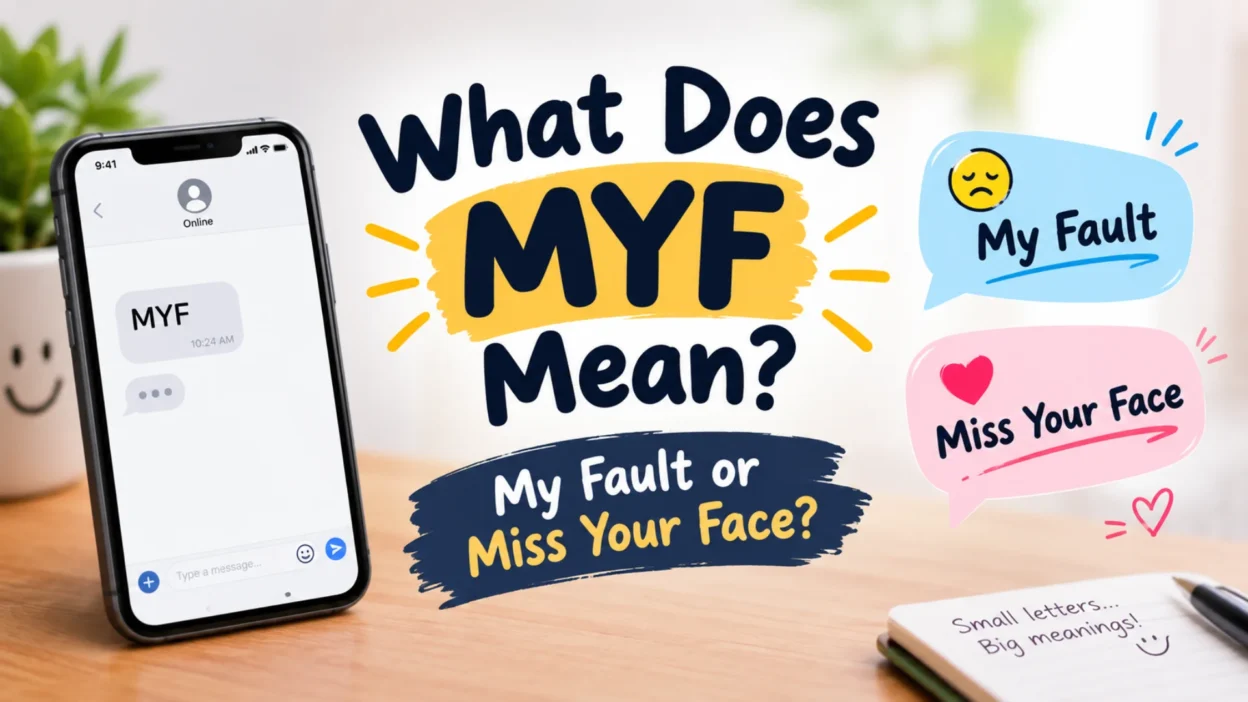
If you’ve spotted “MYF” in a text message, TikTok comment, or group chat and felt completely lost, you’re not alone. This three-letter abbreviation has quietly become a staple of digital conversation, yet its meaning shifts depending on where you encounter it. Understanding what does myf mean requires looking at context, because this acronym carries at least two very different interpretations. One is an apology. The other is an affectionate gesture. Getting them mixed up could lead to some awkward moments.
Most people encounter MYF on social platforms like TikTok, Instagram, or Snapchat. However, it also appears in everyday texting between friends, family members, and even coworkers. The abbreviation has gained traction because it’s quick to type and emotionally versatile. Below, you’ll find a thorough breakdown of every common meaning, real usage examples, and guidance on when to use it and when to avoid it.
The Most Common Meaning: “My Fault”
In most online conversations, MYF stands for “my fault.” It functions as a shorthand apology when someone acknowledges a mistake, whether minor or significant. You’ll often see it dropped in a comment section after someone posts incorrect information, or in a group chat after accidentally sending a message to the wrong person.
This usage mirrors the older “MYB” (my bad), which became popular in the mid-2010s. The difference is subtle. “My bad” tends to sound casual and almost dismissive, while “my fault” carries a slightly more sincere tone of accountability. Consequently, people often choose MYF when they want to signal genuine responsibility rather than a flippant admission.
In a TikTok comment, for example, a creator might write: “Sorry for the confusion, MYF!” after realizing their earlier post contained a factual error. In a friend group chat, someone might type: “MYF, I totally forgot to save you a seat.” The abbreviation keeps the message brief but still conveys remorse.
It’s worth noting that some social media users have criticized this usage. A few creators have pointed out that typing “myf” in place of a real apology can feel hollow, especially in serious situations. The abbreviation works best for small mistakes, not for moments that require a genuine, thoughtful acknowledgment. That distinction matters if you want to come across as sincere rather than dismissive.
The Other Major Meaning: “Miss Your Face”
Here’s where things get tricky. MYF also stands for “miss your face,” a warm and affectionate way to tell someone you’re thinking of them. This meaning is especially common in text messages between close friends, romantic partners, and family members who live far apart.
When used this way, MYF carries no trace of apology. Instead, it’s a playful, endearing expression of longing. Someone might text: “MYF! Can’t wait to see you next weekend.” Or a parent might send: “MYF, sweetie. Hope you’re doing well.” The phrase feels more intimate than a simple “I miss you” because “your face” adds a lighthearted, personal touch.
Interestingly, this meaning often appears in reconnection attempts. If you haven’t spoken to an old friend in months, opening with “Hey, MYF!” can soften the message and signal that you still care. Similarly, someone might use it to check in with an ex-partner without making the conversation too heavy. The abbreviation gives the sender an easy way to express vulnerability without overcommitting.
Because the same letters serve two entirely different purposes, context is everything. If the message follows an error or mistake, MYF almost certainly means “my fault.” If it appears in a warm, affectionate exchange, it’s far more likely to mean “miss your face.” Misreading the tone can lead to confusion, so paying attention to the surrounding conversation is essential.
Other MYF Meanings You Might Encounter
Beyond the two dominant interpretations, MYF has a handful of less common meanings. These appear far less frequently in everyday digital communication, but they’re worth knowing so you aren’t caught off guard.
In business planning, MYF can stand for “Mid-Year Forecast,” a term used in financial reporting and strategic planning. In academic or career counseling contexts, it sometimes refers to “Mapping Your Future,” a nonprofit organization that provides career and college planning resources. Religious communities may use MYF to mean “Methodist Youth Fellowship” or “Mennonite Youth Fellowship,” both of which are church-based youth groups. In the beauty world, “Make Your Face Foundation” is occasionally shortened to MYF, though this usage is niche and largely confined to specific online communities.
None of these alternative meanings dominate social media, but they do exist. If you encounter MYF in a professional document or a church bulletin, it’s safe to assume it’s not a casual apology or an affectionate text. Context remains your best guide.
How to Tell Which Meaning Someone Intends
Distinguishing between “my fault” and “miss your face” doesn’t require guessing. A few simple signals will usually point you in the right direction.
Look at the Surrounding Conversation
If the message follows a mistake, delay, or misunderstanding, MYF probably means “my fault.” Someone who forgot to reply to a message might type: “MYF, I saw this and totally blanked.” Conversely, if the conversation involves affection, nostalgia, or planning a reunion, “miss your face” is the likely meaning. A text like “MYF, it’s been way too long” leans clearly toward longing rather than apology.
Consider the Relationship
You’ll see “my fault” used across a wide range of relationships, from casual acquaintances to close friends. However, “miss your face” tends to appear in warmer, more personal exchanges. It’s less common between coworkers or strangers. If your best friend sends MYF out of nowhere, they’re almost certainly telling you they miss you.
Check the Platform
TikTok and Twitter/X users lean heavily toward “my fault” because these platforms often involve public corrections and accountability. Text messaging and Snapchat tend to host more “miss your face” usage, since those spaces are more private and intimate. That said, exceptions exist everywhere.
When You Should Avoid Using MYF
MYF isn’t appropriate in every situation. In professional emails, formal workplace communication, or any context where clarity and sincerity matter most, spelling out “my fault” or “I miss you” is the better choice. Abbreviations can come across as lazy or overly casual in those settings.
Additionally, avoid using MYF as a substitute for a genuine apology when the stakes are high. If you’ve hurt someone’s feelings or made a serious error, a three-letter acronym won’t repair the damage. A real apology requires specific acknowledgment, not shorthand. Social media users have rightly called out this trend, noting that “myf” can feel like a way to dodge accountability rather than embrace it.
Likewise, if you’re unsure which meaning the other person will read, err on the side of spelling it out. Ambiguity in digital communication causes unnecessary confusion. Clarity always wins.
MYF vs. MYB vs. Other Apology Abbreviations
MYF isn’t the only abbreviation people use to say sorry online. Understanding how it compares to similar terms helps you choose the right one.
| Abbreviation | Meaning | Tone | Common Platforms |
|---|---|---|---|
| MYF | My fault | Slightly sincere | TikTok, text, group chats |
| MYB | My bad | Casual, dismissive | Text, gaming, social media |
| SRY | Sorry | Neutral | All platforms |
| MB | My bad | Very casual | Gaming, texting |
MYF sits in a middle ground. It’s more accountable than “my bad” but less formal than a full apology. That balance makes it useful for everyday mistakes, but it won’t suffice when someone expects a heartfelt response. If you’re in doubt, a simple “I’m sorry” still works better than any acronym.
Platform Differences: Where MYF Thrives
Different platforms shape how people use MYF. On TikTok, the abbreviation almost always means “my fault.” Comment sections are full of creators correcting themselves, and MYF serves as a quick way to own an error without derailing the conversation. Twitter/X follows a similar pattern, though “miss your face” occasionally appears in affectionate replies.
Text messaging is more balanced. Depending on the relationship, MYF can swing either way. Snapchat and Instagram DMs tend to favor “miss your face” because those spaces are more personal. Meanwhile, gaming communities rarely use MYF at all; they prefer “my b” or “mb” for quick apologies during matches.
Understanding these platform norms helps you interpret the abbreviation faster. If you’re on TikTok and someone types MYF after a correction, they’re apologizing. If you’re texting a close friend and they send M.Y.F out of nowhere, they probably miss you.
Generational and Cultural Perspectives
Younger users, particularly Gen Z and younger millennials, drive most M.Y.F usage. These groups grew up with texting abbreviations and treat them as a natural part of digital communication. Older generations may be less familiar with the term, which can lead to confusion when it appears in mixed-age group chats.
Culturally, MYF is most prevalent in English-speaking countries, especially the United States, Canada, and the United Kingdom. However, internet slang spreads quickly, and you’ll now find MYF in conversations worldwide. In some non-English-speaking communities, the abbreviation carries different meanings entirely, which is another reason context matters so much.
Common Mistakes People Make with MYF
The biggest mistake is assuming MYF always means the same thing. Treating it as universally synonymous with “my fault” can lead to misreading affectionate messages, and vice versa. Always check the surrounding context before responding.
Another common error involves using M.Y.F in professional settings. A quick “M Y F” in a Slack message to your boss might seem efficient, but it often reads as unprofessional. Formal communication calls for formal language. Similarly, using M Y F as a stand-in for a meaningful apology can backfire. If someone is upset, they want to hear real words, not an acronym.
Finally, some people confuse MY..F with MYB or other abbreviations. While they’re related, they aren’t interchangeable. MYF. implies ownership of a mistake, whereas MYB is more of a casual shrug. Knowing the difference helps you communicate more precisely.
FAQ: Quick Answers About MYF
What does MYF mean in a text message?
In texting, MYF usually means either “my fault” or “miss your face.” The correct interpretation depends on context. If the message follows a mistake, it’s an apology. If it appears in an affectionate exchange, it’s an expression of longing.
Is MYF the same as MYB?
Not exactly. MYB stands for “my bad” and tends to sound more casual. MYF. stands for “my fault” and carries a slightly more sincere tone of accountability. Both are apologies, but they differ in weight.
Can MYF mean “miss your face” on TikTok?
Yes, though it’s less common on TikTok than “my fault.” TikTok users typically deploy MYF. as a quick apology in comments and captions. “Miss your face” appears more often in private messages or on platforms like Snapchat and Instagram.
Should I use MYF in professional emails?
No. MYF is far too casual for professional communication. Spell out “my fault” or “I’m sorry” instead. Your colleagues and clients will appreciate the clarity and professionalism.
What if someone sends MYF and I’m not sure what they mean?
Ask them. A simple “Hey, do you mean my fault or miss your face?” clears up any confusion immediately. There’s no shame in checking, especially when the stakes are low.
Is MYF appropriate for serious apologies?
Generally, no. MYF works for small mistakes, like forgetting to reply or sending a message to the wrong person. For serious errors or hurt feelings, a full, sincere apology is always better.
Does MYF have any other meanings I should know?
A few. In business, it can mean “Mid-Year Forecast.” In religious contexts, it may refer to “Methodist Youth Fellowship” or “Mennonite Youth Fellowship.” These usages are much less common in everyday digital conversation.
Final Thoughts on MYF
MYF is a small abbreviation with a surprisingly wide range of meanings. Most of the time, it means either “my fault” or “miss your face,” and context tells you which one applies. On TikTok and public social platforms, expect an apology. In private texts with loved ones, expect affection. When in doubt, spell it out.
Digital communication evolves quickly, and abbreviations like MYF come and go. But as long as people make mistakes and miss each other, this little acronym will probably stick around. Understanding it helps you navigate conversations more confidently, whether you’re scrolling through TikTok comments or texting a friend you haven’t seen in months.

Serhii Dunev is a passionate content creator dedicated to crafting meaningful texts, messages, and word inspirations. He aims to help people express their emotions clearly through simple and impactful words.