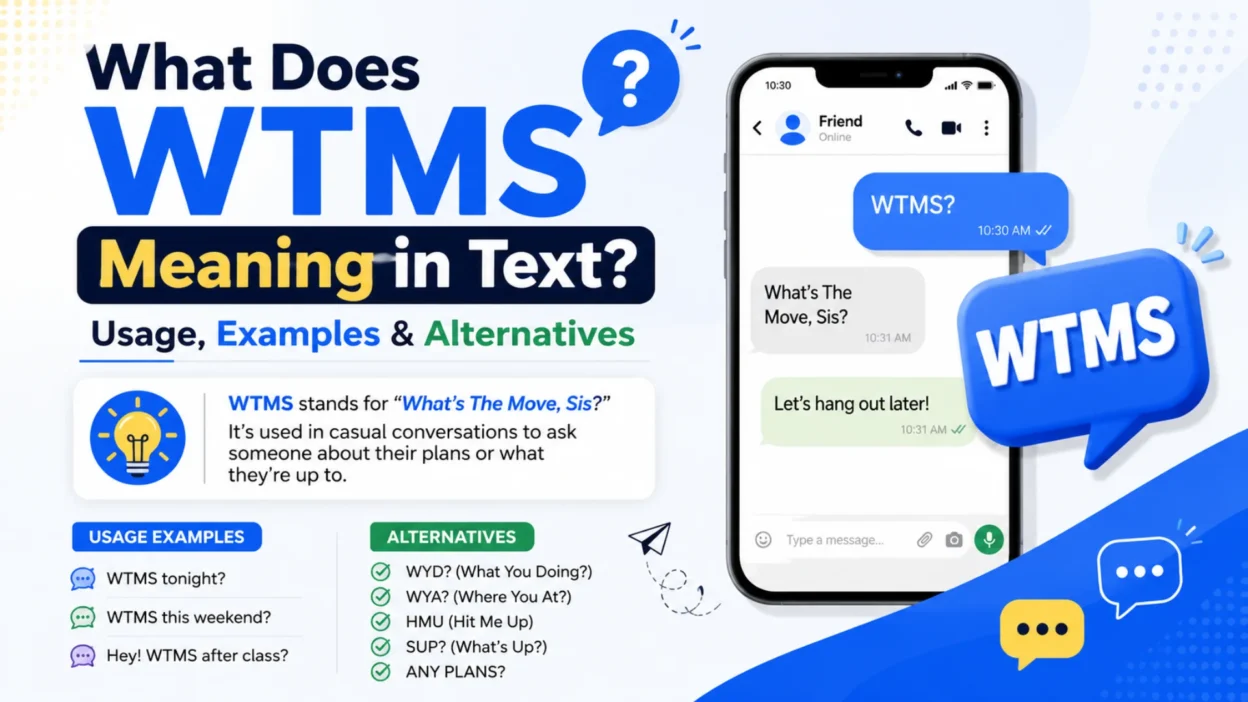
Have you ever received a confusing text message with the acronym “WTMS” and felt completely lost? You are not alone. Millions of people encounter this less common abbreviation and wonder about its exact meaning. In short, “wtms meaning in text” refers to the acronym WTMS, which typically stands for “What’s That Mean, Seriously?” or occasionally “Whatever That Means, Seriously?” This expression conveys confusion, skepticism, or a request for clarification. Consequently, understanding this term can help you decode nuanced digital conversations.
Interestingly, WTMS is a newer slang term compared to classics like LOL or OMG. Therefore, many people search for its definition daily. For instance, a friend might text “WTMS” after you send a vague or unbelievable statement. Similarly, you might see it in comment sections when someone doubts a claim. As a result, mastering “wtms meaning in text” will make you a more confident communicator. Let us explore everything you need to know. 😅
Definition & Core Meaning of wtms meaning in text
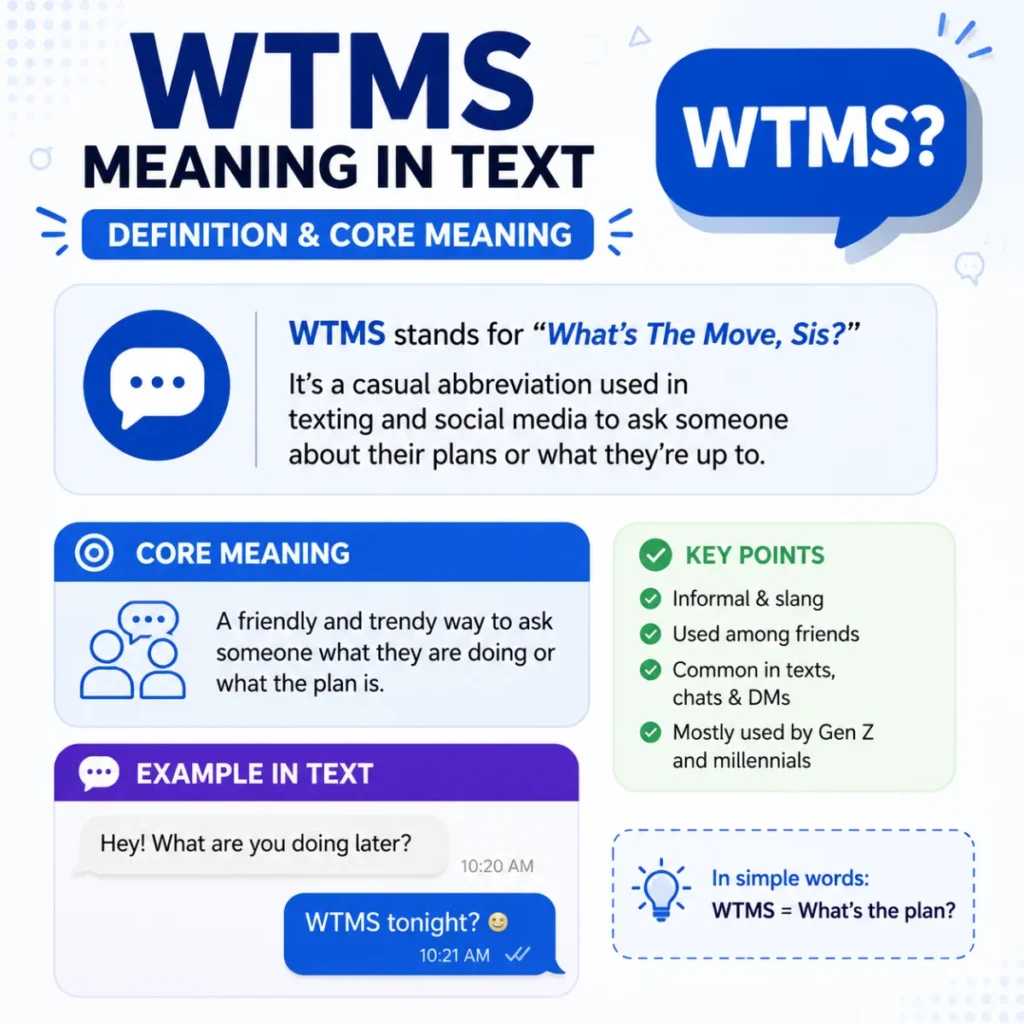
So, what exactly does WTMS stand for? The acronym WTMS expands to “What’s That Mean, Seriously?” In some contexts, it can also mean “Whatever That Means, Seriously?” Both interpretations serve a similar purpose: expressing doubt or a need for explanation.
Typically, someone uses WTMS when they find a previous message unclear, unbelievable, or overly vague. For example, if a friend says, “I just got promoted because of my quantum physics hobby,” you might reply, “WTMS?” This response asks them to clarify or justify their statement. Note that WTMS carries a slightly skeptical tone. It is not merely a request for information; it implies, “I doubt what you just said, or I find it odd.”
Nevertheless, the intensity varies. In some cases, WTMS is playful. For instance, after a sarcastic comment, a friend might type “WTMS” with a laughing emoji. Conversely, in a heated debate, “WTMS” can signal genuine disbelief or frustration. Therefore, always consider the surrounding conversation.
Key takeaway: “wtms meaning in text” revolves around skeptical clarification. Unlike “What does this mean?” (neutral), WTMS adds a layer of “Really? Explain yourself.”
History & Origin of wtms meaning in text
Where did this unusual acronym come from? Unlike WTH or LOL, WTMS does not have a well-documented origin. Nonetheless, linguists trace its emergence to the early 2010s on platforms like Twitter and Reddit. Users wanted a shorter way to say, “What does that mean, seriously?” without typing the full phrase.
Subsequently, the abbreviation gained traction in niche online communities. For instance, gaming forums used WTMS when a player made an unbelievable claim about a rare item drop. Similarly, meme comment sections adopted WTMS to express ironic confusion. However, the acronym never reached the popularity of WTF or SMH. As a result, many people still search for “wtms meaning in text” today.
Interestingly, some sources suggest WTMS originated as a typo of “WTM” (What’s the matter?) with an extra S for “seriously.” Others believe the “S” stands for “sweetie” in sarcastic contexts. Nevertheless, the most accepted meaning remains “What’s That Mean, Seriously?”
By 2018, WTMS appeared in urban dictionaries and slang databases. Today, it remains a niche but useful acronym. You are most likely to encounter it among frequent texters, gamers, or Gen Z social media users.
Real-World Examples of wtms meaning in text in Conversations
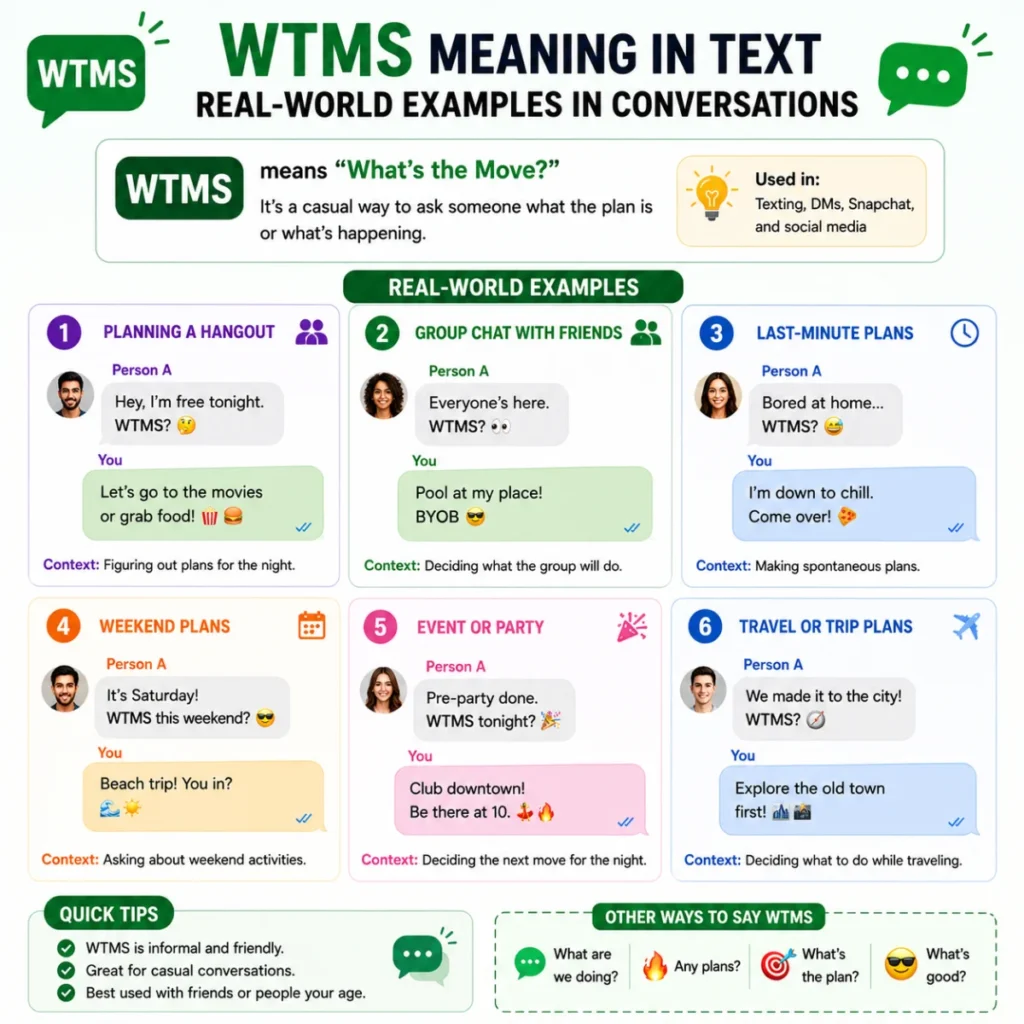
To fully grasp “wtms meaning in text,” let us examine real conversation examples. Each scenario demonstrates how native speakers use WTMS naturally.
Example 1: Skepticism About an Unlikely Claim
Person A: “I can run a marathon in under two hours without training.” Person B: “WTMS? That’s literally the world record pace.” Explanation: Person B uses WTMS to express disbelief and request proof.
Example 2: Confusion Over Vague Wording
Person A: “The project needs more synergy with blockchain-adjacent frameworks.” Person B: “WTMS? Can you explain in plain English?” Explanation: Here, WTMS signals confusion and a polite demand for clarity.
Example 3: Playful Teasing Among Friends
Person A: “I only eat cereal with orange juice instead of milk.” Person B: “WTMS? That’s disgusting 😂 Are you serious?” Explanation: Playful skepticism; the laughing emoji softens the tone.
Example 4: Sarcastic Reaction on Social Media
Person A (tweet): “Money doesn’t buy happiness, but I’d rather cry in a Ferrari.” Person B (reply): “WTMS? That makes zero sense but okay.” Explanation: WTMS expresses ironic disbelief while dismissing the statement.
Example 5: Genuine Request for Clarification in Group Chat
Person A: “We’re meeting at the usual spot at 8 PM tomorrow.” Person B: “WTMS? I’m new here. Where’s the usual spot?” Explanation: Although skeptical (why assume everyone knows?), the user genuinely needs information.
As you can see, “wtms meaning in text” always involves a reaction to something unclear or questionable. The speaker doubts, questions, or challenges the previous message.
How Context Changes Meaning of wtms meaning in text
Context dramatically alters how WTMS is perceived. Let us break down four common digital environments.
Texting Between Close Friends
In personal texts, WTMS is almost always playful or neutral. Friends use it to tease each other or ask for clarification without offense. For instance, “You’re dating your ex again? WTMS?” This conveys surprise but not anger. Typically, close friends understand the intent because of their relationship history.
Social Media (Twitter, Reddit, Instagram)
On public platforms, WTMS often carries skeptical or sarcastic weight. Users employ it to challenge viral claims, fake news, or confusing memes. For example, replying “WTMS” to a politician’s tweet signals strong disbelief. However, because tone is harder to read online, some may perceive WTMS as rude. Therefore, use cautiously.
Gaming Chats (Discord, Twitch, In-Game)
Gamers use WTMS when a teammate makes an irrational play or unbelievable boast. For instance, “I killed the boss solo.” Reply: “WTMS, there’s no boss in this level.” In gaming, speed matters, so acronyms like WTMS are efficient. Nevertheless, overusing it can annoy teammates. Use sparingly for maximum effect.
Dating Apps (Tinder, Bumble, Hinge)
Using WTMS on dating apps is risky. If your match says something odd, replying “WTMS?” might seem accusatory or judgmental. On the other hand, if you have established playful banter, it can work. For example: “I once wrestled a kangaroo.” “WTMS? That’s wild 😂” works well. Generally, avoid WTMS in early conversations. Stick to “What do you mean?” instead.
Tone Nuances: Is wtms meaning in text Rude or Friendly?
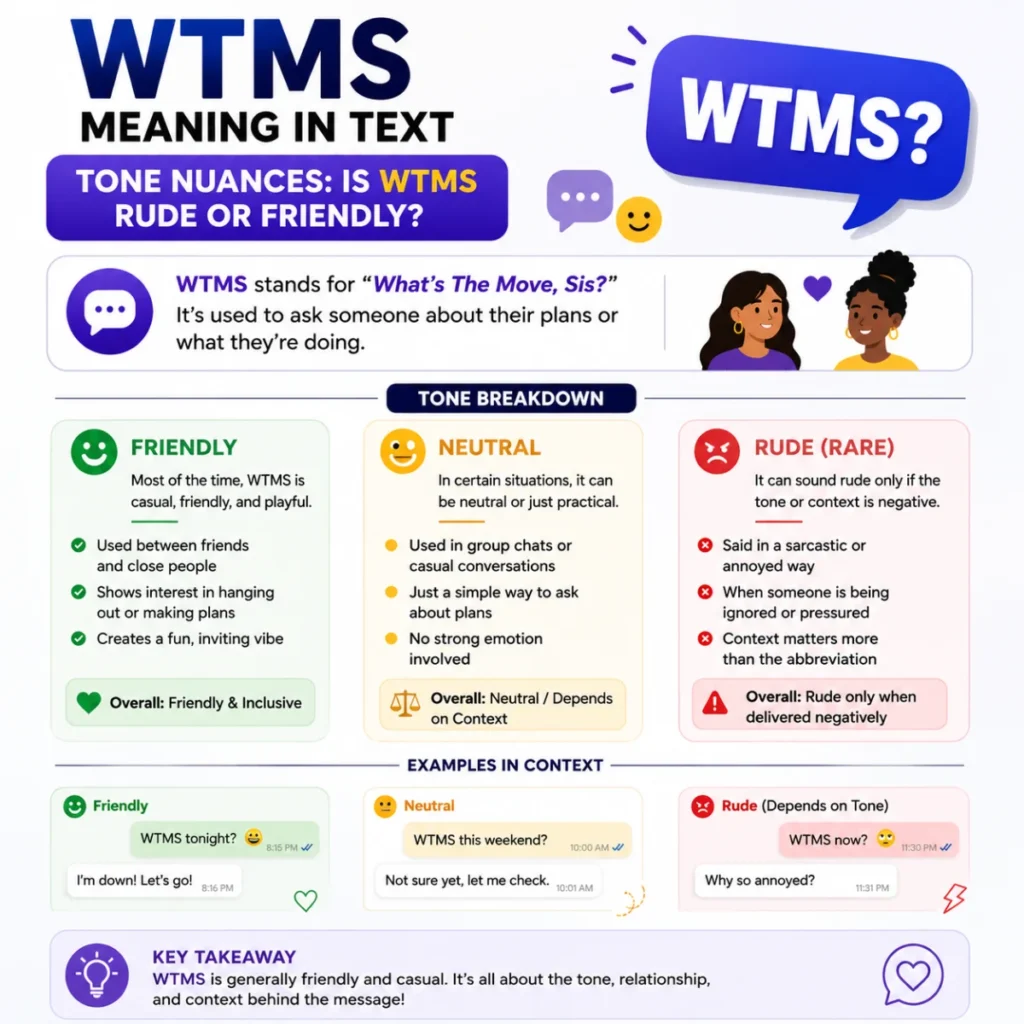
This is a critical question. Is WTMS inherently offensive? The answer depends on relationship, delivery, and context.
With close friends: Not rude. Friends understand your intent. For example, “WTMS, you actually liked that movie?” is clearly teasing. No offense intended.
With acquaintances or coworkers: Potentially rude. Because WTMS implies doubt, it can sound like you are calling someone a liar or an idiot. For instance, texting a colleague “WTMS?” after their update may damage rapport.
Delivery matters greatly. Adding an emoji changes everything. “WTMS? 😅” reads as awkward confusion. “WTMS? 🤨” reads as suspicious. “WTMS! 😂” reads as playful. Without any emoji or punctuation, WTMS can seem blunt or aggressive.
Frequency also plays a role. Using WTMS once in a conversation is fine. However, replying “WTMS” to every message makes you appear hostile or perpetually confused.
To summarize: “wtms meaning in text” is neutral to slightly skeptical. It is not a curse word. Nevertheless, it can feel rude to people who are not familiar with internet slang or who expect polite language. When in doubt, choose a clearer, softer alternative (see the polite alternatives table later).
wtms meaning in text vs Similar Slang Terms (Comparison Table)
Many acronyms overlap with “wtms meaning in text.” Below is a comparison table to help you distinguish them.
Slang TermFull FormPrimary FunctionIntensityOffensivenessWTMSWhat’s That Mean, Seriously?Skeptical clarification requestMediumLow to Medium (context-dependent)WTMWhat’s the matter?Asking about problem/issueLowVery LowWDYMWhat Do You Mean?Neutral clarificationLowNoneWTHWhat the hell?Surprise, frustrationMediumLow (mild expletive)WTFWhat the f***?Shock, angerHighHigh (vulgar)IDKI don’t knowUncertaintyVery LowNoneSMHShaking my headDisappointmentLowNone
As shown, WTMS is most similar to WDYM (What Do You Mean?) but adds skepticism. WDYM is neutral; WTMS implies “I doubt you.” Therefore, choose WDYM for polite clarification. Choose WTMS for playful or skeptical situations.
How to Respond to wtms meaning in text (3 Scenarios)
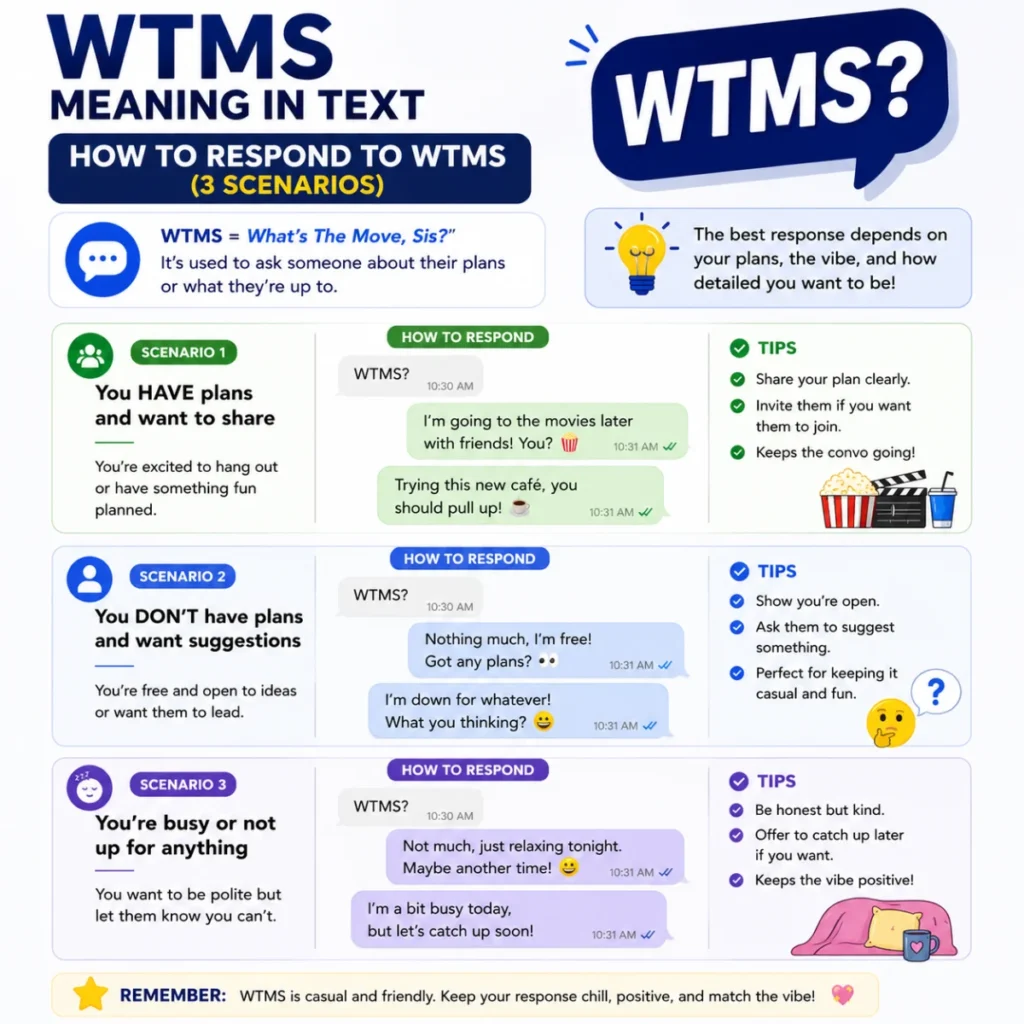
Receiving a “WTMS” text can feel jarring. How should you reply? Below are three common scenarios with appropriate responses.
Scenario 1: They Used WTMS Playfully (Teasing or Surprise)
Their message: “WTMS? You actually ate a whole pizza by yourself?” Your response: “Haha yes, and I’d do it again 😂” or “WTMS back? It was delicious!” Tip: Match their playful tone. Do not get defensive. Laugh it off.
Scenario 2: They Used WTMS Genuinely (Confused but Not Accusatory)
Their message: “WTMS? I don’t understand your last text about the meeting time.” Your response: “Sorry for the confusion! I meant 3 PM Eastern. Does that help?” Tip: Apologize briefly, then clarify. Avoid responding with another “WTMS,” which escalates confusion.
Scenario 3: They Used WTMS Skeptically (They Doubt Your Claim)
Their message: “WTMS? There’s no way you met a celebrity at the grocery store.” Your response: “I know it sounds crazy, but here’s a photo as proof 📸” or “Fair point. Let me explain.” Tip: Provide evidence or gracefully admit exaggeration. Never respond with anger or sarcasm.
Professional Use: Can You Say wtms meaning in text at Work?
The short answer is absolutely not. You should never use WTMS in professional settings. This includes emails, Slack messages to managers, client calls, or internal reports. Why? Because WTMS is informal, unclear, and potentially dismissive.
Consider the perception. If you write to a coworker, “WTMS about the quarterly report?” they may think you are mocking them or doubting their competence. This harms teamwork and trust. Similarly, using WTMS with a client is unprofessional and could cost you business.
What to use instead at work:
- “Could you clarify what you mean?” (polite and neutral)
- “I’m not following. Can you explain further?” (respectful)
- “What does that refer to?” (direct but professional)
- “Help me understand your point.” (collaborative)
Remember: “wtms meaning in text” is strictly for casual, personal conversations. Even in relaxed startup environments, avoid obscure slang like WTMS. Stick to clear English.
Common Misconceptions About wtms meaning in text (4 Myths Debunked)
Several myths surround this niche acronym. Let us correct them.
Myth 1: “WTMS means ‘What’s the matter, sweetie?’”
Reality: No. While some people might use it that way sarcastically, the overwhelming consensus defines WTMS as “What’s That Mean, Seriously?” The “sweetie” interpretation is rare and not standard.
Myth 2: “WTMS is just a typo of WTM.”
Reality: Partially true. WTMS may have evolved from a typo, but it now has its own distinct meaning. The extra “S” for “Seriously” adds skepticism not present in WTM (“What’s the matter?”). Therefore, treat them as separate terms.
Myth 3: “WTMS is always rude.”
Reality: False. Among close friends, WTMS is often playful or neutral. Rudeness depends entirely on tone, relationship, and context. For instance, “WTMS? 😂” is clearly friendly. Do not assume offense.
Myth 4: “Everyone knows what WTMS means.”
Reality: Definitely false. WTMS is a niche acronym. Many people, especially those over 30 or non-native English speakers, have never seen it. Consequently, using WTMS may confuse your audience. Always consider whether the recipient will understand.
5 Polite Alternatives to wtms meaning in text (With Table)
Sometimes you want to ask for clarification without any skepticism or risk of offense. Below are five excellent alternatives. Use these in professional, formal, or sensitive conversations.
Alternative PhraseWhen to UseExample Sentence“What do you mean?”Neutral, everyday clarification“What do you mean by ‘later’? Can you give a time?”“Could you explain that?”Polite, slightly formal“Could you explain that again? I missed the first part.”“I’m not sure I understand.”Soft, non-confrontational“I’m not sure I understand your point about the budget.”“Can you clarify?”Short, professional“Can you clarify the deadline for this task?”“Sorry, what was that?”Informal but friendly“Sorry, what was that? I didn’t catch the last word.”
Each of these alternatives carries zero skepticism or doubt. They simply request information. Therefore, when you cannot judge the recipient’s sensitivity, pick one from this table. Save WTMS for close friends who appreciate playful sarcasm.
Frequently Asked Questions (FAQs) About wtms meaning in text
1What does WTMS stand for in texting?
WTMS stands for “What’s That Mean, Seriously?” In some contexts, it can also mean “Whatever That Means, Seriously?” Both convey confusion or skepticism about a previous message.
Is WTMS the same as WDYM?
No. WDYM means “What Do You Mean?” and is neutral. WTMS adds the word “Seriously,” which implies doubt or disbelief. For example, “WDYM?” asks for clarification politely. “WTMS?” asks while suggesting you think the statement is odd or false.
Can I use WTMS in professional emails?
No. Avoid WTMS entirely in professional communication. It is too informal and may come across as rude or dismissive. Use “Could you clarify?” or “What do you mean?” instead.
How do I respond if someone texts me “WTMS”?
First, assess their tone. If they seem playful, respond with humor. If they seem genuinely confused, apologize and clarify your previous message. If they seem skeptical, provide evidence or admit exaggeration. Never respond with anger.
Is WTMS considered a swear word or offensive?
No, WTMS contains no profanity. However, it can be perceived as rude in formal or unfamiliar contexts because it implies doubt. Among close friends, it is generally acceptable and playful.
Why do people search for “wtms meaning in text” so often?
Because WTMS is a niche acronym. Unlike WTH or LOL, it is not universally known. Many people encounter it on social media or in group chats and need to look it up. Hence, search volume exists.
Do younger generations (Gen Z) use WTMS frequently?
Moderately. Gen Z and younger millennials use WTMS occasionally, but it is less common than WDYM or WTH. You are more likely to see it in niche online communities like gaming forums or meme pages.
Can WTMS be used in a positive way?
Rarely. Because WTMS inherently questions something, it is rarely purely positive. However, it can be playfully positive among friends. For example, “WTMS? You won tickets? That’s awesome!” expresses surprised skepticism followed by excitement.
Conclusion
Understanding “wtms meaning in text” equips you to decode a unique piece of internet slang. As we have learned, WTMS stands for “What’s That Mean, Seriously?” It expresses skeptical clarification requests, playful disbelief, or genuine confusion. Unlike stronger acronyms like WTF, WTMS contains no profanity. Nevertheless, it can feel rude in professional or unfamiliar settings.
We explored real-world examples, compared WTMS to similar slang, and debunked common myths. Additionally, we provided polite alternatives for times when you need neutral language. Remember to always consider your audience and context before using any slang. When in doubt, choose a clearer phrase like “What do you mean?” or “Could you clarify?”
Finally, do not overuse WTMS. Because it implies doubt, frequent use may make you seem perpetually negative or confrontational. Use it sparingly with close friends who appreciate your humor. Now you are ready to interpret and use WTMS like a digital native. Go forth and text confidently! 😉

Serhii Dunev is a passionate content creator dedicated to crafting meaningful texts, messages, and word inspirations. He aims to help people express their emotions clearly through simple and impactful words.