Have you ever opened a text message containing “TMP” and found yourself completely puzzled about its meaning? You are definitely not alone in this situation. Texting abbreviations multiply faster than most people can track. Consequently, encountering an unfamiliar acronym like TMP can interrupt the flow of conversation. TMP meaning in text is actually quite straightforward once you understand its primary definition. For instance, you might see this abbreviation in casual chats, group messages, or even professional Slack channels. In this comprehensive guide, we will explore everything you need to know about this versatile shorthand. Specifically, we will cover its definitions, origins, real-world examples, and common alternatives. By the end of this article, you will confidently understand TMP meaning in text and use it appropriately in your own digital conversations.
Definition & Core Meaning of TMP
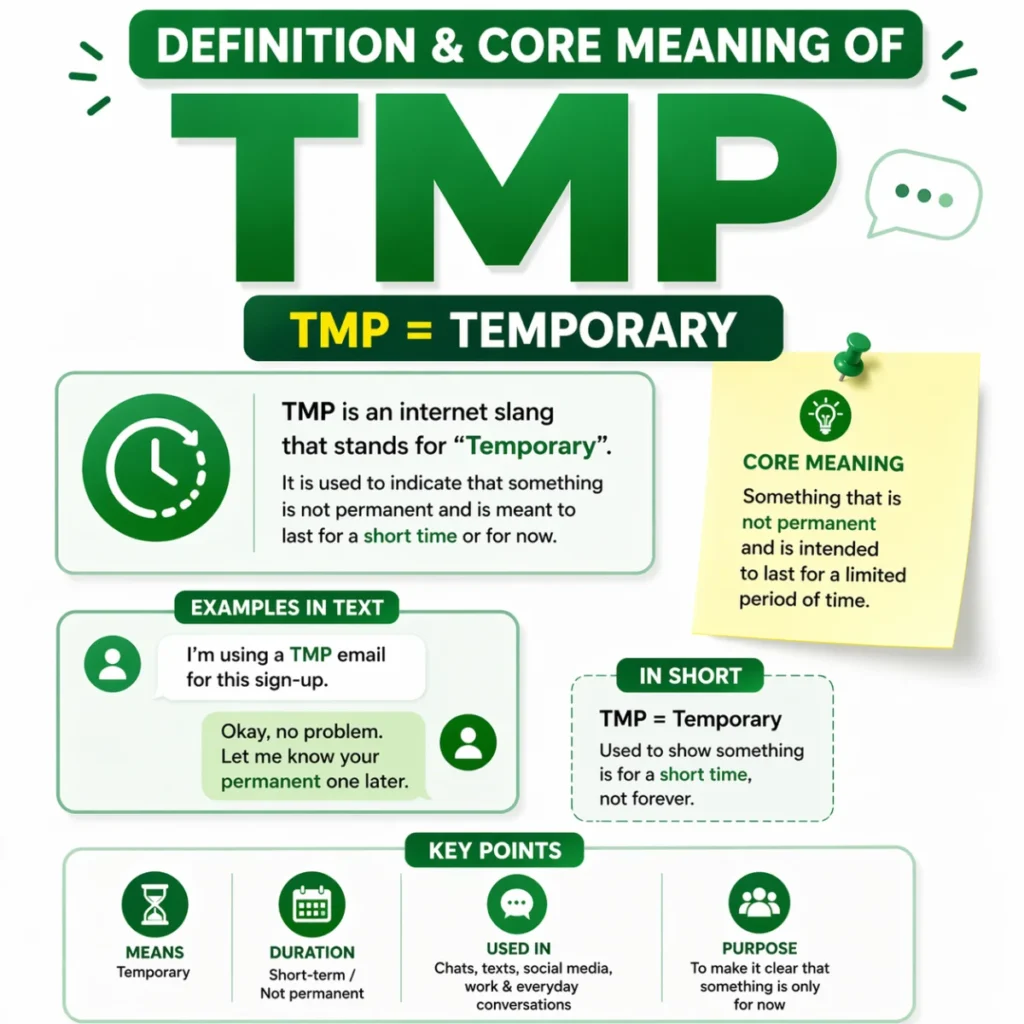
TMP meaning in text most commonly stands for “Text Me Please.” People use this abbreviation as a polite request for someone to send a text message rather than continuing a different form of communication. For example, if someone is busy and cannot type long responses, they might reply “TMP” to signal that a text conversation would work better later. Similarly, TMP can indicate that the current platform (like Instagram DMs or Snapchat) is inconvenient for the sender.
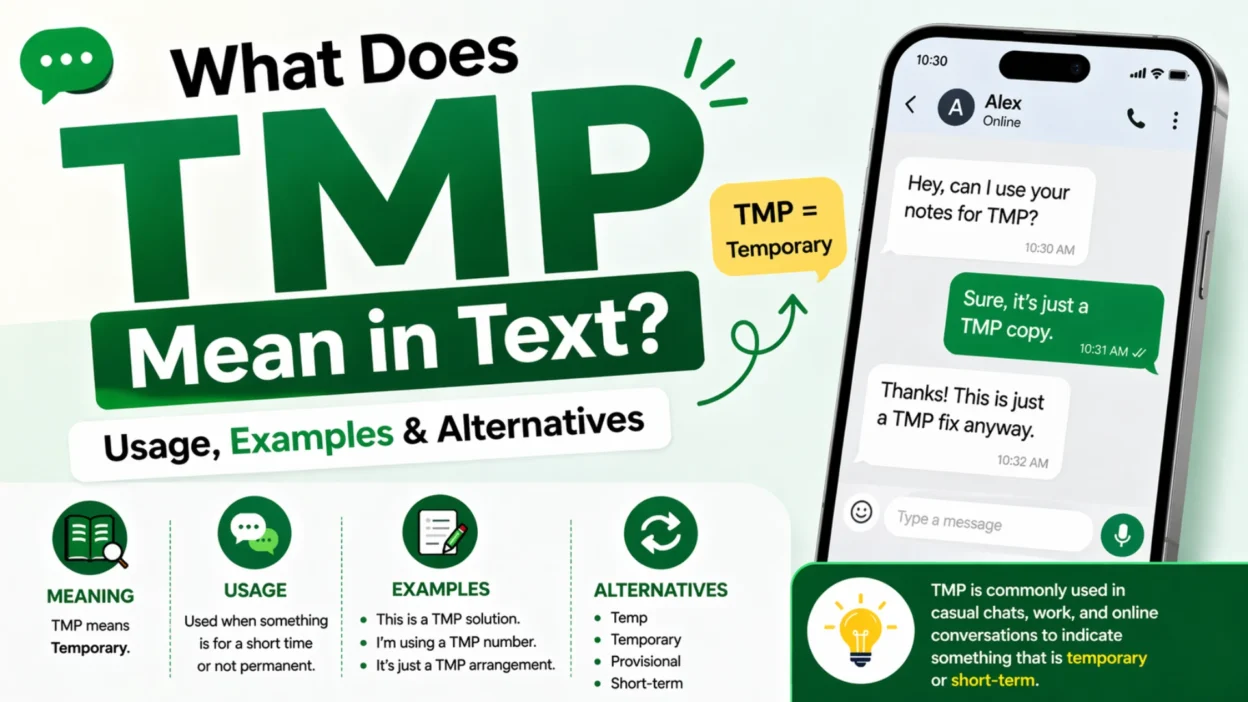
Nevertheless, TMP has a secondary meaning worth noting. In some contexts, particularly among gamers or tech-savvy users, TMP stands for “Temporary.” This usage appears when discussing short-term solutions, files, or situations. For instance, someone might say “This is just a TMP fix” to explain that a solution will not last permanently. Consequently, context determines which meaning applies.
Interestingly, the “Text Me Please” interpretation dominates casual conversation. Most people under 35 will understand TMP as a request to switch communication methods. However, the “Temporary” meaning appears more frequently in technical discussions. Therefore, paying attention to the conversation topic helps you identify the correct definition. When someone says “TMP meaning in text” in a dating context, they almost certainly mean “Text Me Please.” When discussing computer files or project timelines, “Temporary” becomes more likely.
History & Origin of TMP in Text Messaging
The abbreviation TMP emerged during the early 2010s alongside the rise of smartphone messaging apps. Specifically, as people began using multiple platforms (WhatsApp, iMessage, Facebook Messenger, Instagram DMs), the need for switching between them increased. Consequently, users needed a quick way to say “Stop messaging me here and send a regular text instead.” TMP filled this gap efficiently.
Moreover, TMP followed the pattern of similar request abbreviations like “CMB” (Call Me Back) and “TEXT ME.” The shorter version gained popularity because typing “TMP” takes only three characters. For instance, someone in a noisy environment might type “TMP” rather than the full phrase “Can you please text me instead?” This efficiency matters greatly during busy moments.
Additionally, the “Temporary” meaning of TMP has different origins. Computer programmers and IT professionals have used “temp” as shorthand for temporary since the 1980s. Removing the “E” to create “TMP” followed standard file naming conventions where three-letter extensions dominated (like .exe, .jpg, .tmp). Consequently, tech communities adopted TMP as a natural abbreviation that later spread to general texting.
Interestingly, TMP never reached the popularity of abbreviations like LOL or BRB. However, it maintains steady usage among specific demographics. Young adults aged 18-25 use TMP most frequently, particularly in dating app conversations. According to linguistic research, women use TMP slightly more often than men when suggesting a platform switch. Nevertheless, TMP remains useful shorthand worth adding to your texting vocabulary.
Real-World Examples of TMP in Conversations
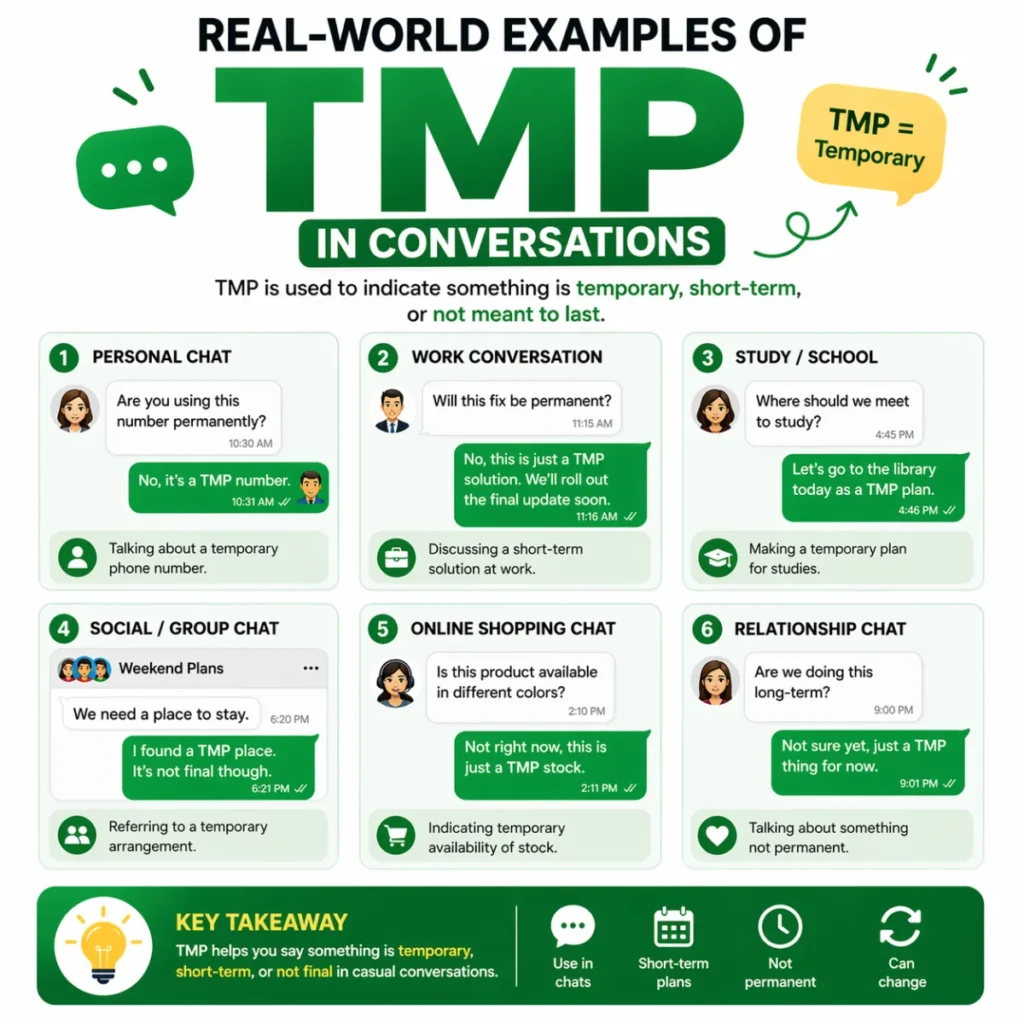
Let us explore how TMP meaning in text appears in actual conversations. Below are four realistic examples demonstrating typical usage patterns across different situations.
Example 1: Switching from Dating App to Text
Person A (Tinder): “I am really enjoying this conversation. You seem cool.”
Person B: “Thanks! Same here. TMP though. This app drains my battery like crazy.”
Person A: “Got it! What is your number?”
Person B: “555-1234. Talk soon!”
Analysis: In this exchange, Person B uses TMP to request moving the conversation from Tinder to standard texting. The abbreviation politely explains the reason (battery drain) without sounding rude.
Example 2: Busy Friend Requesting a Text Later
Person A (Instagram DM): “Hey! What time should we meet for dinner tomorrow?”
Person B: “In a meeting right now. TMP and I will answer properly.”
Person A: “No problem. Text you in an hour?”
Person B: “Perfect. Thanks for understanding!”
Analysis: Here, TMP signals that Person B cannot type a detailed response at the moment. The abbreviation asks Person A to initiate a text conversation later when Person B has more availability.
Example 3: Technical Discussion Using “Temporary”
Person A (Work Slack): “Is this solution permanent or just a quick fix?”
Person B: “TMP only. We need a real patch by Friday.”
Person A: “Got it. I will mark it as TMP in the documentation.”
Person B: “Perfect. Just make sure everyone knows it is TMP.”
Analysis: In this workplace example, TMP means “Temporary.” Both speakers use the abbreviation to distinguish between short-term and permanent solutions. Notice how the technical context makes the meaning clear.
Example 4: Friend Asking to Switch Platforms
Person A (Facebook Messenger): “Did you see what Sarah posted? So dramatic!”
Person B: “My Facebook is glitching badly. TMP please.”
Person A: “Switching to text now. Same number?”
Person B: “Yes! Thank you. This app is driving me crazy.”
Analysis: Person B uses TMP to request moving from Facebook Messenger to standard texting. The abbreviation communicates frustration with the current platform while politely asking for an alternative.
How Context Changes TMP Meaning
The interpretation of TMP meaning in text shifts significantly depending on the platform and conversation topic. Let us examine how context influences this abbreviation.
Texting Between Friends
Among close friends, TMP almost always means “Text Me Please.” Friends use it when their current messaging platform is inconvenient. For example, “My battery is at 2%. TMP” clearly requests a switch to standard SMS. Similarly, “I am driving. TMP and I will respond when parked” shows consideration for safety. Consequently, TMP helps friends coordinate communication methods efficiently.
Social Media Comments and DMs
On platforms like Instagram, Twitter, or TikTok, TMP serves as a bridge from public or semi-public spaces to private texting. For instance, someone might comment “TMP” on a post to request moving the conversation to a more private channel. Alternatively, influencers might post “TMP for collab inquiries” in their bios. Nevertheless, be cautious when asking strangers to text you. Sharing phone numbers carries privacy risks, so reserve TMP for people you trust reasonably.
Gaming Chat (Discord, Twitch)
In gaming communities, TMP has two possible meanings depending on context. First, gamers might use TMP as “Text Me Please” when they need to step away from voice chat. For example, “My headset is dying. TMP and I will explain the strategy.” Second, gamers use TMP as “Temporary” when discussing buffs, power-ups, or game mechanics. For instance, “This shield is TMP only. It lasts thirty seconds.” Therefore, pay attention to whether the conversation involves logistics or game strategy.
Dating Apps
On Tinder, Bumble, or Hinge, TMP serves as a polite transition signal. Users employ TMP when they want to move from the dating app to standard texting. For example, “I am not on this app much. TMP if you want to keep talking.” This usage is extremely common and generally well-received. However, some users prefer keeping conversations on the app for safety reasons. Consequently, respect when someone declines your TMP request. A good response might be “No worries, happy to chat here instead.”
Tone Nuances: Is TMP Rude or Friendly?
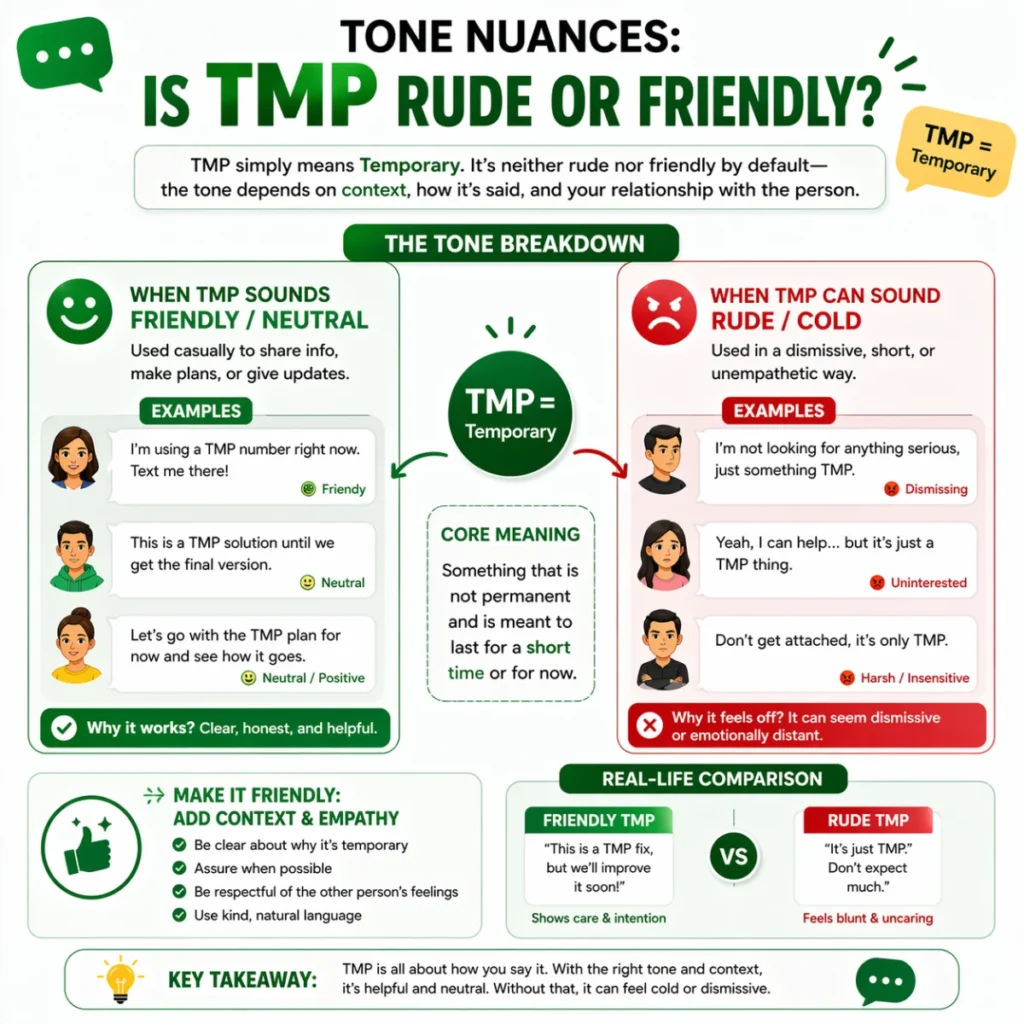
Many people wonder whether using TMP comes across as rude or helpful. The honest answer is that TMP is generally friendly, but delivery matters greatly. Let us break down the nuances carefully.
TMP is generally friendly when:
- You provide a brief reason (battery low, driving, in a meeting)
- You follow TMP with “please” or “thanks” in the same message
- You have already established a positive conversation
- You respond promptly after someone texts you as requested
TMP can seem rude when:
- You write only “TMP” with no explanation or greeting
- You ignore previous messages and just demand a text
- You use TMP to avoid answering a direct question
- You never respond after someone texts you as requested
Consequently, adding a few extra words makes a huge difference. Compare “TMP” alone versus “My phone is dying. TMP?” The second version feels much more polite and reasonable. Similarly, “TMP please” sounds better than just “TMP.” These small additions show respect for the other person’s time and attention.
Interestingly, research on digital politeness shows that request abbreviations work best when paired with context. For instance, “TMP, this app is glitching” justifies the request. Without justification, the recipient might wonder why you are asking them to switch platforms. Therefore, we recommend always adding a short reason when using TMP.
TMP vs Similar Slang Terms
Understanding how TMP differs from other common abbreviations prevents confusion. Below is a comparison table showing TMP meaning in text alongside similar terms.
| Abbreviation | Full Phrase | Purpose | When to Use |
|---|---|---|---|
| TMP | Text Me Please | Request to switch to SMS/texting | When current platform is inconvenient |
| CMB | Call Me Back | Request for a phone call return | When voice conversation is necessary |
| HMB | Hit Me Back | Casual request for any response | When you want acknowledgment |
| HMU | Hit Me Up | General invitation to contact you | When you are open to communication |
| MSG | Message | Verb meaning to send a message | When instructing someone to contact you |
| DM | Direct Message | Send a private message on social media | When specifying platform (Instagram, Twitter) |
| PM | Private Message | Same as DM, older term | On forums or Reddit specifically |
As the table shows, TMP meaning in text is more specific than general invitations like HMU. TMP explicitly requests SMS/texting rather than calls, DMs, or other methods. Consequently, use TMP when you specifically want a text message. Use HMU when you are open to texts, calls, DMs, or any other contact method. This specificity helps avoid confusion about preferred communication channels.
How to Respond to TMP
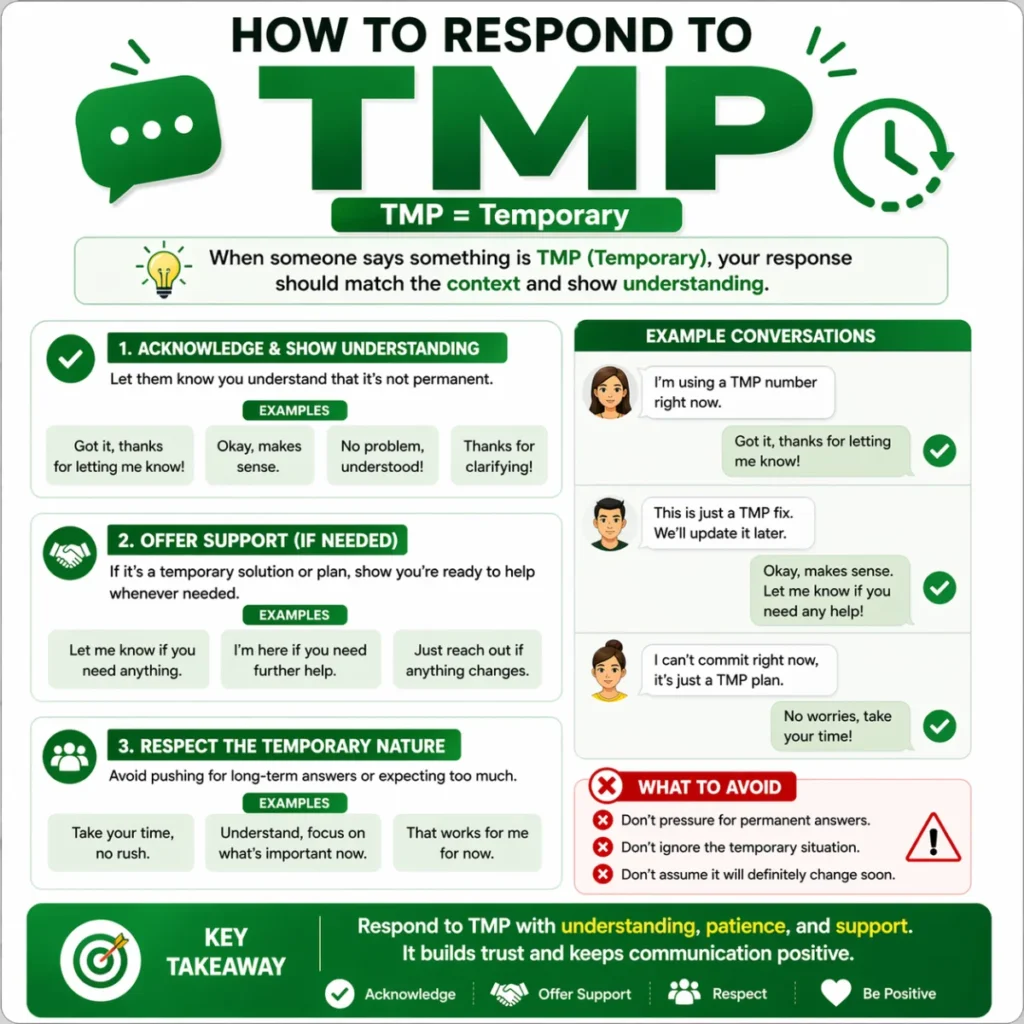
When someone sends you a message containing TMP, your response should acknowledge their request and take appropriate action. Below are three common scenarios with appropriate responses.
Scenario 1: Friend Requests a Text Due to Technical Issues
Their message: “TMP please. My Instagram DMs are not loading properly.”
Good responses:
- “On it! Texting you now.” (Immediate action)
- “Sure thing. What is your number again?” (Clarifying before acting)
- “No problem. Give me one minute.” (Setting expectations)
Poor responses:
- “Why can you not just reply here?” (Argumentative)
- “TMP too I guess.” (Unhelpful repetition)
Scenario 2: Acquaintance Requests a Text Without Explanation
Their message: “TMP”
Good responses:
- “Sure! Is everything okay?” (Polite acknowledgment with concern)
- “Can do. Anything wrong with this app?” (Asking for clarification)
- “Texting you now. What is up?” (Direct action with openness)
Poor responses:
- “No.” (Rude refusal without reason)
- “TMP what?” (Confused or sarcastic)
Scenario 3: Someone Uses TMP to Mean “Temporary”
Their message (work context): “This is just a TMP solution. We will fix it properly next week.”
Good responses:
- “Got it. I will note that it is TMP in the documentation.” (Acknowledgment with action)
- “Thanks for clarifying. How long will the TMP fix last?” (Requesting specifics)
- “Understood. Who needs to know this is TMP?” (Coordinating next steps)
Poor responses:
- “Okay.” (Too vague, no acknowledgment)
- “I thought it was permanent.” (Stating confusion without asking for help)
Generally, responding to TMP requires identifying which meaning applies. When someone asks you to text them, do so promptly. When someone uses TMP to mean “Temporary,” acknowledge the time constraint and plan accordingly. When unsure which meaning applies, ask for clarification rather than guessing.
Professional Use: Can You Say TMP at Work?
Using TMP meaning in text in professional settings depends heavily on your workplace culture and the specific meaning you intend. Let us examine both scenarios carefully.
“Text Me Please” at Work
Using TMP to request a text message is generally inappropriate in formal workplace communication. Professional environments expect clear, complete sentences in emails and internal messages. For example, writing “TMP” to a client or senior manager would seem unprofessional and confusing. Similarly, using TMP with coworkers you do not know well might come across as overly casual.
However, some exceptions exist. In casual internal chats on Slack or Teams, TMP might be acceptable among close teammates. For instance, “My Slack is acting up. TMP if you need me urgently” works in tech startups or creative agencies. Nevertheless, when in doubt, write the full phrase “Text me please” instead of the abbreviation. The extra few seconds of typing are worth maintaining professionalism.
“Temporary” at Work
Using TMP to mean “Temporary” is much more acceptable in professional contexts. Many workplaces use “temp” as standard shorthand for temporary positions or solutions. For example, “We hired a TMP receptionist” clearly communicates that the role is not permanent. Similarly, “This is a TMP arrangement until Q3” appears in business emails regularly.
Best practices for professional TMP usage:
- Define TMP the first time you use it in a document or email chain
- Write “temp” with an E rather than “TMP” in formal communications
- Avoid TMP in client-facing materials where clarity is critical
- Use TMP only in internal communications with established conventions
Consequently, the “Temporary” meaning of TMP works well at work. The “Text Me Please” meaning generally does not. Therefore, consider your audience carefully before typing TMP in any professional context.
Common Misconceptions About TMP
Several myths and misunderstandings surround TMP meaning in text. Let us debunk the most common misconceptions with clear evidence.
Misconception 1: TMP Only Means One Thing
False. TMP has at least two distinct meanings depending on context. The most common meaning is “Text Me Please” in casual conversations. However, “Temporary” appears frequently in technical and professional discussions. Consequently, assuming the wrong meaning can lead to confusion. For example, responding “Here is my number” to someone who meant “Temporary” would create an awkward situation. Always consider context before interpreting TMP.
Misconception 2: TMP Is Rude and Demanding
False when used properly. TMP becomes rude only when used without explanation or politeness markers. Adding “please,” a reason, or an emoji transforms TMP into a friendly request. For instance, “TMP? This app is glitching 🙂” reads as perfectly polite. Similarly, “Could you TMP? I am driving” shows consideration for safety. The abbreviation itself is neutral; tone and context determine politeness.
Misconception 3: TMP Is Outdated and No One Uses It
False. While TMP never reached peak popularity like LOL or OMG, it maintains steady usage. Google Trends data shows consistent search interest for “TMP meaning in text” over the past five years. Dating app users, in particular, continue using TMP regularly to transition conversations to texting. Additionally, tech workers use TMP daily to discuss temporary solutions. Therefore, TMP remains relevant and useful shorthand.
Misconception 4: TMP Is the Same as HMU
False. TMP specifically requests a text message. HMU (Hit Me Up) is a general invitation for any form of contact. The difference matters significantly. For example, telling someone “HMU” means they can call, text, DM, or email you. Telling someone “TMP” means you specifically want a text message. Consequently, using the wrong abbreviation confuses your communication preferences. Be specific about what you want.
5 Polite Alternatives to TMP
Sometimes you want to request a text message without using abbreviations. Below is a table of polite alternatives to TMP meaning in text, ranked from most casual to most formal.
| Alternative Phrase | Formality Level | Best Used When |
|---|---|---|
| “Text me?” | Casual | Friends and close acquaintances |
| “Can you text me instead?” | Casual to neutral | Any situation requiring politeness |
| “Would you mind texting me?” | Neutral | Showing extra consideration |
| “I would appreciate a text when you have a moment.” | Formal | Professional or respectful contexts |
| “Please send me a text message at your earliest convenience.” | Very formal | Business communications or older recipients |
Example sentences using alternatives:
- “Text me? This app keeps crashing.” (Casual and efficient)
- “Can you text me instead? I am about to lose service.” (Polite with explanation)
- “Would you mind texting me? My DMs are glitching badly.” (Extra polite)
- “I would appreciate a text when you have a moment to discuss this further.” (Professional)
- “Please send me a text message at your earliest convenience regarding the project timeline.” (Very formal)
Consequently, choosing the right alternative depends on your relationship with the recipient. For friends, “Text me?” works perfectly. For coworkers, “Can you text me instead?” strikes the right balance. For clients or executives, use the formal alternatives to maintain professionalism.
Frequently Asked Questions About TMP Meaning in Text
FAQ 1: What does TMP stand for in texting?
TMP most commonly stands for “Text Me Please” in text messaging. People use this abbreviation to politely request that someone send a standard SMS text message instead of continuing on a different platform. For example, “TMP, this app is draining my battery” asks the other person to switch to texting.
FAQ 2: Can TMP also mean something else?
Yes, TMP also means “Temporary” in many contexts, particularly technical or professional discussions. For instance, a programmer might say “This is a TMP fix” to explain that a solution will not last permanently. Similarly, a manager might say “We hired a TMP employee” to indicate a temporary position. Context determines which meaning applies.
FAQ 3: Is TMP considered rude to use?
Generally no, but delivery matters significantly. Using “TMP” alone with no explanation can seem abrupt or demanding. However, adding a brief reason like “TMP, my phone is at 1%” makes the request perfectly polite. Similarly, including “please” or “thanks” improves the tone. When in doubt, write the full phrase “Text me please” instead of the abbreviation.
FAQ 4: Can I use TMP in professional work emails?
It depends on which meaning you intend. Using TMP to mean “Temporary” is generally acceptable in professional contexts, especially internal communications. For example, “This is a TMP arrangement” works fine. However, using TMP to mean “Text Me Please” is usually too casual for professional emails. Write the full phrase instead: “Please text me at your convenience.”
FAQ 5: How is TMP different from HMU?
TMP specifically requests a text message. HMU (Hit Me Up) is a general invitation for any form of contact, including texts, calls, DMs, or emails. For example, “TMP” tells someone exactly how to contact you. “HMU” leaves the method open to interpretation. Consequently, use TMP when you have a strong preference for texting. Use HMU when you are flexible about communication methods.
Conclusion
Understanding TMP meaning in text enhances your ability to communicate efficiently across multiple platforms. As we have explored throughout this guide, TMP primarily stands for “Text Me Please” in casual conversations and “Temporary” in technical or professional contexts. Consequently, mastering this versatile abbreviation helps you navigate digital communication with greater ease.
Nevertheless, effective communication requires attention to context and audience. Using TMP with close friends who understand texting shorthand works wonderfully. However, using TMP with older relatives or formal business contacts might cause confusion. Therefore, we encourage you to consider your recipient before typing these three letters. When in doubt, write the full phrase “Text me please” or “temporary” to ensure clarity.
Similarly, remember that politeness transforms how people receive your messages. Adding a brief reason (“battery low,” “driving,” “app glitching”) turns a potentially abrupt “TMP” into a considerate request. Small words like “please” and “thanks” cost nothing but improve relationships significantly. For instance, “TMP please” sounds much better than “TMP” alone. These small adjustments separate effective communicators from confusing ones.
Finally, pay attention to how others use TMP with you. When someone asks you to text them, honor that request promptly. When someone describes something as “TMP” (temporary), plan accordingly without assuming permanence. By fully understanding TMP meaning in text and its nuanced applications, you become a more adaptable and considerate digital communicator. Now go forth and text with confidence! ✅

Serhii Dunev is a passionate content creator dedicated to crafting meaningful texts, messages, and word inspirations. He aims to help people express their emotions clearly through simple and impactful words.