If you received a 2939 text message T-Mobile notification, you may wonder what the number means and why it appeared on your phone. Short codes can look unusual because they don’t follow the standard 10-digit phone number format.
A four-digit sender such as 2939 may belong to an automated messaging service, business, campaign, or other SMS platform. However, the number alone doesn’t confirm who sent the message. The actual wording, timing, and request inside the text provide much better clues.
This guide explains what a 2939 message could mean, how to check whether it looks legitimate, and what you should do if the text seems suspicious.
What Is a 2939 Text Message?
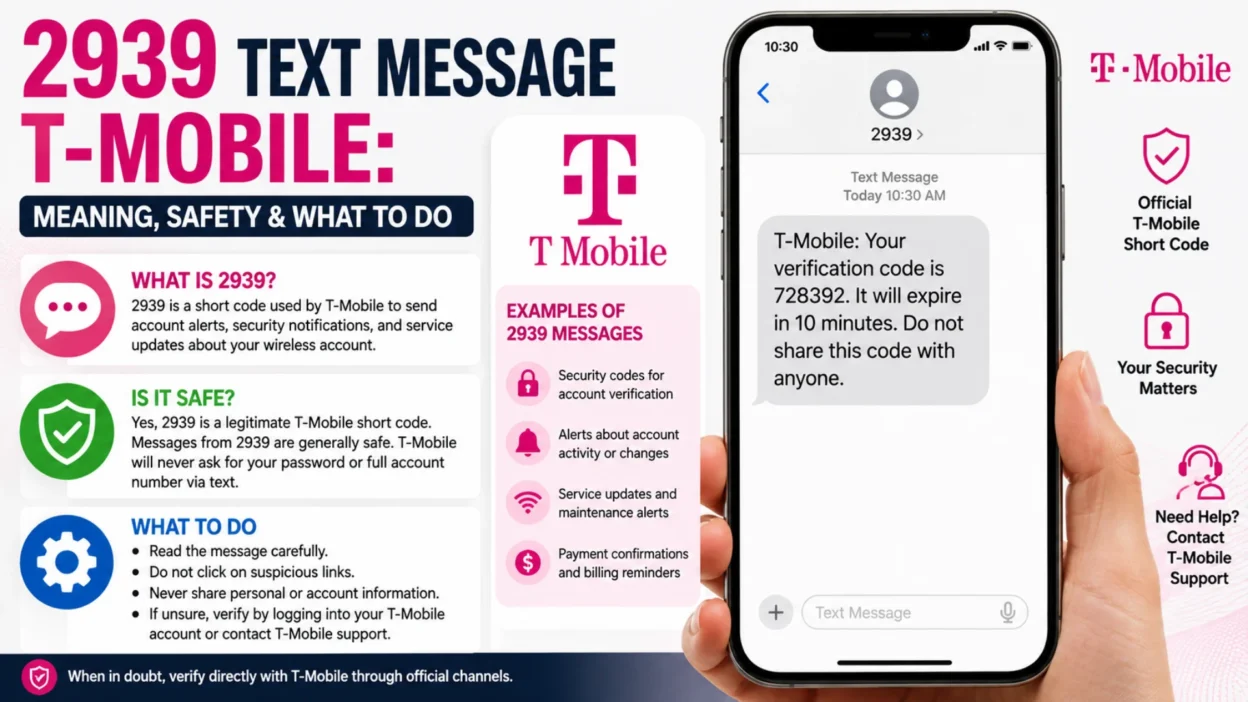
A 2939 text message is an SMS that appears with 2939 as the sender instead of a traditional phone number.
Businesses and automated services commonly use short codes to communicate with customers. These messages can contain alerts, verification codes, reminders, promotional information, or account-related updates.
However, seeing 2939 on a T-Mobile device doesn’t automatically mean T-Mobile sent the message. Your mobile carrier delivers messages from many different organizations.
Therefore, focus on the message content rather than assuming the sender’s identity from the four-digit number alone.
Is 2939 an Official T-Mobile Number?
It’s important to distinguish between receiving a message through T-Mobile and receiving a message from T-Mobile.
T-Mobile supports short-code messaging for different services and communications. Yet that doesn’t mean every short code appearing on a T-Mobile phone belongs to the carrier.
The safest conclusion is that 2939 should be treated as an unfamiliar short code unless the message gives you enough information to identify its source.
Check whether the text:
- Clearly names a company
- Matches something you recently requested
- Contains a verification code you expected
- References a recognizable service
- Gives a legitimate reason for contacting you
- Requests sensitive information
- Includes a suspicious link
- Creates unnecessary urgency
These details can help you determine what kind of message you received.
Why Did I Receive a 2939 Text?
There are several possible explanations for an unexpected short-code message.
You Requested a Verification Code
You might receive a short-code message after signing into an account or confirming an action.
If you recently requested a code, compare the timing and purpose. A matching code may simply be part of the normal verification process.
A Company Sent an Alert
Some businesses use automated SMS systems for customer notifications. The message could relate to an order, appointment, account, or service.
In this situation, the company name usually provides the strongest clue.
Someone Entered Your Number
An accidental phone-number entry can also result in an unexpected message.
For example, someone might mistype their number while creating an account. Their verification text could then arrive on your phone.
You Received a Promotional Message
Marketing campaigns sometimes use short codes to reach subscribers.
If you previously gave a company permission to send promotional texts, the message may be connected to that subscription.
It Could Be Spam
Unwanted messages can also arrive from unfamiliar short codes. Some may simply be advertisements, while others can attempt to trick you into clicking a link or providing information.
Consequently, unexpected messages deserve a quick safety check before you respond.
How to Tell What 2939 Is Sending You
The message itself usually provides more information than the sender number.
Read the entire text and look for context. A legitimate notification often explains why you’re receiving it.
Pay attention to:
- Company names
- Account references
- Verification codes
- Order details
- Appointment information
- Subscription notices
- Promotional offers
- Security alerts
- Payment requests
- Links
- Instructions for replying
For example, a message containing a code that you requested five minutes earlier has a very different context from a random text demanding immediate payment.
That difference matters when evaluating safety.
Is a 2939 Text Message a Scam?
A message from 2939 isn’t automatically a scam. At the same time, you shouldn’t assume it’s legitimate simply because it arrived on a T-Mobile number.
Scammers can use SMS messaging to imitate recognizable companies. Their goal may be to obtain passwords, payment details, verification codes, or other personal information.
Common warning signs include:
- Unexpected requests for money
- Requests for passwords
- Requests for verification codes
- Threats about account closure
- Extremely urgent language
- Suspicious website addresses
- Unusual grammar
- Requests for banking details
- Offers that seem too good to be true
- Instructions to bypass normal security procedures
A suspicious message often tries to make you react quickly. Taking a moment to verify the claim can reduce that risk.
What Should You Do After Receiving 2939?
Don’t panic if an unfamiliar message appears.
Start by reading it carefully. Next, determine whether you recently interacted with the company or service mentioned in the text.
You can follow this simple process:
- Read the complete message.
- Identify the claimed sender.
- Think about recent account activity.
- Check whether you requested a code.
- Avoid clicking unfamiliar links.
- Don’t share passwords or verification codes.
- Don’t provide banking information through an unexpected text.
- Verify important claims through a trusted channel.
- Report the message if it appears to be spam.
This approach helps you avoid unnecessary interaction with suspicious messages.
Should You Reply to 2939?
You shouldn’t reply automatically to an unfamiliar short code.
Some legitimate messaging services provide instructions for stopping messages. For example, a text may tell you to reply with a specific word to unsubscribe.
However, suspicious messages deserve more caution. If you don’t recognize the sender, avoid engaging until you understand why the message reached you.
If the message claims to represent a company you use, contact that company through a trusted method instead of relying on the contact information provided inside the suspicious text.
Should You Click a Link in a 2939 Message?
An unexpected link should always receive extra attention.
A message may appear professional while directing you to a fake website. That site could imitate a familiar login page and attempt to collect your information.
Instead of clicking immediately, consider opening the company’s official app yourself. You can also manually enter a website address that you already know.
Look for signs such as:
- An unfamiliar domain
- A shortened link
- Misspelled company names
- Urgent instructions
- Unexpected login requests
- Requests for payment
- Requests for personal information
If the message doesn’t make sense, there’s usually no reason to interact with its link.
What If 2939 Sent a Verification Code?
An unexpected verification code deserves attention, but it doesn’t necessarily mean someone accessed your account.
Someone could have entered your phone number by mistake. Another possibility is that someone attempted to sign into an account associated with your number.
Most importantly, never share an unexpected verification code with another person.
If someone contacts you and asks you to forward the code, treat that as a serious warning sign. Verification codes exist to confirm an action, so giving one away can weaken account security.
Instead, check the account directly through its trusted application or website.
What If the Message Mentions Your T-Mobile Account?
A message claiming to concern your T-Mobile account requires careful verification.
Don’t provide account passwords, security codes, payment details, or other sensitive information just because a text claims to be from your carrier.
Instead, access your account through the normal method you already use. Check for matching alerts or notifications there.
This independent check is useful because scammers can copy familiar branding and language.
If the information doesn’t appear in your account, be especially cautious about the message.
Can a Short Code Be Spoofed?
Short-code messaging can involve complex delivery systems, and the sender information displayed on a phone doesn’t provide a complete guarantee of authenticity.
Therefore, users should evaluate the entire message instead of trusting the displayed number alone.
A familiar-looking sender can still be associated with unwanted communication. Likewise, an unfamiliar number isn’t automatically malicious.
Context remains important.
How T-Mobile Users Can Handle Suspicious Texts
If you use T-Mobile and receive an unwanted or suspicious message, you can take basic precautions before responding.
First, avoid interacting with suspicious links or requests. Next, preserve the message if you think it may be useful for reporting.
T-Mobile provides mechanisms for customers to report suspected spam messages. Using the carrier’s reporting process can help identify unwanted messaging activity.
You can also use your phone’s built-in blocking features to prevent repeated messages from a sender.
2939 Text Message vs. Normal Phone Number
The biggest difference is the sender format.
A normal phone number usually contains ten digits in the United States. A short code uses fewer digits and often supports automated communication.
| Sender type | Common purpose |
|---|---|
| 10-digit number | Personal or business texting |
| Four-digit short code | Automated messaging |
| Five-digit short code | Alerts, campaigns, and services |
| Six-digit short code | Automated business communication |
Short codes can make large-scale messaging easier for organizations. However, the format doesn’t tell you whether a specific message is trustworthy.
Common Reasons People Search for 2939
People often search for an unfamiliar short code because they want to answer one of a few basic questions.
They may wonder:
- Who sent this message?
- Is 2939 connected to T-Mobile?
- Is the message legitimate?
- Why did I receive it?
- Should I reply?
- Should I click the link?
- Did someone access my account?
- How can I stop the messages?
These questions are reasonable because a four-digit sender gives little information by itself.
The best answer depends on what the message actually says and whether you recently performed an action that explains it.
What You Should Never Share Through an Unexpected Text
Even when a message looks convincing, avoid sharing highly sensitive information through an unexpected SMS.
Never provide the following simply because a text requests them:
- Passwords
- One-time verification codes
- Banking credentials
- Full payment information
- Security answers
- Account recovery codes
- Sensitive identity information
A legitimate service may have secure methods for confirming your identity. You shouldn’t bypass those methods because a text claims that immediate action is necessary.
Common Mistakes to Avoid
People often make simple mistakes when dealing with unfamiliar text messages.
Assuming T-Mobile Sent It
The fact that you use T-Mobile doesn’t mean T-Mobile created every message you receive.
Clicking Before Reading
Opening a link before understanding the message can expose you to unnecessary risk.
Sharing a Verification Code
A verification code should remain private. Sharing it can allow another person to complete an action using your account.
Calling a Number From a Suspicious Text
If you’re unsure about the sender, find the company’s contact information independently rather than using a number supplied in the questionable message.
Deleting Everything Immediately
If a message appears suspicious, keeping a record can sometimes help when reporting the communication.
What If You Keep Receiving Messages From 2939?
Repeated messages can become annoying, especially when you don’t recognize the source.
First, determine whether the messages come from a legitimate service you previously subscribed to. If so, follow the service’s legitimate unsubscribe instructions.
If the messages appear to be spam, use your phone’s blocking and reporting options. You can also report suspected spam through your carrier’s available process.
Meanwhile, avoid replying to suspicious messages simply to tell the sender to stop. Interaction can sometimes encourage additional unwanted communication.
Can Receiving 2939 Mean Your Phone Was Hacked?
Usually, receiving an unfamiliar text by itself isn’t evidence that your phone has been hacked.
Unexpected texts can happen for many ordinary reasons. Someone may have entered your number incorrectly, a company may have an outdated database, or an automated system may have sent a message unintentionally.
However, repeated unexpected verification codes combined with suspicious account activity deserve attention.
Check your important accounts for unfamiliar logins or changes. If you discover something unusual, secure the affected account using its trusted security options.
How to Respond Safely
When you’re unsure about a 2939 message, remember a simple rule:
Pause, verify, then act.
Don’t allow an urgent-looking text to rush your decision. Instead, confirm who supposedly sent it and whether the message matches something you actually did.
For account-related messages, check the account directly. For payment requests, use a trusted billing channel. For verification codes, keep the code private.
This approach is simple, but it can prevent many common SMS-related mistakes.
2939 Text Message T-Mobile: Quick Safety Checklist
Before responding to an unfamiliar message, ask yourself:
- Did I expect this message?
- Do I recognize the company?
- Did I recently request a verification code?
- Does the message explain why it contacted me?
- Is it asking for sensitive information?
- Does it contain an unfamiliar link?
- Is it pressuring me to act immediately?
- Can I verify the information somewhere else?
If several answers raise concerns, don’t interact with the message until you’ve verified its source.
Frequently Asked Questions
What is 2939 on a T-Mobile phone?
2939 is a four-digit short code displayed as an SMS sender. The number alone doesn’t establish that T-Mobile sent the message.
Is 2939 a T-Mobile scam?
Not necessarily. A 2939 message could have several origins, so you should evaluate its content and context before deciding whether it’s legitimate or suspicious.
Why did 2939 text me?
You may have received the message because of a verification request, business notification, marketing subscription, accidental number entry, or unwanted communication.
Should I reply to 2939?
Don’t reply automatically. If you don’t recognize the sender or the message seems suspicious, verify its source before responding.
Is it safe to click a link from 2939?
An unfamiliar link should be treated cautiously. Verify the claimed sender independently before opening it or entering any information.
What if I received a 2939 verification code I didn’t request?
Don’t share the code. Check the associated account for unusual activity and secure it through the service’s trusted account-management tools if necessary.
Can a 2939 text hack my phone?
Receiving a text doesn’t normally mean your phone has been hacked. The bigger concern is whether the message tries to trick you into revealing information or installing something unsafe.
How do I stop unwanted 2939 messages?
If the message belongs to a legitimate service, use its valid opt-out instructions. For suspected spam, use your phone and carrier’s available blocking and reporting features.
Final Thoughts
A 2939 text message T-Mobile notification can be confusing because short codes don’t clearly identify the sender. Still, the number itself isn’t enough to determine whether the message is legitimate, promotional, accidental, or suspicious.
The safest response is to examine the message carefully. Avoid clicking unfamiliar links, never share verification codes, and verify account-related claims through trusted channels.
Most importantly, don’t let an urgent text pressure you into making a quick decision. A few seconds of verification can help protect your accounts and personal information.

Serhii Dunev is a passionate content creator dedicated to crafting meaningful texts, messages, and word inspirations. He aims to help people express their emotions clearly through simple and impactful words.