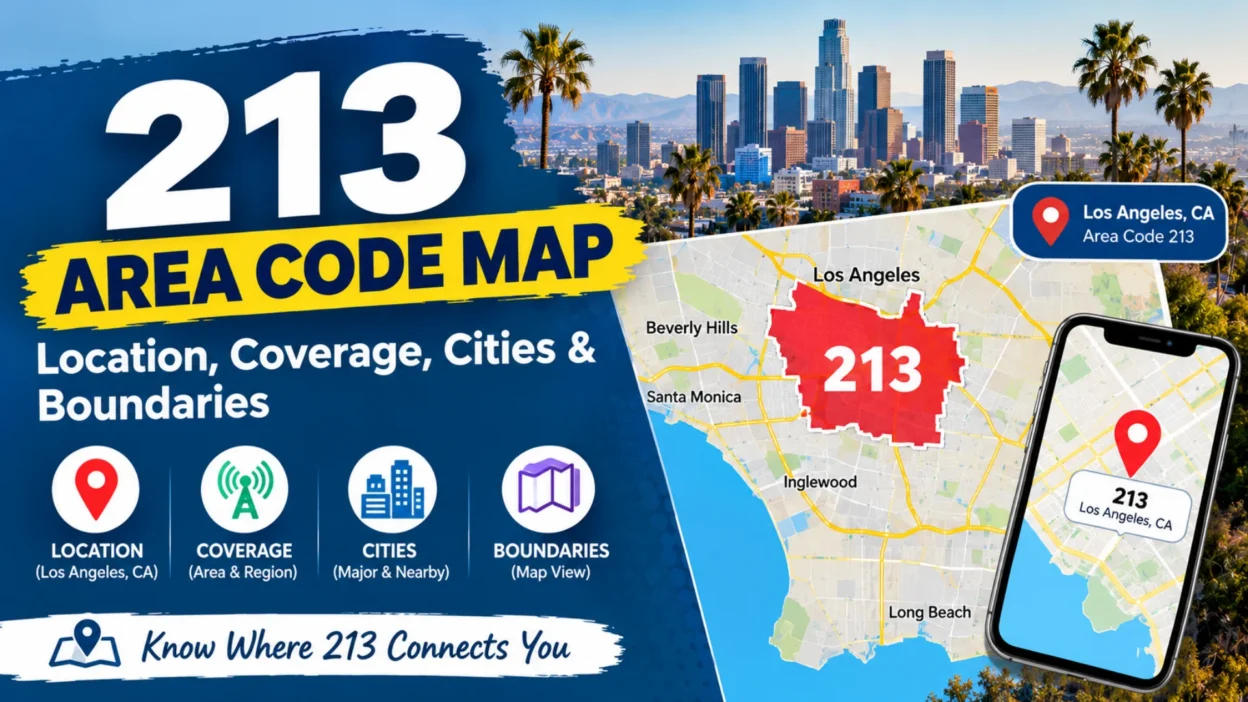
If you’re searching for a 213 area code map, you probably want to know exactly where area code 213 is located, which cities it covers, and how it fits into the larger Los Angeles telephone network. The answer is closely connected to area codes 323 and 738, which now share the same general geographic region.
Area code 213 is associated with Los Angeles County, particularly central Los Angeles and nearby communities. However, its modern coverage isn’t as simple as drawing one isolated boundary around a single part of the city. Since 2017, 213 and 323 have operated as an overlay, and 738 was added as another overlay in 2024.
This guide explains the 213 area code map in simple terms, including its location, major communities, historical boundaries, neighboring codes, and what the map can and can’t tell you about a phone number.
Where Is Area Code 213 on the Map?
Area code 213 is located in Los Angeles County, California, within the Los Angeles metropolitan area.
Its strongest association is with central Los Angeles and the surrounding communities that form the 213/323/738 overlay region. The California Public Utilities Commission describes the region as generally serving downtown Los Angeles and numerous surrounding cities and communities.
On a California map, you won’t find 213 covering a large portion of the state. Instead, it represents a relatively compact urban area within Southern California.
Important locations associated with the region include:
- Downtown Los Angeles
- East Los Angeles
- Bell
- Bell Gardens
- Commerce
- Cudahy
- Huntington Park
- Maywood
- Montebello
- South Gate
- Vernon
- West Hollywood
- Parts of Pasadena
- Parts of Alhambra
- Other Los Angeles-area communities
The exact distribution can be complicated because several communities have more than one area code, and the overlay system allows multiple codes to serve the same geographic region.
213 Area Code Map and Its Main Coverage
A modern 213 area code map should be understood as part of the larger 213/323/738 overlay rather than as a completely separate territory.
In 2017, California eliminated the boundary between the 213 and 323 regions. That change created an overlay arrangement in which both codes could serve the same general area. Later, the California Public Utilities Commission approved 738 as an additional overlay code, which entered service in November 2024.
This means a person living in an area historically associated with 323 might have a 213 number. Another resident in the same general area could have 323 or 738.
Therefore, a map showing only a single colored 213 zone can be misleading if it doesn’t explain the overlay system.
Quick Map Overview
| Feature | 213 Area Code |
|---|---|
| State | California |
| Main region | Los Angeles County |
| Major city | Los Angeles |
| Primary association | Central Los Angeles |
| Overlay codes | 323 and 738 |
| Time zone | Pacific Time |
| Established | 1947 |
| Current system | Geographic overlay |
| Ten-digit dialing | Required |
The California Public Utilities Commission currently lists 213/323/738 as an overlay combination in California.
Which Cities Are Covered by the 213 Area Code?
The 213/323 region reaches beyond downtown Los Angeles.
According to the California Public Utilities Commission, the broader region includes communities such as Alhambra, Bell, Bell Gardens, Beverly Hills, Commerce, Cudahy, Glendale, Hawthorne, Huntington Park, Inglewood, Lynwood, Maywood, Montebello, Monterey Park, Pasadena, Rosemead, South Gate, South Pasadena, Vernon, and West Hollywood, along with unincorporated parts of Los Angeles County.
That doesn’t mean every address in every listed city uses 213.
Many communities have multiple area codes. In some cases, another area code may serve most of the city while 213 is present only in part of it.
For that reason, checking an exact address or phone number is more reliable than using a city name alone.
Is Downtown Los Angeles in the 213 Area Code?
Yes. Downtown Los Angeles is one of the strongest geographic associations with area code 213.
The code’s history is deeply connected to Los Angeles. It was created in 1947 as one of California’s original area codes. Over the following decades, the original territory became smaller as new area codes were created to handle population growth and increasing demand for telephone numbers.
Today, 213 remains closely identified with central Los Angeles.
You’ll commonly see the code associated with areas around:
- Downtown
- Historic Core
- Arts District
- South Park
- Westlake
- Pico-Union
- Chinatown
- Little Tokyo
- Nearby central Los Angeles neighborhoods
The exact neighborhood-level assignment can vary because telephone numbering boundaries don’t necessarily match neighborhood boundaries.
Why Does the 213 Map Overlap With 323?
The overlap exists because of a major change made in 2017.
Originally, 323 was created by splitting part of the 213 region in 1998. For several years, the two codes represented different geographic areas. However, the California Public Utilities Commission later approved a plan that removed the boundary between them.
Since then, 213 and 323 have operated as overlay codes within the same general region.
This arrangement changed how people should interpret a map.
Previously, you could use the area-code boundary as a stronger geographic clue. Today, the same physical area can contain phone numbers beginning with 213 or 323.
The addition of 738 made the map even more interesting.
Where Does 738 Fit on the 213 Area Code Map?
Area code 738 is the newest overlay in this region.
The California Public Utilities Commission approved 738 in March 2023 to provide additional numbering resources for the 213/323 region. The new code became part of the overlay system in November 2024.
Consequently, the modern map is best described as:
213 + 323 + 738 = shared Los Angeles-area numbering region
These codes don’t represent three completely separate territories.
Instead, they can serve the same general geographic area.
This is important if you’re researching a phone number. Seeing 213, 323, or 738 doesn’t necessarily identify a different neighborhood.
213 Area Code Map vs. Old 213 Boundaries
The current map looks very different from the original 213 territory.
When area code 213 was introduced in 1947, it covered a huge portion of Southern California. As telephone usage increased, the region was repeatedly divided into new area codes.
Historical changes produced codes including:
- 714
- 805
- 818
- 310
- 323
The 213 region therefore became progressively smaller over time. The California Public Utilities Commission records multiple historical splits, including the creation of 323 in 1998.
Interestingly, 213 later regained access to areas that had once been separated from it when the 213/323 boundary disappeared in 2017.
That history explains why older maps can look very different from modern maps.
What Areas Surround the 213 Region?
Los Angeles County contains numerous area codes, so several codes appear around the 213/323/738 region.
Depending on the direction you’re traveling, you may encounter codes such as:
- 626 toward parts of the San Gabriel Valley
- 562 toward southeastern Los Angeles County
- 310/424 toward western and southwestern Los Angeles County
- 818/747 toward the San Fernando Valley
- 909/840 farther east
The California Public Utilities Commission lists these combinations among California’s active area-code regions.
However, telephone boundaries don’t always follow city borders or major roads.
That’s why a nearby neighborhood can sometimes have a different code from what you might expect based on a simple map.
Does a 213 Map Show Exact Phone Number Locations?
No.
An area code map provides a general geographic association. It doesn’t identify the exact location of a person, business, phone, or device.
For example, a 213 number may belong to someone who:
- Lives in Los Angeles
- Moved outside the original service area
- Kept an existing number after relocating
- Uses a mobile phone
- Uses a VoIP service
- Operates a business with a local Los Angeles number
Number portability makes geographic assumptions even less reliable.
Therefore, you shouldn’t use a 213 area code to determine someone’s home address or current physical location.
Does Every Los Angeles Address Have a 213 Number?
No.
Los Angeles is served by many area codes.
Even within the broader 213/323/738 region, a particular address could have a number from any of the overlay codes. Other parts of Los Angeles County use different codes altogether.
This distinction is one of the most common points of confusion when people search for a 213 area code map.
The map tells you where the numbering region exists. It doesn’t mean every person or business in that region receives a 213 number.
Why Does Los Angeles Need Multiple Area Codes?
The primary reason is the demand for telephone numbers.
As more people, businesses, mobile devices, internet-based phone systems, and other services require numbers, an area can eventually need additional numbering resources.
California uses both geographic splits and overlays to manage area-code demand. The CPUC explains that overlays add another area code to an existing geographic region rather than creating a completely separate boundary.
For the 213/323 region, the CPUC approved 738 because the existing numbering resources were projected to become depleted.
The overlay approach allows customers to keep existing numbers while adding new numbers to the same geographic area.
How the 213 Area Code Map Changed Over Time
The history of 213 helps explain today’s unusual map.
1947: 213 Begins
Area code 213 was introduced in 1947 as one of California’s original area codes. Its original territory was dramatically larger than today’s service region.
1951–1991: Repeated Splits
As Southern California expanded, portions of the original territory moved into newly created area codes.
The 213 region eventually lost large areas to codes such as 714, 805, 818, and 310.
1998: 323 Is Created
A portion of the remaining 213 region became area code 323.
That produced separate geographic areas for 213 and 323.
2017: 213 and 323 Become an Overlay
The boundary between the two codes disappeared.
From that point onward, both codes could serve the same general region.
2024: 738 Joins the Overlay
Area code 738 entered service on November 1, 2024, adding another source of telephone numbers to the region.
This timeline explains why a modern 213 map can look very different from a historical map.
How to Read a 213 Area Code Map
When looking at a map, focus on the numbering region, not an assumption about individual residents.
A useful map should help you identify:
- The general 213 service area
- Nearby Los Angeles communities
- Adjacent area codes
- The 213/323/738 overlay
- Major geographic boundaries
- Historical changes when relevant
You should also check the map’s date.
Older maps may show 213 and 323 as separate regions. Modern maps should reflect the overlay arrangement and the addition of 738.
A map without a publication date can therefore create unnecessary confusion.
213 Area Code and ZIP Codes Are Not the Same
Another common mistake is treating an area code map like a ZIP code map.
They serve different purposes.
A ZIP code primarily supports mail delivery and geographic organization.
A telephone area code identifies part of a telephone numbering plan.
Neither one necessarily follows city boundaries perfectly.
For instance, one city can have multiple ZIP codes and multiple telephone area codes. Similarly, a telephone area code can cross municipal boundaries.
As a result, you shouldn’t assume that knowing a ZIP code automatically tells you the telephone area code.
Can a 213 Number Be Used Outside Los Angeles?
Yes.
The number can remain associated with 213 even after its owner changes location.
Mobile-number portability makes this especially important. Someone can move to another city or state and keep an existing telephone number.
Businesses can also use virtual telephone services that make geographic assumptions less dependable.
Consequently, a 213 number is best interpreted as a numbering-history or geographic-assignment clue, rather than proof of current physical location.
Is a 213 Number Always From a Local Caller?
Not necessarily.
A caller ID showing 213 may indicate a number assigned to the Los Angeles region, but it doesn’t guarantee that the caller is physically there.
Furthermore, caller ID spoofing can make an incoming call appear to come from a number that the caller doesn’t actually control.
If an unknown 213 number contacts you unexpectedly, don’t judge it solely by the area code.
Instead, consider:
- Whether you recognize the caller
- Whether they leave a voicemail
- What information they request
- Whether they create unusual urgency
- Whether they provide verifiable contact information
A familiar area code should never replace basic caller verification.
Frequently Asked Questions
Where is the 213 area code located?
Area code 213 is associated with Los Angeles County, especially central Los Angeles and nearby communities. It now operates within the broader 213/323/738 overlay region.
What city uses area code 213?
Los Angeles is the primary city associated with 213. The broader overlay region also includes numerous surrounding cities and communities.
Is 213 only used in downtown Los Angeles?
No. Downtown Los Angeles is strongly associated with the code, but the broader 213/323/738 region includes surrounding communities as well.
What area codes overlap with 213?
The primary overlay codes are 323 and 738. The CPUC currently lists 213/323/738 as an overlay combination.
When did 738 become an area code?
Area code 738 entered service on November 1, 2024, as an overlay for the 213/323 region.
Can I identify someone’s exact location from a 213 number?
No. An area code indicates a general numbering region. It doesn’t reveal a person’s exact address or real-time location.
Is 213 a California area code?
Yes. Area code 213 is a California area code associated with Los Angeles County.
Why do some Los Angeles numbers have 213 while others have 323 or 738?
The three codes operate as overlays in the same general geographic region. Therefore, different customers in the region can have different area codes.
Final Thoughts on the 213 Area Code Map
The 213 area code map represents a historic and highly developed telephone region in Los Angeles County.
Although 213 is strongly associated with downtown and central Los Angeles, its modern numbering environment is more complicated than a simple standalone map. Since 2017, 213 and 323 have shared the same general territory, while 738 was added as a third overlay in 2024.
The area code has also changed dramatically since its creation in 1947. Multiple splits gradually reduced its original territory, while later overlay decisions changed how the remaining region is organized.
For everyday searches, the most important point is simple: 213 identifies a Los Angeles-area telephone numbering region, but it doesn’t identify an exact address or guarantee where a caller is physically located.
If you’re checking an unfamiliar phone number, use the map as a geographic clue rather than as proof of identity

Serhii Dunev is a passionate content creator dedicated to crafting meaningful texts, messages, and word inspirations. He aims to help people express their emotions clearly through simple and impactful words.