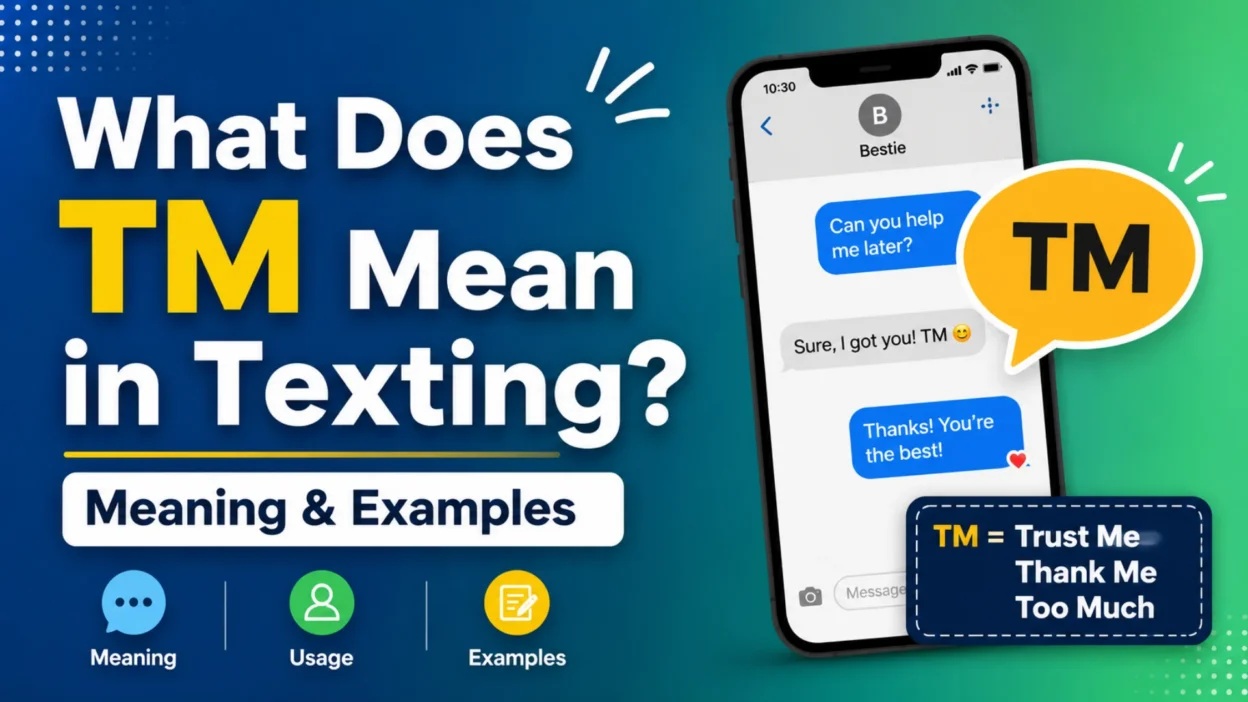
If you’ve received a message containing “TM,” you may have wondered, what does TM mean in texting? In most casual conversations, TM means “tomorrow.” People commonly use this short form when talking about plans, appointments, school, work, social events, or anything happening the following day.
Texting language changes quickly, so abbreviations can sometimes have more than one meaning. TM is a good example. While “tomorrow” is a common interpretation in casual chats, TM can also mean “trademark” in business and branding contexts. The surrounding conversation usually makes the intended meaning clear.
This guide explains the most common TM meanings, how people use the abbreviation, practical examples, suitable responses, and situations where writing the complete word is a better choice.
What Does TM Mean in Texting?
In everyday texting, TM usually means “tomorrow.” It is an informal abbreviation that makes messages shorter and faster to type.
For example, someone might text:
“Are you free tm?”
The sender is asking whether you are available tomorrow.
Similarly, these messages use TM to mean tomorrow:
- “I’ll call you tm.”
- “See you tm!”
- “Can we finish this tm?”
- “Are you coming tm?”
- “Let’s talk tm morning.”
- “I’ll send the pictures tm.”
The abbreviation doesn’t normally change the meaning of the sentence. Instead, it simply replaces the longer word “tomorrow.”
Because texting tends to favor quick communication, people often shorten familiar words. TM fits naturally into this style, especially when both people already understand casual texting language.
Why Do People Use TM in Messages?
The main reason people use TM is convenience. Typing a short abbreviation takes less effort than writing the full word.
However, convenience isn’t the only reason. Texting abbreviations can also create a relaxed tone.
People may choose TM because:
- It keeps messages brief.
- It works well in fast conversations.
- It feels casual and friendly.
- It fits social media communication.
- It avoids unnecessary repetition.
- It is easy to understand from context.
For instance, a friend may write “See you tm” instead of “See you tomorrow.” Both sentences communicate the same idea, but the first feels more like casual chat language.
Additionally, abbreviations can become habitual. Someone who regularly uses short forms may type TM automatically without thinking about it.
TM Meaning Depends on Context
Although TM often means tomorrow, you shouldn’t assume that interpretation every time.
The topic of the conversation provides an important clue. If someone is discussing schedules or future plans, TM probably means tomorrow. If the conversation involves logos, brands, or intellectual property, TM may refer to a trademark.
Compare these examples:
“Can we meet tm?”
Here, TM clearly refers to tomorrow.
“The company added TM to its brand name.”
In this context, TM may refer to a trademark symbol.
Therefore, the words surrounding the abbreviation matter more than the abbreviation itself.
A good rule is simple: look at the subject of the conversation before interpreting TM.
TM Meaning in Different Conversations
The abbreviation can appear in many types of conversations. Its meaning often becomes obvious from the subject.
Friends and Family
Friends and relatives frequently use TM when discussing plans.
Examples include:
- “Are you visiting tm?”
- “I’ll call you tm.”
- “Let’s go shopping tm.”
- “See you tm afternoon.”
These messages are informal, so shortening “tomorrow” feels natural.
School and College Chats
Students may use TM while discussing assignments, classes, exams, or group projects.
For example:
“Are we submitting it tm?”
The student is asking whether the assignment will be submitted tomorrow.
Another example could be:
“Study group tm at 5?”
Here, TM again means tomorrow.
Workplace Group Chats
TM can also appear in informal workplace messaging. Coworkers who communicate through chat platforms may use abbreviations when discussing schedules.
For example:
“Can you review the document tm?”
This means the person is asking whether the recipient can review the document tomorrow.
Still, professional standards vary between workplaces. Some teams communicate casually, while others prefer complete words.
Gaming Communities
Gaming conversations often move quickly, making abbreviations useful.
A player might say:
“Are we playing tm?”
That usually means:
“Are we playing tomorrow?”
Likewise:
“The tournament starts tm.”
Here, TM refers to the following day.
Social Media Conversations
Short forms are common in comments, direct messages, and group chats.
Someone might write:
“New post tm!”
This usually means a new post will appear tomorrow.
The same principle applies to Instagram, Snapchat, WhatsApp, Discord, and other messaging platforms.
TM Meaning on WhatsApp
On WhatsApp, TM can commonly mean “tomorrow” when used in casual conversations.
For example:
“Can you send it tm?”
The sender is asking you to send something tomorrow.
Another message might say:
“Let’s meet tm evening.”
Again, TM refers to tomorrow.
WhatsApp doesn’t give TM a special meaning by itself. The interpretation comes from the conversation.
Consequently, if a WhatsApp message contains TM while discussing plans, “tomorrow” is usually the most reasonable meaning.
TM Meaning on Snapchat
Snapchat users frequently rely on short, informal language. As a result, TM can appear in conversations about plans or upcoming activities.
For example:
“Are you free tm?”
This means:
“Are you free tomorrow?”
A Snapchat user might also write:
“See you tm.”
The intended meaning is generally obvious from the context.
However, Snapchat conversations can move between different topics quickly. If the message isn’t clear, asking the sender can prevent an incorrect assumption.
TM Meaning on Instagram
Instagram DMs and comments can also contain TM.
Examples include:
- “I’ll send it tm.”
- “Are you going tm?”
- “New reel tm.”
- “Talk to you tm.”
In these situations, TM usually means tomorrow.
Instagram also contains many business-related conversations. If someone is discussing branding, TM may instead refer to trademark.
Therefore, the topic remains the best clue.
TM Meaning on Discord and Gaming Chats
Discord conversations can involve gaming, communities, study groups, work, and social discussions.
When users discuss future activities, TM often means tomorrow.
For example:
“Raid tm?”
A gaming group could use this to ask whether the raid is happening tomorrow.
Another example is:
“Tournament tm at 8?”
Here, the sender is asking whether the tournament takes place tomorrow at 8.
Short messages are especially common in gaming communities because participants often prioritize speed and simplicity.
Other Common Meanings of TM
TM doesn’t have a single meaning across the entire internet.
Depending on the context, it can refer to several things.
Trademark
One of the most established meanings of TM is trademark.
You may see the symbol as “™” next to a brand name, slogan, product, or phrase.
For example:
“ExampleBrand™”
In this setting, TM has nothing to do with tomorrow.
Team
Some online communities may use TM as shorthand for “team.” This interpretation is less universal, so the conversation must provide enough context.
For example:
“Our tm needs another player.”
If the conversation is clearly about a multiplayer group, TM could mean team.
Text Message
In some contexts, people may use TM as shorthand for “text message.” However, this meaning is less common than “tomorrow” in everyday casual texting.
Because abbreviations aren’t standardized across every platform, context remains essential.
How to Tell Which TM Meaning Is Correct
You can usually identify the intended meaning by asking a few simple questions.
First, what is the conversation about?
If you’re discussing plans, TM probably means tomorrow.
Second, what words appear around TM?
A phrase such as “see you tm” strongly suggests tomorrow.
Third, is the conversation related to business or branding?
If so, TM may refer to trademark.
Finally, does the conversation involve a specialized community?
Gaming, technical, academic, or professional groups may use abbreviations differently.
For example:
“See you tm.”
The meaning is probably tomorrow.
“Put TM after the brand.”
The meaning is likely trademark.
This approach is more reliable than memorizing one fixed definition.
Examples of TM in Text Messages
Realistic examples make the meaning easier to understand.
Making Plans
“Are you free tm?”
Meaning: Are you free tomorrow?
Arranging a Meeting
“Can we meet tm at 3?”
Meaning: Can we meet tomorrow at 3?
Talking About School
“I’ll finish the homework tm.”
Meaning: I’ll finish the homework tomorrow.
Discussing Work
“I can review the report tm.”
Meaning: I can review the report tomorrow.
Planning a Game
“Are we playing tm night?”
Meaning: Are we playing tomorrow night?
Talking About an Event
“Concert is tm!”
Meaning: The concert is tomorrow.
Promising to Respond
“I’ll reply tm.”
Meaning: I’ll reply tomorrow.
Each example shows how context makes TM easy to understand.
How to Respond When Someone Uses TM
You don’t need a special response when someone uses TM. Simply answer the question or continue the conversation naturally.
For example:
Friend: “Are you free tm?”
Reply: “Yes, I should be free.”
Another conversation:
Friend: “Can we meet tm?”
Reply: “Sure. What time?”
You can also use TM yourself when the conversation is informal.
Friend: “When should I send the file?”
Reply: “You can send it tm.”
In a casual chat, this sounds completely natural.
Should You Use TM in Professional Communication?
Using TM at work depends on the situation.
An informal team chat may allow abbreviations. A formal email, client message, report, or business proposal usually deserves clearer language.
For example, this is casual:
“Can you send the report tm?”
A more professional version would be:
“Could you send the report tomorrow?”
The second sentence removes any uncertainty and looks more polished.
Professional communication often requires consistency. Therefore, spelling out “tomorrow” is generally safer when you’re communicating with clients, managers, customers, or unfamiliar contacts.
When You Should Avoid TM
TM is convenient, but it isn’t appropriate everywhere.
Consider avoiding it when:
- Writing a formal email
- Preparing a business document
- Contacting a new customer
- Sending an official notice
- Discussing an important deadline
- Communicating with someone unfamiliar with texting slang
- Writing content for a broad professional audience
The goal isn’t to avoid abbreviations completely. Instead, choose language that matches your audience.
If clarity matters more than speed, use “tomorrow.”
Common Mistakes When Interpreting TM
One common mistake is assuming TM always means tomorrow.
That interpretation works in many casual conversations, but it isn’t universal.
Another mistake involves ignoring the subject of the conversation. A message about a company trademark should not be interpreted in the same way as a message about weekend plans.
People can also misunderstand abbreviations when communicating across different groups. Someone unfamiliar with texting slang may not recognize TM immediately.
When the meaning isn’t obvious, a simple question works well:
“Do you mean tomorrow?”
That small clarification can prevent unnecessary confusion.
TM vs. TMR vs. TMRW
Several abbreviations can represent tomorrow.
| Abbreviation | Meaning | Typical Style |
|---|---|---|
| TM | Tomorrow | Very short and casual |
| TMR | Tomorrow | Informal |
| TMRW | Tomorrow | Informal |
| Tom | Tomorrow | Casual |
| Tomorrow | Tomorrow | Standard |
The main difference is style rather than meaning.
TM is especially brief. TMRW may be easier for some readers to recognize because it resembles the original word more closely.
When communicating with someone who may not know your preferred abbreviations, writing “tomorrow” is the clearest option.
Is TM Considered Slang?
TM can function as texting shorthand rather than traditional slang.
Slang often carries cultural or social meaning, while an abbreviation simply shortens a word or phrase.
When TM means tomorrow, it doesn’t usually add a special emotional meaning. It mainly makes the message shorter.
For example:
“I’ll see you tomorrow.”
and
“I’ll see you tm.”
communicate essentially the same information.
The second version simply feels more casual.
Is TM Rude or Impolite?
Using TM isn’t inherently rude.
Tone depends on the entire message, the relationship between the speakers, and the situation.
For example:
“See you tm!”
sounds friendly.
However, abbreviations can feel too casual in certain formal situations. A client might prefer:
“I’ll speak with you tomorrow.”
rather than:
“I’ll speak with you tm.”
Therefore, the issue is usually appropriateness rather than politeness.
Why Context Matters So Much With Texting Abbreviations
Texting doesn’t provide the same amount of information as face-to-face conversation. There may be no tone of voice, facial expression, or immediate explanation.
As a result, short abbreviations can sometimes create ambiguity.
TM illustrates this clearly because it can refer to different concepts.
Context provides the missing information. The topic, surrounding words, platform, and relationship between the speakers all help determine the intended meaning.
This is why interpreting abbreviations from a single word can sometimes be misleading.
TM in Casual vs. Formal Communication
The same idea can be expressed differently depending on the audience.
Casual text:
“I’ll call you tm.”
Friendly message:
“See you tm!”
Work chat:
“I can review this tm.”
Formal email:
“I can review this tomorrow.”
All four versions are understandable. The final version simply follows a more professional communication style.
Choosing the right form helps your message sound appropriate without changing the underlying meaning.
What If Someone Sends Only “TM”?
A message containing only “TM” can be harder to interpret.
If the conversation was already about plans, the sender may simply mean “tomorrow.”
For example:
Person A: “When should we meet?”
Person B: “TM.”
In this case, the meaning is probably tomorrow.
However, if there is no context at all, asking for clarification is reasonable.
You could reply:
- “Tomorrow?”
- “Do you mean tomorrow?”
- “TM as in tomorrow?”
A short clarification can quickly resolve the ambiguity.
Expert Tips for Understanding Texting Abbreviations
A few practical habits can make online communication easier.
Read the Whole Message
Don’t interpret an abbreviation in isolation. Look at the complete sentence first.
Consider the Topic
A scheduling conversation points toward “tomorrow,” while a branding conversation may point toward “trademark.”
Think About the Relationship
Friends tend to use more casual language than formal business contacts.
Look at the Platform
Gaming chats and social media often encourage shorter communication.
Ask When Necessary
If the meaning isn’t obvious, clarification is better than guessing.
These habits work for TM and many other texting abbreviations.
Frequently Asked Questions About TM in Texting
What does TM mean in texting?
TM commonly means “tomorrow” in casual text messages. People use it when discussing plans, schedules, events, or activities happening the following day.
Does TM always mean tomorrow?
No. TM can have other meanings depending on context. For example, business and branding conversations may use TM to mean “trademark.”
What does TM mean on WhatsApp?
On WhatsApp, TM commonly means tomorrow when the conversation involves future plans or activities. The platform itself doesn’t determine the meaning.
What does TM mean on Snapchat?
TM can mean tomorrow on Snapchat, especially when users are discussing plans. The surrounding conversation should confirm the intended meaning.
Is TM appropriate for work messages?
It can be acceptable in informal workplace chats, but “tomorrow” is generally better for formal emails, client communication, and official documents.
Is TM the same as TMRW?
Both can mean tomorrow. TM is shorter, while TMRW more closely resembles the spelling of the full word.
Can TM mean trademark?
Yes. TM can refer to a trademark, particularly in business, branding, and intellectual property discussions.
How should I reply to “TM”?
If TM means tomorrow, respond naturally. For example, you could say “Sure,” “What time?” or “That works for me,” depending on the conversation.
Final Thoughts
So, what does TM mean in texting? In most casual conversations, TM means “tomorrow.” It is a convenient abbreviation used when people want to discuss something happening the next day without typing the complete word.
You’ll often see it in conversations about plans, school, work, gaming, social media, and everyday activities. For example, “Are you free tm?” simply means “Are you free tomorrow?”
Nevertheless, TM can have different meanings in other contexts. Business and branding discussions may use TM to refer to a trademark, while specialized communities can assign their own meanings.
The safest approach is to consider the complete message and its context. When you’re communicating casually with friends, TM is usually easy to understand. For formal or important communication, writing “tomorrow” provides greater clarity and professionalism.

Serhii Dunev is a passionate content creator dedicated to crafting meaningful texts, messages, and word inspirations. He aims to help people express their emotions clearly through simple and impactful words.