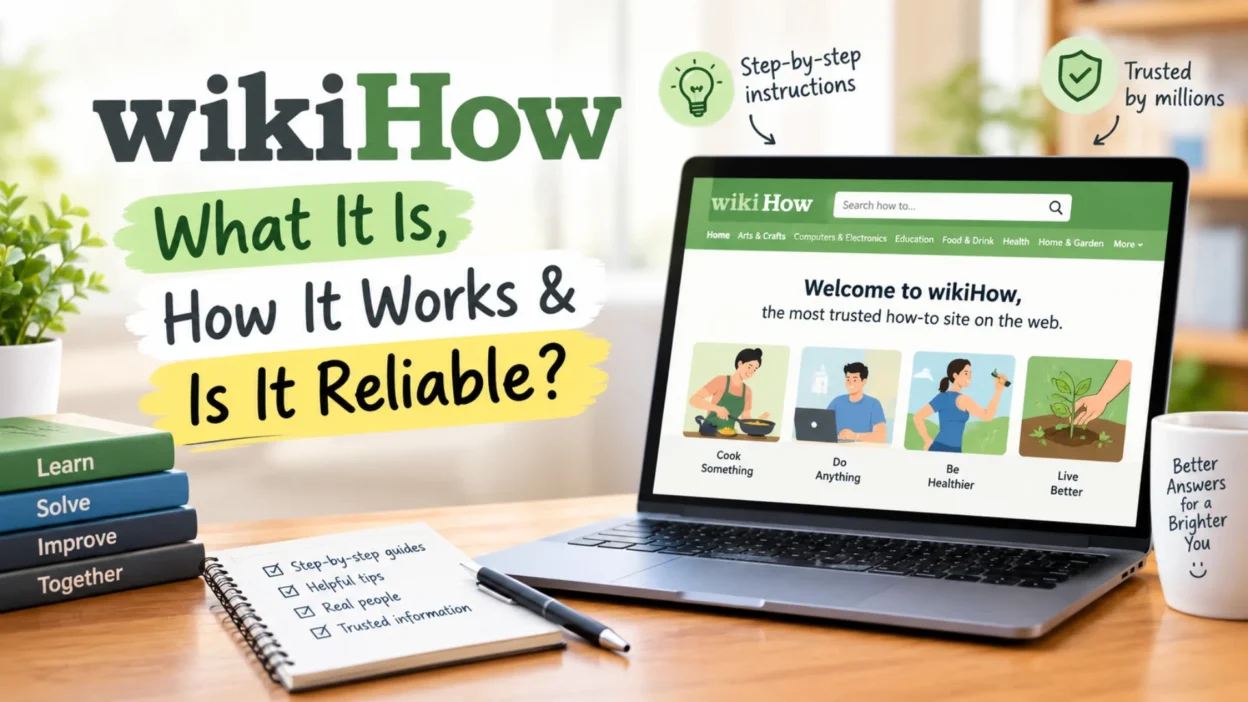
You’ve probably landed on a wikiHow page while searching for something random late at night. Maybe you wanted to know how to fold a fitted sheet, impress a crush, or fix a leaky faucet. The site shows up everywhere, and its illustrated step-by-step guides have become a familiar part of the internet landscape. But what exactly is wikiHow, and why does it feel so different from other how-to websites? The wikiHow name itself signals its approach: a wiki-style platform built on collaboration, where anyone can contribute instructions on almost any topic imaginable.
This guide explains what wikiHow is, how its editorial process works, whether you can trust the information, and why it has attracted both praise and criticism. You’ll also learn how to use the site effectively and when to look elsewhere for advice.
What Is wikiHow?
wikiHow is an online wiki-style publication featuring informational articles and quizzes on a wide range of topics. Founded in 2005 by internet entrepreneur Jack Herrick, its mission is to build the world’s largest and highest-quality how-to manual. The site runs on a modified version of MediaWiki, the same software that powers Wikipedia, allowing users to add, create, and modify content.
Unlike Wikipedia, which focuses on encyclopedic knowledge, wikiHow specializes in procedural instructions. The easy way to think about it: Wikipedia is a wiki-encyclopedia, and wikiHow is a wiki-how-to manual. The site currently contains more than 235,000 how-to articles and over 2.5 million registered users. It operates in 19 languages and reaches a global audience every month.
That combination of scale and accessibility explains much of its popularity. Whether you’re a student, a homeowner, or just curious, there’s usually a wikiHow article waiting for you.
The History Behind wikiHow
Jack Herrick launched wikiHow on January 15, 2005. He chose that date deliberately to honor Wikipedia, which launched on the same day in 2001. Before wikiHow, Herrick and his business partner Josh Hannah purchased eHow, a similar how-to website. However, Herrick concluded that eHow’s business model prevented it from becoming the high-quality resource he envisioned.
He believed the wiki method of content creation would produce better results over time. After selling eHow in 2006, he focused entirely on wikiHow. Herrick once described the difference between the two sites as eating a fast-food burger versus a wonderful home-cooked meal.
The site started as a community-driven project where volunteers wrote and edited articles. Over the years, it evolved into a hybrid organization—a for-profit company run for a social mission. Today, wikiHow employs a team of professional writers, fact-checkers, and content managers, though community contributions still play a role.
How wikiHow Creates and Reviews Content
wikiHow’s editorial process has changed significantly since its early days. While it began as a community-based wiki, the vast majority of new content is now written by a team of professional writers. The process starts with rigorous research and interviews with experts to answer a simple question: what problem are readers trying to solve?
From there, writers and reviewers polish drafts to ensure they are comprehensive and accurate. A team of fact-checkers and content managers regularly audits, updates, and reviews pages to meet editorial standards. wikiHow also collaborates with over 2,800 credentialed experts across fields like medicine, law, finance, relationships, and psychology.
When you see a green expert checkmark on a medical article, it usually means a licensed professional reviewed a version of it. Veterinarians review pet articles, lawyers review legal articles, and so on. This expert review system is part of wikiHow’s effort to build trust with readers.
The Role of Community Contributors
Despite the shift toward professional writing, wikiHow still welcomes community contributions. Volunteers can edit articles, suggest changes, and participate in forums. The site also has a large team of illustrators and photographers who create the distinctive visuals that accompany most guides.
Interestingly, wikiHow’s community has a reputation for being unusually friendly compared to other social platforms. A 2019 Wired profile noted that the site’s contributor community isn’t brimming with trolls. That’s a rare compliment in the world of open collaboration.
What Makes wikiHow Different From Other How-To Sites
Several features set wikiHow apart from competitors in the how-to space. First, its coverage is extraordinarily broad. You’ll find guides on everything from tying a tie to calming a nervous pet. Few sites match that range.
Second, the visual style is instantly recognizable. Most articles include simple line drawings and illustrations created by a dedicated team. That consistency makes the site feel approachable, even when the topic is technical.
Third, the structure is highly standardized. Most articles follow a predictable pattern with numbered steps, tips, warnings, and sometimes videos. Consequently, readers know what to expect before they start reading.
Finally, wikiHow mixes serious instructional content with lighter, almost playful topics. You’ll find articles on writing a resignation letter sitting next to articles on surviving a zombie apocalypse. That range is part of the site’s charm.
Is wikiHow Reliable?
This is the question readers ask most often. The honest answer depends on the topic and the specific article you’re reading. wikiHow’s reliability varies across its content categories.
In medicine, mental health, and legal topics, the site has invested heavily in expert review. Articles in these areas often carry a green checkmark indicating that a credentialed professional reviewed the content. That doesn’t make them flawless, but it adds a layer of accountability.
In lifestyle and hobby categories, the review process is lighter. A guide on making paper flowers doesn’t need a surgeon’s approval. However, it may reflect one contributor’s personal method rather than a universal best practice.
A Notable Example of Error
wikiHow hasn’t been immune to criticism. In one well-documented case, a widely shared article on recognizing and treating a specific medical emergency contained inaccurate information that was later removed. The incident sparked discussion about how much trust readers should place in crowd-edited content.
That said, the site has since strengthened its fact-checking. Mistakes still happen, but they tend to get corrected faster than they did in the early years.
How to Judge a wikiHow Article
A few quick checks help you decide whether an article is worth following. Look for an expert checkmark near the title. Scroll to the bottom to see the sources and references. Check the “last updated” date, since older articles may contain outdated steps. And read the warnings section carefully, because it often flags risks the main steps don’t mention.
If an article lacks sources and covers a high-stakes topic like medication or legal rights, treat it as a starting point rather than a final answer.
The Illustrations That Made wikiHow Famous
Part of wikiHow’s identity is its artwork. The site uses simple line drawings with a consistent style—soft outlines, minimal shading, and a slightly whimsical feel. These images have become a recognizable internet aesthetic in their own right.
A team of illustrators produces most of these visuals. Some are drawn by hand, while others are created digitally to match the site’s house style. The goal is clarity. A reader should be able to follow a step without reading the text twice.
Notably, the illustrations have inspired countless memes online. People often parody the style to make jokes about absurd situations. That cultural footprint is unusual for an instructional website, and it has helped wikiHow stay relevant in internet culture.
Common Criticisms of wikiHow
No platform of this size escapes criticism. Several complaints appear repeatedly in discussions about the site.
Accuracy Concerns
Because anyone can technically edit articles, some readers worry about misinformation. In practice, most high-traffic pages are locked or heavily moderated. Nevertheless, the perception lingers, especially for topics where precision matters.
Generic Advice
Some articles offer advice so broad that it barely helps. A guide on being confident might list obvious tips without addressing real-world nuance. Critics argue that this happens when writers prioritize search traffic over depth.
Search Engine Dominance
wikiHow ranks extremely well in search results, sometimes outranking specialist sites with deeper expertise. That frustrates professionals who feel their more accurate content gets buried beneath a generalist page.
Sometimes Awkward Topics
The site has published articles on sensitive subjects, and some have drawn criticism for tone or framing. In many cases, the content has been revised after feedback.
How wikiHow Has Changed Over Time
The wikiHow of 2008 looks quite different from the site today. Early versions relied almost entirely on volunteer editors, and quality varied wildly. As the site grew, leadership realized that professional oversight was necessary to maintain standards.
Today, the company employs a substantial editorial team, including writers, fact-checkers, and reviewers. Experts from various fields are brought in for specialized topics. Meanwhile, the community still contributes through edits, suggestions, and discussion.
This hybrid model is unusual in the publishing world. It blends the openness of a wiki with the rigor of traditional editorial review. The result isn’t perfect, but it has improved consistency across the site.
How to Use wikiHow Effectively
The site works best when you treat it as a starting point rather than a final authority. Here’s how to get the most from it.
Start With the Overview
Most articles begin with a short summary or a video. Read that first to see whether the article actually addresses your problem. If it doesn’t, move on quickly.
Read the Tips and Warnings
These sections often contain the most practical information. The main steps tell you what to do, while the tips and warnings tell you what to avoid. Skipping them can lead to avoidable mistakes.
Check the Sources
Scroll to the bottom of the page. If the article cites credible sources, that’s a good sign. If it doesn’t cite anything, be cautious, especially with health or legal content.
Compare With a Specialist Source
For anything important—medical symptoms, legal rights, financial decisions—cross-check the advice with a qualified professional or a specialized publication. wikiHow is a helpful companion, not a substitute for expert consultation.
wikiHow in Education and Everyday Life
Teachers sometimes use wikiHow articles as examples of procedural writing. The clear structure and numbered steps make it a useful model for students learning how to write instructions.
In daily life, the site serves as a quick reference. People use it to learn small skills, settle arguments, or satisfy curiosity. A student might read a guide on studying more effectively. A traveler might check how to pack a suitcase efficiently. Someone at home might look up how to remove a stain from a favorite shirt.
That everyday usefulness explains why the site endures despite its critics. It fills a gap between professional manuals and random forum posts.
Platform Differences: Desktop vs Mobile
wikiHow works on both desktop and mobile, though the experience differs. On desktop, you see the full sidebar with related articles, categories, and community links. The layout feels closer to a traditional wiki.
On mobile, the site uses a simplified, app-like interface. Steps appear one after another with large images, which makes following along easier while you’re doing something physical. The mobile app also supports offline reading, which is handy for tasks away from Wi-Fi.
The wikiHow App
The mobile app organizes content into categories and offers a daily feed of suggested articles. It also supports quizzes, which have become a popular feature. Many users discover the site through these quizzes rather than through search.
Generational and Cultural Reach
wikiHow appeals across age groups, though the way people use it varies. Younger users often encounter the site through memes and quizzes. Older users tend to arrive through search results when they need practical help.
Culturally, the site has been translated into many languages, including Spanish, German, French, Arabic, and Hindi. This localization expands its reach beyond English-speaking audiences. However, translated versions sometimes lag behind the English originals in updates and expert review.
FAQ About wikiHow
What does wikiHow mean?
The name combines “wiki,” referring to a collaboratively edited website, with “how,” referring to instructional content. Together, it describes a wiki-style how-to manual.
Who owns wikiHow?
wikiHow is owned by a company founded by Jack Herrick. It operates as a for-profit business with a stated social mission to provide free how-to information worldwide.
Can anyone edit wikiHow?
Technically, many pages remain editable by registered users. However, most high-traffic and sensitive articles are protected or reviewed by professional staff and experts.
Is wikiHow trustworthy?
It depends on the topic. Expert-reviewed articles in medicine, law, and mental health are generally more reliable than community-written lifestyle guides. Always cross-check important advice.
Does wikiHow pay its writers?
Yes. Most new content is produced by professional writers employed or contracted by the company, alongside a volunteer community that suggests edits.
Why does wikiHow use illustrations instead of photos?
Illustrations provide a consistent visual style and avoid copyright issues. They also make steps easier to follow by removing distracting background details.
Is wikiHow free to use?
Yes. The site is free for readers and does not require a subscription to access articles.
How often are wikiHow articles updated?
High-traffic and expert-reviewed articles are updated regularly. Older or less popular pages may go years without revision, so check the last updated date.
Final Thoughts on wikiHow
The wikiHow platform occupies a unique spot on the internet. It’s part encyclopedia, part community project, and part professional publishing operation. Its illustrated guides have taught millions of people small skills they’d otherwise never learn, and its editorial standards have improved considerably since the early days.
That said, it isn’t a replacement for professional advice. Use it as a helpful first stop, check the sources, and verify anything important with a qualified expert. Treated that way, wikiHow remains one of the most useful free resources on the web.

Serhii Dunev is a passionate content creator dedicated to crafting meaningful texts, messages, and word inspirations. He aims to help people express their emotions clearly through simple and impactful words.