You’re typing a message to a friend, and you want to describe that cozy feeling of wrapping yourself in a blanket and shutting out the world. Is it “cacoon” or “cocoon”? The cacoon or cocoon question trips up many people, and the answer is more interesting than a simple spelling correction. Both words exist in English, but they carry completely different meanings. One refers to a silky protective case spun by insects, while the other describes a tropical bean. Understanding when to use each spelling will make your writing clearer and more credible.
This guide breaks down the cacoon or cocoon confusion from every angle. You’ll learn the correct spelling for everyday contexts, discover the botanical meaning of “cacoon,” and see how people use these words in texting, social media, and casual conversation. By the end, you’ll know exactly which word to choose.
The Quick Answer: Cocoon Wins in Everyday Texting
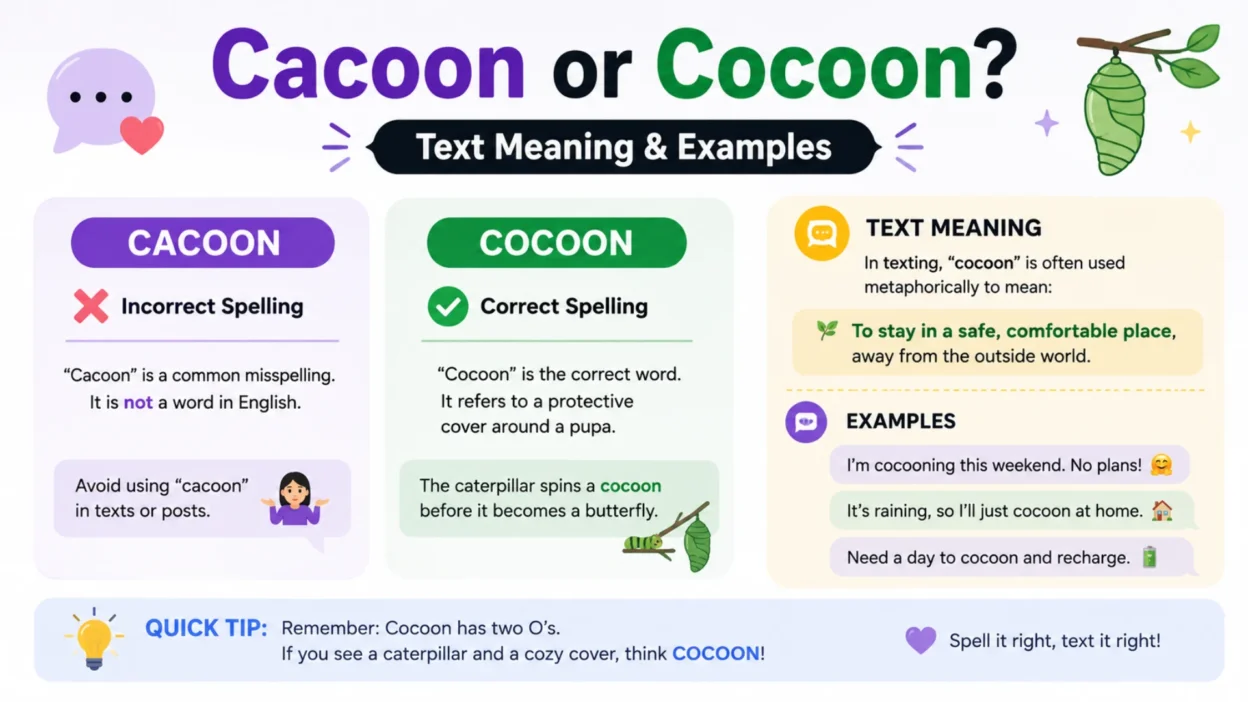
If you’re writing about a caterpillar, a protective shell, or the act of retreating into comfort, the correct spelling is cocoon. This is the word that appears in dictionaries, biology textbooks, and everyday writing across all English-speaking countries. It’s a noun that refers to the silky case certain insects spin during their pupal stage. It also functions as a verb meaning to envelop or protect something.
Interestingly, “cacoon” is also a real word, but it has nothing to do with insects or comfort. In botany, cacoon refers to the large seed of the Fevillea cordifolia plant, a tropical vine native to the Caribbean and Central America. Europeans called it the “snuffbox bean” because the seeds resembled old tobacco boxes. So while cacoon isn’t technically a misspelling, it’s almost never the word people actually need.
| Feature | Cocoon | Cacoon |
|---|---|---|
| Correctness | Standard English | Valid word, but rare |
| Meaning | Silky insect casing; to envelop | Tropical bean seed |
| Part of Speech | Noun and verb | Noun only |
| Common Contexts | Biology, metaphors, slang | Botany, historical texts |
| Everyday Use | Extremely common | Almost never |
Why People Confuse Cacoon and Cocoon
The confusion usually comes from pronunciation. In casual speech, “cocoon” can sound like “cacoon” because the first vowel is unstressed. English spelling doesn’t always match pronunciation, so writers often guess based on sound. Consequently, “cacoon” becomes a common typo in texts, social posts, and even published articles.
Another factor is autocorrect. Some phone keyboards don’t recognize “cocoon” as quickly as they recognize other words. As a result, users may type “cacoon” and send it without noticing. The mistake spreads because people see the misspelling online and assume it’s correct. However, dictionaries and style guides consistently list “cocoon” as the standard form.
The Real Meaning of Cacoon (It’s Not a Typo)
Most people who type “cacoon” are simply making a spelling mistake. Nevertheless, the word does have a legitimate botanical meaning that’s worth knowing. The cacoon bean comes from Entada scandens, a tropical climbing vine found in the Caribbean and parts of Central America. These large, hard seeds were historically used to make purses, spoons, snuffboxes, and other small items.
It’s a niche term that rarely appears outside of botanical texts or historical discussions. Therefore, if you’re writing a text message about wrapping up in a blanket, you’re almost certainly looking for “cocoon.” The botanical cacoon is a fascinating piece of linguistic trivia, but it’s not the word you’ll use in daily conversation.
Cacoon in Botany and History
Botanists and historians occasionally use “cacoon” when discussing indigenous crafts and plant-based materials. The seed’s hard shell made it useful for carving and shaping. In many cases, the word appears in older travel journals and colonial-era documents. Modern readers may encounter it in museum descriptions or academic papers about Caribbean flora. For everyone else, it’s a rare spelling that rarely matters.
Cocoon Meaning Beyond Insects: The Slang You’ll See in Chats
Beyond biology, “cocoon” has taken on a powerful metaphorical meaning that’s especially popular in texting and social media. The term “cocooning” refers to the deliberate act of withdrawing from social interaction and seeking refuge in the comfort of your own home. It’s about creating a personal sanctuary, often in response to stress, anxiety, or simply feeling overwhelmed by the outside world.
The term was popularized in the 1980s by trend forecaster Faith Popcorn. It saw a major resurgence during the COVID-19 pandemic when people were advised to stay home for safety. Today, you’ll see it used everywhere—from Instagram captions to group chats. In digital communication, “cocoon” often signals a need for rest, boundaries, or emotional recovery.
Here’s how people actually use it in messages:
- “I’m cocooning this weekend. Don’t text me unless it’s an emergency.”
- “After that work week, I just need to cocoon for 48 hours.”
- “She’s been cocooning since the breakup. Give her space.”
- “My ideal Friday night is cocooning with a blanket and a good show.”
Notice how the word conveys both a physical action and an emotional state. That dual meaning is what makes it so useful in chat language.
Cocooning as Self-Care
In many online conversations, cocooning is framed as a healthy form of self-care. People use it to describe taking a break from social obligations. Similarly, mental health advocates sometimes recommend cocooning as a way to recharge. However, it can also indicate avoidance if used too often. Context matters when you’re reading or sending this term.
Cocoon in Relationships and Breakups
Cocooning often appears in relationship discussions. After a breakup, someone might say they’re cocooning to heal. In a healthy relationship, partners might cocoon together for a quiet night. The word usually suggests safety and intimacy rather than isolation. As a result, it’s commonly used in supportive messages from friends.
Cocoon vs. Chrysalis: Another Common Mix-Up
While we’re clearing up confusion, let’s address another mistake that even careful writers make. Many people use “cocoon” and “chrysalis” interchangeably, but they’re not the same thing. A chrysalis is the actual pupal stage of a butterfly—the hardened outer shell that forms directly from the caterpillar’s body. A cocoon, on the other hand, is a silky case that moth caterpillars spin around themselves before entering the pupal stage.
In other words, butterflies have chrysalises, and moths have cocoons. Silkworms, which are moth larvae, spin cocoons that humans harvest for silk. This distinction matters in scientific writing, though it’s commonly overlooked in casual conversation. If you’re describing a butterfly’s transformation, “chrysalis” is usually the better choice.
How to Use Cocoon in Text Messages (With Examples)
Using “cocoon” correctly in texts is easy once you know the meaning. You can use it as a verb to describe your plans, or as a noun to describe a protective space. The tone can be playful, serious, or supportive depending on the conversation. Here are some realistic examples for different situations.
Friendly and Casual Examples
- “I’m cocooning tonight. Rain check?”
- “She’s in full cocoon mode until finals are over.”
- “Let’s cocoon and watch movies all day.”
- “I need a cocoon weekend. No plans, no stress.”
These messages are casual and warm. They signal that you need rest without sounding rude.
Social Media Captions
- “Cocoon season is officially here.”
- “Sometimes you just have to cocoon and protect your peace.”
- “My cocoon is my happy place.”
- “Cocooning with coffee and a good book.”
On social media, the word often pairs with images of blankets, candles, or cozy spaces. It’s a popular way to express a need for quiet.
Workplace and Professional Contexts
In professional settings, “cocoon” is less common but still usable. You might say, “I’m cocooning to finish this project,” meaning you’re focusing without interruptions. However, in formal emails, “focus time” or “deep work” may sound more professional. Use your judgment based on your workplace culture.
When You Should Not Use Cocoon
“Cocoon” is a flexible word, but it doesn’t fit every situation. Avoid using it in formal scientific writing unless you’re referring to the actual insect casing. In medical or mental health contexts, “cocooning” can sound dismissive if someone is struggling with serious isolation. Additionally, don’t use “cacoon” as a casual alternative—it will look like a spelling error to most readers.
If you’re writing for a professional audience, choose precise language. “Withdrawing,” “resting,” or “taking a break” may communicate your meaning more clearly. Similarly, in academic writing, use “cocoon” only when discussing biology or metaphor deliberately.
Common Mistakes People Make With Cacoon or Cocoon
The most obvious mistake is using “cacoon” when you mean “cocoon.” This error appears in texts, blog posts, and even product descriptions. Another mistake is using “cocoon” as a synonym for “chrysalis.” As mentioned earlier, these are different stages of insect development.
A third mistake involves overusing “cocooning” as an excuse. In many cases, people use it to avoid responsibilities rather than to genuinely rest. Consequently, the term can lose its positive meaning if it’s used too often. Use it honestly and sparingly.
Platform Differences: Where Each Spelling Appears
Different platforms show different patterns. On Twitter and Instagram, “cocoon” appears frequently in captions and hashtags. On Reddit, users discuss “cocooning” in mental health and productivity forums. In text messages, the word is usually casual and shorthand.
“Cacoon” appears mostly as a typo. You might see it in quick replies, autocorrect fails, or comments from users who haven’t checked the spelling. In academic databases, “cacoon” appears in botanical contexts. Therefore, platform context helps you decide which spelling is intended.
Generational and Regional Usage Patterns
Younger generations often use “cocoon” as slang for self-care and boundary-setting. Older generations may use it more literally, referring to insects or physical wrapping. In the UK, Australia, and Canada, the spelling remains “cocoon” across all age groups. Regional differences mainly affect pronunciation, not spelling.
In some Caribbean communities, “cacoon” may appear in historical or botanical discussions. However, everyday usage still favors “cocoon.” As a result, the standard spelling is consistent across most English-speaking regions.
Cocoon in Pop Culture and Media
The word “cocoon” has appeared in film, music, and literature. A famous 1985 film titled “Cocoon” tells a science fiction story about aliens and life extension. The title uses the word metaphorically to suggest protection and transformation. In music, artists use “cocoon” to describe emotional safety or isolation.
These cultural references reinforce the word’s association with comfort, protection, and change. They also make “cocoon” more recognizable in everyday language. When you use it in a text, you’re tapping into a rich cultural meaning.
How to Remember the Correct Spelling
Remembering “cocoon” is easier with a simple trick. Think of “cocoa,” the drink made from cacao beans. Both words start with “coc” and have a similar cozy feel. You can also picture a coconut, which shares the same double-O pattern. Meanwhile, “cacoon” looks like “cacao,” which relates to chocolate and beans. That connection can help you recall the botanical meaning.
Another strategy is to rely on autocorrect and spell-check. Add “cocoon” to your phone’s dictionary if it keeps changing. Finally, read your message before sending it. A quick review catches most spelling errors.
FAQ About Cacoon or Cocoon
Is “cacoon” a real word?
Yes, but it’s rare. It refers to a tropical bean seed. In everyday writing, “cocoon” is the standard spelling.
Which spelling is correct for texting?
“Cocoon” is correct for texting, social media, and casual conversation. “Cacoon” is usually a typo.
What does “cocooning” mean in slang?
It means withdrawing from social life to rest, recharge, or protect your peace. It’s often used in self-care contexts.
Can I use “cocoon” as a verb?
Yes. For example, “I’m cocooning tonight” is grammatically correct and widely understood.
Is “cocoon” the same as “chrysalis”?
No. A chrysalis is a butterfly’s pupal stage. A cocoon is a silky case spun by moth caterpillars.
Why do people misspell “cocoon” as “cacoon”?
Pronunciation and autocorrect often cause the mistake. The unstressed first vowel makes “cacoon” sound plausible.
Is “cacoon” ever acceptable in professional writing?
Only in botanical or historical contexts. Otherwise, use “cocoon.”
Final Thoughts on Cacoon or Cocoon
The cacoon or cocoon debate usually ends with one clear answer: “cocoon” is the word you need for insects, comfort, and slang. “Cacoon” is a valid botanical term, but it rarely fits modern digital communication. By choosing the right spelling, you’ll avoid confusion and write with confidence.
Whether you’re texting a friend, posting a caption, or writing a professional email, context guides your choice. Use “cocoon” for everyday meaning, and reserve “cacoon” for specialized botanical discussions. That simple rule will keep your writing clear and credible.

Serhii Dunev is a passionate content creator dedicated to crafting meaningful texts, messages, and word inspirations. He aims to help people express their emotions clearly through simple and impactful words.