Three letters show up in your messages and stop you cold. ASL. No emoji, no punctuation, no explanation. The ASL meaning in text depends entirely on who typed it, where they typed it, and what came before it. That’s what makes this acronym so tricky. It isn’t one thing. It’s three completely different things wearing the same three letters.
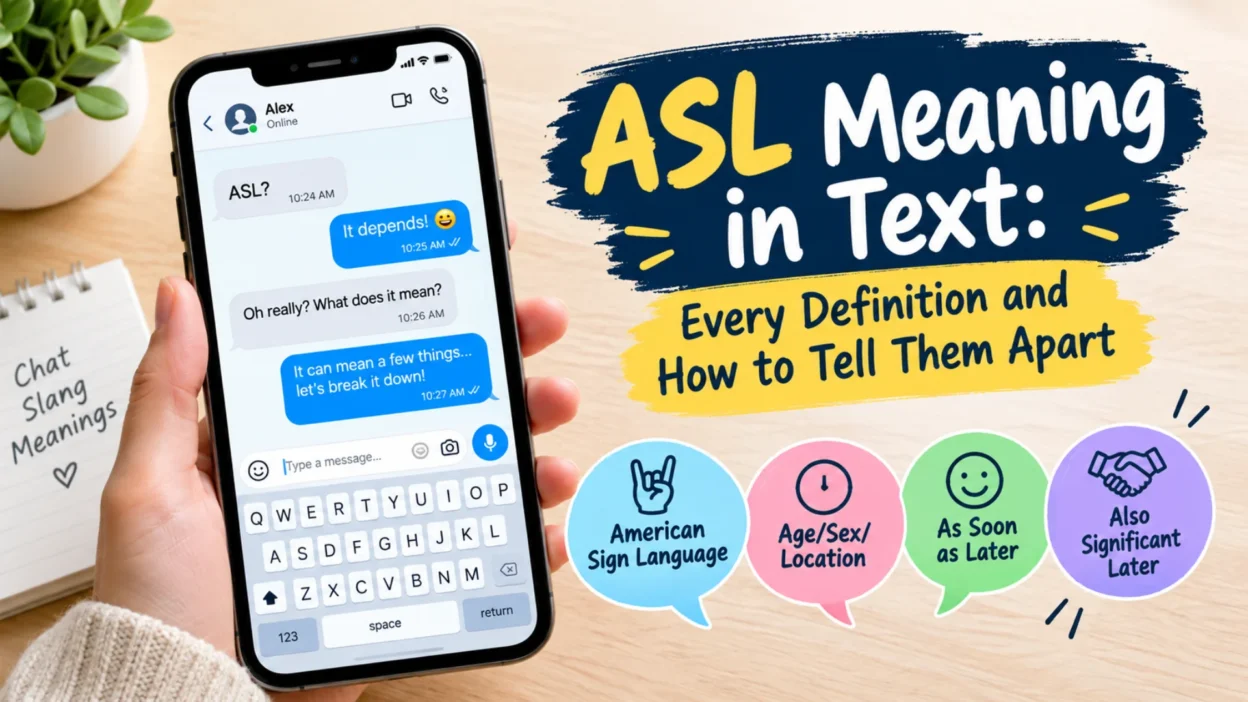
Here’s the core reality: ASL usually stands for “as hell,” “age, sex, location,” or “American Sign Language.” Each meaning belongs to a different world. One lives in casual Gen Z texting. Another belongs to the early internet chatroom era. The third is a real, recognized language used by hundreds of thousands of people.
Getting the wrong one can range from awkward to genuinely concerning. This guide breaks down every valid meaning, shows you how to tell them apart in seconds, and explains when you should avoid the acronym entirely.
The Quick Answer: ASL Unpacked
ASL carries three main meanings in digital communication, and the context decides which one applies.
“As hell” is the modern slang version. Kids and younger texters use it to add emphasis, the same way someone might say “so much” or “like crazy.” When someone types “that’s funny asl,” they mean it’s extremely funny.
“Age, sex, location” is the classic chatroom meaning. It dates back to the early days of the internet, when strangers in chat rooms asked for basic details to figure out who they were talking to. This usage is less common today, but it still appears in anonymous chat spaces and online games.
“American Sign Language” is the formal meaning. It refers to the visual language used by Deaf communities in the United States and parts of Canada. When ASL appears in educational, medical, or accessibility contexts, this is what it means.
Three meanings, three separate worlds, all sharing the same three letters.
How to Tell Which ASL You’re Reading
Telling the three meanings apart takes about two seconds once you know what to look for. The message structure and the surrounding context do almost all the work.
| Clue | What It Suggests |
|---|---|
| ASL appears at the end of a sentence | “As hell” (emphasis) |
| ASL appears as a standalone question | “Age, sex, location” |
| ASL appears in educational or accessibility contexts | American Sign Language |
| ASL follows an adjective like “tired” or “funny” | “As hell” |
| ASL comes from a stranger in a chatroom or game | “Age, sex, location” |
| ASL appears in a news article or policy discussion | American Sign Language |
A practical rule helps here. If ASL sits at the end of a sentence like “I’m hungry asl,” it’s emphasis. It stands alone as a question from someone you don’t know, treat it as a request for personal information. If it shows up in a formal or academic setting, it’s the language.
“As Hell”: The Gen Z Slang That Took Over
The “as hell” version is probably why most people search for this acronym today. It exploded on TikTok around 2020 and spread to every major platform within a couple of years.
Here’s how it works in practice:
- Emphasizing a feeling: “I’m tired asl.” Meaning: extremely tired.
- Emphasizing a quality: “That movie was good asl.” Meaning: really good.
- Emphasizing a reaction: “You scared me asl.” Meaning: scared me badly.
The phrase functions as an intensifier. It slots into a sentence the same way “as hell” does in spoken English, adding weight to whatever adjective comes before it.
Nobody knows exactly who started this usage. According to Know Your Meme, the first known instance of someone linking ASL to “as hell” appeared on Twitter in June 2018, when a user complained about being confused by it for a while. The usage spread quietly for a couple of years before TikTok pushed it into the mainstream.
One important detail: the slang version is often written in all lowercase. “asl” reads as casual and conversational. Uppercase ASL draws more attention to the acronym itself and can create confusion with the other meanings.
“Age, Sex, Location”: The Chatroom Classic
This meaning belongs to an older era of the internet. In the early 2000s, chat rooms and instant messaging programs connected strangers from all over the world. Nobody had a profile picture or a bio. People needed a quick way to figure out who they were talking to.
ASL became that shortcut. According to Wikipedia, it was used in instant messaging programs and internet chatrooms as a question to quickly find out someone’s age, sex, and general location.
A 2001 Pew report called “Teenage Life Online” found that teenagers listed ASL as the most common question asked of people entering chat rooms. By 2004, researchers noted it was the most common chat technique people used to describe their physicality in dating chat rooms.
The question worked like this:
- A: “ASL?”
- B: “18/f/California”
That reply format became standardized: age, slash, gender, slash, location. The slash became so common that many people typed it as A/S/L rather than ASL.
Why This Meaning Still Matters Today
The chatroom era faded, but ASL never fully disappeared. It still appears in anonymous chat platforms, online games, and any space where strangers interact without profiles.
This usage carries real safety concerns. Child safety experts warn that a seemingly casual “ASL?” from a stranger is often the first step in online predation. The question builds a profile that helps bad actors target vulnerable young people. When someone you don’t know asks for your age, sex, and location, that’s a red flag worth taking seriously.
Parents monitoring their kids’ online activity should know this acronym well. A casual “asl” at the end of a sentence is harmless slang. A standalone “ASL?” from an unknown account is something else entirely.
American Sign Language: The Formal Meaning
The third meaning has nothing to do with texting slang. American Sign Language is a complete visual language used by over 500,000 people in the United States. It has its own grammar, regional dialects, and cultural significance. It isn’t just hand gestures or a signed version of English.
ASL developed in the early 1800s, shaped in part by French Sign Language. Thomas Hopkins Gallaudet helped establish the first school for the Deaf in the United States, and the language grew from there. Today it serves as the predominant sign language of Deaf communities in the United States and most of Anglophone Canada.
This usage appears in specific contexts:
- Educational settings and disability services
- News articles about accessibility and Deaf culture
- Medical and legal discussions about interpretation services
- Policy debates about language access
If you see ASL in any of those spaces, it means the language. Nobody is asking for your age, sex, and location.
Platform Differences: Where Each ASL Lives
The same three letters behave differently depending on where you type them. Understanding platform norms helps you read the acronym correctly.
| Platform | Most Common ASL Meaning | Tone |
|---|---|---|
| TikTok | As hell (slang) | Casual, emphatic |
| Instagram DMs | As hell (slang) | Light, conversational |
| Snapchat | As hell (slang) | Quick, casual |
| Text messages | As hell (slang) | Natural conversation |
| Chatrooms and Omegle | Age, sex, location | Inquisitive, sometimes unsafe |
| Online games | Age, sex, location | Often casual, sometimes predatory |
| News and educational content | American Sign Language | Formal, informative |
TikTok and Instagram are overwhelmingly slang territory. ASL there almost always means “as hell.” The acronym shows up in comments and captions, adding emphasis to whatever the creator said or did.
Anonymous chat spaces and online games flip the meaning. ASL there usually asks for personal details. The context is completely different from social media, and the stakes are higher.
News articles, policy discussions, and educational content use ASL to mean the language. This is the most formal context, and the meaning stays consistent across all platforms.
When You Shouldn’t Use ASL
ASL belongs to specific contexts. Using it in the wrong setting can confuse people or create unnecessary concern.
Professional communication. Emails to clients, managers, and colleagues should never include ASL in its slang form. “As hell” spelled out is already casual. The acronym pushes it further into group-chat territory.
Formal writing. Essays, reports, and applications never include texting abbreviations. Standard English applies.
Cross-generational conversations. Older texters often associate ASL with the chatroom meaning. Using it as slang with someone who remembers the early internet can create genuine confusion.
Safety-sensitive contexts. Never send a standalone “ASL?” to someone you don’t know. The question carries a heavy reputation, and it can make people feel unsafe even if your intentions are innocent.
When discussing the language. If you’re talking about American Sign Language, spell it out. Using the acronym in a slang context can create ambiguity that undermines your point.
Common Mistakes People Make With ASL
Most ASL mishaps come from small errors, not big ones.
Mistake 1: Assuming it always means “as hell.” The slang version is popular, but it isn’t the only meaning. The chatroom and language meanings are real and active.
Mistake 2: Confusing capitalization. Lowercase “asl” usually signals slang. Uppercase “ASL” often signals American Sign Language or the chatroom question. The difference matters.
Mistake 3: Sending ASL as a question to a stranger. This can make people uncomfortable. The acronym has a reputation, and even innocent curiosity can come across as predatory.
Mistake 4: Using it in professional settings. Even relaxed workplaces expect clearer language in writing. ASL belongs in the chat window, not the inbox.
Mistake 5: Forgetting the safety angle. Parents and younger users should know the chatroom meaning. Ignoring it leaves a gap in digital safety awareness.
How to Reply to ASL Without Overthinking It
Your reply should match the meaning the sender intended. That’s the entire rule.
1. If it’s the “as hell” version:
- “Right? Same here.”
- “I know, it was so good.”
- “Agreed, 100%.”
2. If it’s the chatroom version from a stranger:
- “I don’t share personal details with strangers.”
- “Not comfortable with that.”
- Ignore it and leave the conversation.
3. If it’s the chatroom version from someone you know:
- “28/m/New York, you?”
- “You first.”
4. If it’s the American Sign Language version:
- “Do you sign? I’ve been learning.”
- “ASL interpretation was provided at the event.”
- Respond to the topic, not the acronym.
5. If you’re unsure which meaning applies:
- “Wait, do you mean as hell or something else?”
- “Not sure what you’re asking.”
- Ask for clarification before answering.
Notice how none of these replies overcommit. They leave space for the conversation to go wherever it’s meant to go.
ASL in Real Conversations
Seeing the acronym in context makes its meaning click faster than any definition.
The Gen Z emphasis
- Person A: “That test was hard asl.”
- Person B: “I know, I barely finished.”
- Result: Shared frustration, casual conversation.
The chatroom question
- Stranger: “ASL?”
- You: “Not sharing that.”
- Result: Boundary set, conversation ends.
The language discussion
- Article headline: “ASL interpretation now required at public events.”
- Reader: Understands ASL means American Sign Language.
- Result: Clear, no confusion.
The TikTok comment
- Video: Someone does a difficult dance.
- Comment: “That was smooth asl.”
- Result: Emphasis delivered, no ambiguity.
Notice how the meaning shifts entirely based on who’s typing and where. Context is everything.
Generational and Regional Patterns
ASL usage splits along generational lines more than regional ones.
Gen Z texters overwhelmingly use ASL to mean “as hell.” They grew up seeing it on TikTok and Instagram, and the slang meaning feels natural to them. Many don’t even know the chatroom version existed.
Millennials and older internet users often associate ASL with the chatroom question or American Sign Language. They remember the early internet era when “ASL?” was the standard opening line in a chat room. For them, the slang version can feel genuinely confusing.
Regional differences stay minor. ASL travels well across English-speaking countries because it originated online rather than in a specific geographic community. The language meaning stays consistent globally because American Sign Language is a defined, recognized language.
ASL vs Similar Acronyms
ASL belongs to a family of abbreviations that dominate casual texting. Learning the relatives helps you pick the right one.
| Abbreviation | Meaning | Best Situation |
|---|---|---|
| AF | As F*** | Stronger emphasis than ASL |
| AFK | Away From Keyboard | Gaming context |
| IMO | In My Opinion | Sharing a personal take |
| SMH | Shaking My Head | Disappointment or disbelief |
| TBH | To Be Honest | Signaling sincerity |
| WYD | What You Doing? | Current activity check |
AF and ASL serve similar purposes. Both add emphasis. AF carries more intensity, while ASL fits more casually into conversation. People swap them freely without much thought.
FAQ
What does ASL stand for in texting?
ASL usually stands for “as hell” in modern texting. It adds emphasis to whatever comes before it. The acronym can also mean “age, sex, location” in chatroom contexts, or “American Sign Language” in formal settings.
Is ASL the same as AF?
Not exactly. AF stands for “as f***” and carries more intensity. ASL means “as hell” and fits more casually into conversation. Both serve as intensifiers, but ASL is milder.
What does ASL mean on TikTok?
On TikTok, ASL almost always means “as hell.” It’s used in comments and captions to emphasize a point, a feeling, or a reaction. It’s one of the most common slang terms on the platform.
When did ASL start meaning “as hell”?
The first known instance of ASL meaning “as hell” appeared on Twitter in June 2018. The usage spread quietly for a couple of years before TikTok pushed it into the mainstream around 2020.
Is it safe to reply to someone who asks for my ASL?
No. If a stranger asks for your ASL in a chatroom or game, they’re asking for your age, sex, and location. Child safety experts warn that this question is often the first step in online predation. Never share personal details with strangers.
Can ASL mean American Sign Language?
Yes. ASL is the standard abbreviation for American Sign Language, a complete visual language used by over 500,000 people in the United States. This meaning appears in educational, medical, and accessibility contexts.
Should I use ASL at work?
No. ASL belongs to informal conversation. Workplace messages should use clear, standard language instead. Even relaxed offices expect professional phrasing in writing.
How do I reply when someone uses ASL as slang?
Match the sender’s energy. If they’re emphasizing something, agree or react. If you’re unsure what they mean, ask for clarification. Short, natural replies work best.
Final Thoughts on Reading ASL Correctly
ASL is a small abbreviation with an unusually wide range. It can add emphasis, ask for personal details, or name a real language. None of those meanings cancels the others out. They coexist because language adapts to context, and context is something no dictionary can fully capture.
The next time those three letters show up in your messages, you won’t need to guess. Read the context, check the platform, and reply like someone who actually understands digital shorthand.

Serhii Dunev is a passionate content creator dedicated to crafting meaningful texts, messages, and word inspirations. He aims to help people express their emotions clearly through simple and impactful words.