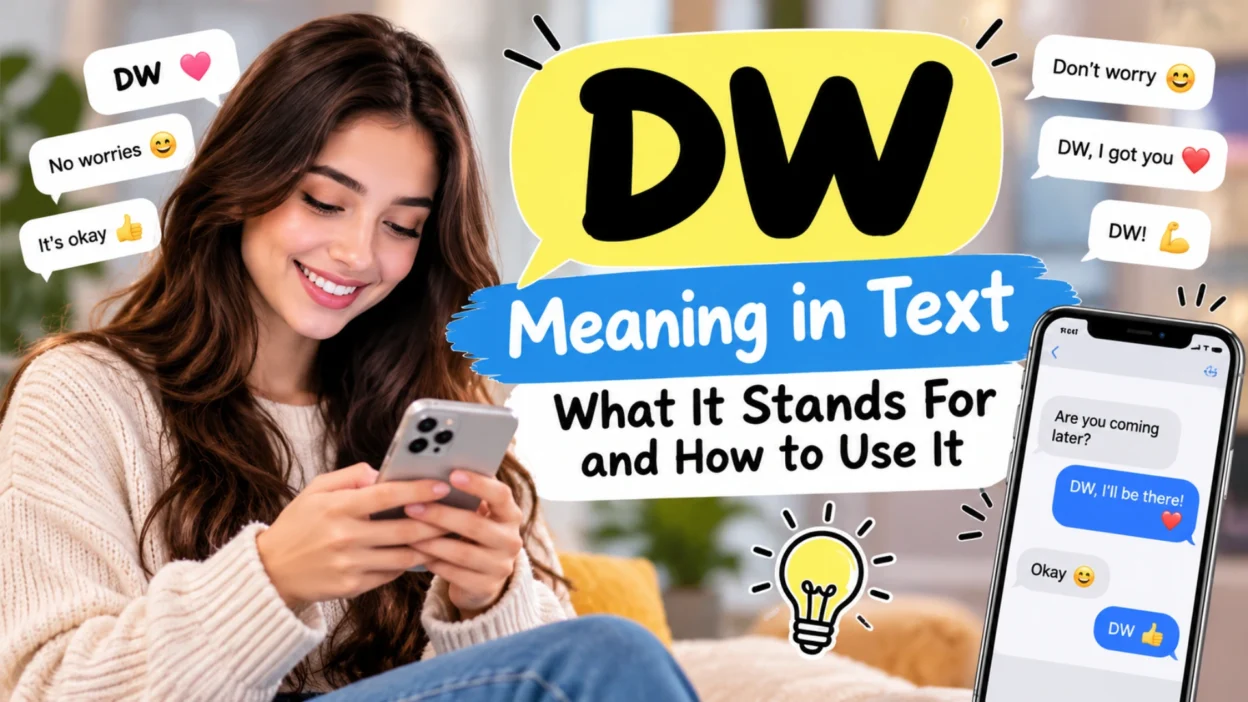
If someone replies “dw” after you apologize or express concern, they are telling you to relax. The dw meaning in text is almost always “don’t worry,” a short and reassuring phrase used to signal that a situation is fine and does not need stress or further explanation. It is one of the most common abbreviations in casual messaging, and it carries a calm, friendly tone that fits naturally into everyday conversations.
Unlike some slang that can feel dismissive or cold, “dw” usually softens the moment. It tells the other person that the mistake is not a big deal, the problem is handled, or the worry is unnecessary. Understanding when and how to use it, and the few situations where it means something else, makes texting smoother and less ambiguous.
The Most Common Meaning: Don’t Worry
“DW” stands for “don’t worry” in the vast majority of text messages, direct messages, and social media comments. It is used when someone wants to reassure another person that everything is okay, that a mistake is minor, or that a concern is not worth the anxiety.
The abbreviation is typically written in lowercase as “dw,” though uppercase “DW” appears as well. There is no difference in meaning between the two forms. It functions as a complete thought on its own, or it can be paired with other words, such as “dw about it” or “dw too much.”
When People Use “DW” in Conversation
The abbreviation appears in everyday moments where reassurance is needed. A friend might send “dw” after you apologize for being late. A classmate might type it when you are stressed about a test. A partner might use it to calm your nerves about a plan that seems uncertain.
The key quality is lightness. “DW” does not demand a long explanation or a formal acknowledgment. It quietly closes the loop on a small worry and moves the conversation forward.
Examples in Context
- After an apology: “I’m so sorry I forgot to reply yesterday.” “Dw, it happens.”
- Calming nerves: “I’m stressed about the presentation tomorrow.” “Dw, you’ve practiced enough.”
- Reassuring about a plan: “I hope we can still get tickets.” “Dw, I checked and there are plenty left.”
- Downplaying a mistake: “I think I sent that to the wrong person.” “Dw about it, it’s not important.”
In each case, “dw” serves as a gentle signal that the other person can stop worrying.
How “DW” Differs from Other Reassurances
“DW” is not the same as “it’s fine” or “no problem,” even though the meanings overlap. “DW” specifically addresses worry. It tells the other person that their anxiety is unnecessary, not just that the situation is acceptable.
This distinction matters in tone. “No problem” acknowledges a small inconvenience. “Don’t worry” goes a step further by addressing the other person’s emotional state. That is why “dw” often appears when someone is visibly stressed, overthinking, or apologizing repeatedly.
Other Meanings of “DW”
“Don’t worry” dominates casual texting, but context can shift the meaning. A few other interpretations appear often enough to recognize.
Dear Wife or Darling Wife
In online forums and communities focused on marriage or parenting, “DW” frequently stands for “dear wife” or “darling wife.” It is used as a shorthand way to refer to a spouse, often alongside similar abbreviations like “DH” for dear husband.
Example:
“My DW surprised me with tickets to the game this weekend.”
This usage is common in older internet forums and some social media groups, but it rarely appears in casual one-on-one texting between friends. If the conversation involves family updates or relationship stories, “dear wife” is a strong possibility.
Doctor Who
In fan communities and entertainment discussions, “DW” can refer to the British science fiction series Doctor Who. This usage is specific to conversations about television, movies, or fandom.
Example:
“The new season of DW starts next month.”
If the surrounding messages mention episodes, actors, or sci-fi, this is the likely meaning.
Other Niche Uses
In real estate listings, “DW” can be shorthand for “dishwasher.” In broadcasting, it may refer to Deutsche Welle, Germany’s international broadcaster. These uses are professional or technical and rarely appear in casual chat.
How to Tell Which Meaning Is Being Used
Context solves most confusion. A few quick signals make the intended meaning clear.
- Tone: A reassuring tone points to “don’t worry.” A family-related story points to “dear wife.”
- Topic: Television and sci-fi discussions point to Doctor Who. Appliance listings point to dishwasher.
- Grammar: “DW” standing alone after someone apologizes usually means “don’t worry.” “My DW” almost always means “my dear wife.”
- Platform: Casual chats favor the slang meaning. Forums and fan communities may use the other meanings.
When in doubt, ask. A simple “dw as in don’t worry?” clears things up without awkwardness.
Is “DW” Appropriate in Every Situation?
“DW” works well in informal settings: texts, group chats, gaming, and quick messages between friends or close colleagues. It is too casual for formal apologies, professional emails to clients, or situations where someone has been seriously inconvenienced.
If the mistake matters, spell it out. “I’m sorry, that was my mistake” carries more weight than a two-letter abbreviation. Reserve “DW” for moments when a light acknowledgment is enough. Because it is casual slang, avoid using it in business communication or formal writing.
Common Mistakes to Avoid
A few habits cause confusion when using “DW.”
- Overusing it: Constant “dw” messages can feel dismissive, as if the person is not taking the other person’s feelings seriously.
- Using it for serious errors: A quick “dw” after a real problem can come across as flippant.
- Assuming one meaning: In forums or family groups, “DW” might mean “dear wife,” so confirm the context before replying.
- Mixing up case: Lowercase “dw” usually signals the slang meaning, while uppercase “DW” often signals the family or fandom meaning. This is a tendency, not a rule.
DW on Different Platforms
The meaning stays consistent across platforms, but the context shifts slightly depending on where you see it.
On WhatsApp and iMessage, “dw” is almost always a quick reassurance. On Reddit and older parenting forums, “DW” often refers to a spouse. On TikTok and Instagram, creators might use it in captions or comments to calm followers, such as “dw, the full video is coming.” In Discord servers, especially gaming ones, “dw” follows a missed play or a small mistake in a fast-moving chat.
The common thread is speed and informality. “DW” fits the rhythm of platforms where messages disappear, chats move quickly, and users prefer not to interrupt the flow with a full sentence.
A Note on Origin and Evolution
The phrase “don’t worry” has been part of English for centuries, but its abbreviation “DW” emerged with early internet culture. It spread through chat rooms, instant messengers, and eventually social media.
What makes “DW” interesting is how it has retained its reassuring, low-stakes character even as it spread across platforms and generations. Unlike some slang that fades or shifts meaning, “don’t worry” and its abbreviation have stayed remarkably stable. The phrase works because it addresses a universal human need: the desire to be told that everything is okay.
FAQs
What does DW mean in a text from a friend?
In most friendly conversations, “DW” means “don’t worry.” It is a casual way to reassure someone that a situation is fine and does not need stress.
Can DW mean “dear wife”?
Yes. In online forums and communities focused on marriage or family, “DW” often stands for “dear wife” or “darling wife.” If the conversation involves family updates or relationship stories, this is a strong possibility.
Is DW the same as “don’t worry”?
Yes, in casual texting the two are interchangeable. “DW” is simply the shortened form of “don’t worry.”
When should I not use DW?
Avoid “DW” in formal apologies, professional emails, or situations where the mistake caused real inconvenience. In those cases, write out a clear and sincere apology instead.
Does DW always mean “don’t worry” in every context?
No. While it is the most common meaning in casual texting, “DW” can also mean “dear wife” in family forums or Doctor Who in fan communities. Context and platform usually make the meaning clear.
Why do people say “DW” instead of “don’t worry”?
“DW” is faster and fits the rhythm of texting. It saves characters and keeps the conversation moving, which suits the tone of casual messaging and group chats.
Conclusion
The dw meaning in text is simple: it is almost always “don’t worry,” a light and quick way to reassure someone that everything is okay. Watch the tone, the topic, and the platform, and you will rarely misread it. Keep “DW” for casual moments, and save the full reassurance for the situations that deserve it.

Serhii Dunev is a passionate content creator dedicated to crafting meaningful texts, messages, and word inspirations. He aims to help people express their emotions clearly through simple and impactful words.