You’re typing a quick message before your first coffee, and your fingers hover over the keyboard. Is it “goodmorning” or “good morning”? The goodmorning or good morning question is one of the most common spelling dilemmas in everyday English. Both forms look almost identical on a screen, and they sound exactly the same when spoken aloud. However, only one of them is correct in standard English. Knowing the difference will make your texts, emails, and social media posts look more polished and professional.
This guide breaks down the goodmorning or good morning confusion completely. You’ll learn the grammar rule behind the correct spelling, see how capitalization works in different contexts, and discover when casual alternatives are acceptable. By the end, you’ll never second-guess this greeting again.
The Quick Answer: Good Morning Is Always Two Words
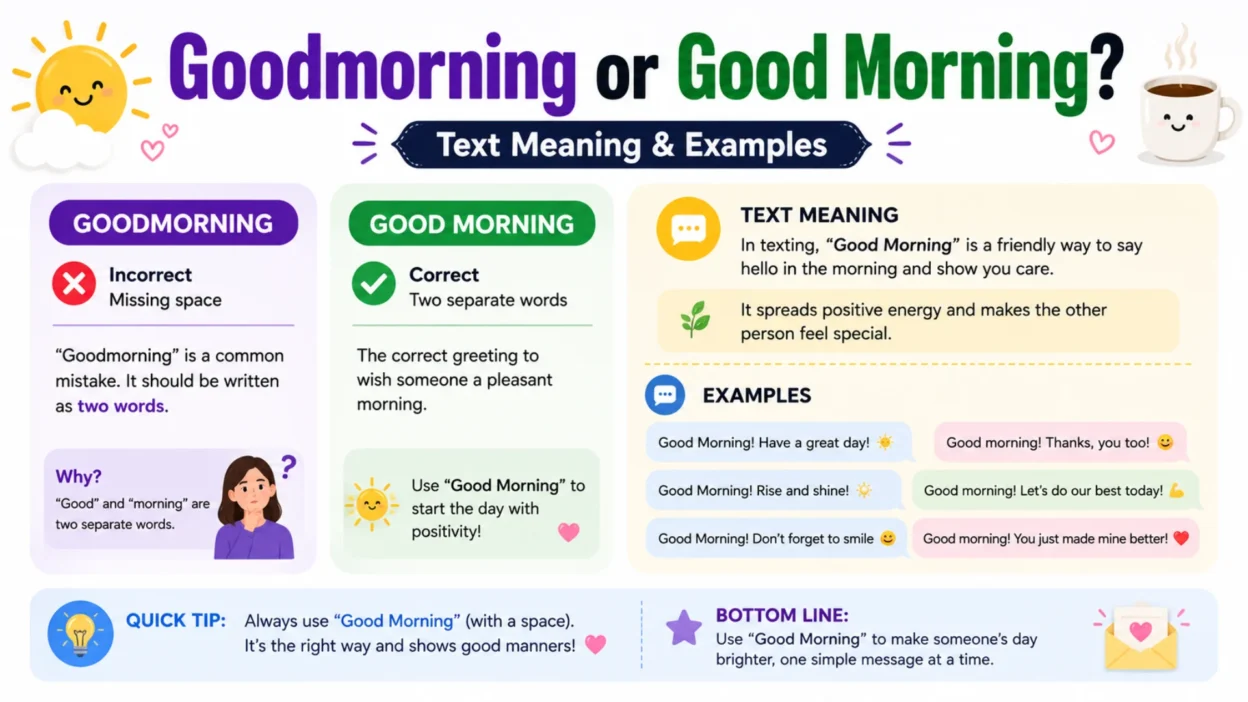
If you’re greeting someone before noon, the correct spelling is good morning. This is the form recognized by every major English dictionary, including Oxford, Cambridge, and Merriam-Webster. The phrase consists of an adjective (“good”) describing a noun (“morning”), and English grammar requires a space between them.
“Goodmorning” as a single word is not accepted in standard English. It’s a common typo that appears in fast text messages, social media captions, and informal chats. You might also see it in brand names, usernames, or hashtags where creative spelling is intentional. Outside those contexts, though, it’s simply a mistake.
| Feature | Good Morning | Goodmorning |
|---|---|---|
| Correctness | ✅ Standard English | ❌ Spelling error |
| Word Type | Two-word phrase | Combined word |
| Dictionary Entry | Yes | No |
| Used In | Emails, texts, speeches | Typos, informal messages |
| Professional Use | ✅ Recommended | ❌ Avoid |
Why People Write “Goodmorning” as One Word
The mistake usually happens for three reasons. First, people type quickly and skip the space bar without noticing. Second, some writers assume it works like “goodbye,” which evolved into a single word over centuries. Third, they see “goodmorning” online and copy it, assuming it’s correct.
However, “good morning” hasn’t merged into one word in modern English. Similarly, “good afternoon” and “good evening” remain two-word phrases. The only exception is “goodnight,” which is sometimes accepted as one word when used as a farewell exclamation. That inconsistency confuses many writers, but the rule for “good morning” stays consistent.
Capitalization Rules: When to Use Capital Letters
Capitalization depends on how you’re using the phrase. If “good morning” starts a sentence, you capitalize the “G.” If it appears in the middle of a sentence as a noun phrase, you usually keep it lowercase. For example: “She greeted me with a cheerful good morning.” In this case, no capitals are needed beyond the first word of the sentence.
Email greetings follow a different pattern. When “good morning” serves as a salutation at the beginning of an email or letter, many style guides recommend capitalizing both words: “Good Morning,”. However, sentence case—”Good morning,”—is also widely accepted and often preferred in modern business writing. Either form works, but consistency matters within a single document.
Good Morning in Text Messages
In texting, capitalization rarely follows strict rules. Most people type “good morning” in all lowercase or with just the first letter capitalized. The casual nature of text messages means you don’t need to worry about formal style. What matters is the spacing. “Goodmorning” still looks like a typo, even in a text.
Good Morning in Social Media Captions
Social media captions often use creative capitalization for emphasis. You might see “GOOD MORNING” in all caps or “Good Morning” with both words capitalized. These choices are stylistic rather than grammatical. The key rule remains the same: keep the space between the two words.
Punctuation: Do You Need a Comma After “Good Morning”?
Punctuation depends on context. When “good morning” is followed by a name, a comma usually separates the greeting from the person’s name. For instance: “Good morning, Sarah.” The comma makes the sentence easier to read and clarifies that you’re addressing Sarah directly. Without the comma, “Good morning Sarah” could momentarily confuse the reader.
If you’re using “good morning” as a standalone exclamation, a comma isn’t necessary. You might write: “Good morning! How did you sleep?” The exclamation point handles the separation. Similarly, in casual texts, punctuation is often minimal. Most people type “good morning” without any comma and rely on context to convey meaning.
Good Morning vs. Good Afternoon vs. Good Evening
The “good + time of day” pattern extends beyond mornings. “Good afternoon” is typically used from noon until around 5 or 6 PM. “Good evening” follows after that. Each phrase follows the same two-word rule. None of them should be written as a single word in standard English.
| Greeting | Time of Day | Correct Spelling |
|---|---|---|
| Good morning | Sunrise to noon | Two words |
| Good afternoon | Noon to around 5 PM | Two words |
| Good evening | After 5 PM | Two words |
| Good night | Farewell at night | Sometimes one word |
Interestingly, “good night” is the outlier. It’s commonly written as “goodnight” when used as a farewell. This exception causes confusion, but it doesn’t change the rules for the other greetings.
Real-Life Examples: How People Actually Use It
Seeing the phrase in context makes the correct spelling easier to remember. Here are realistic examples from different communication settings.
Texting a Friend
- “Good morning! Did you see that game last night?”
- “Good morning, sleepyhead. Coffee’s ready.”
- “Good morning ☀️ Hope today’s better than yesterday.”
Workplace Chat
- “Good morning, team. Quick update on the project.”
- “Good morning! I’ll send the report by noon.”
- “Good morning, everyone. Meeting moved to 10 AM.”
Social Media Post
- “Good morning from this cozy corner of the world.”
- “Good morning! Today’s goal: finish the draft.”
- “Good morning, sunshine. You’ve got this.”
Notice that in every example, the space between “good” and “morning” is preserved. Even in the most casual messages, the correct spelling stays consistent.
When “Goodmorning” Might Be Acceptable
There are rare situations where “goodmorning” as one word appears legitimately. Brand names, usernames, website domains, and hashtags often combine words for stylistic or technical reasons. A cafe might call itself “Goodmorning Cafe,” or a social media user might choose “@goodmorning” as a handle.
In these cases, the single-word form is a creative choice rather than a grammatical one. It doesn’t change the standard spelling of the greeting itself. If you’re writing a caption, sending a text, or composing an email, stick with “good morning.”
Alternatives to “Good Morning” for Different Situations
Sometimes you want to vary your greeting. English offers plenty of alternatives, ranging from formal to playful. Choosing the right one depends on your audience and the context.
Casual Alternatives
- “Morning!”
- “Mornin'”
- “Rise and shine”
- “Top of the morning to you”
Warm and Friendly Alternatives
- “Hope you have a great morning”
- “Wishing you a wonderful morning”
- “Happy morning to you”
Formal Alternatives
- “Good day”
- “Greetings”
- “I hope this morning finds you well”
Each alternative carries a slightly different tone. “Morning!” is quick and casual. “Top of the morning to you” sounds playful or old-fashioned. “I hope this morning finds you well” works in formal emails. Match the greeting to the relationship and the setting.
Common Mistakes to Avoid
Beyond the “goodmorning” spelling error, there are a few other mistakes worth noting. Using “good morning” when it’s actually afternoon or evening can feel awkward or inattentive. Similarly, overusing the greeting in rapid succession within a single conversation can sound repetitive.
Another mistake involves capitalization in professional emails. Some writers capitalize every word, while others use sentence case. Neither is wrong, but mixing styles within one email thread looks careless. Pick a style and stay consistent. Finally, avoid adding unnecessary punctuation. “Good morning,,” or “Good morning..” looks sloppy in any context.
Generational and Regional Differences
Younger generations often shorten “good morning” to “gm” in texting and social media. This abbreviation is efficient but informal. Older generations typically spell out the full phrase, even in casual messages. Neither approach is wrong, but “gm” might confuse someone who isn’t familiar with texting abbreviations.
Regional differences are minimal. In the UK, Australia, and Canada, “good morning” follows the same two-word rule. Some Caribbean and South Asian communities use “good morning” in the same way. Pronunciation varies, but spelling remains consistent across English-speaking regions.
Good Morning in Pop Culture and Media
The phrase appears in films, songs, and television shows. A cheerful “Good morning, Vietnam!” became a famous radio catchphrase in the 1987 film of the same name. In music, “Good Morning” is a song title used by various artists across genres. These cultural references reinforce the standard spelling and make the phrase instantly recognizable.
When you use “good morning” correctly, you’re participating in a long tradition of English greeting culture. The phrase has been part of the language for centuries, and its two-word form has remained stable throughout that time.
How to Remember the Correct Spelling
A simple memory trick can help. Think of other adjective-noun pairs: “blue sky,” “warm weather,” “fresh coffee.” You wouldn’t write “bluesky” or “warmweather.” The same logic applies to “good morning.” The adjective “good” describes the noun “morning,” so they stay separate.
Another trick is to associate “good morning” with “good afternoon” and “good evening.” All three follow the same pattern. If you can remember one, you can remember all of them. Finally, rely on spell-check tools. Most grammar checkers will flag “goodmorning” as an error and suggest the correct form.
FAQ About Goodmorning or Good Morning
Is “goodmorning” a real word?
No. “Goodmorning” is not recognized as a standard English word. It’s a common typo. The correct form is always “good morning” as two separate words.
Why do people spell it as one word?
People combine the words because they type quickly, assume it works like “goodbye,” or copy the mistake from others online. The single-word form has never been accepted in standard English.
Should I capitalize “Good Morning” in an email?
Both words are often capitalized when “Good Morning” serves as a salutation at the start of an email. However, sentence case—”Good morning”—is also widely accepted. Choose one style and stay consistent.
Do I need a comma after “good morning”?
Yes, when you address someone by name: “Good morning, Sarah.” The comma separates the greeting from the person’s name. If you’re using it as a standalone exclamation, no comma is needed.
Is “goodnight” one word or two?
“Goodnight” is sometimes accepted as one word when used as a farewell exclamation. However, “good night” as two words is also correct. This exception doesn’t apply to “good morning.”
Can I use “gm” instead of “good morning”?
Yes, “gm” is a common abbreviation in casual texting and social media. It’s efficient but informal. Avoid using it in professional emails or formal messages.
What’s the difference between “good morning” and “good day”?
“Good morning” is used before noon. “Good day” is more general and can be used at any time, though it sounds more formal. Both are polite greetings.
Final Thoughts on Goodmorning or Good Morning
The goodmorning or good morning debate ends with a clear answer. “Good morning” is always two words in standard English. “Goodmorning” is a typo, even if it appears frequently in casual messages and social media. By keeping the space between the words, you’ll write with confidence and clarity.
Whether you’re texting a friend, greeting a colleague, or composing a formal email, the rule stays the same. Use “good morning” as two words, capitalize appropriately based on context, and add a comma before names. That simple approach will keep your greetings polished and professional.

Serhii Dunev is a passionate content creator dedicated to crafting meaningful texts, messages, and word inspirations. He aims to help people express their emotions clearly through simple and impactful words.