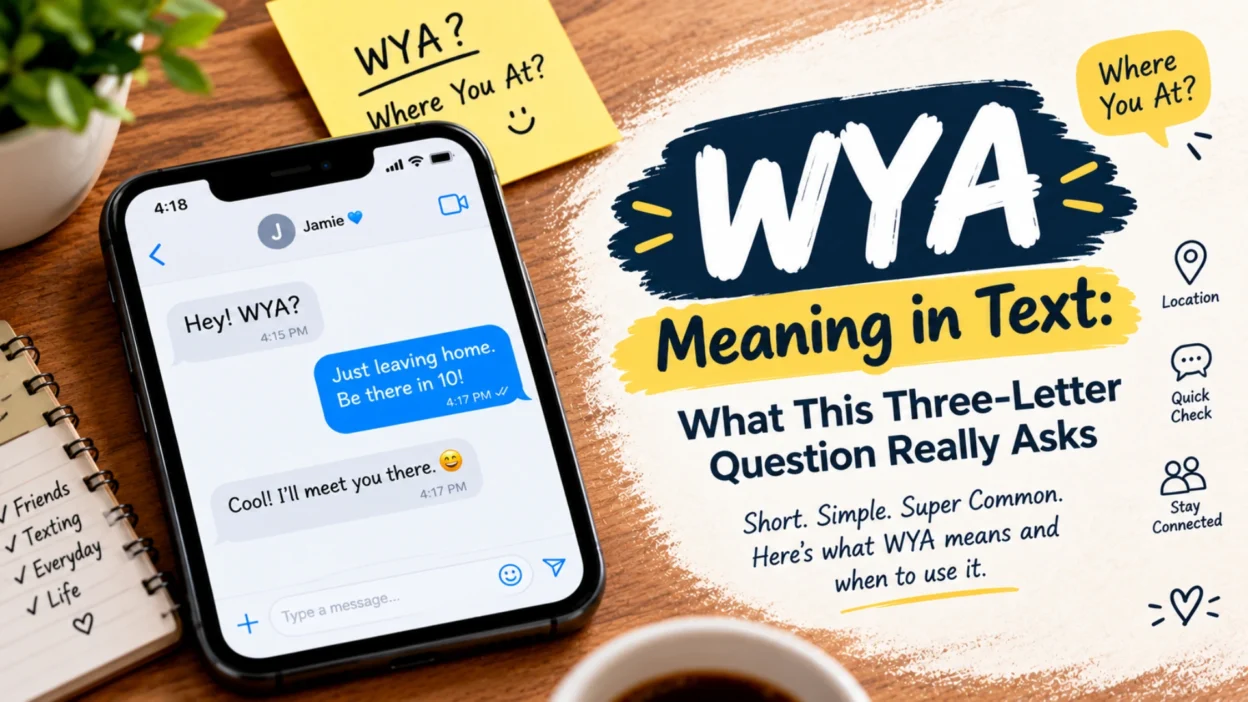
You’re waiting outside a café, phone in hand, when a message pops up: wya. Three letters. No punctuation. No explanation. If you’ve ever stared at that tiny text and wondered whether someone is asking for your location, checking if you’re ignoring them, or just being playful, you’re in good company. The wya meaning in text is simpler than it looks, yet the way people use it carries more nuance than most abbreviations.
At its core, wya stands for “where you at?”—a casual, compressed version of “where are you?”. That’s the definition most slang guides agree on. However, the real answer depends on who sent it, which platform it arrived on, and how the rest of the conversation feels. A wya from a friend running late means something different from a wya from someone who’s been left on read. Understanding those differences is what separates a smooth reply from an awkward guess.
The Core Definition: Where You At, Shortened
WYA is an initialism—each letter stands for a word. The W comes from “where,” the Y from “you,” and the A from “at.” Together, they form a phrase people already used in spoken conversation long before smartphones existed. “Where you at?” was common in casual American speech, especially in urban and hip-hop-influenced language, long before it became a texting staple.
When SMS texting exploded in the mid-2000s, character limits made brevity valuable. Old phone plans capped messages at 160 characters, and every keystroke counted. Short forms like wya were born from necessity as much as from style. The phrase survived because it does one job extremely well: it asks for a location in the fewest possible letters.
Beyond Location: The Three Other Jobs WYA Performs
Most guides stop at “where are you?” and move on. That’s a mistake. In real conversations, wya often does more than request a pin on a map. The same three letters can function as a nudge, an invitation, or even a flirty check-in, depending on the situation.
One common variation is the gentle nudge. If you’ve sent several messages and received silence, a follow-up wya can mean “you’ve gone quiet—are you still there?”. It’s less about physical location and more about re-engagement. Another variation is the invitation. When a group is already gathered and someone sends wya, the underlying message is often “we’re waiting for you—come join”. The location question is real, but the social invitation matters more.
A third variation appears in flirty or teasing exchanges. A wya paired with a laughing emoji or stretched letters can read as playful rather than logistical. The question still asks where you are, but the tone signals that the sender is thinking about you rather than simply coordinating a meetup.
How Punctuation and Formatting Change the Tone
WYA is short enough that tiny formatting choices carry disproportionate weight. A plain lowercase “wya” with no punctuation usually reads as neutral—neither warm nor cold, just efficient. Add a question mark and the message becomes more explicitly inquisitive. Add two question marks and the tone shifts toward urgency or mild annoyance, as if the sender is waiting and wants you to know it.
Stretched letters work in the opposite direction. “wyaaa” feels relaxed and playful, often used between friends who aren’t in a hurry. Capitalizing the whole thing—”WYA”—can feel louder or more demanding, though capitalization habits vary widely between individuals. Emojis add another layer entirely. A wya followed by a crying-laughing emoji softens the question; the same letters followed by a clock emoji sharpen it into a timing check.
The lesson is straightforward: read the formatting before deciding what the sender wants. The letters provide the question, but the punctuation provides the emotional temperature.
WYA on Snapchat: When Location Becomes Social Pressure
Snapchat changes the emotional weight of wya more than any other platform. The app is built around real-time presence—Snap Maps, streaks, and disappearing messages all signal whether someone is active right now. In that environment, a wya can feel more immediate than a standard text. It’s not just “where are you?” It can also mean “I can see you’re online—why haven’t you opened my Snap?” or “are you ignoring me?”.
This doesn’t mean every Snapchat wya is accusatory. Plenty of people use it casually to coordinate plans or check whether a friend is nearby. However, the platform’s design amplifies the sense of urgency. A wya on Snapchat often arrives with an implicit clock attached, even when the sender didn’t intend to create pressure.
WYA in Regular Texting and Group Chats
Standard SMS and iMessage threads tend to host the most literal version of wya. When someone texts wya on a normal messaging thread, they usually want a physical location, often because a meetup is in progress or running behind schedule. The question is logistical, and the expected answer is practical: “five minutes away,” “at the station,” “still at home.”
Group chats introduce a different dynamic. A wya dropped into a group thread can function as a roll call, checking who’s available or who’s already on the way. It can also be a conversation starter when the chat has gone quiet. In that context, the sender isn’t necessarily asking for coordinates; they’re asking whether anyone is still present and engaged.
The Grammar Question Nobody Asked For
“Where you at?” is grammatically incomplete in standard English. The full form would be “where are you at?”, and even that phrasing draws criticism from some language purists who argue that “where are you?” is sufficient. The extra “at” has been debated for decades, and style guides generally discourage it in formal writing.
However, texting doesn’t follow formal writing rules. WYA exists in a register where efficiency and tone matter more than grammatical completeness. The phrase is understood instantly by anyone who uses it, which is the real test of communication. Using wya in a work email would be out of place; using it in a group chat among friends is entirely normal. The grammar debate is interesting, but it doesn’t change how the abbreviation works in practice.
When WYA Doesn’t Belong: Professional and Formal Settings
One of the most common mistakes people make is dropping wya into professional communication. In a work email, a client message, or a note to a manager, the abbreviation usually feels out of place. A colleague asking about a meeting location deserves “Where are you?” rather than “wya”.
This isn’t because the abbreviation is rude by nature. It’s about register. Text slang signals informality, and professional settings typically expect fuller language. Using wya in a job interview follow-up or a message to a new client can make the sender seem careless, even if the intent was friendly and efficient.
A practical rule: keep wya for friends, peers, and casual chats. In anything that could be forwarded to a manager or saved in a record, write the question in full.
Common Mistakes People Make With WYA
The first mistake is assuming wya always means the same thing. It doesn’t. Location, nudge, invitation, and playful check-in are all valid readings, and ignoring the context leads to misunderstandings.
The second mistake is using wya with people who may not recognize it. Parents, older relatives, or new acquaintances might read it as a typo or an unfamiliar acronym. A quick expansion—”wya (where are you?)”—can prevent confusion without much effort.
The third mistake is misreading the tone. If a message says “wya??” after several unanswered texts, the sender is probably not being casual. The doubled question mark signals impatience, and a slow reply may escalate the situation. Reading the punctuation is as important as reading the letters.
Finally, some people reply to wya with a simple “here” and nothing else. That answers the literal question, but it often misses the social cue. If the wya was an invitation, a fuller reply like “on my way, five minutes” works better than a single word.
How to Reply to WYA Without Overthinking It
The right reply depends on what the sender is actually asking. If the question is logistical, give a location and a time estimate: “ten minutes away” or “just left the office.” That answers the question and reassures the sender that you’re moving.
If the wya feels like a nudge, acknowledge the silence. A short “sorry, was offline—what’s up?” repairs the gap without over-explaining. When the message carries an invitation, respond to the social meaning: “be there soon” or “save me a seat” shows you understood the real request.
For playful or flirty wyas, matching the energy usually works. A light “why, miss me?” or a well-placed emoji keeps the exchange fun without turning it serious. There’s no universal script, but the principle is consistent: answer the question the sender meant, not just the one they typed.
WYA and Similar Text Abbreviations Compared
| Abbreviation | Common Meaning | Typical Tone |
|---|---|---|
| WYA | Where you at? | Casual, inquisitive, sometimes impatient |
| WYD | What you doing? | Casual, curious, friendly |
| HMU | Hit me up | Informal, inviting contact |
| IDK | I don’t know | Neutral, uncertain |
| OMW | On my way | Reassuring, practical |
| BRB | Be right back | Casual, temporary pause |
| IRL | In real life | Clarifying, informal |
WYA belongs to the same family of shorthand as WYD and HMU, but it stands apart because it asks for a concrete piece of information. WYD invites conversation; wya asks for a location. That specificity is why it remains useful even in an era of location sharing and live maps.
Generational and Regional Nuances
Younger texters tend to use wya without thinking about its origins. It’s simply part of the vocabulary. Older users may recognize “where you at?” from spoken language but still find the abbreviation unfamiliar or overly casual. That gap isn’t a hard rule, but it explains why wya sometimes needs a quick explanation in mixed-age conversations.
Regional usage varies as well. English-speaking internet communities share the same core meaning, but the frequency of use and the comfort level with the impatient version differ from place to place. In some circles, wya is almost invisible because it’s so common; in others, it still reads as distinctly online slang.
These differences don’t change the definition. They simply remind readers that digital communication isn’t uniform. The same three letters can feel native to one person and foreign to another.
Frequently Asked Questions About WYA
What does WYA stand for in text?
WYA stands for “where you at?”, which is a casual way of asking “where are you?”. The abbreviation is common in texting, social media, and group chats.
Is WYA rude?
It can be, depending on tone and punctuation. A plain “wya” is usually neutral. A “wya??” after unanswered messages can feel impatient or demanding. Context and formatting matter more than the letters themselves.
What does WYA mean on Snapchat?
On Snapchat, wya usually means “where are you?”, but the app’s real-time features can make it feel more urgent. It may also imply “I can see you’re online—why haven’t you replied?”.
How should I reply to WYA?
Give a location and, if relevant, a time estimate. “Five minutes away” or “still at home, leaving soon” answers the question clearly. If the message feels like an invitation, respond to that social meaning instead.
Is WYA okay to use at work?
Generally, no. WYA is casual slang, and professional communication usually calls for “Where are you?” written in full. A quick message to a close teammate might be an exception, but client emails and formal reports are not the place for it.
Does WYA have any other meanings?
In most contexts, wya means “where you at?”. Occasionally, it appears in music lyrics or meme culture as a standalone phrase, but the core meaning stays the same. No widely used alternative definition competes with the location question.
Why do people use lowercase “wya” instead of uppercase “WYA”?
Lowercase is simply more common in casual texting. It blends into the sentence and matches the relaxed tone of quick messages. Uppercase appears too, but it doesn’t make the abbreviation more formal.
Is WYA still commonly used?
Yes. It remains a familiar abbreviation in texting and online chat, alongside similar shorthand like WYD and HMU. Its use is especially strong in casual, peer-to-peer communication.
Final Thoughts: Three Letters, One Clear Question
WYA is a small abbreviation with more range than it first appears to have. At its core, it shortens “where you at?” for faster digital conversation. Around that core, meanings branch: the logistical check-in, the gentle nudge, the group invitation, the playful tease.
The practical takeaway is straightforward. Use wya with friends and peers. Avoid it in professional writing. Pay attention to punctuation and platform before deciding what someone meant. And when in doubt, answer with a location and a time—then add a little warmth so the reply lands the way the sender hoped.

Serhii Dunev is a passionate content creator dedicated to crafting meaningful texts, messages, and word inspirations. He aims to help people express their emotions clearly through simple and impactful words.