
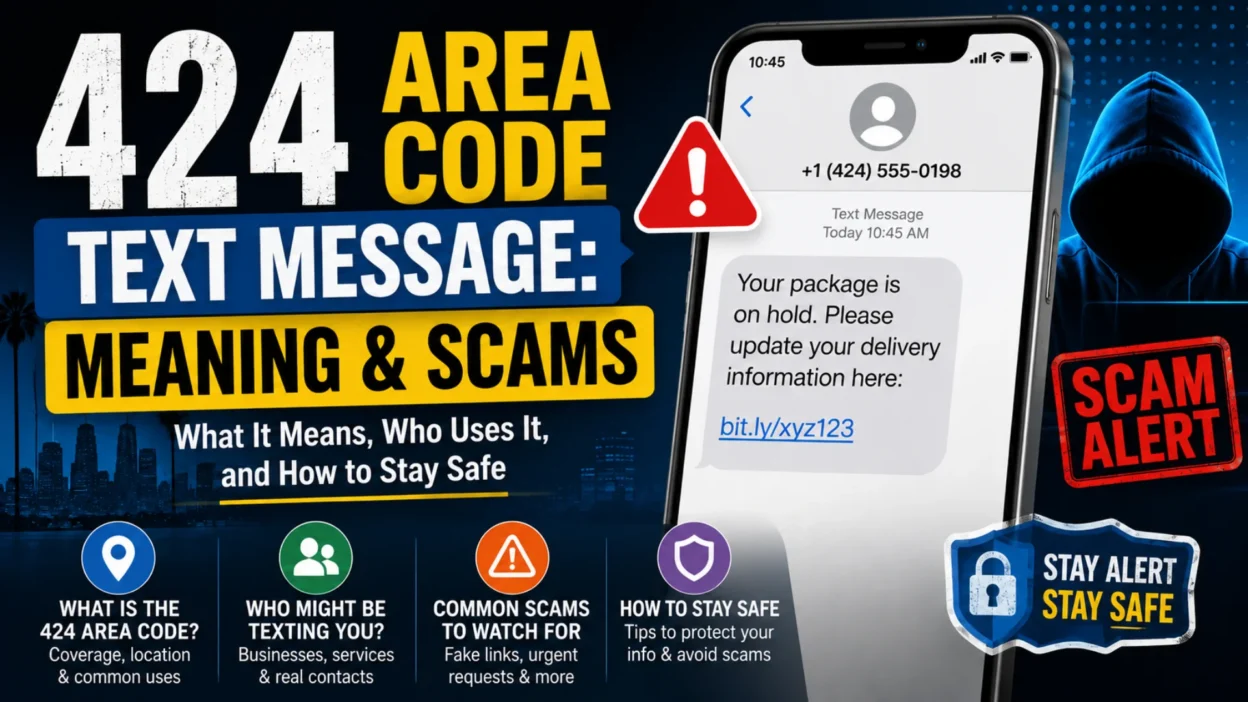
Receiving a 424 area code text message from an unknown number can make you curious about who is contacting you. You may wonder whether the number belongs to someone in California, whether the message is legitimate, or whether it could be spam. Area code 424 is a real U.S. area code associated with parts of Southern California, especially the Los Angeles area.
However, an area code alone doesn’t tell you whether a message is safe. A 424 number can belong to a real person, business, service, or unknown sender. Scammers can also use phone-number spoofing to make a message appear to come from a familiar-looking local number. Therefore, it’s better to examine the message itself before deciding whether to reply.
What Does a 424 Area Code Text Message Mean?
A 424 area code text message simply means the phone number displayed in the message uses the 424 area code.
The sender could be:
- A friend or family member
- A local business
- A delivery service
- A customer-support team
- An automated notification system
- A wrong-number texter
- A marketing company
- A spammer
- A scammer
So, seeing 424 on your screen doesn’t automatically mean something is wrong.
For example, someone who lives in Southern California may legitimately contact you using a 424 number. On the other hand, an unknown sender could use the same area code to make a suspicious message look local.
Where Is Area Code 424 Located?
Area code 424 is associated with Southern California, particularly the western and southwestern parts of Los Angeles County.
It is commonly associated with areas such as:
- Los Angeles
- Santa Monica
- Beverly Hills
- Torrance
- Inglewood
- Culver City
- El Segundo
- Hawthorne
- Manhattan Beach
- Redondo Beach
- Malibu
- Carson
- Compton
- Gardena
- West Hollywood
Area code 424 also operates alongside area code 310 in an overlay system. This means two different area codes can serve the same general region.
The area is in the Pacific Time Zone, which is another useful detail if you’re trying to understand when an unknown sender may be active.
Is a 424 Area Code Text Message a Scam?
Not necessarily.
The 424 area code is legitimate. Thousands of ordinary people and businesses can have numbers beginning with 424.
The problem is that scammers don’t need a special area code. They can use ordinary U.S. numbers or manipulate the number shown on your device.
A message becomes more suspicious when the sender:
- Requests money
- Sends an unexpected link
- Asks for private information
- Demands immediate action
- Claims your account is in danger
- Offers an unrealistic prize
- Promises guaranteed investment profits
- Pretends to be a government agency
- Tries to start a strange conversation
The area code should be treated as background information, not proof that a message is legitimate or fraudulent.
Why Am I Getting Texts From a 424 Number?
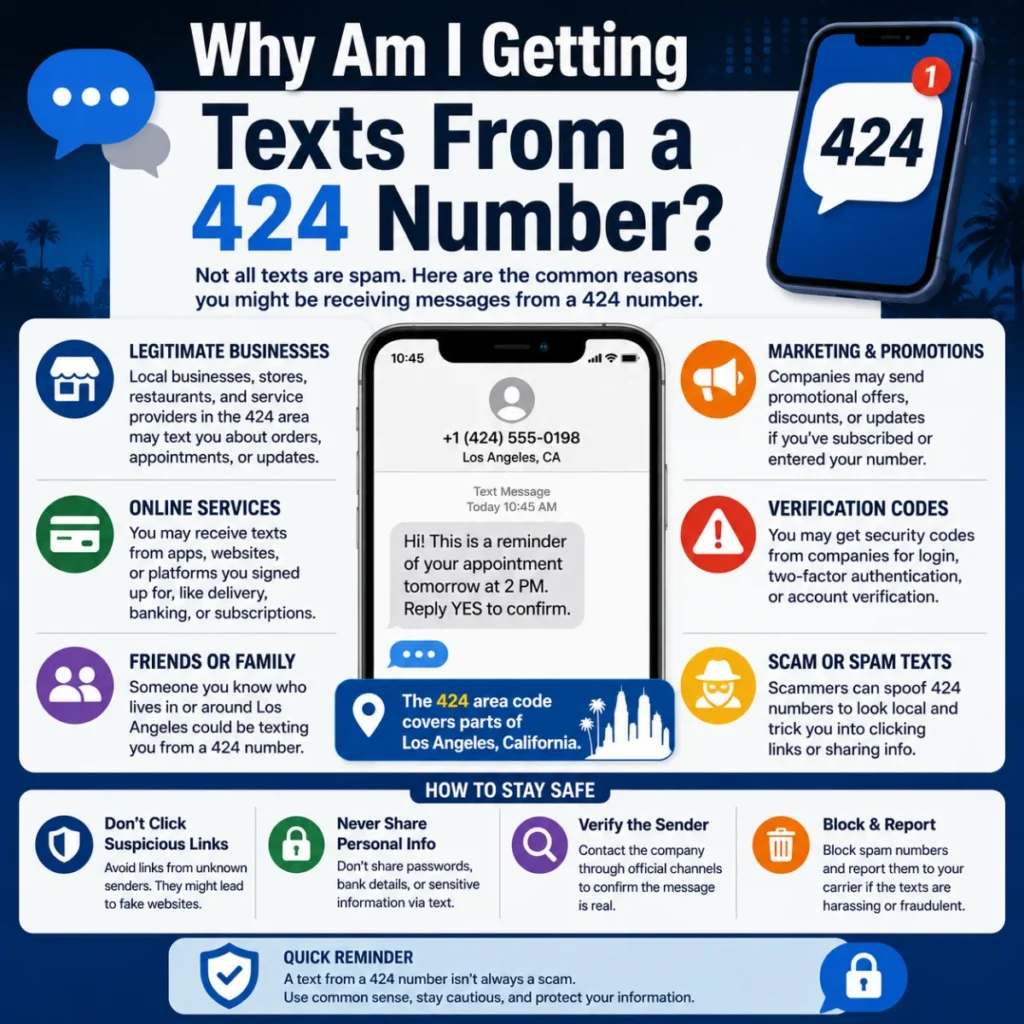
There are several possible reasons.
Someone You Know Has a 424 Number
The simplest explanation is that a friend, relative, coworker, or acquaintance is contacting you.
You may not immediately recognize the number, especially if the person recently changed phones or uses a separate number.
A Business Is Contacting You
Businesses in the Los Angeles region can use 424 numbers for customer communication.
You could receive a text about an appointment, delivery, reservation, order, or service.
It’s a Wrong-Number Text
Someone may have entered the wrong phone number by mistake.
A simple wrong-number message doesn’t necessarily indicate fraud.
However, you don’t need to continue chatting with a stranger just because they apologized for the mistake.
It’s Spam
Some unwanted texts are promotional or automated.
They may advertise products, services, jobs, loans, or other offers.
It’s a Scam
A scammer may use a 424 number to make the message appear local.
That’s especially common when the sender wants you to trust the message before asking for something.
Can a 424 Number Be Spoofed?
Yes.
Phone-number spoofing allows a sender to make a different number appear on the recipient’s device.
This creates an important limitation when identifying unknown texters.
A person could receive a message that appears to come from a 424 number even though the sender isn’t actually located in Southern California.
Therefore, don’t assume:
424 = Los Angeles = trustworthy.
The number may look local, but the sender’s identity still needs to be verified.
Common 424 Area Code Text Message Scams
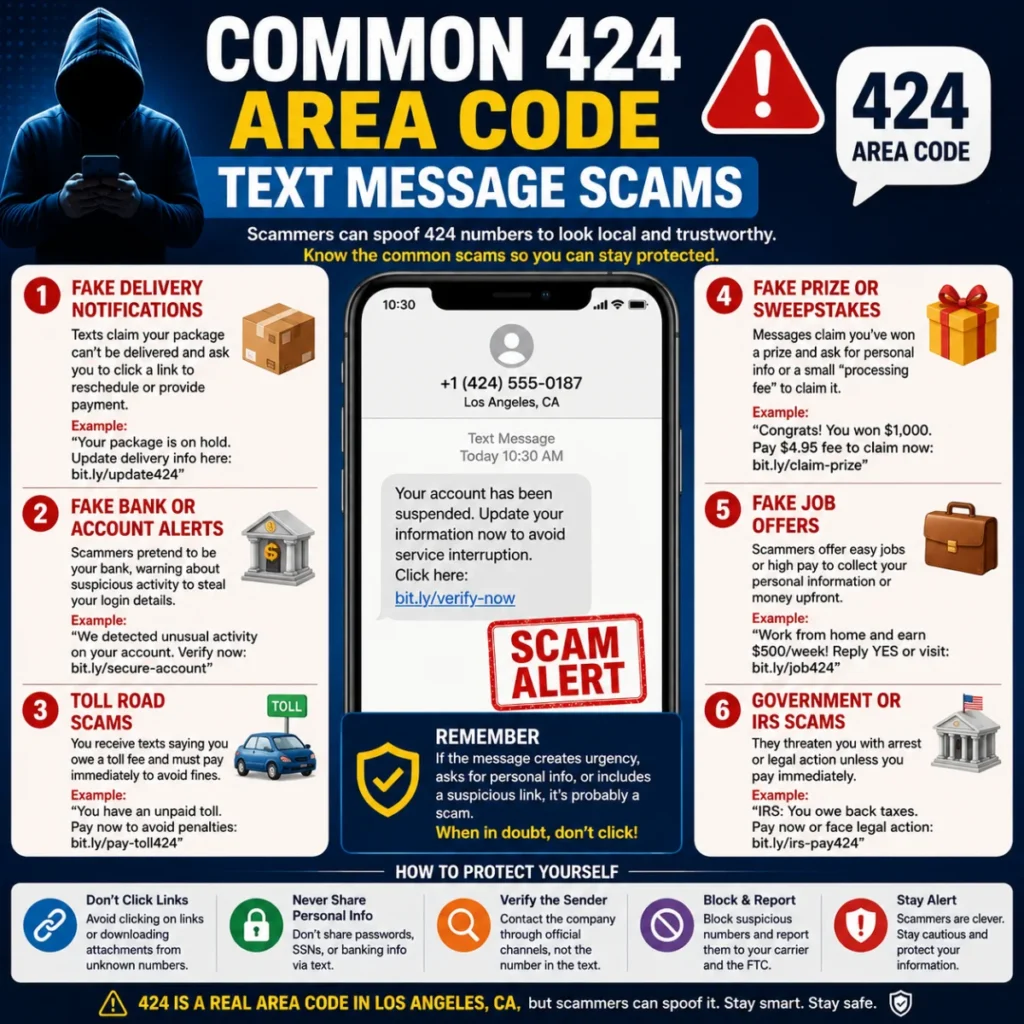
Scammers can use many different stories to get your attention.
Fake Delivery Messages
You may receive a text claiming that a package couldn’t be delivered.
The message could ask you to:
- Confirm your address
- Reschedule delivery
- Pay a small fee
- Update delivery information
- Click a tracking link
If you’re expecting a package, check your order through the retailer or delivery company’s official app instead of using the link in an unexpected text.
Fake Bank Alerts
Another common tactic involves fake banking notifications.
The message may claim that someone used your card or that your account has been locked.
It might then ask you to click a link and “verify” your account.
Don’t use the supplied link.
Instead, open your banking app yourself and check your account activity.
Wrong-Number Scams
A message may begin with something innocent:
“Hey, is this Mike?”
You might reply that they have the wrong number.
The sender may then continue talking and eventually introduce a business opportunity, investment, or personal request.
If a wrong-number conversation becomes unusually persistent, it’s safer to stop responding.
Fake Job Offers
Unexpected job offers through text should be handled carefully.
A sender might promise easy remote work and high earnings.
Later, they may request personal information, banking details, payment, or cryptocurrency.
A legitimate job opportunity should be independently verifiable.
Investment Scams
Some scams begin as casual conversations.
The sender may talk about cryptocurrency, trading, or another investment opportunity.
The promise of fast or guaranteed profits is a major warning sign.
Never send money simply because an unknown texter claims to have an easy way to make more.
Fake Government Messages
Scammers may pretend to represent a government agency.
The message may claim that you owe money or face legal consequences.
Don’t respond to threats through the text.
Verify the claim independently using a trusted government contact method.
How to Tell if a 424 Text Is Suspicious
You can identify many warning signs by reading the message carefully.
1. You Don’t Recognize the Sender
An unknown number isn’t automatically dangerous.
Still, you should be more careful when there’s no obvious reason for the person to contact you.
2. The Message Creates Urgency
Scammers often want you to act before you have time to think.
Watch for phrases such as:
- Act immediately
- Final notice
- Your account will close
- Payment required today
- Respond within one hour
- Verify now
Urgency doesn’t prove fraud, but it should make you slow down.
3. The Message Contains an Unexpected Link
Don’t click random links simply because a message mentions a company you recognize.
A fake website can look almost identical to a legitimate one.
Instead, visit the company’s official website or app separately.
4. It Requests Personal Information
Be careful if a stranger asks for:
- Passwords
- Bank details
- Credit card numbers
- Social Security information
- Verification codes
- Account recovery codes
- Identification documents
Unexpected requests for sensitive information deserve serious caution.
5. It Requests Money
An unknown sender asking for payment is another major warning sign.
Be especially cautious with requests involving gift cards, cryptocurrency, wire transfers, or other difficult-to-reverse payment methods.
What Should You Do After Receiving a Suspicious 424 Text?
Don’t rush to respond.
Instead, follow these steps:
1. Stop and read the message carefully.
Don’t let urgency control your decision.
2. Check whether you recognize the sender.
Think about whether you recently gave your number to someone or contacted the company mentioned.
3. Avoid unexpected links.
Don’t open a link until you’ve verified the message.
4. Don’t share sensitive information.
Keep passwords and verification codes private.
5. Don’t send money.
Verify financial requests independently.
6. Take a screenshot.
Keep evidence if you may need to report the message.
7. Block the number if necessary.
This can stop additional messages from that particular sender.
8. Report suspicious texts.
Use the spam-reporting tools available on your phone or through your mobile carrier.
Should You Reply to an Unknown 424 Number?
If you don’t recognize the number, it’s usually better not to reply immediately.
A response such as “Who is this?” may seem harmless. However, it can confirm that your number belongs to an active user.
That may encourage additional spam.
If the message appears legitimate and you can identify the sender, replying is different.
Context matters.
When the sender is completely unknown and the message is unnecessary, ignoring it is often the safer choice.
What If the 424 Text Only Says “Hi”?
A simple “Hi” isn’t automatically a scam.
However, an unexpected greeting from a stranger can be a conversation starter.
Some suspicious senders begin with a friendly message instead of immediately asking for money.
They may gradually build trust before introducing an investment opportunity, job offer, or other request.
If you don’t know the number, you don’t have to respond.
What If the Sender Says “Wrong Number”?
Wrong-number texts can be genuine.
People make mistakes when entering phone numbers.
Still, you don’t need to continue the conversation.
If someone says:
“Sorry, I thought this was Sarah’s number.”
You can simply leave the conversation alone.
Be more cautious if the person keeps messaging you after the supposed mistake.
A conversation that quickly turns toward money, investments, personal information, or moving to another app deserves extra caution.
Is a 424 Text From California?
The 424 area code is associated with California, particularly the Los Angeles region.
However, this doesn’t prove that the person currently lives in California.
Mobile users can keep their phone numbers after moving to another state.
Businesses can also use virtual phone systems.
Additionally, spoofing can make an unrelated sender appear to have a 424 number.
Therefore, the area code provides information about the number, not necessarily the sender’s current physical location.
Does 424 Mean Los Angeles?
Generally, yes. Area code 424 is strongly associated with the Los Angeles area and nearby communities in Southern California.
However, it doesn’t identify an exact neighborhood.
Multiple communities share the area code, and 424 overlaps with 310.
So, you shouldn’t use a 424 number to determine someone’s exact address or current location.
424 Area Code vs. 310 Area Code
Area codes 424 and 310 serve overlapping areas of Southern California.
| Feature | 424 Area Code | 310 Area Code |
|---|---|---|
| State | California | California |
| Main Region | Los Angeles area | Los Angeles area |
| Time Zone | Pacific | Pacific |
| Relationship | Overlay | Overlay partner |
| Common Cities | Santa Monica, Torrance, Inglewood, Beverly Hills | Many of the same areas |
Because these codes overlap, receiving a 424 number doesn’t necessarily tell you more about someone’s location than a 310 number would.
Is a 424 Number Safe to Call Back?
If you don’t recognize the number, there’s usually no reason to call back immediately.
A legitimate caller may leave a voicemail or provide enough information to explain why they contacted you.
If the text claims to be from a bank, delivery company, government agency, or other important organization, use a trusted contact method instead.
Don’t assume the phone number inside an unexpected message is the correct number to call.
What If a 424 Text Claims to Be From Your Bank?
Don’t click the message’s link.
Instead:
- Open your banking app.
- Check your recent transactions.
- Look for security notifications.
- Contact your bank using the number on your card if necessary.
- Follow the bank’s normal security process.
This method helps you avoid fake banking websites.
The same approach works for credit cards, payment services, shopping accounts, and other important services.
What If a 424 Text Claims You Have a Package?
If you’re waiting for a delivery, a fake package message can look convincing.
Don’t assume the message is genuine just because you actually ordered something.
Check the order directly through the retailer’s app or website.
Look at the tracking information there.
If the message asks you to pay a small fee or provide personal information, verify the request before doing anything.
What If You Already Replied to a 424 Text?
Don’t panic.
If you only replied with something harmless, stop the conversation if it becomes suspicious.
Don’t provide additional information.
If you shared a password, change it through the legitimate service.
If you shared banking information, contact your financial institution.
If you gave someone a verification code, secure the affected account immediately.
The right response depends on what information you shared.
What If You Clicked a Link in the Text?
Your next steps depend on what happened.
If you opened the link but didn’t enter anything, close the page and don’t interact with it further.
If you entered a password, change that password through the legitimate website or app.
If you entered financial information, contact your bank or card provider.
If you downloaded an unfamiliar file or application, review your device and remove anything you don’t recognize.
Most importantly, don’t assume that clicking a suspicious link automatically means everything is lost. Take sensible security steps based on what happened.
How to Block a 424 Text on iPhone
On an iPhone, open the unwanted conversation and access the sender’s information.
Use the available option to block the sender.
You may also see an option to report a message as spam.
Blocking prevents future messages from that specific number, although scammers can switch to new numbers.
How to Block a 424 Text on Android
Android phones generally allow users to block and report unwanted senders.
Open the conversation and access the message options.
Choose the available blocking or reporting feature.
The exact steps can vary depending on your phone manufacturer and messaging application.
If you regularly receive suspicious texts, consider enabling the spam-filtering features available on your device.
Should You Report a Suspicious 424 Text?
Yes, especially if the message appears fraudulent or keeps targeting you.
Before deleting the message, save a screenshot if you may need evidence.
Keep details such as:
- Sender number
- Message content
- Date and time
- Suspicious links
- Payment requests
- Information you shared
You can then use your carrier’s available spam-reporting options.
If you’ve experienced financial fraud or identity theft, take additional steps appropriate to the situation.
Common Mistakes to Avoid With 424 Text Messages
Trusting the Area Code
A California area code doesn’t guarantee that the sender is genuine.
Clicking a Link Out of Curiosity
You don’t need to open a suspicious link to find out where it goes.
Sharing a Verification Code
Security codes should remain private.
Sending a Small Payment
A small amount can still be part of a scam.
Continuing a Wrong-Number Conversation
If you don’t know the person, you don’t need to keep chatting.
Assuming a Company Name Proves Authenticity
Scammers can impersonate recognizable businesses.
Verify the company independently before taking action.
424 Area Code Text Message Safety Checklist
When you receive an unexpected 424 text, ask yourself:
- Do I recognize the sender?
- Was I expecting this message?
- Does the message contain a link?
- Is money being requested?
- Is personal information being requested?
- Does the message create urgency?
- Can I verify the claim independently?
- Does the sender want me to move the conversation elsewhere?
If several answers make you uncomfortable, don’t respond.
Block and report the message instead.
When a 424 Text May Be Legitimate
Not every unknown 424 text is dangerous.
It may be legitimate when:
- You recently contacted a local business.
- You’re expecting a delivery.
- You made an appointment.
- A friend recently gave you their number.
- You recognize the organization.
- The information matches something you already know.
- You can verify the message independently.
Even then, be careful with unusual requests.
When a 424 Text Deserves Extra Caution
Take a closer look when the sender:
- Demands immediate payment
- Requests a verification code
- Sends a suspicious link
- Claims you’ve won something
- Offers guaranteed investment profits
- Threatens legal consequences
- Requests your password
- Pretends to be a government agency
- Asks you to install an application
- Wants you to keep the conversation secret
These behaviors matter much more than the area code itself.
Final Thoughts on 424 Area Code Text Messages
A 424 area code text message isn’t automatically a scam. Area code 424 is a legitimate California area code associated with the Los Angeles region and surrounding Southern California communities.
The important thing is to avoid judging a message solely by its number.
A genuine person or business may contact you from a 424 number. At the same time, scammers can use local-looking numbers to make suspicious messages appear trustworthy.
If you don’t recognize the sender, take your time. Don’t click unexpected links, don’t share sensitive information, and don’t send money because a text tells you to do so.
When something feels unusual, verify it independently.
Pause first, verify second, and respond only when you’re comfortable.
FAQs About 424 Area Code Text Messages
Is 424 a real area code?
Yes. 424 is a legitimate U.S. area code associated with Southern California, particularly the Los Angeles region.
Where is area code 424 located?
Area code 424 mainly serves communities in and around western and southwestern Los Angeles County, including places such as Santa Monica, Beverly Hills, Torrance, Inglewood, and Malibu.
Is a 424 area code text message a scam?
Not necessarily. A 424 number can belong to a real person or business. However, scammers can also use 424 numbers, so the content of the message matters.
Why am I getting random texts from 424 numbers?
You could be receiving a wrong-number text, business notification, spam, or scam. If you don’t recognize the sender, avoid responding until you can verify the reason for the message.
Can a 424 number be spoofed?
Yes. Phone-number spoofing can make an incoming message appear to come from a different number than the one actually used by the sender.
Should I reply to a random 424 text?
If you don’t recognize the sender, it’s usually safer not to reply. A response can confirm that your number is active.
What should I do if a 424 text contains a link?
Don’t click it immediately. Verify the sender and the claim first. If the message supposedly comes from a company, access that company’s service independently.
Is it safe to call a 424 number back?
If you don’t recognize the number, there’s generally no need to call it back immediately. Verify the reason for the contact before making a call.
Does 424 mean the person is currently in California?
No. The number is associated with California, but mobile users can keep their numbers after moving. Spoofing can also make the displayed number misleading.
Should I block a suspicious 424 number?
Yes. If the message is unwanted or suspicious, blocking the sender is a reasonable step. Reporting the message as spam can also help.
What if I gave personal information to a 424 sender?
Secure the affected account immediately. Change compromised passwords, contact your financial institution if financial information was exposed, and monitor for unusual activity.
Conclusion
Receiving a 424 area code text message doesn’t automatically mean you’ve encountered a scam. The area code is legitimate and is used by people, businesses, and services across Southern California.
Still, an unfamiliar message should be handled carefully. Scammers can make their messages appear local, use fake stories, and create urgency to encourage quick decisions.
The safest approach is simple: don’t trust the area code alone.
Check the sender, understand the request, verify important claims independently, and avoid sharing sensitive information. If the message seems suspicious, you can ignore, block, and report it.

Serhii Dunev is a passionate content creator dedicated to crafting meaningful texts, messages, and word inspirations. He aims to help people express their emotions clearly through simple and impactful words.