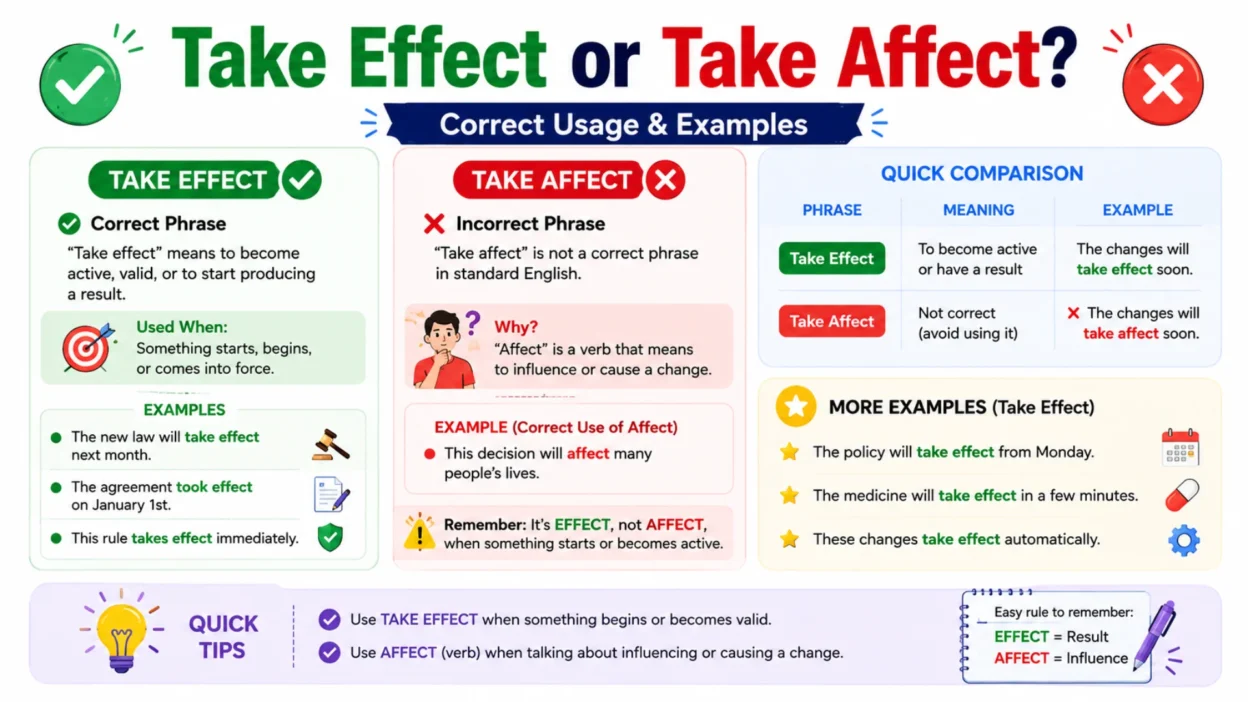
You’re drafting an email about a new company policy, and you pause at the keyboard. Should you write “take effect or take affect”? This tiny spelling choice trips up millions of writers every year, and the stakes feel higher when the sentence matters. The good news is that the rule is simpler than most people think. One version is correct in almost every situation, while the other usually signals a grammar mistake. This guide explains exactly when to use each phrase, why the confusion exists, and how to remember the difference for good.
By the end, you’ll know how to write about laws, policies, medications, and deadlines with confidence. You’ll also understand the rare situations where “affect” genuinely belongs.
The Short Answer: Take Effect Is the Standard Phrase
When you mean “to become active,” “to start working,” or “to come into force,” the correct phrase is take effect. This is the form you’ll find in legal documents, medical instructions, business memos, and everyday writing. For example, a new tax law takes effect on January 1. A painkiller takes effect within thirty minutes. A schedule change takes effect next Monday.
“Take affect” is not a recognized phrase in standard English. It appears constantly in drafts, text messages, and even published articles, but it doesn’t carry the meaning most writers intend. Typically, it’s a simple mix-up between two similar-sounding words. Consequently, readers notice it immediately, and it can undermine your credibility.
| Phrase | Status | Typical Meaning |
|---|---|---|
| Take effect | ✅ Standard | To become active or operative |
| Take affect | ❌ Not standard | Usually a mistake |
| Affect (verb) | ✅ Standard | To influence something |
| Effect (noun) | ✅ Standard | A result or outcome |
Why the Two Phrases Get Confused
English has a small group of word pairs that sound alike but behave differently. “Affect” and “effect” sit at the top of that list. Their pronunciations are nearly identical in fast speech, and their spellings differ by just one letter. As a result, writers often choose based on sound rather than grammar.
Another factor is autocorrect. Phone keyboards sometimes swap the words without warning. Meanwhile, people read so much informal writing online that the wrong version starts to feel normal. Interestingly, the confusion isn’t a sign of carelessness. It’s a genuine quirk of a language with messy spelling rules.
The phrase “take effect” makes things harder because it uses the noun form. Many people learn a simple rule—”affect is a verb, effect is a noun”—and then apply it too broadly. Since “take” is already the verb in the sentence, the word that follows should be a noun. Therefore, “effect” is the right choice.
Affect vs Effect: The Grammar Behind the Rule
Understanding the parts of speech clears up most of the confusion. “Affect” usually works as a verb, meaning to influence or change something. Weather affects crop yields. Stress affects sleep quality. A late flight affects your entire schedule.
“Effect” usually works as a noun, meaning a result, consequence, or outcome. The effect of the storm was severe. Caffeine has a strong effect on some people. The new rule had an immediate effect.
Now look at the phrase in question. “Take” is the verb, so the next word needs to be a noun. That leaves “effect” as the natural fit. Specifically, “take effect” means to produce a result or begin operating. It’s an idiom, which means the words work together as a fixed unit rather than as separate pieces.
One Exceptions Worth Knowing
Grammar rules rarely stay perfectly clean, and this pair is no exception. “Effect” can occasionally work as a verb meaning to bring something about. A new manager might effect changes in a department. This usage sounds formal and appears mostly in business or academic writing.
Similarly, “affect” can work as a noun in psychology. It refers to a person’s outward emotional expression. A clinician might describe a patient’s flat affect. That’s a specialized term, though, and it rarely appears in everyday conversation.
Take Effect in Real Sentences
Seeing the phrase in different contexts makes the pattern easier to absorb. Here are examples from common situations.
Laws, Rules, and Policies
- The updated privacy policy takes effect on March 1.
- New parking regulations took effect last week.
- The ban will take effect once the council votes.
- These rules take effect immediately after signing.
Medicine and Health
- The medication takes effect in about twenty minutes.
- Once the anesthetic took effect, the procedure began.
- Side effects often fade as the drug takes effect.
- The vaccine takes effect roughly two weeks after the shot.
Plans and Decisions
- The merger takes effect at the start of the fiscal year.
- Her resignation takes effect at the end of the month.
- The price increase took effect without warning.
- The new schedule takes effect when the semester begins.
Notice that every sentence describes something becoming active. That’s the core meaning, and it holds across law, medicine, and business.
Related Forms You’ll See in Writing
“Take effect” changes shape depending on tense and sentence structure. Recognizing these forms helps you spot the correct spelling in any context.
Took Effect
This is the simple past form. The policy took effect yesterday. The change took effect without any announcement.
Taking Effect
This is the continuous form. The new rules are taking effect gradually. The treatment is taking effect slowly.
Will Take Effect
This is the future form. The contract will take effect on Monday. The changes will take effect next quarter.
In Effect
This phrase means something is currently active. The curfew is in effect until further notice. A similar expression, “into effect,” follows the verb “come.” The law came into effect last spring.
All of these forms use “effect.” None of them use “affect.”
When “Affect” Actually Belongs in a Sentence
Writers sometimes overcorrect and avoid “affect” entirely. That’s a mistake, because the word is useful and correct in plenty of situations. The key is knowing which role it plays.
Affect as a Verb
Whenever you describe influence or impact, use “affect.” Delays affect delivery times. The noise affected her concentration. Rising costs affect small businesses most. In each case, something is acting on something else.
Affect as a Noun
In psychology and psychiatry, “affect” describes observable emotion. A doctor might note a patient’s blunted affect. This usage is technical, and it’s usually pronounced with the stress on the first syllable.
So “affect” isn’t a forbidden word. It just doesn’t belong after “take” when you mean “become active.”
Common Mistakes Beyond This One Phrase
The “take effect or take affect” mix-up rarely travels alone. A few related errors tend to appear alongside it, and fixing them together makes your writing noticeably stronger.
“Effect” Used as a Verb by Accident
Some writers try to make “effect” do the work of “affect.” For instance: “The delay effected our schedule.” That sentence needs “affected” instead. Reserve the verb form of “effect” for formal phrases like “effect change.”
“Affect” Used as a Noun Outside Psychology
Outside clinical contexts, “affect” as a noun sounds odd. A sentence like “the affect was immediate” should use “effect.” Readers will stumble over it.
Missing Articles and Prepositions
People sometimes drop small words that the phrase needs. “Take effect” usually stands alone, but “come into effect” and “put into effect” require their prepositions. Similarly, “in effect” needs “in.” Small omissions like these make otherwise correct sentences feel rushed.
Confusing “Personal” and “Personnel”
This isn’t part of the same word pair, but it shows up in the same documents. A policy affects personnel, not personal. Careful proofreading catches both.
Take Effect in Professional and Academic Writing
In formal writing, precision matters more than speed. Legal documents almost always use “take effect” when describing when a rule becomes binding. Contracts often specify an effective date, which is the same idea in noun form.
Academic writing follows the same pattern. A researcher might note that a treatment took effect within forty-eight hours. A policy paper might state that new regulations take effect in the following fiscal year.
Meanwhile, business communication uses the phrase constantly. Project managers announce that a schedule change takes effect immediately. HR teams explain when benefits take effect. In each case, the two-word phrase signals a clear starting point.
Because these documents carry consequences, errors stand out. A misspelled phrase in a contract can look careless, and it may even trigger questions from a client. Fortunately, the fix is simple once you know the rule.
Platform Differences: Where Each Version Shows Up
Different platforms produce different error rates. On social media, “take affect” appears fairly often because posts are written quickly. On forums and comment sections, the mistake is common too. Nobody proofreads a reply written in ten seconds.
In email, the error shows up less often, though it still happens. People tend to review work messages before sending them, especially when a manager or client is copied.
Published articles and books rarely contain the mistake, because editors catch it. When it does appear in print, readers often assume the writer didn’t have professional editing. That’s a small but real reputational cost.
Academic databases and legal archives almost never show “take affect.” The phrase simply doesn’t exist in those registers.
Regional and Generational Patterns
English speakers around the world make the same mistake. In the United States, the United Kingdom, Canada, and Australia, “take effect” is the standard form. Spelling conventions differ across these regions in other ways, but this phrase stays consistent.
Generation plays a minor role. Younger writers who grew up texting tend to type faster and proofread less. Older writers who learned formal grammar in school may still mix up the pair, because the words have always sounded alike. In many cases, the error has nothing to do with skill and everything to do with speed.
Memory Tricks That Actually Stick
A few simple techniques make the correct choice automatic. Try the one that fits how you think.
The first trick uses the letter “e.” Effect starts with “e,” and so do the words “end” and “result.” If your sentence describes an outcome or a starting point, choose “effect.”
The second trick uses alphabetical order. Affect comes first alphabetically, and it’s usually the action word. Effect comes second, and it’s usually the result. Action then result—that’s the natural sequence.
The third trick is a substitution test. Replace the word with “result.” If the sentence still makes sense, you want “effect.” “The law takes result” sounds clumsy, but the meaning fits. “The weather takes result” makes no sense at all, which tells you that sentence needs “affect” somewhere else.
Finally, lean on technology. Most grammar checkers flag “take affect” as an error. Turn on that feature and read the suggestion before dismissing it.
Quick Reference Table
Keep this table nearby when you’re writing something important.
| Sentence Meaning | Correct Phrase | Example |
|---|---|---|
| Something becomes active | Take effect | The rule takes effect Monday |
| Something influenced something | Affect (verb) | Rain affected the turnout |
| A result or outcome | Effect (noun) | The effect was dramatic |
| Currently active | In effect | The ban is in effect |
| Emotional expression (clinical) | Affect (noun) | The patient showed flat affect |
FAQ About Take Effect or Take Affect
Is “take affect” ever correct?
It isn’t a standard phrase in English. However, a sentence could theoretically contain both words side by side in an unusual construction about emotional expression. In everyday writing, treat “take affect” as an error.
What does “take effect” mean exactly?
It means to become active, operative, or functional. Laws take effect on a set date, medications take effect after a certain time, and policies take effect when leadership approves them.
Why do people write “take affect” instead of “take effect”?
The two words sound almost identical, and many people learn the affect versus effect rule imperfectly. Fast typing and autocorrect add to the problem.
What’s the difference between “affect” and “effect”?
“Affect” is usually a verb meaning to influence. “Effect” is usually a noun meaning a result. The phrase “take effect” uses the noun because “take” already supplies the verb.
Does “take effect” need a hyphen?
No. It’s an open phrase with two separate words, and neither takes a hyphen. The same applies to “took effect” and “taking effect.”
Can I write “take affect” in a text message?
You can, but readers may notice the error. Even in casual chats, “take effect” is the clearer choice and takes no extra effort.
Is “come into effect” the same as “take effect”?
Yes, they mean roughly the same thing. “Come into effect” often appears in legal writing, while “take effect” works in almost any context.
How do I check my writing for this mistake?
Run a grammar checker and search your document for the word “affect.” Review each instance and confirm it’s acting as a verb or as a clinical noun.
Final Thoughts on Take Effect or Take Affect
The take effect or take affect question has a straightforward answer. Use “take effect” whenever something becomes active, whether you’re describing a law, a medication, or a schedule change. Save “affect” for sentences about influence, and reserve the noun form for psychology.
That single distinction handles the vast majority of situations you’ll encounter. Consequently, your writing will read more cleanly, and readers will focus on your message instead of your spelling. When in doubt, substitute “result” and see whether the sentence still holds together. If it does, you want “effect.”

Serhii Dunev is a passionate content creator dedicated to crafting meaningful texts, messages, and word inspirations. He aims to help people express their emotions clearly through simple and impactful words.