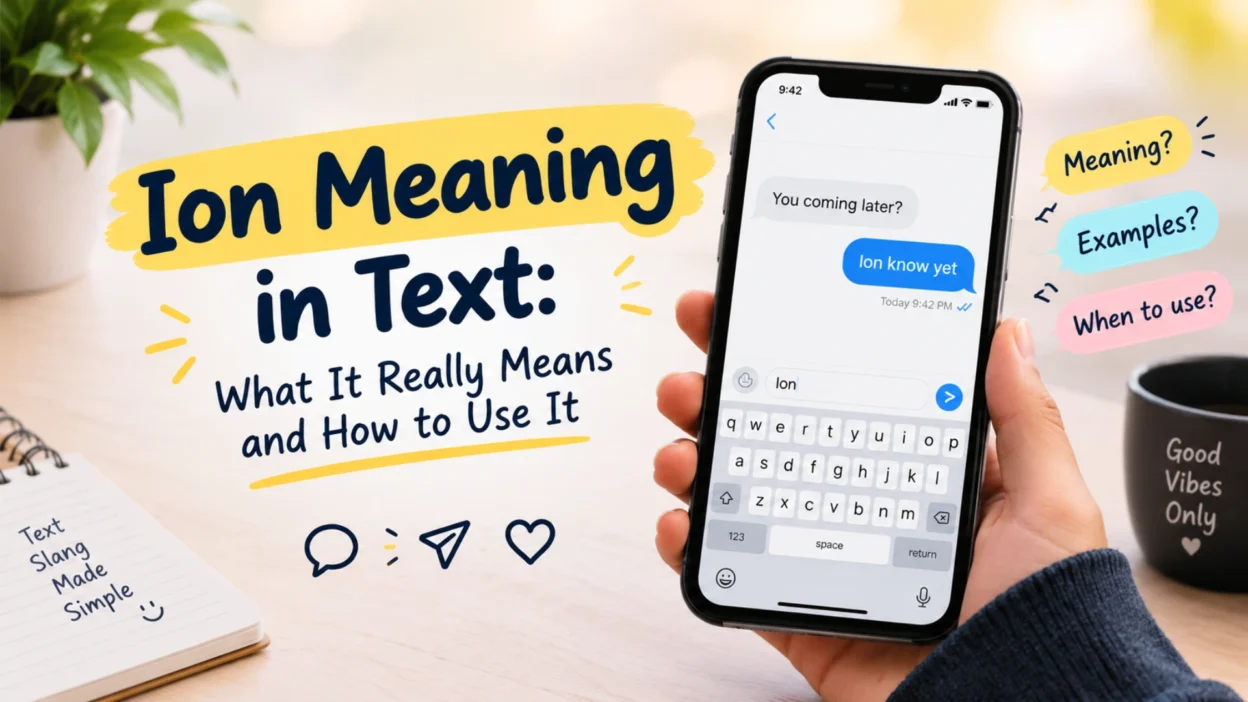
You’re in a group chat, and someone types: “ion know about that.” You read it twice. Is that a typo? A chemistry reference? A strange way of spelling “I own”? If you’re not steeped in text slang, the ion meaning in text can feel genuinely puzzling. The word looks like it belongs in a science textbook, yet here it is in a casual conversation about weekend plans.
Here’s the short answer: in texting and online chat, ion is a slang contraction of “I don’t.” It mimics the way “I don’t” sounds when spoken quickly and casually—something close to “eye-own” or “eye-un.” That phonetic shortcut became a written form, and it’s now common in informal digital communication, especially among younger users and in Black English.
But ion has a second, less common meaning too: “In Other News.” When spelled in all caps as ION, it functions as a conversational pivot, similar to “anyway” or “by the way.” Same three letters, two very different jobs.
This guide breaks down both meanings, explains how to tell them apart, and covers the situations where ion works—and where it absolutely doesn’t.
The Quick Answer: What Does Ion Mean in a Text?
Before diving into nuance, here’s the simplest possible breakdown:
- ion (lowercase) = “I don’t.” “ion know” means “I don’t know.”
- ION (all caps) = “In Other News.” A transition phrase used to change the subject.
- Ion (capitalized, in science) = A charged atom or molecule. Not slang.
The first two are internet slang. The third is chemistry. Context—capitalization, sentence position, and the surrounding conversation—tells you which one you’re looking at.
Most people who search for “ion meaning in text” are encountering the lowercase slang version. It shows up in texts, social media comments, and group chats, often in place of the full phrase “I don’t.” Once you recognize it, you’ll start seeing it everywhere.
Where Did Ion Come From?
The slang ion didn’t come from a committee or a viral trend. It emerged organically from the way people actually speak. Say “I don’t know” quickly and casually, and the words blur together. The “I” softens, the “d” almost disappears, and what comes out sounds like “ion know” or “I own know.”
That phonetic reality is the foundation of the slang. Writing it as “ion” is simply capturing spoken language in text form. Linguists call this eye dialect—spelling words the way they sound rather than the way they’re traditionally written.
The Role of Black English
The ion contraction is closely associated with Black English (also called African American Vernacular English, or AAVE). In AAVE, the pronunciation of “I don’t” often reduces to something that sounds like “ion.” Writing it that way in digital communication is a natural extension of that speech pattern.
This origin matters for two reasons. First, it explains why ion exists at all—it’s not random slang; it’s phonetic. Second, it’s a reminder to use the term respectfully. Recognizing where a slang word comes from helps you use it appropriately, rather than treating it as generic internet noise.
The slang use of ion in internet writing picked up momentum in the 2000s, alongside other phonetic contractions like “finna” (fixing to) and “tryna” (trying to). Meanwhile, the acronym ION for “In Other News” also emerged in the same era, used as a transitional phrase to shift topics.
The Two Main Meanings of Ion in Text
There’s a real risk of confusion here, because the same three letters serve two completely different functions. Understanding the difference is the key to reading ion correctly.
Meaning 1: “I Don’t”
This is the dominant meaning in casual texting. Ion replaces “I don’t” in a sentence, usually before a verb.
Examples:
- “ion know” = “I don’t know”
- “ion care” = “I don’t care”
- “ion wanna go” = “I don’t want to go”
- “ion have time” = “I don’t have time”
- “ion think so” = “I don’t think so”
Notice the pattern. Ion always precedes a verb, just as “I don’t” would. The rest of the sentence stays the same. It’s a direct substitution, not a new grammatical structure.
This usage is casual, fast, and conversational. It’s the kind of thing you type without thinking, the same way you might type “gonna” instead of “going to.”
Meaning 2: “In Other News”
When written as ION (usually all caps), the letters stand for “In Other News.” This version functions as a transition phrase. It signals that the speaker is changing the subject or introducing something unrelated to the current topic.
Examples:
- “ION, did you see that new trailer?”
- “That meeting was brutal. ION, I’m getting coffee. Want anything?”
- “ION my sister just got engaged!”
In this role, ION works like “anyway,” “by the way,” or “speaking of which.” It’s a conversational hinge. The all-caps spelling is a helpful clue, but not everyone follows that convention. Some people type lowercase ion even when they mean “In Other News,” which is why context matters so much.
How to Tell Them Apart
Here’s a quick decision guide:
- If ion is followed by a verb (know, care, want, think), it almost certainly means “I don’t.”
- If ion stands alone at the start of a sentence or appears before a comma, it’s probably “In Other News.”
- If ion is in all caps (ION), lean toward “In Other News.”
- If ion is lowercase and embedded mid-sentence, lean toward “I don’t.”
This isn’t foolproof, but it covers the vast majority of cases.
Ion vs. the Chemistry Ion: Avoiding Confusion
There’s a third meaning of ion that has nothing to do with texting: the scientific ion. In chemistry and physics, an ion is an atom or molecule with a net electric charge, resulting from the loss or gain of electrons. The term was coined by Michael Faraday in 1834, rooted in the Greek word for “going.”
The overlap is purely coincidental. The scientific ion and the slang ion share spelling but no etymology. However, the collision creates some amusing moments. People encountering “ion know” for the first time sometimes read it as a science reference, which leads to confusion in group chats.
If you’re writing for a general audience and want to avoid ambiguity, capitalization helps. Write “ion” for slang and “Ion” (or “ion” in a scientific context) for chemistry. Most readers will infer the right meaning from the surrounding words anyway.
How Ion Shows Up on Different Platforms
The meaning of ion stays consistent across apps, but the way people use it shifts depending on the platform’s culture and audience.
Text Messaging (SMS and iMessage)
In one-on-one texts, ion is a speed tool. It’s what you type when you’re walking, multitasking, or just not in the mood for full sentences. “ion know” is faster to type than “I don’t know,” especially on a phone keyboard. The tone is neutral and casual—neither rude nor affectionate, just efficient.
Twitter and X
On Twitter, ion thrives in short, punchy posts. It’s common in reactions, hot takes, and conversational replies. The lowercase version (“ion”) blends into the text, while the all-caps ION stands out as a topic-shift marker. Because tweets are public, ion here carries a slightly performative quality—it’s part of a personal voice.
TikTok Comments
TikTok’s comment sections are a hotspot for ion. It appears in reactions to videos, often paired with humor. “ion know who needs to hear this but…” is a common opener. The fast, informal nature of TikTok comments makes ion feel natural and at home.
Instagram DMs and Comments
On Instagram, ion shows up in DMs and comment threads, usually among younger users. It’s less common in public comments on polished influencer posts, where people tend to write more carefully. In DMs, though, it’s everywhere.
Discord and Gaming Chats
Gaming communities use ion in real-time chat, where speed matters. “ion have ammo” or “ion know the callout” are common during matches. The abbreviation fits the fast-paced, low-formality environment of voice and text chat in games.
When You Should Avoid Using Ion
Ion is informal. That’s its entire personality. Using it in the wrong setting can make you sound careless, confused, or out of touch.
Avoid ion in these situations:
- Professional emails: “Ion have the report ready” will not impress your manager. Write “I don’t have the report ready” instead.
- Academic writing: Essays, reports, and research papers require standard English. Slang has no place.
- Customer service messages: If you’re contacting a company, clarity matters. Use full words.
- With people who don’t know the slang: If your recipient is older or less online, ion may read as a typo or a science term.
- Formal social media posts: If you’re posting on behalf of a brand or organization, ion undermines credibility.
The rule is simple: if the context calls for clarity and professionalism, spell out “I don’t.” Ion is for friends, peers, and casual spaces.
Common Mistakes People Make with Ion
Even a simple contraction can trip people up. Here are the most frequent errors and how to avoid them:
- Confusing ion with “I own” or “I on”: Ion is not a typo for either. If the sentence doesn’t make sense with “I don’t,” double-check.
- Using ion in formal writing: This is the most common mistake. Slang belongs in casual communication.
- Assuming ion always means “I don’t”: Sometimes it’s “In Other News.” Capitalization and position are your clues.
- Overusing it: Like any slang, ion loses its natural feel if it’s in every sentence. Mix it up.
- Misreading tone: Ion itself is neutral. It doesn’t imply anger, sadness, or attitude. The rest of the message carries the emotion.
Generational and Cultural Context
Ion is most common among Gen Z and younger millennials—people who grew up texting and are fluent in phonetic abbreviations. For them, ion isn’t a deliberate stylistic choice; it’s just how casual digital speech looks.
Older generations may not recognize it. A parent reading “ion know” might assume it’s a typo or ask for clarification. That gap isn’t a problem, but it’s worth remembering when you’re communicating across age groups.
Culturally, ion is rooted in Black English and has spread through hip-hop, social media, and internet culture. Recognizing that origin is part of using the term respectfully. It’s not just “internet slang”—it has a specific linguistic history.
Regional Usage
Within the United States, ion is used fairly broadly online, though it’s more common in some communities than others. Internationally, English-speaking countries with heavy social media usage have picked it up, but local slang often competes. In the UK, for example, “ion” is less common than in the US, where the phonetic contraction aligns more closely with certain accents.
Ion vs. Similar Texting Contractions
Ion isn’t alone in the world of phonetic texting shortcuts. It belongs to a family of contractions that capture spoken language in written form.
- Finna = “Fixing to” (about to)
- Tryna = “Trying to”
- Gonna = “Going to”
- Wanna = “Want to”
- Ion = “I don’t”
- Yall = “You all”
What sets ion apart is that it contracts a subject and a verb, not just a verb phrase. That makes it grammatically distinct. It’s also one of the few contractions that changes the spelling of the subject (“I” becomes “io”), which is why it can look so unfamiliar at first.
Expert Tips for Using Ion Naturally
If you want to use ion without sounding forced, keep these guidelines in mind:
- Match the medium: Ion is for texts, DMs, comments, and casual chats—not emails or documents.
- Keep it lowercase for “I don’t”: Lowercase ion signals the contraction. All caps ION signals “In Other News.”
- Don’t overthink it: Ion is meant to be effortless. If you’re pausing to decide whether it fits, it probably doesn’t.
- Read the room: If the conversation is serious or professional, skip it.
- Know your audience: If the other person isn’t fluent in text slang, spell it out.
Myths vs. Facts About Ion
- Myth: Ion is a typo.
- Fact: It’s a deliberate phonetic contraction of “I don’t.”
- Myth: Ion is only used by young people.
- Fact: While Gen Z popularized its online use, people of various ages use it in casual texting.
- Myth: Ion always means “I don’t.”
- Fact: In all caps (ION), it can mean “In Other News.”
- Myth: Ion is disrespectful.
- Fact: It’s neutral; tone depends on context and relationship.
Frequently Asked Questions About Ion in Text
What does “ion” mean in a text from a girl?
It usually means “I don’t.” For example, “ion know” means “I don’t know.” The tone is casual and neutral. It’s not a sign of attitude or disinterest—it’s just a fast way of typing.
Is “ion” rude?
No, not on its own. Ion is informal, but it’s not inherently rude. It can feel out of place in professional settings, but in casual conversation, it’s perfectly normal.
What should I reply to “ion know”?
A simple “That’s fair” or “No worries” works. If you want to keep the conversation going, offer a suggestion or ask a follow-up question. Don’t overanalyze it.
Does “ion” always mean “I don’t”?
In lowercase texting, yes, that’s the dominant meaning. When written as ION in all caps, it often means “In Other News.” Context and capitalization are your guides.
Is “ion” a real word?
In standard English, “ion” is a scientific term for a charged atom. The slang “ion” is not standard English, but it’s a recognized informal contraction in digital communication.
Can I use “ion” in a work email?
Generally, no. Workplace communication should use standard English. Write “I don’t” instead. Ion is best reserved for casual, personal messages.
What’s the difference between “ion” and “I don’t”?
They mean the same thing in casual texting. Ion is a phonetic spelling of how “I don’t” sounds in fast speech. The difference is formality, not meaning.
Is “ion” still popular in 2026?
Yes. It remains common in texting, social media comments, and group chats, especially among younger users. While slang evolves, ion has proven durable because it’s fast, intuitive, and rooted in natural speech.
Final Thoughts on the Ion Meaning in Text
The ion meaning in text comes down to two possibilities: “I don’t” or “In Other News.” The lowercase version is the everyday contraction—a phonetic shortcut that captures how “I don’t” sounds in casual speech. The all-caps version is a conversational pivot, a way to change the subject without a hard stop.
Understanding ion isn’t just about decoding slang. It’s about reading context: capitalization, sentence position, and the relationship between the people texting. Once you recognize those cues, ion stops looking like a typo and starts making perfect sense.
So the next time someone types “ion know,” you won’t have to pause. You’ll know exactly what they mean—and you’ll probably type it back without even thinking.

Serhii Dunev is a passionate content creator dedicated to crafting meaningful texts, messages, and word inspirations. He aims to help people express their emotions clearly through simple and impactful words.