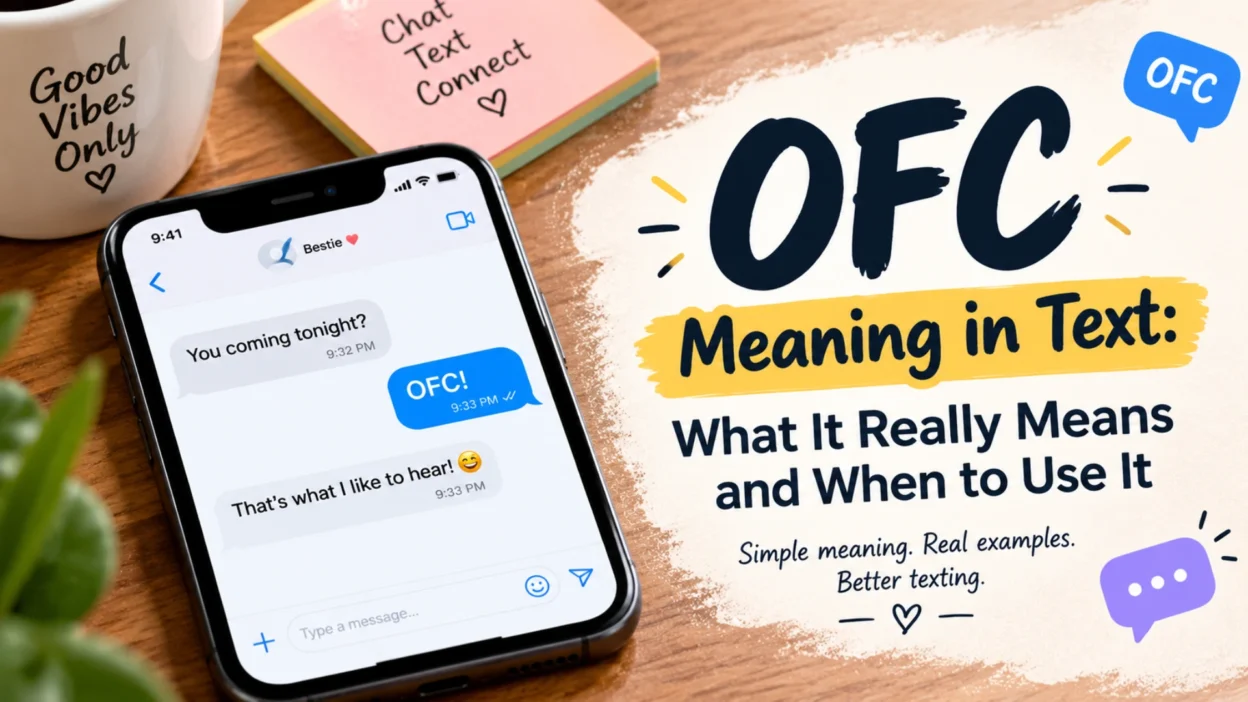
If you’ve ever received a message ending with ofc meaning in text, you’re not alone in pausing for a second. This three-letter abbreviation pops up in text threads, group chats, social media comments, and even fanfiction forums. Sometimes it’s friendly. Sometimes it’s sarcastic. And occasionally, it has nothing to do with “of course” at all.
The short answer is simple: ofc usually stands for “of course.” However, context changes everything. Depending on who sent it, where it appeared, and how the rest of the sentence reads, ofc can express agreement, reinforce the obvious, or carry a sharper tone. Understanding those shades of meaning matters more than memorizing a single definition.
The Core Meaning: Of Course, Shortened
In texting and online conversation, ofc is a compact way to write “of course.” People shorten the phrase because typing three letters is faster than typing two words, especially during quick back-and-forth messaging. The abbreviation grew out of early internet chat culture, when platforms like AIM and MSN Messenger made shorthand a daily habit, and “of course” was already a high-frequency phrase in everyday speech.
Functionally, ofc performs the same role as “of course” in a sentence. It confirms plans, grants permission, agrees with a statement, or marks something as obvious. What changes is the delivery: ofc feels casual, immediate, and built for digital communication rather than formal writing.
Interestingly, the lowercase version “ofc” appears far more often in text messages than the uppercase “OFC”. That lowercase habit aligns with how people use it in casual chats—it blends into the sentence rather than announcing itself as a formal acronym.
The Two Main Meanings People Actually Argue About
Search around online and you’ll find a long-running debate about whether ofc means “of course” or “of f***ing course.” Both readings exist, and neither is a myth. The difference usually comes down to tone, relationship, and punctuation.
When OFC Is Simply “Of Course”
In most everyday texts, ofc carries a neutral-to-friendly tone. A friend asks if you’re coming to dinner, and you reply “ofc” to confirm. A classmate asks for notes, and “ofc” signals willingness to help. A coworker asks whether you received a file, and “ofc” means yes, it arrived.
This version often functions as a softer version of “obviously.” It reassures the other person without sounding dismissive. According to social media marketing expert Macy Olalia, ofc is frequently a faster way to say “no problem,” “you’re welcome,” or “definitely” in casual conversation.
When the F Stands for Something Else
In sarcastic or emphatic messages, ofc can stand for “of f***ing course.” The extra word adds intensity, usually when the sender thinks the answer should have been obvious from the start. A message like “ofc the bus is late again” carries a different emotional weight than a simple “ofc, I’ll be there.”
Tone determines the reading. If the conversation is relaxed and the people involved swear around each other, the stronger version is plausible. In a more neutral exchange—or with someone who doesn’t usually use profanity—the standard “of course” meaning is the safer interpretation.
How Placement Changes the Feeling
Where ofc sits in a sentence often shifts its tone more than people realize. At the beginning of a sentence, ofc usually reads as positive assurance. “Ofc I’ll help you move” sounds supportive and definite. At the end of a sentence, it can become slightly sarcastic or condescending. “I’ll help you move, ofc” might imply that helping was never in question—or that the request was unnecessary.
This positional nuance is one reason ofc can confuse readers. The same three letters can feel warm in one message and sharp in another. Reading the surrounding words matters more than the abbreviation itself.
OFC in Fanfiction and Fandom Spaces
Texting isn’t the only place ofc shows up. In fanfiction communities, ofc commonly stands for “original female character.” An original female character is a female character invented by a fanwork creator rather than taken from the source material.
This meaning has deep roots in fandom culture. The concept of original characters, and original female characters specifically, was already circulating in fan communities by the early 2000s, though the practice of inserting new characters into existing stories goes back even further. Writers use “ofc” as a tag or shorthand to distinguish their invented characters from canon characters—those who already exist in the original work.
Context makes the distinction clear. If someone asks for feedback on their ofc in a writing group, they’re not asking about the phrase “of course.” They’re talking about a character they created. If the same abbreviation appears in a dinner-planning text, the fanfiction meaning is almost certainly irrelevant.
OFC vs. OFC Not: A Small Addition With a Big Flip
Adding “not” completely reverses the meaning. “OFC not” translates to “of course not,” a firm negative that implies the answer should have been obvious. If someone asks whether you’d skip a friend’s wedding, “ofc not” communicates that skipping was never a real option.
The same logic applies in sarcastic exchanges. A question like “Did you forget your keys again?” might get “ofc not” as a slightly exasperated denial. The abbreviation doesn’t change the grammar; it just compresses the phrase.
This pattern mirrors how “of course not” works in speech. The abbreviation preserves the emphasis while removing the typing effort. That efficiency is the whole point of text slang.
Platform Differences: Texting, Snapchat, TikTok, and Instagram
The meaning of ofc stays fairly consistent across platforms, but the surrounding culture changes how it feels. On Snapchat, ofc fits the app’s fast, casual reply format. Quick responses between friends are the norm, and ofc slips naturally into that rhythm.
On TikTok, ofc appears in comments and captions, often when someone agrees with a creator’s point or confirms a shared experience. The abbreviation functions as a lightweight agreement marker in public comment threads. On Instagram, ofc shows up in direct messages and comments, usually in casual exchanges about plans, preferences, or relatable moments.
Text messaging remains the most common home for ofc, especially in one-on-one conversations and group chats. The platform doesn’t change the definition, but it does shape the pace: faster platforms encourage shorter replies, and ofc is built for speed.
When OFC Doesn’t Belong: Professional and Formal Settings
One of the biggest mistakes people make with ofc is dropping it into professional communication. In work emails, client messages, or anything addressed to someone in authority, the abbreviation usually feels out of place. A boss asking whether a report was sent deserves “Of course, I’ve sent it” rather than “ofc I have, sir”.
This isn’t about the abbreviation being inherently rude. It’s about register. Text slang signals informality, and professional settings typically expect fuller language. Using ofc in a job interview follow-up or a message to a new client can make the sender seem careless, even if the intent was friendly.
A reasonable rule: keep ofc for friends, peers, and casual chats. In anything that could be forwarded to a manager or printed in a record, write “of course” in full.
Common Mistakes People Make With OFC
The first mistake is assuming ofc always means the same thing. It doesn’t. Context, tone, and community determine the reading, and ignoring those signals leads to misunderstandings.
The second mistake is using ofc with people who may not know the abbreviation. Parents, older relatives, or new acquaintances might read it as a typo or an unfamiliar acronym. A quick expansion—”ofc (of course)”—can prevent confusion without much effort.
The third mistake is misreading sarcasm. If a message says “ofc you’d say that” after a disagreement, the sender is probably not offering warm agreement. Tone matters, and ofc can carry an edge when the conversation is tense.
Finally, some people assume uppercase OFC is more formal than lowercase ofc. In reality, both are casual. Capitalization doesn’t make the abbreviation professional; it just changes the visual style.
How to Respond When Someone Sends OFC
Responding to ofc depends on what it’s doing in the conversation. If it’s confirming plans or granting permission, a simple “thanks” or “see you then” works. If it’s expressing agreement, you can mirror the tone with a casual acknowledgment.
When ofc appears sarcastically, matching the energy usually helps. A lighthearted “lol fair” or “I know, I know” keeps the exchange friendly without escalating. In a more serious conversation, it’s fine to clarify: “Just to confirm—you mean of course, right?” That question prevents assumptions from turning into misunderstandings.
There’s no universal script. The best response follows the same principle as the abbreviation itself: read the context, then reply.
A Quick Comparison: OFC and Similar Text Abbreviations
| Abbreviation | Common Meaning | Typical Tone |
|---|---|---|
| OFC | Of course | Casual, agreeable, sometimes sarcastic |
| LOL | Laughing out loud | Light, humorous |
| OMG | Oh my God | Surprised, emphatic |
| IDK | I don’t know | Neutral, uncertain |
| TBH | To be honest | Candid, informal |
| NGL | Not gonna lie | Candid, confessional |
| IYKYK | If you know, you know | Insider, playful |
OFC belongs to the same family of shorthand as LOL and OMG, but it carries a wider tonal range. A single abbreviation can reassure, agree, or gently mock, depending on how it’s used. That flexibility is why it remains common across messaging apps and social platforms.
Generational and Regional Nuances
Younger texters tend to treat ofc as ordinary vocabulary, using it without much thought about its origin. Older users may recognize “of course” but still find the abbreviation unfamiliar or overly casual. That gap isn’t a rule, but it does explain why ofc sometimes needs a quick explanation in mixed-age conversations.
Regional usage also varies. English-speaking internet communities share the same core meaning, but the frequency of use and the comfort level with the sarcastic version differ from place to place. In some circles, ofc is almost invisible because it’s so common; in others, it still reads as distinctly online slang.
These differences don’t change the definition. They simply remind readers that digital communication is not uniform. The same three letters can feel native to one person and foreign to another.
Frequently Asked Questions About OFC
Is OFC always short for “of course”?
No. In most texting and social media contexts, ofc means “of course,” but in fanfiction communities it commonly refers to “original female character.” The surrounding conversation usually makes the intended meaning clear.
Can OFC be rude?
It can be. The abbreviation itself is neutral, but tone and placement matter. At the end of a sentence, ofc sometimes reads as sarcastic or condescending. In a tense exchange, it may carry an edge that a full “of course” would not.
Is it okay to use OFC at work?
Generally, no. OFC is casual slang, and professional communication usually calls for “of course” written in full. A quick message to a close teammate might be an exception, but client emails and formal reports are not the place for it.
What does “OFC not” mean?
“OFC not” means “of course not.” It’s a firm negative that implies the answer should have been obvious, similar to how “of course not” works in speech.
Why do people use lowercase “ofc” instead of uppercase “OFC”?
Lowercase is simply more common in casual texting. It blends into the sentence and matches the relaxed tone of quick messages. Uppercase appears too, but it doesn’t make the abbreviation more formal.
Does OFC mean something different on Snapchat or TikTok?
The core meaning stays the same across platforms: usually “of course.” Snapchat and TikTok encourage fast, casual replies, so ofc fits naturally into those environments. The platform changes the pace, not the definition.
What should I do if I’m not sure which meaning someone intended?
Ask. A short clarification like “Do you mean of course?” costs little and prevents confusion. Context usually provides the answer, but when it doesn’t, a direct question is the safest choice.
Is OFC still commonly used?
Yes. It remains a familiar abbreviation in texting and online chat, alongside other widely recognized shorthand like LOL and OMG. Its use is especially strong in casual, peer-to-peer communication.
Final Thoughts: Read the Room, Not Just the Letters
OFC is a small abbreviation with more range than it first appears to have. At its core, it shortens “of course” for faster digital conversation. Around that core, meanings branch: the emphatic version with profanity, the fanfiction version about original characters, the sarcastic placement at the end of a sentence.
The practical takeaway is straightforward. Use ofc with friends and peers. Avoid it in professional writing. Pay attention to tone before deciding what someone meant. And when in doubt, expand the abbreviation or ask a quick question. Three letters shouldn’t create confusion—especially when the context is right in front of you.

Serhii Dunev is a passionate content creator dedicated to crafting meaningful texts, messages, and word inspirations. He aims to help people express their emotions clearly through simple and impactful words.